
Translated material
A preliminary report on the Air India company, in which 260 people died, was a preliminary report on the Boeing 787 disaster.
It follows from it that immediately after takeoff, someone turned off the fuel supply to the engines of the aircraft
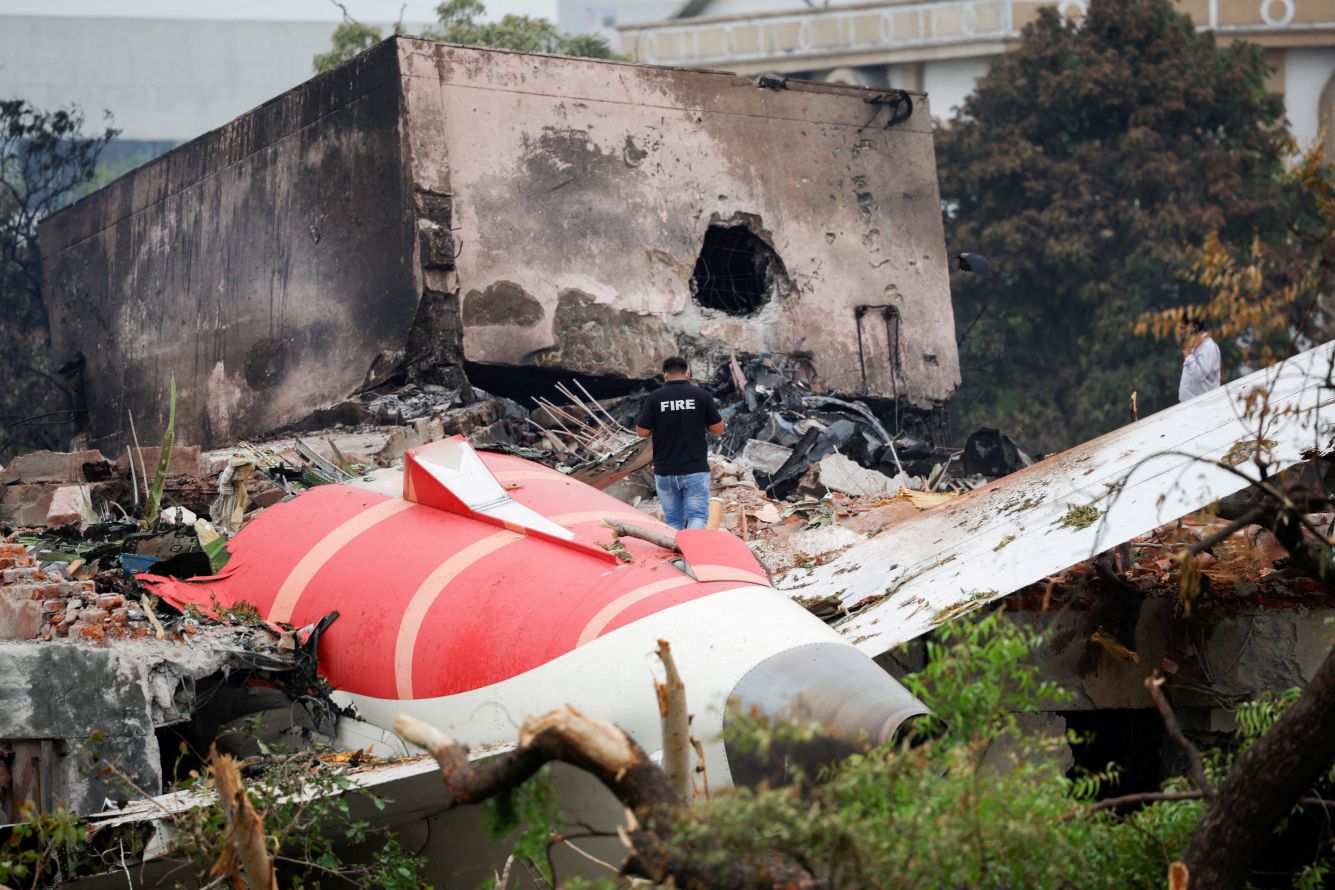
The Indian Civil Aviation Department issued a preliminary report on the causes of the Boeing 787 aircraft disaster, which occurred on June 12 in Akhmadabad. The document-a very detailed and informative investigation for this stage-hints that the direct cause of the crash of the aircraft was the disconnection of the fuel to the engines three seconds after it from the runway. Ten seconds after that, one of the pilots restarted the first engine, after another four seconds - the second. However, they did not have time to gain momentum, and 41 seconds after the end of the strip, the liner fell into the city.
Listen to the audio version of this text on "Radio Medusa"
The AIR India AIR India Airlines, which followed from Ahmadabad to London, occurred on the morning of June 12. This is the first incident with Boeing 787, ending with deaths and a complete write-off of the planan of the aircraft in the entire 14-year history of operation of the model. During the crash of the liner, 241 passengers and crew member and 19 people on earth were killed. The plane fell less than a minute after taking off to the hostel of a medical university.
The crash - and the lack of official information about its possible reasons within a month - gave rise to many versions of varying degrees of credibility. In professional forums (in which the current and former pilots and aircraft are involved), they discussed the following options:
- The pilot mistakenly translated the shutters and dumplings of the aircraft (possibly instead of the chassis) from take -off position 5 to position 0, used in cruising flight. Clinks are used to increase the lifting force of the wing at low speed (during take -off and landing). A decrease in the surface of the wing at low speed could lead to a fall in the lifting force created by him and the fall of the liner, the authors of this version thought.
- For some reason, both engines refused, which happens extremely rarely. Possible causes of such a malfunction were discussed-from the ingress of large birds (the most common cause) to fuel pollution with water, steam or any other substance.
- Incorrect operation of the autonomous engine control system (Full Authority Digital Engine Control, Fadec), which for some reason turned off the power plants.
- Deliberate (or even malicious) disconnection of fuel supply to the engines with pilots.
What is written in the report?
The report was released shortly before midnight on July 12 by Indian time - a few minutes before the expiration of the monthly period of the month since the disaster. According to WSJ, the investigation was accompanied by conflicts between Indian officials and American representatives from the US National Security Council, the US Federal Civil Aviation Department (FAA), Boeing and GE Aerospace (Americans participated in the investigation, as the liner was made in America).
US representatives were unhappy that Indian investigators provided little public information, slowly deciphered and analyzed information from “black boxes” and even wanted to take these boxes to a secret place. However, the report was nevertheless completed on time and turned out to be very informative (although he left a lot of questions, which is not uncommon at this stage of the investigation).
Here is the main information from the report:
- Pilots (a very experienced captain and a less experienced second pilot) arrived in Akhmadabad from Mumbai on the eve of the departure and had an adequate time to relax. At the airport, they took a medical examination, including an express test for the presence of alcohol in the body.
- The crew of the previous flight left a message about the malfunction in a special journal - incorrect operation of the horizontal stabilizer position sensor. Techniques on Earth carried out work to eliminate the malfunction (it - at least directly - did not affect the outcome of the next flight).
- The second pilot was piloted by the plane, the commander was a control pilot. The plane had normal loading and centering.
- Clinks and dumpings were set to position 5 and remained in it until the end of the flight. The chassis was never removed - and the pilots did not make an attempt to remove them: this is clear by the position of the chassis lever on the found fragments of the cabin found.
- The aircraft run through the strip was regular (judging by the parameters presented in the report).
- Three seconds after separation from the aircraft from the strip, the fuel supply switches to the engines (two of them - one for each of the engines), as stated in the report, “moved from the position of Run to the Cutoff position” - “turned off”. First, one switch “changed the position”, after a second - the other. This led to the immediate cessation of fuel supply and stopping the engines. The liner after the separation from the strip in a few seconds managed to dial 400 feet high above the ground (about 120 meters) and an additional 30 knots (about 55 km/h) of speed. Then he began to quickly lose speed, and then decline.
- After a few seconds (the exact time is not reported in the report), one of the pilots asked the other: “Why did you turn off the engines?” The second replied: "I did not do this." In the report, the dialogue is given in indirect speech, the exact words said by pilots, and their intonation is not reported.
- The electricity of all aircraft systems is produced from the engines through the generators and the pressure in hydraulic systems is provided. However, there are spare options that have successfully worked: the liner’s computer systems strictly turned on the emergency turbine on the algorithm (RAT, which automatically or manually “fan”, which works from the running air flow and produces electricity for the most urgent needs), and then the auxiliary power unit, which fully provides electricity, but does not give a traction to continue the continuation flight.
- 10 seconds after the engines disconnecting the fuel supply switch to one of them again moved to the Run position. After another four seconds, the second switch “moved”.
- In the next few seconds, the automatic control system (FADEC) consistently restarted the engines. The first even began to gain momentum, the second - did not have time. The thrust of the only engine operating at low speeds was not enough to stop the reduction.
- Nine seconds after trying to restart the second engine, one of the pilots managed to give the distress signal to the dispatchers.
- After another six seconds, the recording of the parameters with a “black box” was interrupted - that is, the plane ran into the hostel building. 32 seconds passed from the moment of separation of the liner from the ground.
Why do you need the opportunity to turn off the fuel supply in flight?
In normal mode, fuel supply switches are used only on Earth - when starting the engines before the flight and when they turn it off after.
However, emergency modes are possible in flight: for example, a checklist, when one engine refuses, orders the pilots to turn off the fuel supply to it (to avoid fire). In addition, for example, if two engines malfunction, it is ordered to try to restart them, for which you need to turn off the fuel supply, and then turn it on very quickly again. The performance speed matters : the faster the fuel will be supplied again, the greater the chance to resume the operation of the engines. That is why the pilots have the opportunity to switch the fuel supply modes not only on Earth, but also in flight.
However, the report does not say anything about any refusals of one or two engines before the switches “moved” to the Cutoff position in the third second of the flight. Thus, we can conclude that switching was unprovided.
Is it possible to accidentally convert the switches to another mode?
On modern aircraft, special fuses are installed, excluding the unintentional switching of the levers of the fuel supply system. All Boeing models are installed by Honeywell production switches; To transfer the switch to another position, it first needs to be pulled up, and then move horizontally to another position and release. Thus, the position of the switch cannot be changed by a random movement of the hand - or the object that has fallen on it.
The switches themselves are in a relatively inaccessible place on the central panel - under the levers of engine thrust (ore). At the moment when the aircraft running around the runway reaches the speed of decision to take off (that is, a few seconds before the end of the ground), the control pilot removes the hand from the ores and returns it to the helm. In the first ten seconds of the flight, he performs one operation on the central panel - he puts the chassis lever into the “Remove” mode. However, the lever is far from the fuel supply switches. Next to the switches are only circuit breakers of automatic control of horizontal stabilizers - with their help you can transfer this control into manual mode.
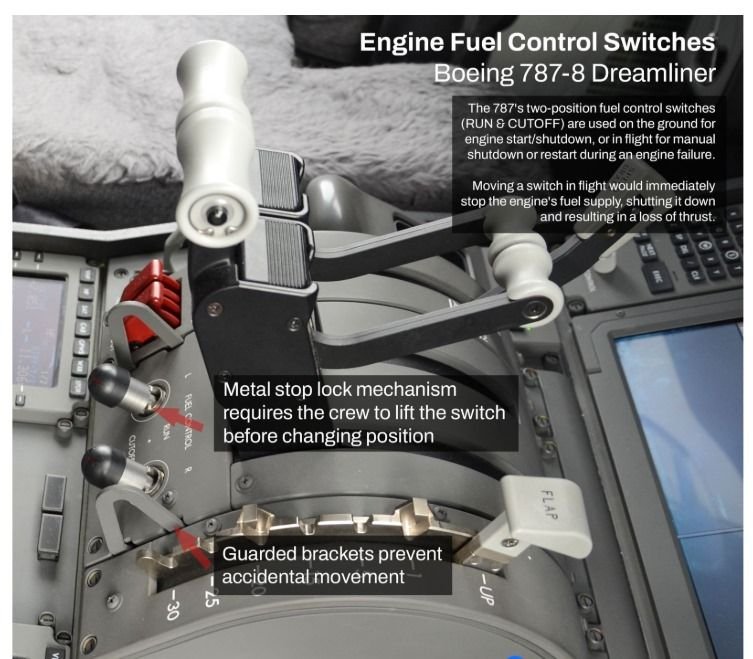

Thus, as follows from the report and from the procedures for managing the aircraft, there were no reasons for manipulating the pilots with the pilots.
Maybe some computers' mistake led to the transfer of switches?
Extremely doubtful. Firstly, judging by the report, the spontaneous flight parameters in the “black boxes” (Flight Data Recorder, FDR) recorded a single commands of the transfer of two switches to the Cutoff position with a difference of a second, and then a clearly man-made translation into the RUN position. Secondly, the report separately states that the investigators do not offer any urgent reasons to ensure flight safety for Boeing (a manufacturer of all aircraft systems) or GE Aerospace (manufacturer of engines and automatic control system). This always clearly indicates that the technique is beyond suspicion (at this stage of the investigation).
The only mention of the theoretical possibility of a malfunction contained in the report is given without any explanation. It says that in 2018 , the American FAA regulator informed users of various Boeing models, on which Honeywell switches are installed, that over time, a failure may occur in the controllers of these switches that the fuse from accidental use ceases to work-the same “delaying” the switch. The message did not require any immediate actions from airlines, so Air India did not check the controllers on its aircraft.
It is doubtful that this could somehow affect the fate of the AI-171 flight: for this it must be assumed that at the same time the fuses at once on two switches, and then they, for some reason (the random movement of the pilot’s hand that fell on them) moved to the Cutoff position. It is more likely that some of the investigation participants wanted to maintain the possibility of influencing technical causes, not a human factor.
And what can be the options for the influence of the human factor?
It seems that only two options (since the report does not report any malfunctions with which the crew had to encounter on a run or in the first three seconds after the break):
- clouding (complete “loss from the flight circuit”) of one of the pilots;
- His malicious action.
In the history of aviation (including relatively recent) there are examples of both the first and second scenario.
So, for example, in 2023, one of the pilots of the Nepali Airlines airline instead of releasing spoilers (used for braking in flight), transferred the turboprop engines of his ATR 72 into idle mode; The plane crashed , 72 people died.
The aviation industry fights with such “eclipses” by improving interaction and mutual control between pilots - and by introducing automatic systems that do not allow or correct the crew errors. This has already led to a decrease in the level of accident rate at times over the past decades.
"Aviation suicides" remain a rare, but quite real problem.
- In 2015, one of the Germanwings pilots, previously secretly treated from the airline due to mental problems, took advantage of the fact that his colleague left the cabin to the toilet, and sent a plane with 150 people on board in the Alps.
- In 1997, the pilot of the Indonesian Silk Air, suffering from financial problems, defeated Boeing 737 with 104 people.
- In 1999, the Egypt Air pilot sent Boeing 767 to the ocean. 217 people were killed with it. The Egyptian authorities did not admit that the pilot broke the plane consciously.
- In 2014, the commander of the Boeing 777 Malaysia Airlines, who flew out of Kuala Lumpur, flew instead of Beijing into the southern part of the Pacific Ocean-having previously worked out maneuvers on the home simulator. The place of the fall of the aircraft (as well as the motives of the pilot) is still unknown.
Aviation authorities and airlines are working on the prevention of such problems. In addition to medical selection and testing, more complex programs are created: pilots are offered assistance in the event of personal problems - financial, family, etc. - with guarantees that their recognition will not entail dismissal without compensation.