
Translated material
Study, study and study at rallies
Student protests in Serbia went to re -examination and vacation

The protest of the opposition involving students in Belgrade. Photo: AP / TASS
At first glance, protests in Serbia were radicalized after a massive speech on June 28, but in fact, social discontent has not subsided since December 2024. At the same time, the protesters have not yet been able to have a significant impact on power in the country. The reasons are not in insufficient numerical support or social breadth of the protest movement itself. It covered all large Serbian cities and even small settlements, and the rally on March 15 gathered a record number of people in the history of Serbia - about 300 thousand. The main problem of protesters lies in the lack of participants, but an organized guide that can think not only tactically, but also strategically.
The student movement, which from the very beginning was recognized as the only organizer and leader, at the same time not only inspired, but also paralyzed the protest.
Firstly, it took the student movement six months, from December to May, to recognize the obvious: the regime, being in the power of 13 years in a row, could not investigate and judge for corruption, since he seized and subjugated the allegedly independent judicial system and state supervisory authorities. In parallel with the loss of precious time, which allowed the authorities to go on the offensive after the unauthorized, albeit the largest rally in the history of Serbia on March 15, the student movement stubbornly refused to cooperate with the opposition parties and activists of civil society.
Secondly, after the transition in May from institutional to political requirements, including a call to conduct early parliamentary elections as soon as possible, a student movement devoid of a leader, did not develop a clear strategy for achieving this goal. In reality, the regime controls all the necessary institutions that determine whether to conduct or not hold the required elections. Since the authorities have all institutional levers, and the student movement from the very beginning determined the protests as exclusively non -violent, the only remaining instrument of pressure on the regime is civil disobedience. However, influential trade unions did not provide practical support to students, limiting themselves only to rhetorical statements and without announcing a general strike.
In Serbia, civil disobedience is reduced to blocking the key infrastructure. It was expected that the protest on June 28 would lead to a blockade, for example, the main highway passing through the center of Belgrade. However, students did not even have a plan of action after the completion of the rally in the evening of the same day.
- Thirdly, the student movement is split, which explains the lack of strategy and a series of truly mass rallies that had no practical effect, except for demonstrating wide support of protest. These disagreements are double in nature: ideological split and disagreement in the issue of tactics. The common denominator of students' views is the desire for democracy, the transparency of the government, the fight against corruption and the rule of the law. These values indicate liberalism, which, however, does not make students liberals in an ideological sense. On the contrary, the most active wings of student protests are extremely right and extremely left.
The extreme left wing convinced most students who do not have a clear ideological position to support a rally in Belgrade on May 1. This rally turned out to be a complete failure both in terms of the number of participants - only 18 thousand people gathered - and according to the results: the trade unions remained loyal to the regime.
The extreme right wing turned out to be much more successful in attracting people, organizing in the capital to the Vididni Festival on June 28 a rally using rhetoric and the symbols of nationalist movements of the 1990s, as well as the Vucich regime itself-with invited speakers discussing the Serbian Integalism, he is also the “Serbian world”, he is a great Serbia. Only a few, in particular the rector of the University of Belgrade, Vladan Dzhokich, adhered to the initial goals of the student movement, calling for elections and democracy. This rally gathered 140 thousand people, becoming the second largest in the history of Serbia, although he did not push the power in Belgrade to the ultimate goal of the protruding - early elections.
Disagreements on the tactics of protests appeared at the end of the rally when some of the students returned to their universities, and the other headed the protest column. It is worth noting that most of the 140 thousand people began to disperse when the first nationalist performances began.
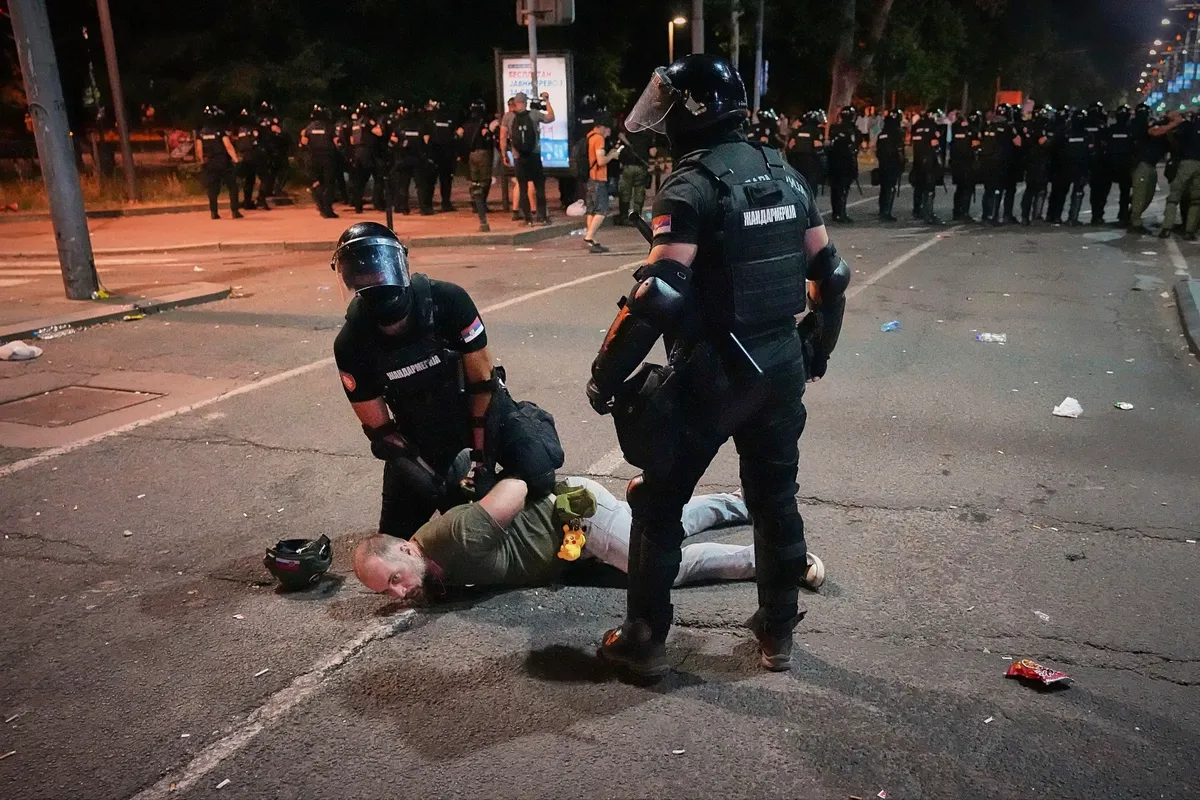
After that, the police received an order to form cordons on the streets adjacent to the square where the protest was held. At some point, people in masks stood out from the mass of the remaining demonstrators, who began to advance to the police cordons. Part of the crowd and students followed them. Apparently, their goal was to break through the cordon and attack the “anti -Maidan” regime camp in front of the parliament building.
But the police quickly dispersed this group of radicals, after which it applied violence even to those who continued to stand still. As a result, the extreme right wing of students failed as much left.
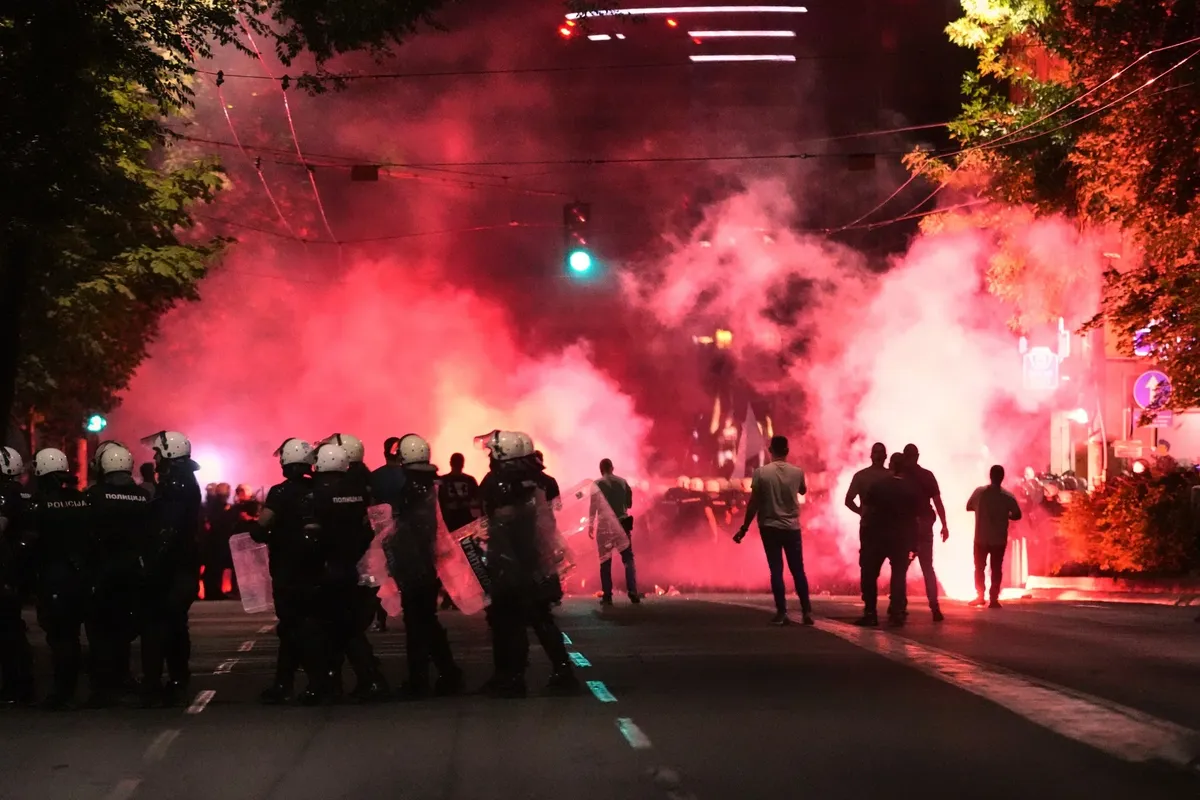
In an effort to demonstrate to their supporters the full control over the situation after the rally acceleration on June 28, the very next day, June 29, the regime began to detain students of various faculties. This prompted citizens to build barricades on the streets of Belgrade and several other large cities of Serbia. Citizens themselves realized the need for civil disobedience as the only effective way to confront the regime at this stage, but they also lacked the organizational center that would coordinate their actions. The blockade attracted a large number of people only on June 29, after which they became sporadic and gathered at best hundreds of citizens, and most often dozens. On that day, the police were paralyzed, because it seems that the regime was taken by surprise, but then the police began to use the force to remove the blockade.
One of the significant incidents was the operation on July 2 in front of the Faculty of Law in the center of Belgrade, when the police detained dozens of students who blocked the street in front of their faculty.
Random and sporadic blockade did not have real chances of force to force the early elections and mainly caused inconvenience to ordinary people who go to work or returning home.
Citizens did everything in their power, and what seemed logical to them: each blocked the main transport arteries in their area. However
The complete disorganization of the student movement was again manifested in the fact that it did not use the available resources to create a significant and centralized blockade of the key infrastructure.
As a result, the students themselves called for the blockade in Belgrade on July 9, since several villages in the south of Serbia were badly damaged by summer fires. The exhausted residents of the capital perceived this as a worthy reason to terminate the shares and since then did not conduct significant protests or blockade.
Will this become the end of the protest movement? Definitely not. Public dissatisfaction remains high, the Wuchic rating is low, and citizens have repeatedly proved that they no longer feel fear of the system and are ready for mass protest actions. However, if the student movement remains disorganized and self -isolated from the political resources of the opposition and the civil sector, the chances of holding the parliamentary elections until 2027 will remain low.
The creation of a single Popular Front remains a key condition for the success of the protest movement. And the possibility of its formation cannot be completely excluded. In the end, the student movement has passed from neutral requirements for political, albeit late. This transition indicates that the student movement can recognize its mistakes and change the course.
Be that as it may, in the near future, the Wuchic regime will face even more serious resistance.