
Translated material
Akunin* and arrested
One -act tragicomedy about how the trial of the writer passed - more precisely, over his words

Boris Akunin. Photo: Irina Buzhor / Kommersant
(18+) This material (information) was produced, distributed and (or) by foreign agents Bykov Dmitry Lvovich and Boris Akunin (Chkhartishvili Grigorem Shalvovich) or concerns the activities of foreign agents Dmitry Lvovich and Boris Akunin (Chkhartishvili Grigory Shalvovich)
On July 14, the second Western District Military Court sentenced the writer Boris Akunin* to 14 years in prison. In addition, he was a fine of 600 thousand rubles and forbidden to administer digital platforms. The accusation consisted of three points: the writer was accused of justifying terrorism - this once, of non -fulfillment of the duties of the “foreign agent” - two and in the calls for the forcibly overthrow of the constitutional system - three. Below is a story about how this court passed.
This essay is not only an attempt to describe the tragicomism of the trial, which was held without a suspect, without witnesses and in fact without evidence. This is an attempt to understand how the most popular writer was sculpted from the most popular writer in Russia by the most important literary anti -hero in Russia - and how much the literary word actually weighs.
The eternal trouble of Russia. Everything in it is confused. The good is defended by fools and bastards, martyrs and heroes serve evil.
B. Akunin, "State Advisor"
Part 1. Never talk to unknown
Once in July, at an hour of unprecedentedly hot noon, in a dying era, from which then there would be nothing left but old photographs, the trial of the empty bench of the defendants passed.
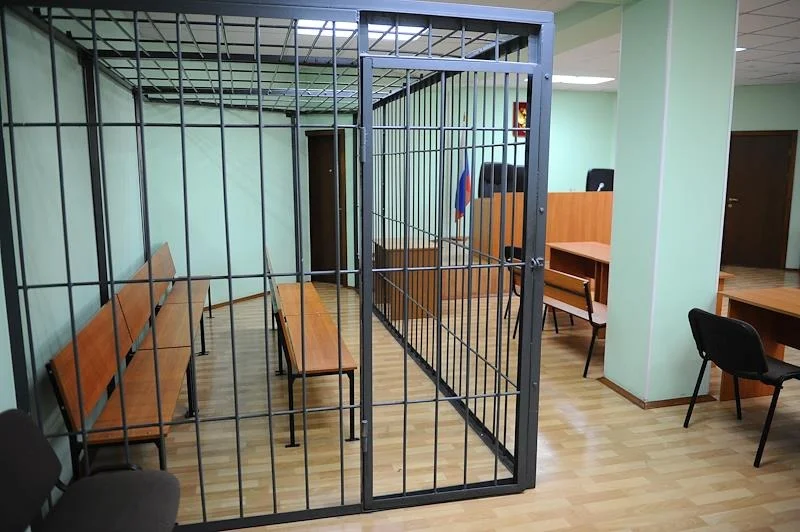
That is, of course, someone had to sit on the bench-and not even someone, but the most famous writer of Russia, whose books have long become the subject of the interior even in the most not reading houses, Boris Akunin*, aka Grigory Chkhartishvili*. But in the stuffy, hot and cramped hall of the Second Western District Military Court into the no less red-hot and stuffy morning Monday of the 14th day of the summer month of July, Akunin did not appear-and he never planned to appear there-so the aquarium and the bench remained empty.
Two judges were empty and two judges on both sides of the central, in which the judge Oleg Shishov was sitting - the one who recently sentenced the Belgorod volunteer Nadine Geisler to 22 years, and before that, one of the youngest Politicals, Arseny Turbin, to five years of the penal colony. There are other feats of justice on his account, but these are the most noticeable. So, this Shishov was sitting between two empty chairs.
The seats were empty and the seats in front of the door to the hall, where the witnesses could wait for the interrogation - but there were no witnesses. With the exception of one, everyone else (in the amount of three people) affected the absent: who is because of employment, and who, on the contrary, due to the vacation.
And there were almost no listeners in the hall either: to follow one of the strangest trials over the most famous modern Russian writer, whose autograph was once built in this city of caravans, only six journalists came-and at least three were clear regulars in court and sympathized with the charges. This was clear from the laughs: we laughed at different remarks with them - so you usually recognize “strangers” and “our” in the theater.
In a good way, there should not have been a lawyer here: both before, and even during the court, Akunin managed to warn all subscribers that he would not send anyone to be represented, but since it would be impossible to launch the process without a defender, a lawyer- Oleg Dubinin -was still appointed.
Akunin himself was not appealed - as Judge Shishov said, "the opinion of the defendant does not clarify in connection with his absence."
Moreover, it was not clear what exactly, according to him, was absent: the defendant or his opinion.
In general, whoever you are grabbed - nobody is. Although one witness, as already mentioned, was still: after establishing the procedure for the consideration of the case, a certain Natalya Kopylova materialized-as it turned out, a lonely pensioner with a secondary specialized education, personally with the defendant, is not familiar. When she spoke, her voice turned out to be so unexpectedly deaf and weak that one might think, as if she was not too confident even in her name and surname. She entered, and stood behind the department uncertainly - as if she doubted not only in every word, but in every step.
“Only, if possible, quickly,” she asked, “otherwise my heart presses something.”
The judge - with a stone person who, many times during the meeting, who took a deeply yearning expression - carefully specified whether she needed help and whether she could work standing, after which he explained the rights and duties and added:
- Before starting interrogation, I explain that your testimony cannot be based on rumors, guesses or assumptions. Establishment of these explanations?
Kopylova nodded doomedly.
And started:
Prosecutor Makarova : Tell me, what do you know about the conversation between Akunin and Zelensky, organized by prankers Vova and Lexus?
Witness : Well, these prankers - they seemed to be introduced on behalf of Zelensky and talked with him, and he said that he even agreed to finance military operations, the Armed Forces.
Pause
Prosecutor, persistently : And what else do you know?
Witness : About this?
Prosecutor : About Akunin.
Witness, diligently : A, Akunin himself. Well, he grew up in a fairly decent family, he has a father - a participant in the Great Patriotic War, awarded orders, and I was always surprised how such a father grew up such a father. Who and our power dears,
And Vladimir Putin at one time insulted Caligula.
Prosecutor : Did he ever say anything about the accession of Crimea?
Witness : Yes, he even called it ***. And when our troops entered the Donbass at the invitation of the DPR and the LPR, he was against it.
Prosecutor : Where did you get this information from?
Witness : From the Internet.
Prosecutor : In which network did you read this?
Witness : Yes, in Yandex is full. Yes, even on Wikipedia.
Prosecutor : But are these his own words?
Witness, timidly: well, this was discussed, in my opinion, even by Solovyov.
Prosecutor, impatiently : "In my opinion"?
Witness : I can’t say for sure, but I saw it in several sources. The heat does not affect me well.
Prosecutor : But he approved the attacks on the Crimean bridge? Approved? Or ... did not approve?
The witness, even quieter : you know, in my opinion, approved.
Prosecutor : "In my opinion"?
The witness is hopeless and completely deaf : I feel bad, you understand.
After that, the exhausted witness was seated, her testimonies were announced at the February interrogation and released quite quickly. On this financially tangible participants in the process are over. But the witnesses still remained - those three that were not able to find today within Moscow.
These three were the expert-linguist Alexei Boytsov , an employee of the Zakharov Publishing House Veronika Ryamova and Tatyana Morozova unknown to anyone.
However, Morozova herself, including Akunin, did not know much: it followed from the protocol read by the prosecutor that Morozova had an idea of the writer Akunin only thanks to a few books that her husband found, but she did not read those either. And at the same time, she nevertheless confirmed that Prank Vova and Lexus (both of his parts) saw with her ears and was convinced that the writer really called to destroy the constitutional system with violent methods, justified terrorism and committed all other crimes sane.
Ryamova spoke a little more substantially: the interrogation protocol voiced by the monotonous prosecutor’s voice stated that at first she described the process of making books in the Publishing House of Zakharov in detail, which had long been published “Fandian”, when Grigory Shalvovich began to be published there, described the process of editing and proofs (“He has one of his wife”). The book publisher's educational program was almost over Happy end when the last line of purely technical issues suddenly sparkled the latter: “How did you react to Akunin and Zelensky’s conversation?”
“It became unpleasant for me,” I admitted in the protocol of the interrogation of Ryamov, “I was outraged that Chkhartishvili justifies the bombing of Russian territories, that he negatively spoke about all the Russians.
The protocol of interrogation of the third witness, Boytsov - part -time expert, who conducted a linguistic analysis of Akunin’s speech in the same video - turned out to be even less substantial. The exploration of the linguist allowed him to determine that Chkhartishvili spoke out against the special operation of those who began it - and also “justified the permissibility of the attack, violent and hostile actions, and violations of the country's territorial integrity.” But when he was directly asked whether Akunin justified terrorism, it suddenly turned out that the answer to this question was not included in the sphere of Boytsov’s specialization.
The witnesses also dried up on this.
And no matter how the prosecutor tried to pretend that all available evidence will not be reduced to the only two -part video on the inhibited YouTube, she did not work out
- Because the accusation actually kept only on him, on one interview, in which the writer unsuccessfully talked with strangers. And this accusation was formulated as follows:
“The public justification of terrorism, committed using telecommunication networks, including Internet Internet. Namely: Chkhartishvili from July 17 to December 13, 2023, being in an unidentified place outside the borders of the Russian Federation, on the Internet during oral communication through video communication with two indefinite persons, he made active actions aimed at declining the latter to participate in actions aimed at a violent change in the constitutional system of the Russian Federation. "
That is, the writer, who unsuccessfully talked with the unknown people who called him, was accused of forcing these most unknowns to participate in something. It turned out to be more difficult to find the ends in this spiritual session.
And in general: the court turned out to be ghostly - the concentration of intangible bodies per square meter of the greenhouse was too high. But communication with the spirits continued, and the complete physical absence of Akunin in the aquarium was overly compensated by his metaphysical presence: at the request of the prosecutor, all eight weighty volumes of the case were read out, of which, in the absence of the best, it consisted of the most accessible evidence: of the words.
Probably, in recent history, what is now being judged in Russia for words, and the fact that the writer in Russia is more than a writer has not been shown so clearly.
In a cramp room heated to the temperature of the oven, the prosecutor of Makarov with a stress and ending with a stress and ending, the quotes from the Akunin interviews, from Akunin’s performances-and from all 33 posts of the Eto Boris Akunin telegram channel for the absence of a foreign dick.
“I am against collective responsibility,” Akunin once said in an interview with Dudu*, and now these phrases were buzzing under the ceiling of a judicial greenhouse in unison with a half-dead air conditioning. - Each is worthy of an individual attitude - to be responsible for his actions, not for strangers. It's like a believer before God. He will not ask from all Russians or from all Germans. He will ask you personally. ”
The words were lively, but the monotonous tone pressed on them, as the granite plate presses on the ground, from which, under the best conditions, something could germinate. The prosecutor’s face was stone and tired, the face of Judge Shishov was stone and bored, the faces of journalists sitting next to me were dreary - and it was absolutely clear,
That none of them do not care about this red -hot hall, nor before this process, nor to the words that are filled with the space. No one needed it - everyone wanted only one thing: to say and disperse to live on.
And only when, at the request of the prosecutor, they turned on the video with the very pink, the atmosphere in the hall changed markedly: the words sounded in the first person - as they should, and all of them were listened to - even those who already managed to learn by heart. The effect, however, for some reason they made a different one: "What a cutie, neither decrease nor add!" - a satisfied in a whisper was concluded by a nearby employee of the court, who clearly stood not in the positions of defense. In my opinion, there was nothing to decrease and really, but I wanted to add-the mounting gluing, cut off the replicas of Akunin almost in the middle of words, was too roughly bulging.
But there was no case to such trifles, the verdict was, as one might assume, was issued in advance - and from the final hour that began at the fourth hour of the debate, no one expected anything outstanding. And in vain.
When the prosecutor uttered her final replica, requesting a total of 18 years of imprisonment and 400 thousand rubles of a fine, the lawyer Dubinin still immersed in thoughtful silence.
Lawyer Oleg Dubinin:
- Dear court, dear participants. The defense today heard the testimonies of witnesses - but on the fact of evidence of guilt brought in the charge, I did not see. The witness of Kopylov questioned today is a citizen who saw the video and made subjective conclusions. Almost every citizen of the Russian Federation can actually be such a witness. The same applies to the rest. This is time.
The second: I don’t understand why the preliminary investigation did not cause the main witnesses, namely Vladimir Alexandrovich Kuznetsov and Alexei Vladimirovich Stolyarov, known to us as Vovan and Lexus. One of the main episodes by which the greatest time is requested is the conversation with them - they are direct witnesses and there are many questions to them.
For example: Is the one with whom they associated is my client? Yes, some examinations prove that a person in the video is visually similar to the writer Akunin, but we all perfectly understand what digital technologies exist. After all, falsification, sounding, and the investigation in no way checked whether the intellect participated in this telephone call under the guise of my client. These are three.
In another place at another time, a standing ovation could be heard here. But they did not sound. Only a couple of journalists quietly cried with happiness through the stifled laughter.
***
And then you know: two hours later, Judge Shishov sentenced the sentence - 14 years of imprisonment plus 600 thousand rubles of a fine. All the books seized in warehouses were to be returned to the publisher, and the arrest of the property of the author and his wife was to extend. In anticipation of the printed verdict, everyone went into the corridor - to meet the heavy guns and barking to the neighboring cabinet already led a group of new terrorists.
“It was good before,” someone complained from the other end of the corridor, “quietly, peacefully.” And now we have only extremists and terrorists.
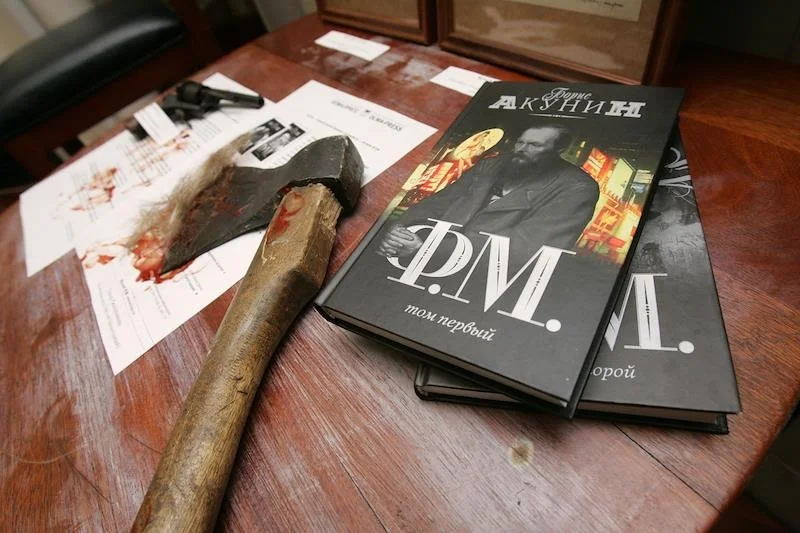
The Second Military Court has recently become the center of attraction for terrorists and extremists from all over the country: from Arseny Turbin to Boris Akunin, from the arsonists of the relay cabinets to Berkovich and Petriychuk. What kind of peace is there - they go, trample ...
The prosecutor of Makarov came out of the hall - outside the prosecutor’s table, she was smiling and gently stepped forward with journalists sitting next to me, who turned to “you”.
- Did you like the sentence? One of them asked.
- How much, very! - quite confirmed Makarova. But then she turned and added:-Although what difference does it make to me? What is one thing, what else, the third.
And then she added, looking at me with suspicion:
“You just need to filter the bazaar - even if you talk to the clowns.”
And it became completely clear that she did not understand any of the words sentenced today.
Part 2. "Evil Man"
“Evil Man”, “The villain” - this is how Grigory Chkhartishvili is translated from the Japanese pseudonym. Only the stress in the original is not put on the second, but on the third syllable: "Akunin."
The fact is that when Chkhartishvili began the cycle about Fandorin, he was very interested in the phenomenon of evil. Moreover, not small and vile evil, but a large one - one that is difficult to fight against, which is not easy to recognize at first sight that can be admired - in general, evil with charisma. The cycle about Fandorin was conceived as a cycle about one kind person, who from the book to the book fights with a whole gallery of different acunites, which are almost an encyclopedia. So, according to the author, the pseudonym appeared.
Then - on April 1, 1997, when the translator and Japanist Chkhartishvili reborn to the writer Boris Akunin - nothing prophetic in this pseudonym was visible. The prophetic one is now visible - when the system appointed him from all modern Russian literature for the role of the main villain, terrorist and “foreign agent”. And, probably, the mystery of why the regime with such perseverance sculpts from Akunin Akunin, only Erast Petrovich Fandorin could unravel - but if you try to produced as he would do, this will turn out that.
Во-первых, для того чтобы понять логику назначения Чхартишвили на роль главного злодея от литературы, нужна не дедукция, а жизненный опыт — и он подсказывает мне, что нынешняя власть не читает книг, а значит, и не имеет к ним особенно серьезных претензий. Книги и пьесы Акунина запрещаются, видимо, только потому, что они написаны Акуниным —
человеком, который говорит публично то, что говорит, отстаивает те идеалы, которые отстаивает, и живет так, как живет. То есть потому, что они написаны свободным, талантливым и известным автором.
Если все же сделать попытку понять, что в творчестве Акунина-Чхартишвили может раздражать нынешних охранников Кремлевской стены, то мне видится здесь одна-единственная особенность всего его творчества. Дело в том, что писатель Акунин насквозь, целиком и полностью демократичен. Акунин, по моему убеждению, — эталон полифонии, многоголосия в тексте. Все герои у него всегда живые, все разные, голос одного никогда не спутаешь с голосом другого, и над ними никогда не царит Автор, диктующий, кто прав, а кто виноват. Акунин никогда не перебивает даже тех своих героев, кто высказывает мысли, с которыми сам он совершенно не согласен. И даже когда в игру вступает не Акунин-беллетрист, а Чхартишвили-эссеист и философ, транслятор идей, мыслитель, — он никогда не выставляет свои мысли как истину в последней инстанции. Чхартишвили — автор сомневающийся, но не боящийся при этом сомневаться вслух. И уж точно не боящийся спора.
Из этой же особенности исходит и его страсть к литературной игре. Игра — жанр не монологический, для игры нужен соперник, нужна свобода выбора. Игра есть равноправие и равенство всех перед лицом судьбы. Игра, в конце концов, есть демократия. Поэтому то, что Акунин оказался писателем, всерьез занимающимся игровыми жанрами, кажется мне абсолютно закономерным: жанр, который называется интерактивной литературой и который Акунин всю жизнь активно развивает, предполагает, что читатель оказывается свободным от воли автора, строящего свое произведение так, а не иначе, свободным от предсказуемости сюжета, свободным от линейности. Более того: читатель оказывается не просто существом, от которого ничего в книге не зависит, а героем этой книги, соавтором, имеющим возможность выбирать будущее.
В одной из книг Акунина способность выбирать названа главным видовым качеством Homo sapiens. В России, как мы знаем, этим качеством пользоваться не принято. Интерактивная же литература воспитывает в своих читателях чувство ответственности за свой выбор, потому что именно он определяет, как будет развиваться сюжет дальше.
То есть либерально-демократические ценности такая литература реализует наилучшим образом — неудивительно, что Акунин-Чхартишвили, будучи последовательным сторонником свободы личности, так увлечен этим жанром. И неудивительно, что он — единственный из крупных современных писателей, кто много лет всерьез занимается развитием этого жанра, — так неприятен насквозь тоталитарной власти. Я не хочу сказать, что Акунин-Чхартишвили обязан званием «врага народа» своим интерактивным литературным играм. Я хочу сказать только, что сама природа его творчества и его психологии до корней своих противна сегодняшнему российскому государственному устройству.
Неудивительно и то, что это государство так постаралось стереть его с лица своей земли.
Отсутствие подсудимого на скамье подсудимых — это, конечно, пик превращения писателя в слово, но момент, когда Акунин — действительно самый популярный, самый публикуемый, самый читаемый, самый экранизируемый современный русский автор — стал понемногу физически исчезать из российского пространства, настал давно.
Времена, когда он не сходил с экранов, закончились в 2014 году, тогда же, когда он уехал из России насовсем (точнее сказать: до тех пор, пока). Времена, когда Акунин не сходил с театральных подмостков, продлились ровно на десять лет дольше. Правда, еще с 2022 года, когда Акунин-Чхартишвили высказался против военных действий предсказуемо однозначно, его имя потихоньку стали стирать с театральных афиш и программок.
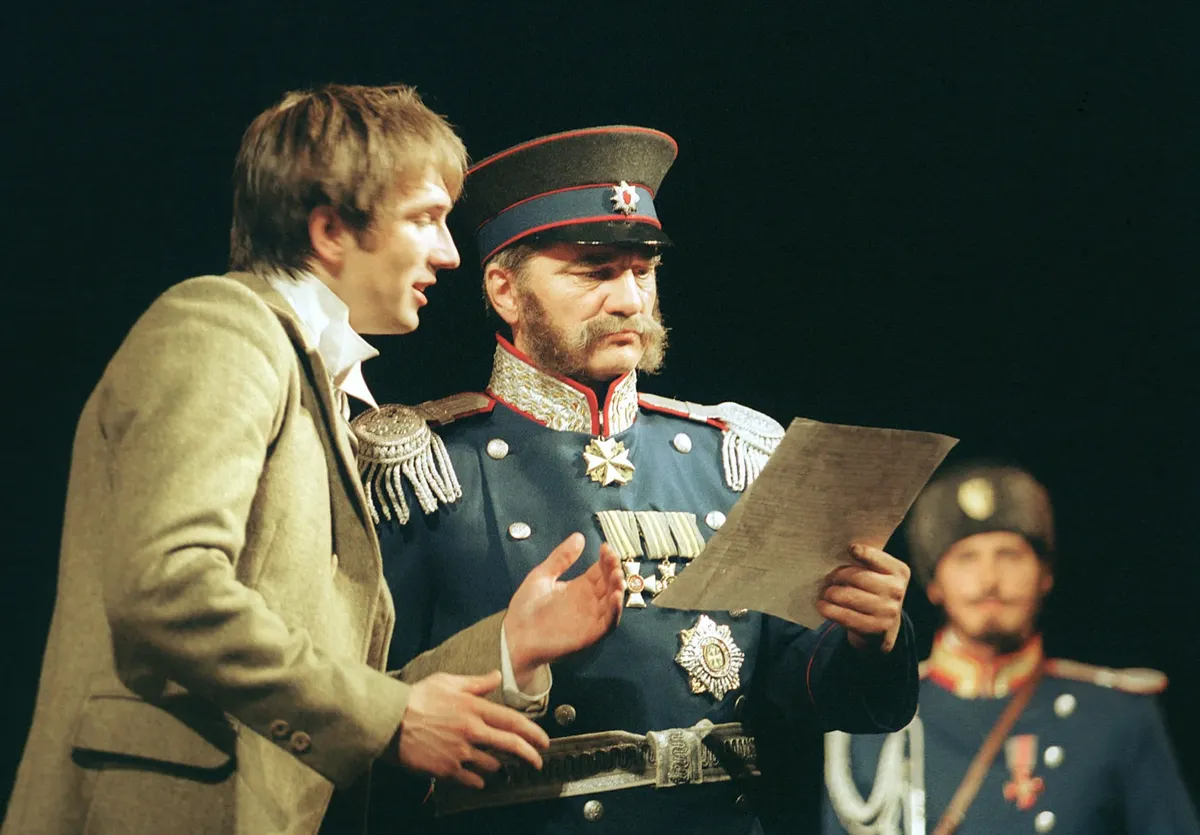
Первыми это сделали РАМТ и Александринский театр. РАМТ предлагал тогда три акунинских спектакля: «Инь и Ян. Белая версия», «Инь и Ян. Черная версия» и «Эраст Фандорин». В Александринке шел один — «1881», про то, как самодержавная Россия собиралась эволюционировать в прекрасное демократическое государство, но не смогла, и теперь ее ждет революция.
Осенью 2022 года бдительная публика заметила, что из программок всех этих спектаклей исчезло имя автора. Автор о такой политике уже знал — незадолго до этого ему звонил взволнованный худрук РАМТа. Поначалу Акунин над идеей безымянных афиш посмеялся: слова, мол, народные. Но осознав ответственность, на предложение согласился:
для него было важнее, чтобы его произведения доходили до аудитории — даже становясь при этом безымянными. Той же логикой он руководствовался и в книгоиздании: после 2022 года свои книги он до последнего выпускал в России.
Но в декабре наверху было принято решение объявить Акунина-Чхартишвили «врагом народа» — и тогда начался парад отмен. Сначала издавать Акунина отказалось издательство АСТ, за ним убрали с полок его книги маркетплейсы. И почти мгновенно афиши убрали театры: все три спектакля пришлось снять РАМТу, «1881» убрала Александринка, «Приключения Эраста Фандорина» — Московский губернский театр.
Но и на этом представление не закончилось. В январе санкт-петербургский театр LDM без предупреждения переписал мюзикл «Алмазная колесница», легким движением руки заменив в нем Фандорина на Марко Поло, а Японию на более дружественный Китай. И не смирившаяся с потерей спектакля Александринка составила официальный документ, в котором говорилось, что текст спектакля состоит из «компиляции исторических материалов и диалогов, созданных на основе архивных документов», в связи с чем его авторство принадлежит «творческой группе постановки театра и режиссеру спектакля», а не Акунину. Опустился железный занавес, зазвучали бурные и продолжительные аплодисменты.
В 2022 году — видимо, поняв, что книгоиздание, театры и кино в России закончат именно этим, — Чхартишвили создал собственный сервис BAbook, занимающийся публикацией книг, статей, являющийся одновременно виртуальным книжным магазином, площадкой для всевозможных обсуждений и много еще чем. В числе других на сайте этого проекта появилась полка с книгами Дмитрия Быкова*, чьи стихи Чхартишвили очень любит. Однажды он процитировал отрывок одного из стихотворений, сказав, что это краткое содержание того, о чем написаны вообще все книги, все пьесы, все сценарии — все проекты Акунина-Чхартишвили. По-моему, оно еще и является очень четким диагнозом всему, что происходит с акунинскими произведениями сейчас в России. Стихотворение это такое:
Не надо думать в светлые времена,
Что человек похож на бокал вина,
Пьянящ и сладок, и на просвет рубинов.
Не надо думать в темные времена,
Что человек похож на кусок говна,
Что мир состоит из трусов и хунвейбинов.
***
На прошедшем 14 июля суде обвинение Акунина во многом строилось не только на видео с пранком, но и на приведенной в первой части цитате про «эволюционерство» и «революционерство». Эта цитата для него очень знаковая. Чтобы сделать из последовательного «махрового эволюционера» апологета революции, режиму нужно было очень постараться — и он постарался.
Интересно, как сработал здесь еще и выбранный псевдоним: не «Борис Акунин», а «Б. Акунин», как подписывал самые первые свои беллетристические книги Чхартишвили. Ничего общего между эволюционером Акуниным и анархистом-революционером Бакуниным тогда не было — кроме, может быть, идеи о самостоятельности регионов, которая у Бакунина в несколько другой форме, но появляется. Теперь копилка общего пополнилась: оба революционеры. Впрочем, думаю, что эти слова Чхартишвили все-таки произнес в запале. Хотя то, что igne natura renovatur integra, становится постепенно очевидно, к сожалению, многим. В любом случае, восторга от этого Чхартишвили явно не испытывает. Но вряд ли это снимет с него обвинения со стороны обиженных «патриотов».
«Акун и н» в переводе с японского — это, разумеется, злодей. Но это не злодей в том смысле, который мы привыкли в это слово вкладывать. Это сильный человек, у которого свои правила, и эти правила он устанавливает для себя сам. Они не совпадают с предписаниями закона, но за свои принципы акун и н не пожалеет жизни.
Закон можно попрать, обнулить, нарушить — акун и н, становясь для такого закона врагом и злодеем, свои правила не обнуляет и не нарушает. И в этом смысле Чхартишвили представляется мне достойным носителем своего псевдонима, который он так прозорливо выбрал двадцать восемь лет назад.