
Translated material
The end of the season
The State Duma before the holidays adopted a whole scattering of repressive laws, whose slurred is intended. Explain

Plenary meeting of the State Duma of Russia. Photo: Dmitry Dukhanin / Kommersant
18+. This material (information) was produced, distributed and (or) sent by foreign agent Vishnevsky Boris Lazarevich or concerns the activities of the foreign agent Vishnevsky Boris Lazarevich.
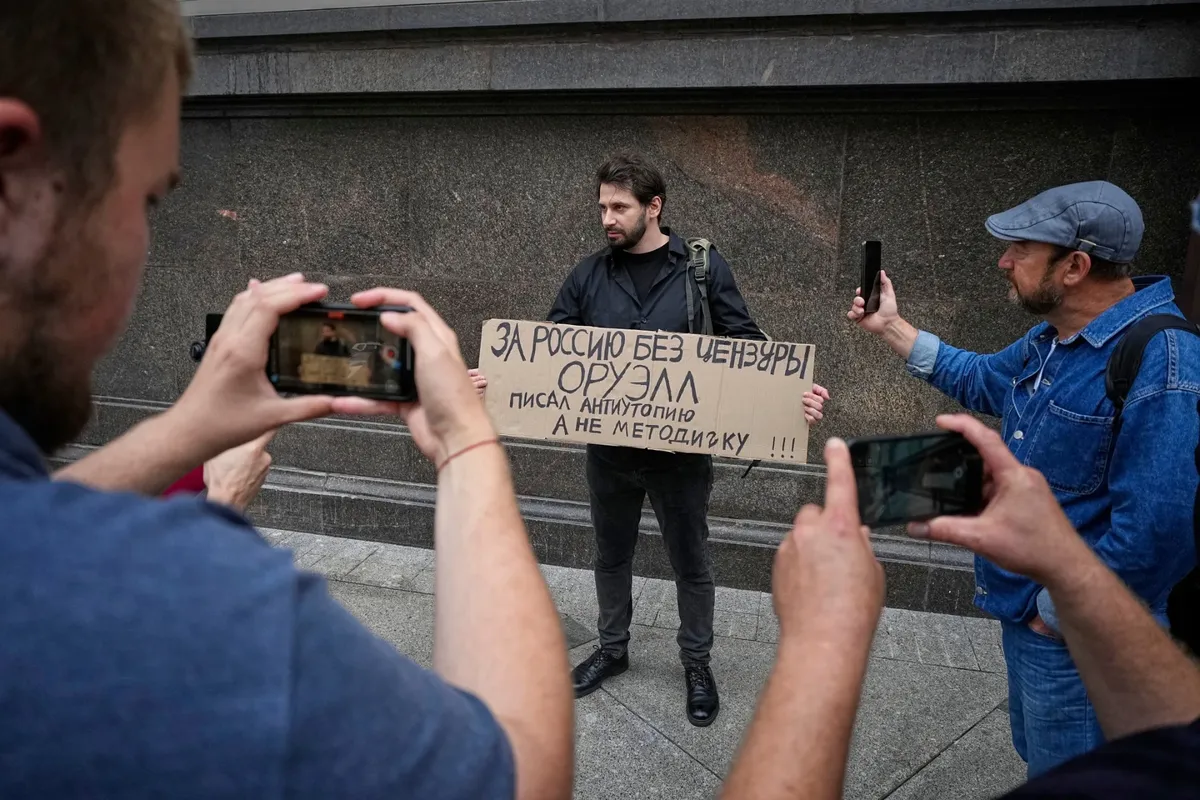
Speaking about the prohibitive and repressive laws adopted under the curtain of the Duma season, they mainly discuss those of them that concern fines for the “search for extremist content” on the Internet - just accepted by the State Duma in the third reading without any changes.
The consideration was postponed for a week, because even the characters completely loyal to the authorities expressed dissatisfaction, but, apparently, the team did not have to change anything “from above”.
The law was adopted almost only by the votes of United Russia - out of 306 votes, only a few people from other fractions.
Among them, Oleg Leonov and Rosa Chemeris from the “New People”, Yana Lantratov and Dmitry Gusev from “SR”, Alexey Zhuravlev, Dmitry Svishchev and Rifat Shaikhutdites of the LDPR ...
The Communist Party and most of the “newly people” voted against, most of the “Social Revolutionaries” abstained, most Zhirinovites did not participate in the vote.
But about this law - a little lower, because it is no less important much less often the other norms discussed on the “twisting of the nuts”, adopted in recent days.
... The first of them provides for “the possibility of recognizing an extremist organization of an extremist community in the event of legal force of a criminal case in relation to a person for creating a community provided for in Article 282-1 of the Criminal Code of the Russian Federation, for the leadership of this community or participation in it.”
This measure, the authors report, “seems necessary, taking into account the public danger of extremist communities” and “taking into account that the Ministry of Justice of Russia is a list of public and religious associations, other organizations in respect of which the court has made a decision on the liquidation or prohibition of activities on the grounds provided for in July 25, 2002 No. 114-ФЗ“ About about about Countering extremist activities ”, the bill is proposed to include information about extremist communities in the specified list, while changing the name of the list.”
The initial reaction of many lawyers (and most of the media) to this innovation was an idea that in order to recognize extremist any community - formal or informal, political or non -political - enough recognition of any of its participants. With the actual establishment of not only collective responsibility, but also collective guilt.
A careful reading of the formulations shows a slightly different, but still dangerous picture.
First of all, it shows that elementary logic is violated in them.
An “extremist organization” is an initially designed structure, in some way legal, which at a certain stage begins to engage in extremism (to incite hatred, to demand a violent change in the constitutional system, and so on, in accordance with the Federal Law “On Combating Extremist Activities”). In this case, it is declared extremist, its activities are prohibited in court, and the participation in it or the organization of its activities is declared criminal and punished under Article 282-2 of the Criminal Code of the Russian Federation.
Now, as they say, follow your hands.
The concept of an “extremist community” is defined in Article 282-1 of the Criminal Code of the Russian Federation-as an “organized group of persons for the preparation or commit of an extremist orientation crimes”.
That is, the creation or participation in the extremist community is the commission of a crime. And if a person is convicted under Article 282-1 for the creation, the organization of an extremist community or participation in it, this means that this extremist community already exists, is indicated in the court’s sentence and is intended specifically for the “preparation or committing of an extremist crimes”.
Of course, the question arises -
Why additionally prohibit its activities as an “extremist organization”, if it is criminal, which is established by the court sentence under article 282-1?
But this is not the main thing: if the citizen convicted person under article 281-1 consists not only in the “extremist community”, for the creation, leadership or participation in which he is punished, but also in any other communities-from political parties and ending with circles of beekeepers or cutting and sewing, or, as already written, “house logic”, from the point of view of legal logic, the amendment of the State Duma, which was adopted by the State Duma. It does not mean that these communities can be declared “extremist” as part of a certain “collective guilt”.
Nevertheless, there is a danger, and it must be realized - knowing how numerous “organs that are not mistaken” and their representatives act in practice.
It is easy to imagine the following situation.
The court verdict of conviction under Article 282-1 goes to the Ministry of Justice. The ministerial official finds out that the convict is a political or public organization. And exactly the way it happens with the register of “foreign agents”, without any judicial events, at its discretion, submits an organization to an “extremist” list. After that, Rosfinmonitoring immediately blocks her accounts ... And then you are tormented by the dust to swallow, trying to cancel these decisions in court.
Not only does this take time, it is also unknown how it ends - because the system, as it happens with all, without exception (at least in the last three years), “foreign” affairs, will consider it by its obligation to not cancel even the most absurd and illegal repressive decision ...
... As for the “foreign” topic, the State Duma made amendments to Article 330.1 of the Criminal Code of the Russian Federation, canceling the so -called “administrative prejudice” for “non -fulfillment of the duties of“ foreign agents ”.
Earlier, the legislation stipulated that it is possible to bring to criminal liability only after two administrative offenses under Art. 19.34 Code of Administrative Offenses (violation of the procedure for a foreign agent) within one year, now one administrative offense will be enough for this.
This dramatically increases the risks for all those declared by the “ino-agent” without any court are deprived of two dozen constitutional rights and are found in dozens of prohibitions that largely block not only socio-political activities, but also the possibility of obtaining livelihoods. Especially taking into account how and for what “bodies” are drawn up on “violation of the procedure for the activities of foreign agents” (demanding punishments even for the absence of a “dick” where it should not be at all) and how uncritically these protocols are considered in court.
The proposal to cancel the “administrative prejudice” at the recent St. Petersburg Law Forum was nominated by the Deputy Minister of Justice Oleg Sviridenko - the same one who signed decisions on entering into the discriminatory register. Like, the “foreign agents” triumph in the fact of their inclusion in the register, ”and“ minor fines do not contribute to the observance of the law ”.
Where the deputy minister saw the "triumphant", I personally do not know. Among my colleagues in Yabloko and my friends (some of which were brought into the register without any legal grounds, very seriously complicating their lives), and in general, there are no such people among those who remained in Russia.
Perhaps there are among those who left - to which all these prohibitions, restrictions and fines are usually indifferent, because they are inaccessible to the Russian law enforcement system.
But even there, some (albeit a few) began to understand that
Entering to the register is not a reason for Yernichi, and that the more they are sophisticated in journalistic skill, while in full security, the more difficulties the Russian authorities create more and more difficulties for those who have not left anywhere ...
As soon as the proposal sounded, it was clear that it would be immediately picked up in the State Duma, which happened - under the statements about the need to approach those who “betrayed our country”, and “protect Russia from the intervention of unfriendly countries acting through deduced foreign agents”.
The fact that in “foreign agents” have long been entered without any “foreign financing”, but only for an interview with a foreign media, and none of the “foreign agents” were able to say in court, under the “influence” of which country it is supposedly located, no one began to remind in the State Duma.

Unanimously “for” these amendments to the law, together with the United Russia, were voted by the Communists, the Socialist -Revolutionaries, and Zhirinovtsy, and the “newly”. The small - and rare - the front they allowed themselves only when considering the law on fines for the search for "extremist content."
... In this law, a lot is remarkable, starting with the technology of its adoption (in the form of amendments to the second reading of the long-lying law on forwarding activity, which, as a rule, happens when they urgently require something dubious to adopt) and continuing the unexpected reaction of completely odious characters that began to complain that these amendments can make it difficult for them to complicate the usual serial informing and television exposure.
The story began to “spin” widely in the information field, the third reading of the law was postponed for a week - but they did not change anything.
Speaker of the State Duma Vyacheslav Volodin said that now “the time is not only challenges, but also the time of hostilities”, that “decisions adequate to this situation are made”, but that “with the adoption of the law, we should not leave this issue without control” and “for our part in law enforcement practice, we will see how the norms of the law together with the government, with the specialized ministry, with control and supervisory authorities will work, and if we see, and if we see That the norms are imperfect, they require adjustments, we will return to this issue. ”
It was possible to see that the “norms are imperfect” at once, but the position of the “tops” did not change, which proves the arrival of Maksut Shadayev’s Minister of Communications to this issue. He stated that “the decision allows you to defy - on the one hand, to prevent the further spread of extremist materials, on the other hand, so far do not make decisions on blocking large Western platforms” (the word “so far”, of course, is not an accident). That “only 5.5 thousand materials” are on the list of prohibited, and not the entire platform. And in general, the law will affect “only units”, which are in the “field of interests” of law enforcement agencies.
Shadaev also said in the Duma that access to social networks would not be punished, even if they are recognized as extremist organizations, but only to specific materials: these are books, articles, videos, audio recordings, tracks.
That “if the user does not know that this material is included in the register, and he does not have intent, even if he uses VPN, he will not be subjected to any punishment.”
And that "law enforcement agencies must prove the presence of intent, and this is the main task in order to make an appropriate decision on an administrative offense."
There were immediately questions:
Should a law -abiding citizen know by heart the mentioned list of 5.5 thousand “extremist materials”, and will not be punished by an attempt to familiarize themselves with them?
Who and on what basis is “in the field of interests” of law enforcement agencies, and how wide is this “field”?
Finally, is the minister County that law enforcement agencies are increasingly not even considered necessary to prove any “political” in “political affairs”? And what do the courts agree with this, rewriting administrative protocols or indictments into their decisions?
In the State Duma, no one, of course, asked this.
As a result of the Code of Administrative Offenses, it is supplemented by Article 13.53, according to which the “deliberate implementation of the search in the information and telecommunication network of the Internet is obviously extremist materials included in the published federal list of extremist materials or specified in paragraph 3 of Article 1 of the Federal Law of July 25, 2002 No. 114-ФЗ“ On Combating Extremist Activities ”and receiving access to access They, including using software and hardware access to information resources, information and telecommunication networks, which is limited to access, entails an administrative fine on citizens in the amount of three thousand to five thousand rubles.
At the same time, fines were introduced (from 50 to 80 thousand rubles for citizens and from 80 to 150 thousand rubles for officials) for advertising “software and hardware means of access to information resources, information and telecommunication networks, access to which is limited”. True, just for using the VPN is not yet punished. Once again, the keyword is “for now”.
... Of course, the question arises - why all this?
Existing repressive laws no longer provide the necessary level of silence, and you just need to ban those with whom they do not know how to argue?
The refrigerator does not connect to the TV, and official messages act only until going to the store, for a carfamon or pay for an apartment?
Or is it simpler, and in the State Duma it is necessary to imitate the frenzied activity in the fight against “internal enemies” in the hope that they will appreciate zeal, and they will definitely not be punished for excessive cruelty?
As the official RIA Novosti joyfully reports, speaking of the fines for the search for “extremist content”, the police will not inspect the phones: “They plan to find violators by appeals of citizens.”
Immediately I recall both the speed of knocking, and the Dovlatovskoye "But who wrote 4 million denunciations?"