
Translated material
What happens to the Internet in Russia
What happens to the mobile Internet in Russia - the analysis of "features"
Briefly
Russians have long been living in reality, where censorship exists not only on TV, but also on the Internet. Since 2012, a huge number of resources have been introduced to the register of prohibited sites, and the war has even accelerated this process. In 2025, another trend was especially pronounced: in the regions, not specific resources began to block, but to completely limit the work of mobile Internet. This is most often done under the pretext of attacks of seedlings. People who have long been accustomed to rely on the Internet cannot not only contact each other, but also get to the destination or pay for purchases in the store. What is happening with the Internet in Russia and whether the Internet shutdown really helps to protect himself from drones, - the “line” explains along with the experts of Ooni and Roskomvoboda.What is a blocking?
For many years, individual resources have been blocking in Russia. These are the opposition media, the sites of human rights organizations and other pages, the contents of which the Russian authorities consider extremist or undesirable. Since September 2020, blocking unwanted content has become quite simple - then Roskomnadzor began to demand from the operators to establish “technical means of counteract threats” (TSPU). This is a special device that is located in the networks of communication operators, but is controlled through Roskomnadzor. Thanks to this equipment, the supervisory authority can block traffic directly, without the participation of the provider.
What is Shatdown?
Shatdown is a complete restriction in the work of the entire mobile Internet. Most often, 5G, 4G and 3G is disconnected, leaving only Edge - such a speed is not enough even to send a message. This means that it is impossible not only to go to a specific site, but also to use the Internet in any form as a whole: write a message in the messenger, pay for the purchase at the box office. This method of restricting communication is also not new for Russia: for example, mobile Internet was jammed during various opposition rallies and events.
Large -scale shutdowns of mobile Internet at once in several regions of Russia occurred during the May holidays of 2025 under the pretext of protecting from assassins. And since then this practice has been used constantly.

What is the scale of disconnects now?
According to the “In touch” project , in the first 11 days of July, the Internet in Russia turned off 744 times - this is 14% more than for the whole of June. Residents of 77 regions faced problems. The pace does not decrease: only on July 16, interruptions with mobile Internet were recorded in 67 regions, and in 53 of them residents complained about the disconnection of the wired Internet. In the whole region, city or in a particular area, can be limited to communication.
Moreover, it seems that the shutdowns are in no way connected with the proximity of the village to the war zone. For example, the Omsk region became a record holder for the number of disconnects - although the region is located two and a half thousand kilometers from Ukraine. The problems were also affected by the Krasnoyarsk Territory, Yakutia and Chukotka. But in the Belgorod and Oryol regions, the Internet was disconnected much less often than in the neighboring Bryansk and Kursk - that is, the logic “the closer to the front, the more disconnects” there are no.
How does the mobile Internet disconnect?
Ords on the shutdown of the Internet can give a variety of structures: Roskomnadzor, FSB, local authorities, regional administrations of the Ministry of Emergencies.
Turn off technologies also differ depending on the region. For example, in the Siberian Federal District, the shutdown occurs along the Roskomnadzor line-through TSPU devices: traffic is blocked from IP addresses from certain locations. However, most often, after the announcement of “unmanned danger”, communication operators are directed to disconnect the work of the 5G and 4G protocols, and often 3G in the entire region or at separate stations.
On July 15, the mincifers and telecom operators discussed that in the future it is planned to create a disconnection regulation of mobile Internet and appoint a single body responsible for blocking.
Disconnecting mobile Internet helps to protect yourself from attacks of enforcement?
Disconnecting mobile Internet can really interfere with the work of drone operators - they often use mobile Internet to transmit data and coordinates. But their main communication channel is still satellite.
That is, disconnecting mobile Internet at best only a little complicate the work of drones.
In Ukraine, which is subjected to much more massive attacks of drones, mobile communications are not disconnected to fight them.
Why then do mobile communications turn off in Russia?
According to many experts, the protection against airplane attacks is a cover for other tasks. For example, to test the technology of isolation of the Russian Internet. This version explains why the mobile Internet was disconnected, for example, in the Sverdlovsk region, which Ukraine did not attack at all in Yakutsk.
However, the head of the "Internet Protection Society" Mikhail Klimarev believes that the shutdowns are a systemic reaction of the regional authorities to threats. Turning off the mobile Internet, they demonstrate to the Kremlin that they did everything possible to prevent and minimize risks. That is, first of all, they protect themselves from accusations of inaction, and not residents - from attacks of seedlings.
This applies primarily to the attacks of seedlings, but not only. In the Sverdlovsk region, the Internet was disconnected during the visit of Prime Minister Mishustin, and in Yakutsk during the national holidays.
An indicative example is the disconnection of mobile Internet in the Altai Republic. They began during mass protests of residents against the liquidation of local self -government, initiated by the head of the region Andrei Turchak. These protests became one of the most massive in Russia since February 2022, and the main slogans of the protesters directly demanded the resignation of the head of the region. It was during the protests in the region that regular shutdowns began, which the local operational headquarters explained "the need to ensure the safety of important objects, not to allow espionage and various kinds of provocations for which the telecommunication network is used."
What is the scale of the damage from the shatdows?
It is difficult to evaluate the scale - disconnection of the Internet leads not only to economic losses, but also to the psychological discomfort of the population.
Disconnecting mobile Internet critically violates the usual lifestyle for residents of most Russian regions. And the point is not only about the restriction of messengers. People are used to using navigators, paying cards and using a QR code, making banking transfers through applications. During the Shatdown, all this becomes impossible.
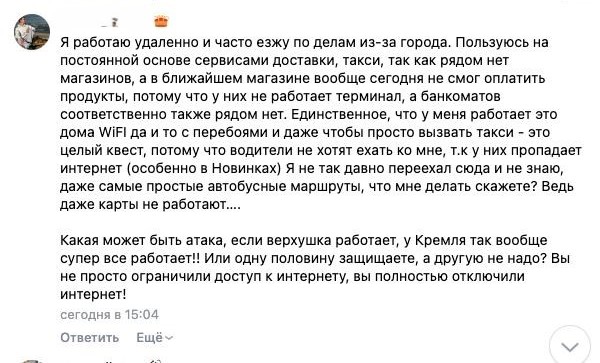
Businesses receive severe damage. The most obvious victims are mobile operators who literally lose income, turning off the mobile Internet. Serious losses are the banking sector due to a reduction in the number of transactions.
Critical problems arise in the regional business - taxi and delivery services, which requires communication with couriers.
What to do to be prepared to turn off the mobile Internet:
- Make sure that you or your loved ones have access to an unlimited stationary Internet.
- Find the Wi-Fi public points on the network. Such points are usually in cafes, restaurants, administrative institutions and transport. But use them only with VPN.
- Have a taxi number at hand, which accepts orders by phone.
- Install offline cards for GPS navigation in advance-for example, Yandex maps, 2GIS or Google Maps.
- Store cash at home - they will come in handy if the terminals and ATMs stop working.
- Write down the phones of loved ones on paper or notes on the device - this will help if only a stationary connection remains.
- Buy a SIM card of different operators-perhaps someone one will not turn off the connection.
- Download books, music and TV shows in advance-in many streaming services there is a function of an offline imposition.
What to do if the mobile Internet is turned off:
- Rect the network parameters on the phone - try 2G or 3G. Sometimes they work, even if the main networks are jammed.
- Do not use applications that work only with a constant connection - they can fail, write off funds and create errors.
- Try alternative messengers working when turning off: Briar, BitChat, Bridgefy, Fireside and others. They are energy -consumed and difficult to use, but can help in an emergency.
What to do if the Internet has slowed down in your region:
- Close resource -intensive applications. Even in the background, they generate traffic and overload the channel.
- Disconnect extra devices from Wi-Fi. Temporarily translate smart TVs, prefixes, vacuum cleaners and other “smart” devices into an autonomous mode.
- Disconnect the auto -loading photo and video in messengers - this will accelerate their work. The setting can be found in each specific application.