
Translated material
Hey steam locomotive, do not knock the wheels ...
The railways of Russia suffer losses. There is no money for investments. But this is not only the problem of Russian Railways, but a reflection of the situation in the economy
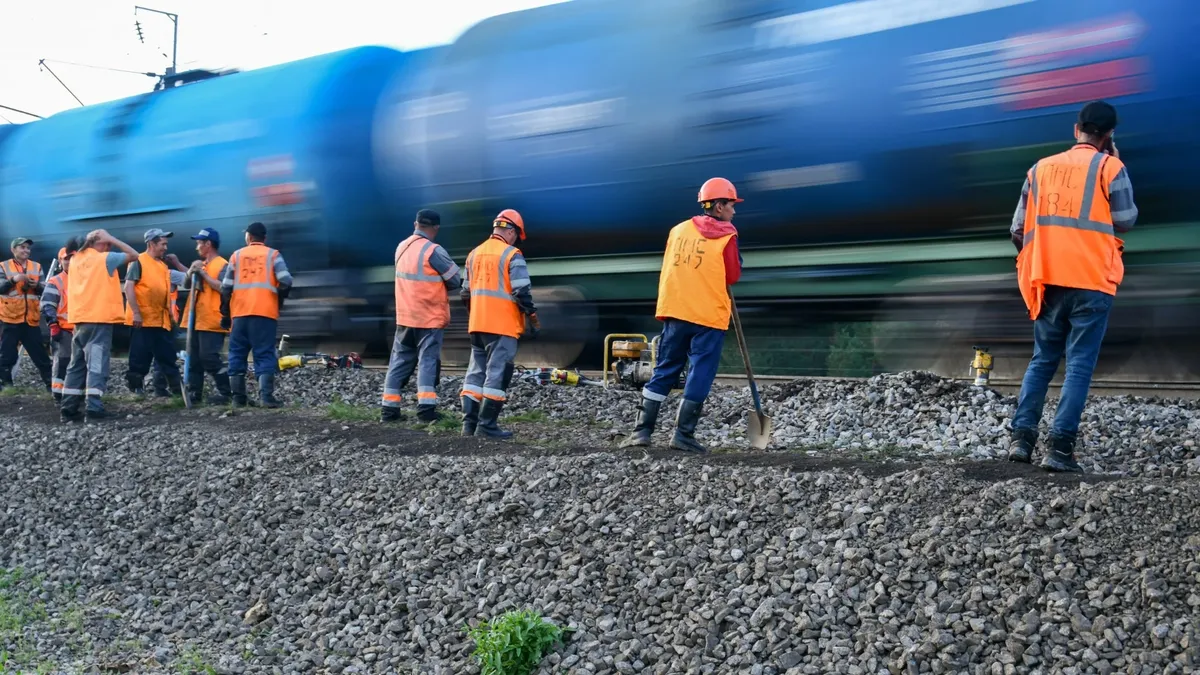
Photo: Evgeny Epapanchintsev / TASS
The railways of Russia are more than transport. This is a mirror of the economy where each car is a drop of blood in the country's body. The results of the first half of 2025 showed: this organism has problems.
Less and more complicated
The general dynamics of cargo transportation is as follows. Take the main numbers. The total loading amount was reduced to 554.5 million tons (–7.6% by 2024, or –45.9 million tons). And export transportation decreased by 2.7% (–5.5 million tons).
These figures say more eloquently any analysts and publicists: 554 million tons of cargo - 7.6% less than a year ago. The total loading amount decreased by 45.9 million tons - it is equivalent to how if all goods transported within 37 days of continuous operation of the entire railway network disappeared.
Why? And therefore, for example, that the construction sites got up - the loading of cement and building materials decreased by almost 20%. Metallurgical giants slowed down - ferrous metals were sent on rails by 17% less. Crisis in the coal sector - there are big problems in the Kuzbass. Production falls (or is overstated by what no one buys) in mechanical engineering of different types-factories begin to switch to a 4-day working week. Even the transportation of containers, these “unsinkable” symbols of globalization, for the first time in many years went on decline.
Help "New"
Reducing loading through key cargoes
(Comparison: absolute values/average daily)
Coal:
- –3.6% (–6.1 million tons) / –3.1%.
Reason: Reducing exports (–2.5%) and internal demand.
Oil and oil products:
–5.0% (–5.2 million tons) / –4.5%.
Oil export: –5.0% (–2.1 million tons).
Ferrous metals:
- –17.2% (–5.5 million tons) / –16.7%.
Reason: the decline in construction and mechanical engineering.
Construction goods:
–19.5% (–11.3 million tons) / –19.1%.
Cement: –15.2% (–1.8 million tons).
Reason: freezing infrastructure projects.
Corn:
- –36.4% (–5.8 million tons) / –36.1%.
Reason: Reducing exports and crops.
Container transportation:
–2.5% (–0.6 million tons) / –1.9%.
For the first time during the years, a decrease (previously there was growth).
If you translate all these interest into more visual images: the lost volume of coal could heat the millionaire city for four years, and the missing oil products are 125 fully loaded Aframax tankers.
Alarming situation with building materials, falling by 19.5% (11.3 million tons) is the volume of materials sufficient for the construction of 15,000 multi -storey buildings.
Black metallurgy demonstrates a drop in transportation by 17.2%. To understand the scale: “lost” 5.5 million tons is a volume sufficient for the production of 7 million cars, or the equivalent of the annual production of two average metallurgical plants.
Here we can talk about Domino's effect: first, the construction sites were slowed down, then orders for metal structures were reduced, now the demand for raw materials is falling.
Another serious failure is grain. Minus 36.4%. 5.8 million tons-annual bread consumption of a 30 millionth country, or flour for 85 billion loaf of bread. Entire echelons, which a year ago they brought wheat to the ports, from where the vessels with grain went to Egypt and Turkey, are now idle. Fields that have given a “compact” crop, elevators, where they are half empty and where there are few people clogged with grain, because there are few people who are hunting at existing prices, and ships looking for goods in other countries are a reflection of problems in the agricultural sector.
But fertilizers are a new “king” of Russian exports. An increase of 4.8% - Brazilian plantations, Indian fields, African farms - more and more countries depend on Russian mineral fertilizers.
Mineral fertilizers: +1.6 million tons. This is enough for feeding 16 million hectares of crops, such a volume is able to increase yield in the importing countries by 5–7%. Non -ferrous metals also hold - +2.9%. Copper for electronics, nickel for batteries, aluminum for aviation.
In general, analysts identify three key factors for such a decline:
Structural changes in the economy
The share of construction in GDP decreased from 6.2 to 4.9%.
Industrial production shows negative dynamics for four consecutive months.
Transformation of export flows
The reorientation to Asian markets requires new logistics solutions - and the road is the only one, it is clogged, which leads to the falling speed of cargo delivery and the rise in the cost of transportation. Add yourself a lack of locomotive brigades and those who serve the paths.
The loss of the European direction is not fully compensated.
Internal demand
Real incomes of the population practically do not grow the third quarter in a row.
Investment activity of business at minimums.
Where to get the money?
In this situation, Russian Railways faced financial problems. Net profit fell from 118.3 billion rubles. (2023) to 13.9 billion rubles. (2024). Losses due to underloading-127 million tons of cargo, not fed in the first half of 2025, led to the benefit of profit in the amount of about 200 billion rubles.
Other factors are a growing debt load and infrastructure costs (for example, the expansion of the eastern training ground is frozen). In June, during a speech at the PMEF-2025, the Deputy General Director of Russian Railways Andrei Makarov directly stated that the construction of the third stage of the Eastern training ground, including the Trans-Siberian and Baikal-Amur highways, would have to be transferred for a year or two, because there is currently not enough money.
Earlier it was assumed that the work would start in 2024, later they were transferred to the beginning of 2025, but the deadlines again had to be reviewed due to the reduction of the holding investment program. And in this regard, railroad workers have to think primarily about their financial problems than about the interests of specific cargo carriers.
To solve these problems, Russian Railways prepares a large -scale reform of the tariff policy aimed at rapprochement of the cost of transportation for:
Raw materials (iron ore, coke, coal) - growth of 13.5–21%.
Finished products (ferrous metals, scrap) - a decrease by ~ 15.8%.
Containers and empty mileage - +15% and +5% (2026), then still +5% (2027).
The declared goal of the reform is to reduce cross subsidies, where high tariffs for metals compensate for losses from cheap raw materials transportation.
The idea of rapprochement to 2027–2028. The cost of transportation of goods of the I and III tariff classes by rail has been expressed for a long time. Now the “tariff maneuver” has decided to start with those types of transportation that are often carried out in the framework of one industry or even one holding. Obviously, the initiators of the reform expect that losses and winnings from the rapprochement of tariffs for the same consignor will not cause such severe rejection as if they were distributed to different industries. And so the increase in the costs of transporting raw materials for a vertically integrated holding will be compensated to a decrease in the cost of delivery of finished products to one degree or another.
However, the consequences of this tariff earthquake will reach all corners of the economy:
The construction sector will be the first to feel the rise in price of the metal rolling, they will be forced to revise the cost of machine builders, but the end consumers will see new numbers in the price lists.
At the same time, Russian Railways risks the risk of getting a boomerang effect - raising tariffs may not lead to an increase in income, but to a reduction in the cargo base. Today, 127 million tons of potential cargoes did not fall into the wagons. In addition, raising Russian Railways for carbon transportation in 2025 will significantly increase the transport costs of coal companies, where logistics expenses already reach up to 50% of the cost.
This is especially critical for regions with remote ports, such as Kuzbass and Khakassia. By the middle of 2025, the volumes of production in Kuzbass had already decreased by 6.1%, and further rise in the cost of transportation risks the reduction of export supplies and deterioration of the financial stability of the industry.
Experts draw two scenarios of tariff reform:
Hard - Russian Railways consistently carries out the reform, industry adapts through increasing prices and optimization of logistics.
Compromise - there are point solutions for especially affected industries, the process is stretched for years.
But in any case, the era of cheap railway transportation of raw materials irrevocably goes into the past. The new rules of the game will require all market participants not just adaptation, but a real production reboot.

On rails or on wheels?
The Railways of Russia still “work on coal and oil”-these two giant forms almost half of the entire cargo flow. But:
Coal is slowly losing ground - its share decreased from 28.4 to 28.1%. Sanctions and logistics traffic jams in the East make themselves felt.
Oil, on the contrary, on the rise - 17.7% against the previous 17.0%. Apparently, black gold is still more reliable than coal.
But the construction sector and metallurgy - traditional "breadwinners" of railways - are going through not the best times.
Black metals (–9.3%) and scrap (-18.5%) lose volumes.
Building materials are also in the red - the housing construction crisis hits cargo transportation.
Meanwhile, trucks select customers from railway workers: +8.5% growth against –4.2% of the railway. Now they compete even at distances up to 5000 km - earlier railway workers felt calm after 2000 km.
The only ray of light in the inhibitory cargo flow is container transportation: +5.9% of the volume (up to 7.88 million TEU) The share increased from 4.1 to 4.4%.
But can this growth compensate for the fall in traditional sectors?
Where are the wagons slow down?
Eastern dead end. The throughput of the BAM and the Trans -Siberian Railway does not have time for demand. Plan - 162 million tons, reality - 150 million.
The wagons have become slower. The wagon turnover grew by 10.6% (now 20.7 days). The precinct speed fell by 5.1%.
Sanctions and new routes. The export of coal to the east is growing, but not quickly enough to compensate for losses in the western direction.
What next?
Railways are “at a crossroads”: either accelerated modernization, especially in the east. Or further loss of goods in favor of vehicles.
Railways remain a frame for freight transportation, but almost do not grow. The emphasis is on the repair and electrification of old lines.
Roads are actively built, but the quality is lags behind. The main task is to eliminate “white spots” in rural areas.
The regional gap intensifies:
The center receives both the railway and auto -infrastructure.
East and North depend on the outdated paths.
Future? Without large -scale investments in both types of transport, Russia risks getting:
Overloaded federal highways.
"Frozen" railways that do not have time for the economy.
Isolated areas where the only transport is helicopters.
But are there any means for investments in rails and roads?
In this story there is something deeply symbolic. Railways have always been a mirror of the economy - their rhythm accurately repelled the country's pulse. Today, this pulse has become uneven, and the mirror shows an alarming picture.
Help "New"
(Numbers: Rosstat, Ministry of Transport, Railways reports. 2024–2025)Russian railways - the third in the world in length (122 thousand km), are second only to the United States and China. This is the heritage of the imperial and Soviet eras, when steel highways connected huge territories into a single economic space.
Network structure:
87 thousand km (71.3%) - public paths (Russian Railways and other operators).
35 thousand km (28.7%) - non -public paths (industrial branches, private access roads).
The largest highways:
Oktyabrskaya railway (12.2%) -connects Moscow and St. Petersburg, the most loaded passenger corridor.
Moscow railway (10.3%) is the center of the transport system of the European part.
Sverdlovsk and Far Eastern (by ~ 8%) - key arteries for freight transportation (coal, ore, containers).
Kaliningrad (0.8%) is the smallest, but strategically important due to exclus.
White spots on the map: in 6 regions of railways there is no at all:
- Nenets Autonomous Okrug, Altai Republic, Kamchatka, Magadan, Tuva, Chukotka. Reasons: complex relief, low population density, economic inappropriate.
Problems of growth: over 15 years, the network has increased only 122.6 km (2024). The main reasons:
High cost of construction (especially in Siberia and in the Far East).
Priority for the modernization of existing lines before expansion.
All this farm needs urgent modernization. In addition, although the length of the railways and the third in the world, it is enough to open any map to see how different the density of the railway message is from the same China. But there is no money. Why - everyone understands.
From the editorial office:
By the way, one should not forget about another factor that reduces the profitability of railways - is unlikely to be military cargo and everything necessary for the VPC is carried into profit.