
Translated material
To the death of "lack of alien". Dmitry Bykov* about why children have nowhere to live
In mid-July, two filmmakers-Yuri Kara and Yuri Moroz, representatives of the same directorial generation who entered the profession in the late 1980s-early 1990s passed away. Valery Todorovsky, Vladimir Khotinenko, Alexey Balabanov, Alexander Khvan and many others belong to him. For the writer Dmitry Bykov, these deaths became the reason for thinking about why the post -Soviet “new wave”, and the new country, did not work out and could not work out by definition.
1.
This text is provoked not only by the widely discussed statement by Konstantin Bogomolov about how lucky his contemporaries were, but also by the simultaneous departure of two talented directors of the previous generation - Yuri Kara and Yuri Moroz, namesake with very symbolic surnames. In Russian culture, everything is generally symbolic and clearly, as if an invisible hand writes its story specifically for idiots.
The brilliant directorial generation, which was called the post-Soviet new wave and which had their own ideologists, the ranks of which were also thinned (Alexander Timofeevsky-Ml., Andrei Shemyakin, Alexei Medvedev), far from justified the hopes assigned to her. Valery Todorovsky, Dmitry Meskhiev, Ivan Okhlobystin, Igor Sukachev, Vladimir Khotinenko, Nikolai Lebedev, Nadezhda Kozhushanaya, Bakhtier Khudonazarov - then they were all together. Now of those who are alive, some do not shoot, others shoot the series, but not one reaches the level of their own early paintings, not to mention civil leadership and moral authority (thank you at least those who do not “zest”).
And how many early deaths are in this generation from disappointment!
Alexei Balabanov, whom some considered the leader, and others of the generation anti -owner, left in 2013, his peer Alexander Khvan - ten years later. Both were far from fully realized. In 2015, having barely lived up to 54 years, the most successful debutant of the generation Vasily Pichul died.
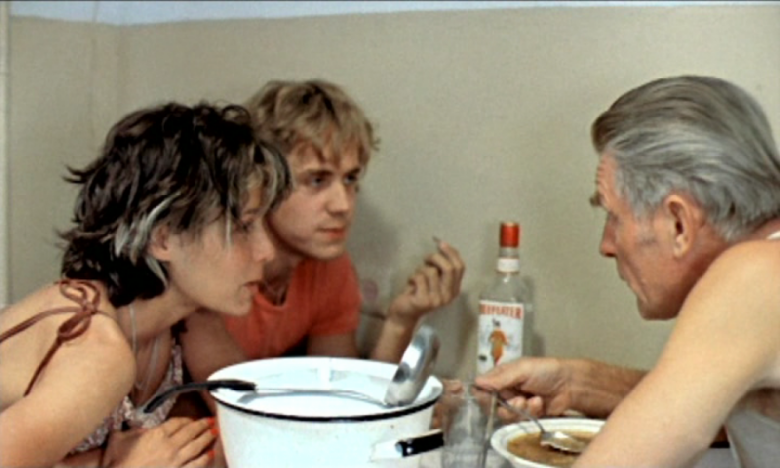
Shot from the film "Little Faith" (1988), dir. Vasily Pichul
Actually, the tragic fate of this brilliant generation was indicated after the departure of Alexei Samorov (1994) and Peter Lucik (2000). This tandem worked more and better than anyone, and they could, on their own assurances, save the Soviet project, or post -Soviet, name as you want. In their best scenario, but what is the novel, “Duba-Duba”, who fascinated me immediately and forever, this is directly said:
“Tsar ... which of them is now the king? You see, to be honest, I would write to a comrade ... Well, one of the comrades ... But I can serve them. You and I can come up with anything, any script. Let's make a film about an honest young communist? "
They could do everything. If they got together, with all peers and colleagues, for whom they were unconditional leaders and leaders, they would save Russia or what was left of it. And it would not be a fake like a “Russian project” or “old songs about the main”. Cinema, who also had a Renaissance, the magazine “Session”, and their leaders like Alexei Erokhin and Sergey Dobrotelskoye (Erokhin died in 2000, Dobravitysky at 38 in 1997) could also join this in the nineties.
2.
One could recall that the restructuring began with the V Congress of the Union of Cinematographers, which turned the cosmetic repair of the system into its large -scale cancellation, and not only on the cultural front. But the paradox lies in the fact that it was after the fifth congress to the screens that shelter cinema came out mainly - sometimes great, like “agony” or “repentance”, and sometimes quite ordinary. But actually masterpieces in post -Soviet cinema did not appear, except for the “asthenic syndrome” of Muratova (I am ambiguous with all the perfection of individual episodes, although I understand that this is the fact of my biography).
“Asthenic Syndrome”, which is also prohibited at first because of the mat, expressed the main emotion of the so-called perestroika-terrible fatigue and increasing disgust. With such a mood, the revolution is not started.
It is also curious and also symbolic that the adaptation of the “Master and Margarita” Elma Klimov did not take place, and the shot by the film Yuri Kara lay down in the safe for seventeen years and came out when no one was needed. The fifth congress, like any Russian revolution, successfully coped with the destruction of the existing system, that is, censorship and rental, but did not propose anything new, but by and large he launched the system of many years of creative degradation and launched the ascence of Nikita Mikhalkov to the peaks of power. It was Mikhalkov’s performance in defense of Sergei Bondarchuk (whose style, we will be frank, by that time, Mikhalkov made a non -conformist by that time, which he was not a renewal, but was a strong middle peel that exploits other people's discoveries, and a brilliant characteristic actor of the supporting actor, which did not come out of roles in Ryazanov’s films. However, Ryazanov glued the eternal role to everyone - Akhedzhakova also remained a truth -seeker from the Garage. But if Ryazanov, as it were, released this holiness from her, then Paratov subsequently climbed from Mikhalkov, he is a guide from the Station for Two. As a brigade commander Kotov, alas, he did not add anything to this image.
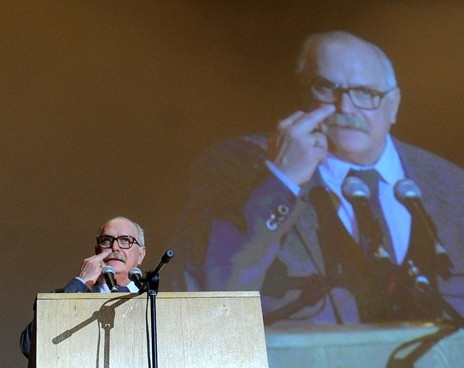
Nikita Mikhalkov at the IX Congress of the Union of Cinematographers of Russia
Sergey Karpov / ITAR-TASS
The genuine tragedy of the Soviet, and the post-Soviet, cinema was the silence of two great directors with similar and also non-prophetic Marxist-Leninist names: Marlene Khutsiev, the Great Formist, removed a very uneven “infinity”, in which there were truly brilliant breakthroughs, and Elekim Klimov did not remove anything. It was the creative silence and subsequently, perhaps, the madness of Klimov was a reflection of the main drama of Soviet metaphysics, which Klimov felt, while others ignored.
Recently, Alexander Gelman recalled how Klimov dreamed to saturate the production drama “We, the Nizhiy” mysticism. And in this idea itself, in his proposal to introduce a mysterious figure with an unclear function there was more mind and talent than in the play itself, with all due respect to Helman and his socialist method. Klimov could pull out Soviet cinema out of an atheistic impasse, Andrei Smirnov could overcome socialist realistic limitation, but they had to leave the leadership of the Cinematographers, and Sergei Solovyov, with all the purely human sympathies to him, did not draw to the role of the banner. After ASSU, he himself did nothing significant, and the cinema of the nineties correlates with the pre-perestroika in about the same way as “2-Assa-2” with the 1988 film, also very pale against the background of “little faith”.
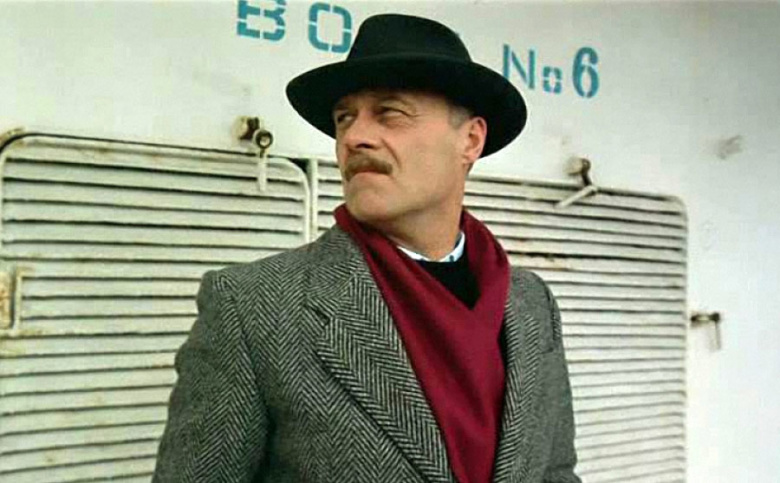
Stanislav Govorukhin in the film "Assa"
Photo: Film studio "Mosfilm"
As Bashirov rightly remarked (and Yuri Shevchuk), Solovyov was not taken seriously to the Russian rock, they touched him. This did not draw on the aesthetic revolution, unlike the songs of Tsoi and the Aquarium, and the rockers were disappointed in what was happening even before the Asssa. The death of Tsoi and the suicide of Bashlachev should have warned a lot. The problem is that the restructuring ended with the revenge of Mikhalkov and his dreams, but thought not for this. One could still endure this, delighted in the person of Mikhalkov, a full -fledged reaction, but the Mikhalkov brothers, like their father, are distinguished by a phenomenal ability to vulgarize everything that they can reach. In the case of Andrei Sergeyevich, this is not so noticeable, and he had serious good luck. In the case of Nikita Sergeyevich, alas, it is limited to the triumph of the mass poult on any material, including piercing “five evenings”. Today, alas, it is clear that the play is far from first -ortous, full of thawing illusions, but there is also genuine humanity in it, which in the nineties was no longer a trace.
Was this triumph of post -Soviet vulgarity without a trace of Soviet humanity? I'm afraid yes.
Humanity is generally a fragile tissue, which, according to Petrushevskaya, is "destroying, destroying, that's the matter." Maybe in 1985 it was too late to start. But one way or another, in the same 1985 it was not too late to say that nothing would work, as Motyl Okudzhava said at the very beginning of perestroika. He said this in the kitchen and restrainedly repeated in late verses. Klimov said about this with his whole fate, but again he did not formulate aloud, not wanting, probably, to interfere with the process of liberation of the country. Vadim Abdrashitov spoke about this with his fifteen-year silence, he formulated something aloud, but such silence is usually explained by the artist’s personal crisis. The appearance of the best film by Alexei Herman “it’s hard to be a god”, in which no one wanted to peer, tried to explain the same crisis. Now everything is clear, but now this film is shown around the clock on the first channel. Still, however, the shots of the "Time of the Dancer" flash.
Subscribe to read the whole
Make a subscription Redefine.media to read Republic
Subscribe [you can pay for a Russian or foreign card. The subscription is extended automatically. You can unsubscribe at any time.]
Where are the money subscribers going