
Translated material
A manual has been developed for the military on how to “convey the truth” about “SVO” during public speeches
They are advised to say that the civilian population welcomes them, and to laugh off uncomfortable questions
The Academy of the Knowledge Society has launched a course on preparing for public speaking for “SVO participants,” which should teach them to “effectively convey the truth about a special operation” and “emotionally talk about their exploits,” Vorstka discovered .
In order not to miss new texts from “Layout”, subscribe to our telegram channel
To the question “How many people have you killed?” It is recommended to answer that “this is a dire necessity”
The course is designed for those who returned from the war in Ukraine and speak with stories about “SVO” to different audiences - for example, schoolchildren, students, volunteers or government officials, including Vladimir Putin.
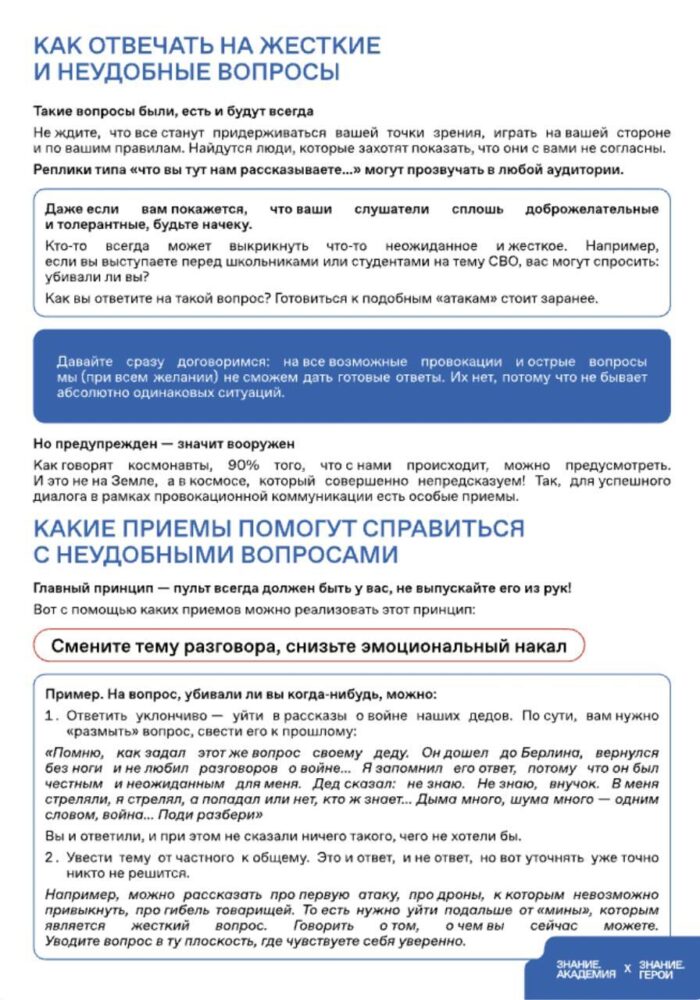
After lectures on speech, SVO participants receive a training manual (available at Vorstka) with ready-made, detailed answers to questions about combat operations, life in the trenches, traitors in the Russian army, “enemies” and residents of occupied territories.
For example, to the questions “Have you ever killed?” and “How many people have you killed?” It is recommended to answer that “this is a difficult necessity” and “if we do not win, the enemy will destroy us, our wives and children.” At the same time, SVO participants are also advised to note that the Russian military “always tries to prevent unnecessary deaths.”
The authors of the manual recommend talking about “humane treatment of prisoners”
“We always strictly follow international law. They [the prisoners] are sure to be fed, treated, allowed to contact their relatives, many have been saved after being seriously wounded,” this is how they recommend answering the question about prisoners.
When asked about love for their homeland, military personnel are asked to answer that they need to “defend it from an enemy with weapons.” “Do not go to rallies and write beautiful words on social networks, but do something specific so that the Motherland can be preserved and become better,” the manual says.
If a military man is asked about civilians, he should answer that they “express gratitude for protection and support” and see the Russian army as “protectors who bring security and stability.” The actions of the soldiers, according to the manual, “strengthen trust and mutual understanding” in order to jointly “restore infrastructure” in the occupied territories.
Course participants are taught to avoid answering uncomfortable questions
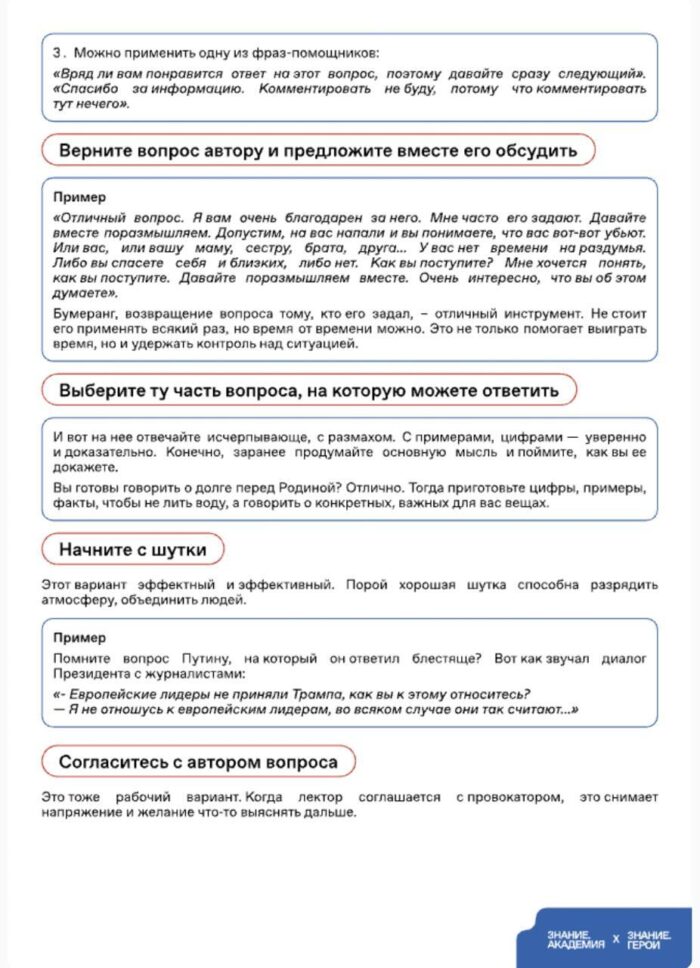
Course participants are also taught how to respond to “provocations” in the audience and how to answer uncomfortable “tough” questions. They are given techniques on how to subtly change the topic of conversation, laugh it off, “reduce the emotional intensity,” or make the person asking the question confused and not know how to react.
“You can use one of the helper phrases: “You’re unlikely to like the answer to this question, so let’s give you the next one,” the manual advises.
The course on public speaking for SVO participants is taught by Tamara Kartasheva - in the 2000s she worked for NTV, was a Kremlin pool reporter and editor of political talk shows on federal television channels. Now Kartasheva is a speech coach. In particular, after 2022, she conducted master classes for those returning from Ukraine and, according to her, prepared Russian heroes for a meeting with Putin.
At her lectures, Kartasheva offers basic theory on speaking to a wide audience, and also analyzes videos of successful and unsuccessful public speeches by military personnel over the past three years. In one of her lectures, she gives a soldier a speech and explains how he should have reformulated his story about the death of a colleague.
The trainer advises the military to talk about combat operations using details - for example, a story about the first months of the war in Mariupol, according to her, can become more vivid if we mention the “red backpack of a young Marine” who “took” the city.
“You can tell about a real object: an icon, a rosary, letters from the front,” advises Kartasheva.
The online course on public speaking, the authors say, should teach returning military personnel from Ukraine to talk about “NWO” so that “the audience eagerly awaits every word.”
Previously, “Verstka” wrote about another online course that was developed by “Znanie” - in November 2024, Russian teachers were taught how to protect schoolchildren from “neo-Nazist propaganda and recruitment” and “re-form the identity” of children from Ukraine.
Support “Vestka” - it’s important and safe →