
Translated material
Rotting West, special path and deep people: the history of three myths of modern Russia
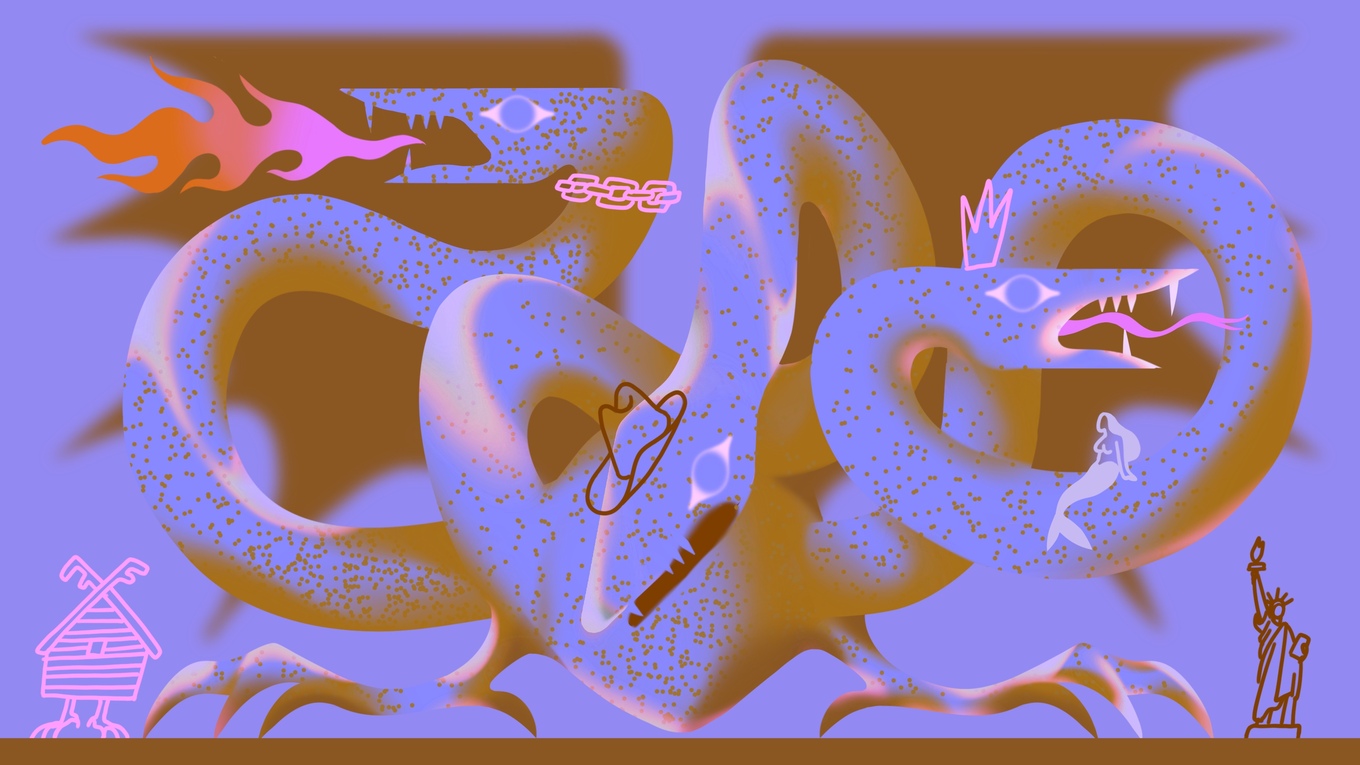
From Turgenev to Dugin
Both Russian and foreign propaganda willingly use myths to explain the processes within Russia. On the one hand, myths arise about a special path opposed to the rotting West. On the other hand, narratives about the deep people and their eternal slave nature. Although these ideas are actively developing in modern media space, they appeared several centuries ago. Journalist Lola Romanova tells how these myths arose and why they do not lose relevance.
Perito opens a new set to the book club “After words” - for those who want to better understand how the world we live in.
This time two programs are open at once. The first invites Nigeria, Vietnam, the USA and South Korea - through the books of Chimanda Adchi and Viet Than Nguen. The second is stories from the Karibov, from Burma, India and Japan, which we will read along with Amitav Gosh, Yuko Tsushima and the mysterious third author.
The first group starts on September 15 , the second - September 29 . The number of places is limited. Details and recording - on the site.
"The slave consciousness of the Russian man"
“First, wild barbarism, then rude superstition, further foreign dominion, cruel and humiliating, whose spirit subsequently inherited, is the sad story of our youth. <...> The era of our social life, corresponding to this age, was filled with dull and gloomy existence without strength, without energy, animated only by atrocities and softened only by slavery, ”wrote the philosopher and publicist Peter Chaadaev in 1836.
In his “ philosophical letters ”, Chaadaev compared the historical path of Russia and other peoples. In the 19th century, such thoughts arose against the backdrop of the repressive reign of Nicholas I. At that time, the intelligentsia began to think about the causes of the defeat of the Decembrists and the historical fate of the country.
The authorities, of course, did not like the letter. Chaadaev was called to the police and declared crazy, and then placed under house arrest. The text made a great impression on domestic thinkers and in many ways set the direction of their work.
The main problem for the Russian intelligentsia of the first half of the 19th century was serfdom, which was often called slavery in the texts of that time. So, in the collected works of “Past and Duma”, Alexander Herzen showed different fate of the serfs and divided them into “fanatics of slavery” and “martyrs of slavery”. The first, for example, belongs to the fortress, who was exiled by the landowner, who still dreamed of seeing his master “in cavalry and regalia”. At the same time, Herzen not only describes the external nature of the behavior of serfs, but also notes that serfdom oppresses and fuels their souls.
The arguments about the influence of slavery on the soul did not stop even after its cancellation. “The government freed us from serfdom, thanks to him; But the habits of slavery were too deep into us; Soon we will get off with them, ”reasoned the eloquent razor, Sozont Potugin from the novel by Ivan Turgenev“ Smoke ”. Turgenev himself considered the meek subordination of the rude power by the almost national line, which developed among the people because of many years of serfdom.
At the end of the XIX century - the beginning of the XX century, judgments about man and national character tried to explain scientifically. Doctor of Philology Konstantin Bogdanov, who studied the question of the emergence of a slave character in social anthropology, calls academician Ivan Pavlov one of the most authoritative and consistent propagandists of this idea.
In May 1917, Pavlov, together with Academician Max Gubergritz, performed in the Petrograd Biological Society with the report “Reflex of Freedom”. The experiment was conducted on dogs, and by the reflex of freedom, scientists meant the instinct of overcoming obstacles that fetter the movement. According to their observations, the instinct has a innate character, but it can be suppressed if you keep the dog on a leash for a long time - then a “reflex of slavery” arises. Pavlov completed scientific research on the exclamation of the cultural and historical code of the Russian people: “How often and diverse the reflex of slavery manifests itself on Russian soil, and how useful it is to recognize it!”
The history of the USSR with its new forms of enslavement, for example, a system of collective farms, gave society a new occasion to think about the phenomenon of slave thinking. During this period, the myth was actively distributed in foreign journalism. So, in the midst of the Cold War, the American historian Richard Pipes in the book “Russia under the Old Region” argued that the roots of Russian authoritarianism should be sought in its past. According to the pipe, it was historical experience that formed the features of national culture, the main of which is the need for strong power.
After the collapse of the Soviet Union, as historian Alexander Zamyatin wrote , a myth of a Soviet man arose, and criticism of his mass consciousness appeared with him. The Soviet man was accused of "slave-Holes-robbery morality" and the "national-state of inferiority complex."
The discussion about the slave consciousness of the Russians revived after the outbreak of war in Ukraine - both in social networks and in the academic community. In 2022, the candidate of philosophical sciences Olgert Kharitonov published the book “War and Feminism”, where she tried to determine the origins of the armed conflict. In her opinion, it was the slave consciousness of the people to the war: “The Russian people never was and could not be a liberator: living in the conditions of the dictatorship, which means captivity, cannot bring freedom <...> the Russian people never had a historical opportunity to develop a different public consciousness except slave.”
Today, such an idea is broadcast mainly on Facebooks of radical emigrants and foreigners. Political scientist Dmitry Travin notes that this myth does not withstand criticism: secondary enslavement existed throughout Europe east of the Elbe, and there were no specific conditions for the formation of slave thinking in Russia. In the book "Who is the power here?" Political scientists Sam Green and Graham Robertson also refute the idea of Russia's doom to autocracy. They emphasize that each democratic country experienced undemocratic regimes, and analyze the real indicators of the level of education, trust in democratic values and welfare to prove that history is not a fatal nature.
"Russia has a special way"
“Our civilization is original, it has its own path. And there is not a drop of superiority and a sense of superiority ”-with such a statement in September 2022, at the concert in honor of the celebration of the 1160th anniversary of the origin of Russian statehood, Vladimir Putin spoke .
The position of a special path has existed since the 19th century. The Minister of Education Sergei Uvarov , author of the triad “Orthodoxy. Autocracy. Nationality ". The first philosophical letter of Chaadaev coincided in time with the spread of this ideology, the historian Andrei Zorin emphasizes , and gave rise to a discussion about a special path. The Slavophiles developed this idea mainly: their concepts were built around thought about the uniqueness of the country's history.
The help for the Slavophiles was the church doctrine “Moscow - the Third Rome” existing from the 14th century. Medieval scribes saw the relationship between the fall of Constantinople in 1453 and the liberation of Russia from the Tatar-Mongol yoke in 1480 and decided that Russia was predetermined to be a “refuge of the right faith and true education”.
The manifesto for the late Slavophiles was Nikolai Danilevsky’s book “Russia and Europe”. In it, the author argued that historical progress is not linear, and history is a series of different cultural and historical types. Along with the German-Roman cultural type, he insisted on the existence of a separate Slavic civilization, superior to other cultural and historical types and personified by the Russian Empire. According to Danilevsky, it should unite the “liberated” Slavic peoples and surpass the German-Roman civilization. Danilevsky was supported by Fedor Dostoevsky, who considered his book "The Future Hand Book of All Russians."
It is noteworthy that some Westerners, ideologically opposed by Slavophiles, later began to reflect on a special path. In the book “On the development of revolutionary sentiments in Russia”, Herzen argues that both Western and Oriental features are inherent in the Fatherland, and therefore “Russia is a new part of the world developing in its own way.”
The features of messianism, as the philosopher Nikolai Berdyaev wrote , and Russian communism found: “Marxism, such non -Russian origin and non -Russian nature, acquires a Russian style, the eastern style, almost approaching Slavophilism <...> from Moscow, from the Kremlin, which should enlighten the bourgeois darkness of the West.” According to the observations of the historian Andrei Zorin, the idea of the world revolution, which was fed by the mood of 1917, degenerated into the project of local paradise, and therefore a new special path.
In the 1920-1930s, the ideological course of Eurasianism arose, which inherited the principles of Slavophiles. The Eurasians believed that the West has long lost its right to world leadership and only interferes with the USSR, the heir to the Russian Empire, to play the role of the mediator between Eastern and Western civilizations. After the collapse of the USSR, a new search for state identity began, and neo -expansion took shape in Russia. Its supporters claim that Russia plays a special role of the bridge between the East and the West.
Separate philosophers of neo -Eurasia, in particular Alexander Dugin , represent Russia as an independent, third civilization. In 2024, Dugin gave an interview to American journalist Tucker Karlson, who presented a philosopher as a writer with great ideas. Dugin reflected on the topic of the decaying West, which is opposed by the spirituality of the Russian world - the main component of Russia as a special civilization. The idea of a special path in his rhetoric acquires a personalist character, Vladimir Putin appears as a guide, protecting traditional values around the world.
Some modern researchers are sure that the ideas of the special path of Russia do not exist on such a scale, and the myth of it is a new form of nationalism and the justification of the excessively personalized nature of the current system of political power.
Political scientist Dmitry Travin believes that the idea of a special path has developed in other countries. For example, during the revolution in England, its citizens were confident that the British were “elected by the Lord for a special mission”, and in the era of modernization, Germany contrasted their culture of the “corrupting civilization of Western countries”. The philosophy of a special path, according to the political scientist, flourishes during disasters within the country, when she is looking for internal comfort.
"Rotting West"
Although the “rotting West” stamp over the past decades has become a meme rather than the ideologist, the origins of the critical perception of the West appeared in the Middle Ages. First of all, the religious differences were emphasized between Russia, which adopted Christianity according to the Byzantine model, and the Catholic countries of Europe. The perception of Western countries was also influenced by eschatological representations, according to which paradise is located in the east, and hell - in the West.
Although, starting with ancient Rus', relations with the West underwent changes and eventually became warmer, the concept of a decaying West, established in the 19th century, did not arise from scratch. Some thinkers, mainly Slavophiles, began to worry about the extreme borrowing of Western customs and talk about the decline of Russian culture.
In 1841, the historian and literary critic Sergei Shevyryov published in the journal Moskvityan the article “The Russian view of the formation of Europe”. In it, he compared the West with a person who has evil and an infectious ailment: “We kiss with him, hug, divide the meal of thought, drink a bowl of feelings - and we do not notice the hidden poison in our careless communication, we do not feel the feast of the future corpse in the fun of the feast that already smells of.”
In the 19th century, Slavophiles and thinkers close to them criticized the West even for his successes. The writer Vladimir Odoevsky believed that the achievement of the highest level in the development of technology, industry, education and political institutions is a sign of falling and perdition, since "the highest development of the forces of any organism is the beginning of its end." In condemning the West, they also resorted to already well -known religious oppositions: “It is necessary that our Christ, whom we preserved and whom they did not know!”
Despite the widespread in the 19th century the idea of the decaying West and its smooth cultural adaptation, this concept was not original Russian. It belongs to the marginal branches of German and French romanticism at the end of the XVIII - the first third of the XIX century, notes the candidate of philological sciences Alexander Dolinin. One of her apologists was Frederick Schlegel , whose labors were well known in Russia. In the two -volume book “Aesthetics. Philosophy. Criticism ”Schlegel claimed that the West is doomed to rotting:“ The family of people in Europe will not change for the better, but <...> will more and more deteriorate due to internal damage and, finally, outwardly plunge into a state of weakness and poverty, which cannot be transformed, in which he may then be able to extract him from there. ” The revival of the West, according to the philosopher, can only come from the east.
The Russians thought about the decaying West and being in exile. At the beginning of the 20th century, having responded to the work of Oswald Spengler “Sunset of Europe”, the Russian intelligentsia took on the role of privileged observers who can explain its fatum to the West and at the same time carry a saving religious idea.
The concept also developed within the USSR: the idea of the crisis of capitalism in the Marxist teaching began to be identified with the idea of the death of the West, and the propaganda discourse incorporated the old Slavophil cliches. In 1918, Joseph Stalin wrote a newspaper note “From the East Light!”, In which he argued that the West with his imperialist cannibals turned into a focus of darkness and slavery.
Over the years of the existence of the USSR, the myth of the decaying West has bloomed. The Soviet posters contrasted the progressive future of the USSR and outlived the West.
After the collapse of the USSR, Russia began to build new relations with Western countries, but a positive attitude towards them did not last long. The narratives about the rotting West finally returned to the public sphere in 2022. Media and politicians began to argue that the war is coming with the West, although such a cliche is the usual way of demonizing the enemy and justifying confrontation.
Valery Garbuzov, the former director of the Institute of the United States and Canada of the Russian Academy of Sciences, in 2023 published a column in an independent newspaper, where he tried to make out anti -Western myths on which the Russian political program is being built, in particular the myth of the decaying West. He reasoned that these myths were needed to immerse society "into the world of illusions and accompanied by great -power and patriotic rhetoric, undisguised and intentional unlimited retention of power at all costs." Soon after the publication, the Garbuzov column was removed from office.
The German political scientist Andreas Minland notes that anti -Western rhetoric from political stands began to intensify after the Ukrainian Orange Revolution . Gradually, the stamp began to appear again in the pro -government media. Two centuries later, the West in their representation continues to “rot”, Western countries are accused of individualism, hedonism and loss of values. And this is seriously used as evidence that Russia is the only stronghold of human and adequate attitude to reality.