
Translated material
Sitting season
In 2025, the security forces detained almost 100 high -ranking officials on suspicion of corruption. This is a record level of arrests for at least the last 10 years
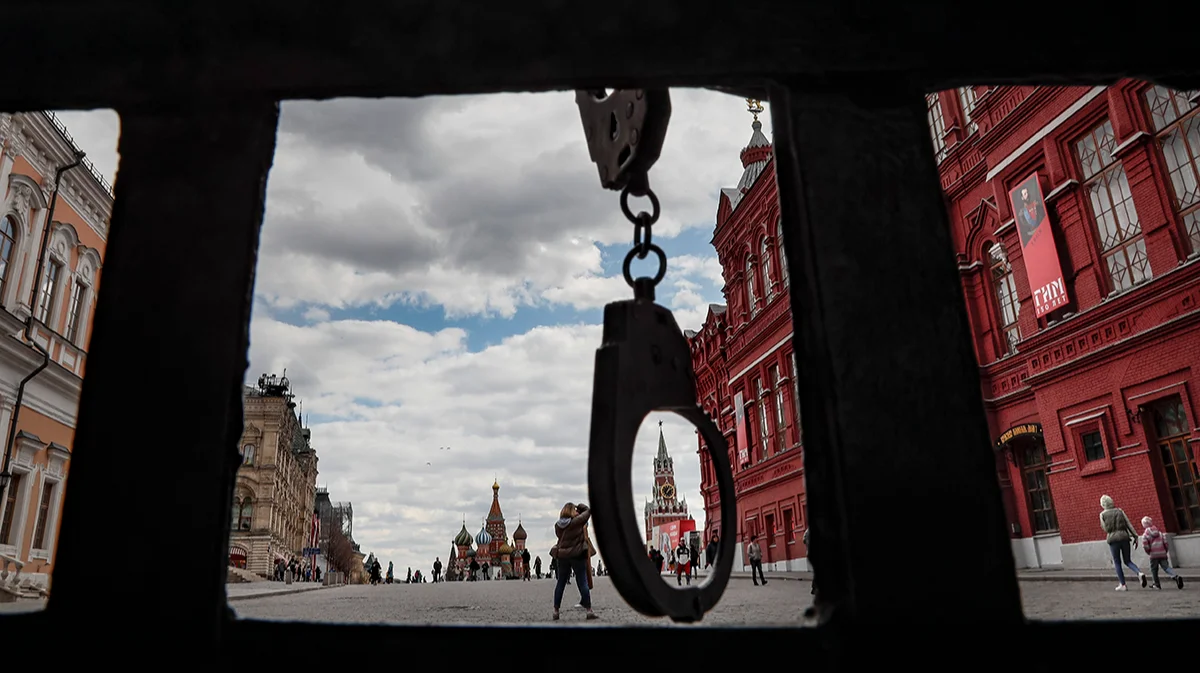
An handcuffs at the closed gates leading to Red Square in Moscow, Russia, April 29, 2022. Photo: Yuri Kochetkov / EPA
The suicide of the Minister of Transport of Roman Starovoit, the former governor of the Kursk region, became one of the most high -profile events of July. Cases of billions of embezzlement during the construction of fortifications on the border with Ukraine have already affected at least four large officials of two regions: the Kursk and Bryansk regions. However, this is only the top of the iceberg. In Russia, there is a real cleaning of high -ranking officials. Who is planted, for what and why right now - in the study of Novaya Gazeta Europe.
Last week, the former governor of the Tambov region Maxim Egorov was detained - he is charged with receiving a bribe on an especially large scale. On July 22 of this year, the Novgorod Minister of Transport Konstantin Kuranov was arrested by similar suspicion. Just a few days earlier, on July 18, Stanislav Shultsev, Deputy Chairman of the Government of the Novgorod Region, was taken into custody - also in the case of a bribe on an especially large scale.
In total, since the beginning of 2025, a criminal prosecution of at least 99 deputies and high -ranking officials has begun: at least deputy heads of federal and regional ministries and departments, as well as mayors of regional capitals and their deputies. This is an average of 14 cases a month.
The number of criminal cases of 2025 is already approaching the indicators of the full 2024th and almost twice the entire 2021 years.
We have collected data on open sources - primarily media publications. We take into account precisely the date of initiation of the criminal case, and not the sentencing. Hereinafter, we are talking only about deputies and officials in the narrow sense: the heads of state -owned enterprises and state institutions are not included in the calculations. Although they can take place under corruption and are considered officials, they are not subjects of state power.
Among the departmental officials, employees of law enforcement agencies turn out to be the greatest blow: almost a third (28%) of criminal cases falls on their lot. The following is the field of construction and housing and communal services (18%), economics and industry (11%), transport and nature management (8%each).
Almost half of all the detentions of high -ranking officials over the past 10.5 years have occurred for 3.5 years, which have passed since the beginning of a full -scale war. Moreover, the number of arrested federal officials of the top-level-from ministers to departments and their deputies-even exceeded pre-war indicators.
“In order to survive, autocracies need to be afraid, but not to promote the car of great terror,” explains political scientist Ekaterina Shulman. -Now we see that every next detention of the official is not presented publicly as part of some kind of campaign, an element of large-scale cleaning. On the contrary, the system avoids such rhetoric. Meanwhile, the growth of risks for officials, redistribution of assets and the inability to safely leave the country is one of the main destabilizing factors in modern Russia.
The reaction of the elites to the suicide of the former minister of transport of Roman Starovoit confirms the words of Schulman: tension and fear inside the system increase. According to the interlocutors of Faridaily, in government circles the news of the death of a colleague became a shock. In many statements - along with sympathy - a feeling of hopelessness sounds: "Almost lifelong sentences, the murder of Prigozhin, Timur Ivanov ... They make you think that if you are in these millstones, you will be changed into powder."
Against this background, many people took the act of Starovoit not only as a tragedy, but also as a gesture that violated the unspoken rules of the game: “Oddly enough, Old Assembly showed a way out, which many will now consider it possible,” one of the interlocutors of the publication admitted.

New corruption rules
Criminal cases against officials are often accompanied by confiscation of property and large fines, several times higher than the proven damage from the crime.
So, on June 25 of this year, the Secretary of State of Dagestan Magomed-Sultan Magomedov was detained . The very next day, on June 26, the court satisfied the lawsuit of the Prosecutor General’s Office for the seizure of Magomedov and his relatives in the income of the state of the Kaspatroilservis oil reference complex (previously Dagnefteprodukt OJSC), MSB Holding, Dagestan New Technologies and Neftrodukttsynab, as well as other property belonging to them. The most now former official was released on a recognizance not to leave.
The ex-head of the Biysk Special Administration of the Ministry of Emergencies Viktor Velikodny seized 34 real estate objects, including residential and non-residential premises in Sochi, the shopping center and the indoor market-the property was formed mainly for relatives and controlled by a large organization. And the former governor of the Penza region Ivan Belozertsev, accused of receiving a bribe, was sentenced to 12 years in a maximum security colony and a fine of 450 million rubles (the amount of a bribe amounted to about 30 million rubles).
“In fact, against the backdrop of the nationalization of factories, reproduction and redistribution of large businesses, all these confiscation and fines are just a penny,” the sociologist, who wished to remain anonymous. - This is only a side effect of increasing repression against officials.
According to the expert, the main goal of such repressions is to intimidate and consolidate around the authorities.
The signal supplied by the state is directed, first of all, to the elites - those who flirted with opposition circles in whose loyalty there are doubts.
Secondly, wealthy people who are not part of the political elite. Among them there are no those who openly criticize the authorities - no one can afford this now - but many do not show sufficiently hot support to the regime and “Svo”, while constantly trying to withdraw their money abroad. And finally, the third addressee is the security forces.
- For security officials, a lot is changing now. One of the stable articles of income for them was a corruption “rent” from private enterprises, factories. But now these plants are one by one into the hands of “correct people” - this means that the rules of the game are changing, ”the expert says. - The state demonstrates: the old schemes no longer work, now other rules of the game and other requirements for the level of loyalty.
Corruption affairs today are increasingly turning into a quick and almost formal procedure. According to the lawyer who talked with the editors, from the beginning of the investigation to the sentencing is now passing much less time than before - primarily because the standard of evidence has significantly decreased.
“Previously, the investigating authorities very carefully assessed the prospect of sending the case to the court,” the lawyer says. “If there were at least some fears that the prosecution will fall apart in court,” the case will be sent for a subsequent sentence, ”the charge in this form simply did not reach the court. And now the requirements for evidence have decreased, so everything happens quickly and without interference: both the investigation and the court.
The decrease in the quality of the investigation and trial is noted by many in the law community. Thus, Lawyers Artyom Yablokov and Daniil Gorkov argue that if, before, the accusation of corruption cases was based, as a rule, the capture of the guilty during operational-search measures, it was required to fix the fact of transferring money or other property to the suspect, today "there are enough testimonies of witnesses to prove guilt."
In April 2025, on charges of receiving a bribe on an especially large scale, the deputy chief of the Ministry of Emergencies Dmitry Daudashvili was convicted . The court sentenced him to 15 years in prison and a fine in a five -fold bribe. According to Daudashvili’s lawyers, the investigation was not found evidence of the transfer of funds, and the entire charge is built on the testimony of several interested parties. One of these witnesses was an employee of the Ministry of Emergencies Viktor Velikodny, at that time the defendant of the criminal case of the embezzle of budget funds - it is likely that he had personal motives to cooperate with the investigation.
It happens that the prosecution is based on testimonies that have only an indirect attitude to the crime itself.
“The accusation can be built on the words of the person who handed over the money to the intermediary,” says our interlocutor from the advocacy. -And for some reason, the intermediary did not carry the money further along the chain. As a result, the “bribery” did not take the money, they did not reach him, but the bribe taker or intermediaries say that he had to become the final recipient. And all the accusation is built on such testimonies. Their evidence -based value is extremely small, but in the courts it now rolls.
Easy goals of the stick system
In parallel with the growth of demonstrative affairs against high -ranking officials in Russia as a whole, the “fight against corruption” is gaining at the middle and grassroots level. According to the Prosecutor General’s Office, almost a quarter more corruption crimes were revealed for the first quarter of 2025 than in the first quarter of 2024: 15.5 versus 12.5 thousand.
“At the risk group is a lower bureaucracy,” the editorial staff tells the editorial staff of criminal justice. - These are people who sign papers for economic expenses for state contracts or organize the activities of budgetary institutions. And they risk being guilty in any unplanned situation.
Most of the defendants are not officials of the “first echelon” and not top managers of state-owned enterprises, but initial and middle workers, including ordinary civil servants and state employees, employees of commercial firms: cashiers, forwarders, storekeepers and commodity experts.
The former deputy head of the Kaltan city district (Kemerovo region) was sentenced in 2025 to 7 years in a maximum security colony for a bribe of 300 thousand rubles. In Buryatia, a criminal case has been instituted on the excess of powers against the school principal - he signed an act of repair work, despite “numerous violations in the reconstruction of the roof”. In Krasnoyarsk, under a corruption article (assignment or waste - Article 160 of the Criminal Code of the Russian Federation), a cashier was convicted , stolen 80 thousand rubles from the cash desk.
Among the reasons for the growth of the number of criminal cases against ordinary officials, experts call law enforcement officers to achieve the necessary indicators. In relation to civil servants, heads of state and budgetary institutions, it is easiest to conduct an investigation.
“This is due to the complexity of the workflow and the full control of [bureaucracy],” says the researcher of criminal justice . - Corruption is not only bribes, often it is waste, abuse, and the use of official position.
According to experts, "the density of regulating the activities of civil servants is such that nothing is almost impossible to violate."
“The investigation usually seeks to overestimate the amount of damage,” the researcher, who had talked with the editors, adds, “that is, the official is charged not only by what was actually stolen or wasted. Even if something was done with budget money, but not as it should be-in violation of regulations and procedures-the prosecution will include the entire amount of the funds spent to the detriment.
In addition to the desire of the security forces, to demonstrate an effective struggle against corruption, the persecution of low rank officials may have other motives. Our interlocutors distinguish both the desire to increase “rental payments” by security forces (corruption for non -confidence), and possible echoes of the struggle of some elite clans with others.