
Translated material
Dead "water"
The course of his birthday life consists of nothing plus ideology. But that is why it can cause real harm to children

Photo: Culture.ru
School studies in schools must be made obligatory - by analogy with "talk about important." Such sentences sound in the Duma, and there is no doubt - they will be accepted. Moreover, the course for 5–9 grades has already been taught for a whole year, albeit within the framework of “extracurricular activities”. True, not yet everywhere. Totally, “Seat Deviations”, or Noszh (“Moral Foundations of Family Life”), was introduced in all schools of the Samara, Tver and Kherson regions.
We asked to analyze the course program compiled at the Institute of Education Development Strategy, a professional psychologist who has experience working with children.
"What should boys and girls should be"
We must start with the psychological characteristics of the age at which the program is aimed. What do we know about teenagers 11-15 years old?
In children at this age, abstract and logical thinking is actively developing, they are capable of independent analysis of the norms, rules, views of others. Moreover, the “task” of this age is to learn to conduct such an analysis.
Teenagers have an interest in moral dilemmas, in the issues of justice and the meaning of life. A good ability for self -reflection is already obvious. At this age, it is important to continue to accompany the child in his rethinking of reality. Emotions become deeper and more contrasting, children are very sensitive to evaluative judgments from peers and adults. Self -esteem and self -awareness are very dependent on the external attitude. This is the age of vulnerability to exception and internal stigmatization. Any teenager 11-15 years has been living in conditions of self -criticism, anxiety, aggression, suppression of his emotions.
The most important social group is peers. And here it is important to remember the risk of bullying on their part. There is a need for borders, personal space. The question "Who am I?" Arises. This is the time of the formation of identities. Including the self -awareness in the field of sexuality, gender roles and moral landmarks becomes relevant. This is the age of exploring oneself, understanding oneself.
Therefore, when working with children of this age, dialogue is extremely important, and not imposing “correct” or “wrong”.
Normative pressure - for example, on the topic “what boys and girls should be” can cause a deep internal conflict.
And as we see from the characteristics of age, the course of this conflict can be hidden from adults and have the most severe consequences for the mental development of the child.
This is a general idea of those to whom the program is aimed. Now let's try to attach to the object the proposed “educational tool” in the form of the course “My family” (extracurricular activities, 5–9 grades).
Terms replace knowledge
It is assumed that the program will be taught out of school time in Russian schools. Its content is very blurred, and this abundance of “water”, on the one hand, gives some freedom to the teacher, but on the other hand, turns into a lack of content. The authors are limited only to a multiple repetition of phrases about "traditional spiritual and moral values." Get at least their exhaustive list!
For some reason, he does not have a course in the course. But in reality-there is, in the Decree of the President of the Russian Federation of 09.11.2022, "On approval of the foundations of state policy to preserve and strengthen traditional Russian spiritual and moral values." Among the "traditional" values for Russians there, for example, are the life, dignity, rights and freedoms of man, humanism ...
But for some reason they will not talk about this. They could learn about these concepts in the course of social studies, but, as you know, it was canceled. So what “values” the teacher will talk about, depends on himself. Maybe - about the equality of men and women, or maybe about the "home building." Maybe about everyone’s right to a worthy life, or maybe about the “sin of abortion”.
The authors argue that the program is aimed at "the introduction of young people into the traditional system of family values for our Fatherland and the formation of viscenic value-semantic attitudes: marriage, large families, chastity."
The course was developed on the basis of the Decree of the President of the Russian Federation No. 809 “On the approval of the foundations of the state policy to preserve and strengthen traditional Russian spiritual and moral values”, which gives it an obvious ideological character.
The authors of the course intend to solve as many as eight serious problems in 34 hours. According to their version, the fifth grader will comprehend the “meanings and values of family life” on this elective (what kind of “meanings” these are, of course, it is not said in the text), recognizes it “from the perspective of psychology, cultural studies and ethics” and even solve “personal meaningful issues”.
Even the tasks of the course are formulated as not specifically as possible. We see general formulations deprived of the content: “awareness of the system of family values”, “Ensuring civil identity”. It is impossible to find meaning in this sluggish science -like porridge.
The authors did not make it difficult to explain what kind of concepts they mean why Russian values allegedly were supposedly contained and whose specifically, given the multinational state. Finally,
Who and how determines what is “civil identity” and how does it correlate with the personal experience of a teenager? The document does not have scientific argumentation and base, there is no pedagogical specificity and taking into account the variety of students' experience.
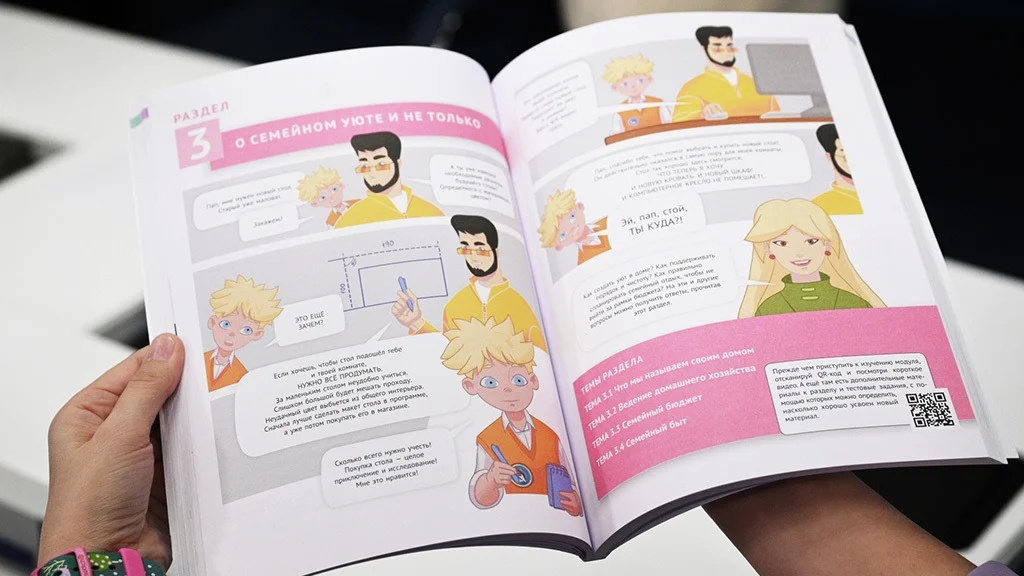
Terms replace real knowledge. For example, “taxonomy of family terms” - it looks science -shaped, but again it does not give any specifics. What classifications should teachers use if the program excludes the variety of families? Both the teacher and the student are unclear what exactly needs to be taught and learned.
The passage about the “formation of ideas about family life from the perspective of psychology, cultural studies and ethics” does not indicate, the scientific approaches of which researchers will be used, what schools of philosophical thought, what authors. Obviously, the current world approaches to family life will contradict modern state ideology in Russia.
This all creates the illusion of content, but in fact hides the lack of a scientifically based approach. In addition, it is associated with the lack of a theoretical scientific base for modern state anti -gender ideology.
Child - instrument of state lords
Ideologems and politicized attitudes deserve special attention in the program. Example: “Civil and social identity as successors of the traditions of the family” is a biopolitical thesis where the personality obeys the genus, nation, history. Something dangerous from world history resembles ... This thesis, to put it mildly, excludes individual self-determination in all its diversity. This is a technique characteristic of authoritarian models of education: replace a personal choice with a collective mission.
Well, strictly speaking, the program does not have educational goals and at least some measurable results. The list of desired achievements is large, but is a vinaigrette from general and very abstract statements. How will the results be evaluated? How will the teacher distinguish “realized”, or “accepted”, or “achieved civil identity”? How can one evaluate the “awareness of Russian identity in a multicultural and multi -confessional society”? Probably only with the help of scientific and pedagogical intuition.
In the content of the course, it is easy to notice ideological engagement, since the focus is constantly maintained on “traditional values”, “historical mission of the family” and “civil identity”. This, by and large, violates the principle of secular and neutral education, which should be ensured by Art. 14 of the Constitution of the Russian Federation and Art. 29 of the Convention on the Rights of the Child.
Perhaps one of the most problematic zones of this program is the imposition of the only permissible family model: "The formation of clear value attitudes on family and large families, so that students associate their future with a family way of life." The program approves only one type of family as a value norm. This is a heterosexual diverse family (marriage between a man and a woman). A large family as an ideal. A family with a traditional division of gender roles (man is a breadwinner, a woman is a mother). Other forms of the family that exist in reality are not mentioned, which means they are excluded from the educational discourse.
This will include not only the same-sex unions in the Russian Federation, which the state car is so afraid of, but also incomplete families (single mother, lone father), families with foster children (adoptive parents, guardians), childless families (including medical reasons), a family where there are parents and children with disabilities, a family where children under the upbringing of grandparents and grandfathers, mixed and inter-ethnic Families (cultural differences are not taken into account). And these types of families are no less common in Russia than the “ideal family”.
Further, in the text of the program there is a phrase: "The value of the family in the minds of young people deviates under the influence of destructive ideology." “Destructive ideology” means everything that does not coincide with the official model of the family in Russia: the right to choose marriage or celibacy, age age, number of children, feminism and so on.
There is a significant risk that adolescents from incomplete or foster families, or families where parents have a disability, will feel that their experience is “abnormal”.
Adolescents who are not suitable for heteronomatic standards receive a signal about their “irregularities”, which enhances anxiety, guilt and stigma. In children, a false hard binary installation is formed: “There is a right family (heteropopara plus a lot of children), and everything else is dangerous, bad or unacceptable.” Even when a woman alone wants to give birth and raise a child or when the family decides to give birth to a child after 30 years and so on.
It is clear that the program in this sense violates international standards (it is clear that anyone else cares): Art. 2 of the Convention on the Rights of the Child: "The participating states undertake to respect the rights of the child without any discrimination ... for family position or other circumstances." The recommendations of UNESCO and the Council of Europe: "Education should be inclusive and take into account cultural and family diversity."
That is, this is not an educational program, but a tool of state ideological propaganda: it does not have alternative opinions, the only and unattainable scenario of life is imposed on, through “destructiveness” the diversity of life scenarios is excluded. The program as a whole is more likely to be subordinated to the needs of demographic policy, and not the needs of the psychological development of children. But this is not hidden: "The course is aimed at solving the demographic problems of Russia." That is, adolescents become an instrument of state policy. The interests of the child are not placed above the interests of the state, which violates Art. 3 Convention on the rights of the child.
... In general, the course “My Family” uses the psychological vulnerability of children 11-15 years old to consolidate their loyalty to state ideology and to use subsequently to solve demographic problems.
Alternative information that comes from parents, guardians and other adults or peers can resist this obvious manipulation.
The course is directly dangerous for adolescents, as it increases the risk of isolation, exclusion, low self-esteem, failure to reckon yourself and your family, family conflicts due to “irregularities” or “non-compliance with the standard”, and an increase in anxiety and depression. The risk of bullying at the school or among peers for the "irregularity" of the family is also growing.
"Seat Devilment" in this form contributes to the loss of critical thinking, passive subordination of imposed roles, a refusal to independently choose a life path
Unfortunately, the program "My Family" is not just a course about the family for schoolchildren. This is an instrument of state ideological intervention, disguised as education. Although if such a course was collected in the interests of adolescents, it would be a significant support in the future life of children.
Marina Zorina