Date
Author
Отдел культуры «Новой газеты Европа»
Source

Preserved copy
Translated material
The beauty of errors
Director Yuri Butusov died. After the outbreak of war, he left Russia, was fired from the Vakhtangov Theater, survived the crisis, but never gave up
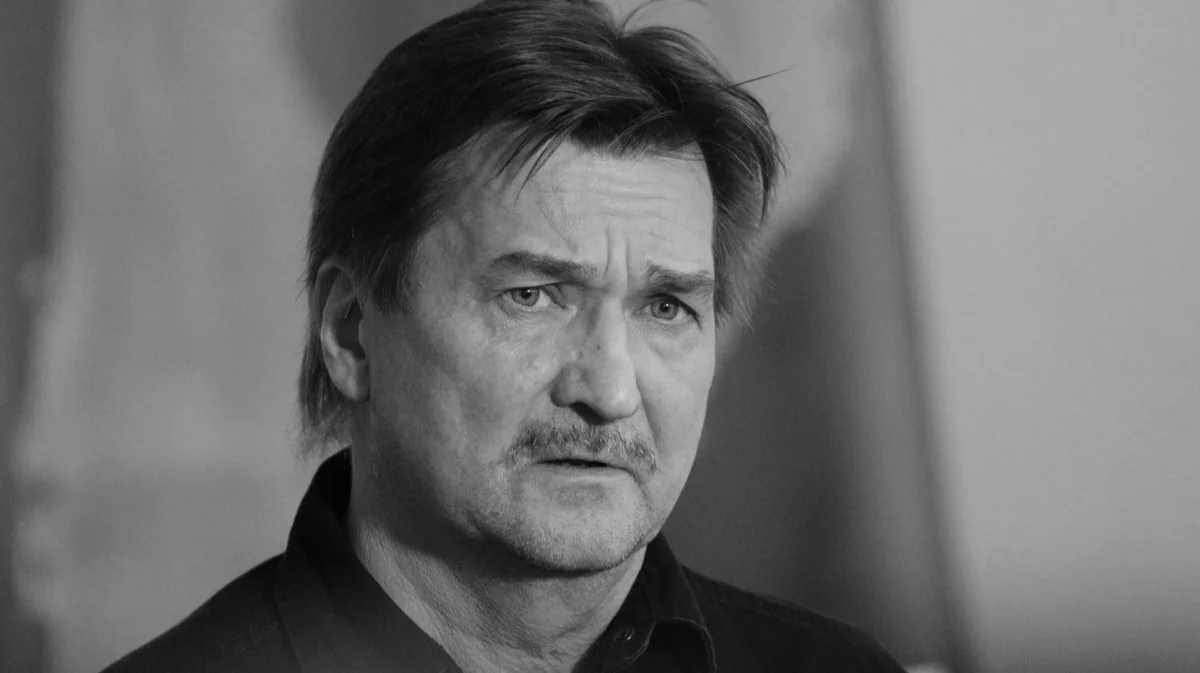
Yuri Butusov, before the premiere of the play “P” on the themes of Nikolai Gogol’s works “The Examiner” in the Satyrikon Theater, Moscow, January 20, 2022. Photo: Kirill Zykov / AGN "Moscow"
Yesterday Yuri Butusov - one of the most popular, famous and loved by the viewer of modern Russian directors - died in Sozopol, in Bulgaria. He was pulled by a wave in the sea.
In his tragic death, you can see a very evil irony of fate: Butusov’s life has always been somehow connected with different elements. To start at least with the fact that he received his first higher education Butus ... at the shipbuilding institute (later in an interview he called this choice “randomness”, but at the same time added that “ships are beautiful”).
But he spontaneously worked spontaneously in the directing of Butusov: he liked to collect the composition of the performance with sketches, that is, he set the direction to the actors, and then looked at the scenes they proposed - and the method of trial and error took away the most energetic and paradoxical ones. To put “classically” - that is, simply reproducing the play - Butusov was not interesting: he lay down and mounted texts, always put a modern soundtrack - in the range from Arvo Pyurt to Didioli, from Michael Jackson to Nirvana in the same performance. And turned it on at full volume!
The performances staged long, with the repetitions of the same scenes, and his actors could change roles directly during the performance (in the "Seagull" in the "satyricon", for example, during the action of Nina could become Masha). Critics ironized: “How to put the performance of Yuri Butusova? Take Chekhov, Brecht or Shakespeare, turn on the music louder, dress everyone in black or red - the performance is ready. ” And the audience joked, Butusov’s performances had a web of a rock concert-but the director himself did not argue with this impression, but worked for him. In the satirikon "Seagull" he himself popped up on the stage to dance with the artists and destroy the scenery.
At the same time, Butusov did not immediately start his way in directing-the director's faculty of the St. Petersburg Academy of Theater Arts graduated from the age of 34. But the late start compensated for a loud debut: the diploma performance “Waiting for Godo”, where the stars were played by Konstantin Khabensky, Mikhail Trukhin and Mikhail Porechenkov (and Alexander Shishkin spoke, who became the co -author of Butusov for many years). In 1999, the performance received two “golden masks” at once: the award in the nomination “The best work of the director” and “Prize of criticism and theater journalists” (further Butusov will receive a bunch of personal “gold masks”: for the best directing of the performances “Seagull” (“Satyric”), “Three Sisters”, “Uncle Vanya” (Lensovet Theater) and Pen) (Vakhtangov Theater), and in 2014 - the jury special award “For the search for a unique stage language” in the performances “Macbeth” and “Good Man from the Sezean”).
Butusov’s success gave rise to interesting competitions: for example, in 2011 the Golden Mask for the best female role was claimed by Laura Pizzheuri from the St. Petersburg Lensovet Theater, where since 2011 Butusov has been the main director, and Alexander Ursulyak from the Moscow Theater named after Pushkin.
Both stars did work with Butusov. Then the award went to Ursulyak - for simultaneously the roles of Shen, those and Shui that in the "good man from the Sezuan", which Butusov set in early 2013 in Moscow. This performance was one of the main hits of the Pushkin Theater.
About this work, Alexander Ursulyak said like this: “... as soon as I was scared by Butusov! They said that he was the director of the member <...> at rehearsals, the director goes his own way-experimentally. Today he wants one, tomorrow another. For someone who loves stability, this is not easy. I really like this way of existence. I am not embarrassed by the fact that he loves to change everything. ”
The "good man from the Sezuan" was carried out from the repertoire of the theater. Pushkin only last summer - with a full house - but “Macbeth. Cinema ”Until now, in the repertoire of the Lensovet Theater: the nearest show on September 7 (and there are no longer tickets) and December 13. And this is despite the fact that the duration of the performance is almost five hours with three intermission.
And despite the scandal with which Butusov left the post of artistic director of this theater in 2018. In an open letter, the director wrote that the Culture Committee of St. Petersburg and the theater director Valery Gradovsky “blocked” his initiatives as Khudruk. In an interview with Fontanka on March 7, Yuri Butusov said that he wanted to change the system in the theater, in which the artistic director and director at the same time were engaged in the leadership: “I should have the right to appoint the director. It doesn’t matter who this person is. I just have to have such a right. ” The head of the St. Petersburg Culture Committee, Konstantin Sukhenko, said that after the departure of the artistic director Yuri Butusova, he wants to create a classic theater on the basis of the institution. I say: "Why don't you laugh and joke with people?" He replied that as an artist has the right to do so, ” the Fontanka official quoted.
Seven years later, Butusov’s most performances (five out of ten who are going in Russia) can be seen in the Lensovet Theater. And there is a feeling that the reason is not only in the support of the troupe (then two -thirds came in support of the artistic director), but also in the fact that the viewer votes behind Butusov’s ruble. But the “cheerful performance-hita”, which Sukhenko dreamed of, did not appear in these seven years.
After leaving the theater, the Lensovet Butusov moved to Moscow. Rimas Tuminas, the artistic director of the Vakhtangov Theater, invited him to take the post of chief director. In theatrical terminology, this meant that Butusov was prepared in the successors of Rimas - due to the fatigue, age and disease of the latter.
At the same time, Butusov, as the director, remained in other theaters - and in January 2022 he released the evil and prophetic performance “P” in the Satyricon, staged based on the play by Mikhail Durnenkov. Konstantin Raikin became Khlestakov, Timothy of the Tribuunts, who was also famous for the performances of Butusov, - Gorodnichi, Maryana Spivak (the main role in Zvyagintsev’s “Lyubov”), his daughter.
Durnenkov, who began in the theater.doc, connected the Gogol's “Examiner”, the memories of the artists, for example, about how an ambulance did not travel to his mother with a covid and a heart attack, and a political agenda. For example,
In one of the scenes of the performance, when the petitioners came to Khlestakov, they suddenly began to voice the list of the international “memorial” repressed from the lists
(On the eve of the premiere, the Supreme Court decided on its liquidation ). All this was formed in a detailed, painted portrait of modern Russian life with pain and love.
It was this performance in 2023 that he received a Golden Mask. True, he was already played without the names of the playwright and the director at the poster - they both left Russia, but if Butusov had not yet spoke sharply, then Durnenkov was alreadyaccused of discrediting the army. In that year, the nomination “Best Director” and “The Best Practur” was generally canceled - which did not prevent the jury from recognizing the performance itself the best in great form. (In the fall of the same year, the “Golden Mask” was reformatted - so that such liberties would no longer happen there.)
Despite the fact that one of the important authors for Butusov was Brecht, he was never associated with the political theater. Therefore, his departure from Russia after the outbreak of war became sudden for many. He did not make loud statements, and the Russian Federation did not have criminal claims against him - but his position was quite obvious. Soon he was fired from the post of Glavrezh of the Vakhtangov Theater - like the artistic director of Rimas Tuminas, and director Kirill Krok (recently famous for the prosecution of the prosecution in Berkovich and Petriychuk) remained one of the richest theaters of the capital.
Butusov left for France, where he was soon admitted to the National Union of directors: French colleagues said that they wanted to help the Russian director find the way to the French viewer, promised to include him in teaching, finding a job in the theaters of France and Europe. But Butusov did not know foreign languages and almost did not work before his departure abroad - after all, he did not set himself the task of building an international career (as they successfully and for many years did, for example, Kirill Serebrennikov or Timofei Kulyabin).
Perhaps the Butusov method, requiring energetic and chaotic rehearsals, deep contact with artists, also complicated the overcoming of the cultural barrier.
The promised career in France, despite all the promises and loud words of local colleagues, did not work out. And the first premiere of Butusov, after leaving, was the performance at the Russian theater in Vilnius - “Rosencrantz and Guildenster are dead” based on the play of Tom Stoppard. Butusov planned this absurd play to put on the main stage of the Theater of Nations-the premiere was scheduled for May 2023.
After the premiere of Rosencranza and Guildenstern, Butusov went to Norway, where he released the “ struggle for the throne ” based on Ibsen’s play in Trondheim, and in the summer of 2024-the play “ Gogol. Portrait "on the based on the Gogol novel at the Riga Russian Theater named after Mikhail Chekhov. The text for him was written by Esther Bro (Asya Voloshina) - a playwright, with whose plays Butusov worked in Russia.
The adaptation to the European scene of Butusov was difficult, but for the summer of 2025, it seems, something began to work out. He was waiting for a new production in Norway, rehearsals in Romania soon began, there were proposals in Bulgaria and even in China. So, although not at once, the career trajectory began to take shape.
Recall that at the time of departure, Butusov was 60 years old. To make a decision on leaving at this age, without knowledge of languages and established connections, and most importantly - to leave directly from a situation of absolute success - this requires at least great courage and determination.
The Director of the Vakhtangov Theater Kirill Krok, who shot the last performance of the ex-head (“Per Gunt” from the repertoire, Laureate “Golden Mask-2021” for the best work of the director), reacted to Butusov’s death:
“I am convinced: the main, fatal life mistake of the director, philosopher, thinker - and now I'm talking about Yuri Nikolaevich Butusov - his decision was to leave Russia in 2022. I will not analyze the reasons now, although I know what pushed him to this step and who put his hand to this ... ” Then Krok calls Butusov the artist with a capital letter and notes that in Europe he had not had such opportunities that were in Russia. “Millions loved him here. Here they were admired. <...> Leaving the country that loved and waited for him - this was his biggest mistake. "
A similar thesis, but with another sign , Marina Davydova, the editor-in-chief of the magazine Theater, the ex-program director of the Salzburg festival (he left Russia due to threats ):
“... He, unlike me, for example, could calmly stay in Russia. He was not only adored by the public <...> he, although he never bend under the authorities, according to some incomprehensible logic enjoyed its favor. "Supervotes" did not interfere with his name. He was appointed the actual successor of Rimas Tuminas in the fatting theater of Vakhtangov with his huge budgets and a clever director. Could live in Moscow and work. <...> But he was a man with some incredibly aggravated conscience. He threw everything at once! He went to exile with his beloved wife and two children - in fact to nowhere. Not knowing languages! Without obvious European ties. Without any hope, to acquire a theater that at least somehow corresponded to its scope. It was difficult, painful, traumatic ... "
Both statements are based on facts. And both reduce the tragic death into the sea and the fate of man to one and only episode.
... The scenography of the play “Rosencrantz and Guildenstern Dead” was made by the artist Marus Nyakroshus, the son of director Aimuntas Nyakroshus, one of the most important for Butusov himself. The scene was forced by buckets, which were then lifted with ropes with weighted fellows resembling ship masts. And then from these buckets almost the whole performance was raining.
In this work, Butusov seemed to be back to talking about rock and fate, begun by a student and graduate of the St. Petersburg Academy of Theater Arts, who could not put a “funny performance” in the status of a Khudruk, who was then adored by the students (this year, by the way, the directors of his acting and directorial course were released-from the workshop without a teacher’s behalf), who was dancing as a dancing, as a dancing, as a dancing, as a dancing. The rock star, in its performances and which has left-like a rock star.
Such a death could appear in his play. With a horizon schematically drawn by the artist - between the sea and the sky - and with the sobbing choir of all who came to the theater and fell in love with it because a graduate of the shipbuilding institute once decided to outplay an accidental choice, "not to join the army." And at the same time he changed the Russian theater so that it is now impossible to present it without Yuri Butusov.