
Translated material
"We will bury you"
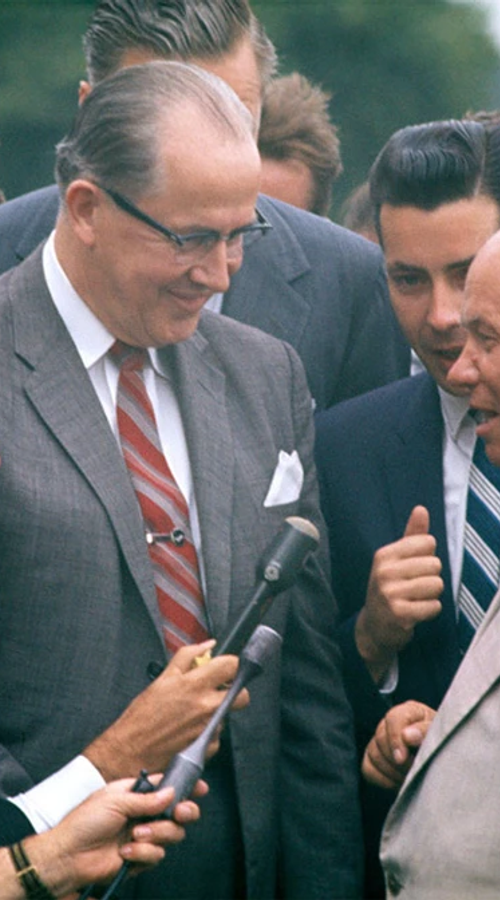
We talk about the most famous mistakes of translators and their political consequences
On February 8, 2024, DOXA was included in the register of "undesirable organizations."
If you are in Russia or plan to return to it, you can not replace our materials on social networks, refer to them and publish quotes.
Read more about what is possible and impossible, read in the cards .
Translation difficulties
On August 15, negotiations between US President Donald Trump and Vladimir Putin will be held in Alaska. The meeting agreed on the meeting in Moscow, where the special settlement of Trump Steven Witkoff arrived at Putin.
After this meeting, the German publication Bild, referring to his sources, reported that the American “misunderstood” Putin’s requirements - in particular, Whitkoff could tell Trump that Russia was ready to abandon the occupation of the Zaporizhzhya and Kherson regions. It is not known whether the cause of the too general and incomprehensible formulations of Putin was the reason or was it a translator's mistake. Nevertheless, the upcoming meeting of Putin and Trump can be the result of this “misunderstanding”.
In these cards, we will talk about other mistakes of translators. Some of them changed the course of history, while others remained a funny reminder of the complexity of this profession and how even the most experienced professionals could be mistaken.
Overload instead of rebooting
The most striking translated “blunder” in relations of the United States and Russia has recently occurred on March 6, 2009 between US Secretary of State Hillary Clinton and the head of the Russian Foreign Ministry Sergei Lavrov.
At that time, Russia and the United States sought to normalize relations, and the presidents Dmitry Medvedev and Barack Obama exchanged official visits.
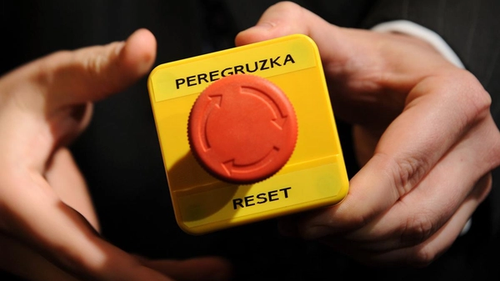
Fabrice Coffrini / Reuters
As a symbolic gesture at a meeting with a laurel, Clinton gave the Russian diplomat a red button, on which, instead of the word “reboot”, “overload” was written. The author of this idea was the then employee of the Obama administration Michael McFol, who made this mistake.
The error was in something prophetic. Three years later, the United States began to impose sanctions against Russia on the “Magnitsky list”, five years later-due to the annexation of Crimea, and then began to investigate Russian intervention in the American elections. Such is “Peres for the load”.
"We will bury you"
On November 18, 1956, at the reception of Western ambassadors at the Polish Embassy in Moscow, the first secretary of the CPSU Central Committee Nikita Khrushchev said: “You like it or not, but the story is on our side. We will bury you. "
Due to inaccurate translation and selective citation, this phrase appeared in the first lanes of the Western media in the wording “We will bury you” (We Will Bury You).
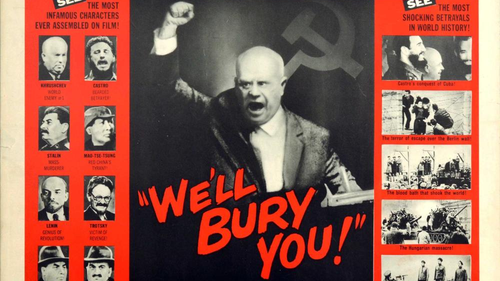
Poster to the American film We'll Bury You 1962
Many perceived this as a direct threat to the USSR addressed to the United States, but after a few years Khrushchev explained that "he did not mean literal digging the grave with a shovel, but only that capitalism would destroy his own working class." He referred to the idea of Marx that the aggravation of the contradictions of capitalism would lead to the transition to a new social system - communism.
According to the personal translator Viktor Tuprev, Khrushchev was famous for the fact that during negotiations with the leaders of other countries, especially the United States, he often used Russian and Ukrainian sayings. These expressions put translators into a dead end, since they have no exact analogues in other languages.
Khrushchev also did not avoid sharp expressions. Once, during a conversation with an American journalist, he stated: "Let Adenauer go." When the editor-in-chief of the newspaper Pravda sarcastically remarked to the translator: “Yeah, let him try [to translate it]!”, Khrushchev retorted: “What to try? All peoples are fed! ”
Keep silent or ignore?
Translation errors can lead to dramatic consequences. In 1950, the Japanese professor of Kazuo Kawaii in 1950 claimed that the incorrectly translated word from the statement of the Japanese prime minister caused the nuclear bombing of Hiroshima and Nagasaki.
On July 28, the United States, Great Britain and China adopted the Potsdam declaration describing the conditions of the surrender of Japan. Commenting on this document, Japanese Prime Minister Kantaro Suzuki used the word mokusatsu (黙殺), which can mean “ignore”, “masterfully keep silent” or “leave without comment”.
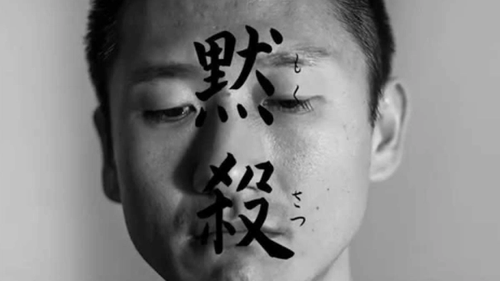
Frame from the short film Mokusatsu (2015)
Mubi
According to Kawai, the Sanizer countries interpreted the prime minister’s statement as a refusal of surrender, although the Prime Minister most likely had in mind the abstinence from commenting.
Many historians dispute this version, believing that the allies correctly understood the meaning of the statement of the Japanese prime minister, which, however, did not prevent tragic events.
What is sovereignty?
Sometimes the consequences of translation errors can be haunted by entire nations for many centuries. This happened with the indigenous people of Maori, living in New Zealand.
Recently, Maori held some of the largest protests in their history. They opposed the bill introduced to the Parliament of New Zealand by the Libertarian Party Act Political (ACT), which is part of the ruling coalition. This bill offers a new interpretation of the Vaitanga agreement signed in 1840 between the leaders of the Maori tribes and the British colonialists.
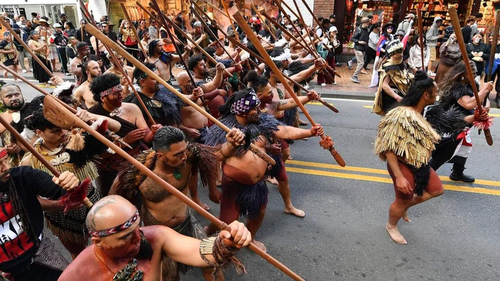
Demonstration for Maori's rights in Wellington, the capital of New Zealand
Sanka Vidanagama / AFP
The Waitanga Treaty consists of three articles: in the first lead, Maori agree to give in to the sovereignty of the British colonialists; The second assigns the right to ownership behind the indigenous people of New Zealand; The third promises protection and privileges for the indigenous residents of New Zealand, which include Maori - they make up about 15% of the country's population or 600 thousand people.
Since the contract was drawn up both in English and in the language of Maori, some terms, such as “sovereignty” or “property”, allow various interpretations, which the ACT party took advantage of. Maori is sure that the revision of this contract will infringe on their rights to land and preserve their own culture.
Unlucky Jimmy Carter
Democrat Jimmy Carter was elected US President in 1977. Immediately after taking office, he began a large tour of European countries to establish international relations.
During this tour, Carter visited Poland. The problem was that among 17 translators of the White House, not a single person was in Polish. I had to hire freelance employees to help the Poles understand the president’s speech.
As a result, the phrase “When I Left the United States” (“When I left the United States”) was translated as “when I left the United States forever.” A great statement for the newly elected president ...
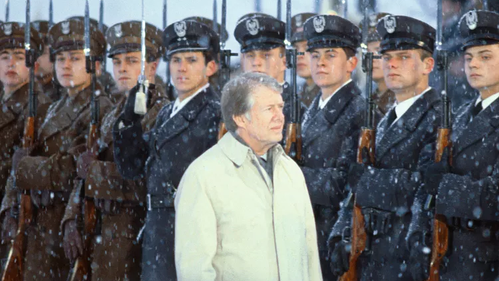
Jimmy Carter in Poland, 1977
Bettmann Archive
The phrase of Carter that he highly appreciates the Polish Constitution in 1791 in the context of the history of human rights was mistakenly translated as "your constitution is ridiculous."
But that's not all. At one of the moments, Carter said that he wanted to know what the Polks wish from his future.
The problem arose due to the fact that the word Desire used by Carter has a double meaning: a neutral “desire” and a more intimate “sexual attraction”.
As a result, the phrase of the crankcase on Polish sounded like "I want to have sex with the Poles."
Mr. Whitehaus and soda in Quebec
The announcers sometimes read the text from the television screen, without attaching the importance of what is written in it.
In 2016, this led to a curious mistake during the performance of Canadian Prime Minister Justin Trudeau in the White House. He spoke French - one of the official languages of his country.
The ABC television channel announced the computer program, which was supposed to translate the Trudeau from French into English in real time. The program failed and began to process French speech as if it were English.
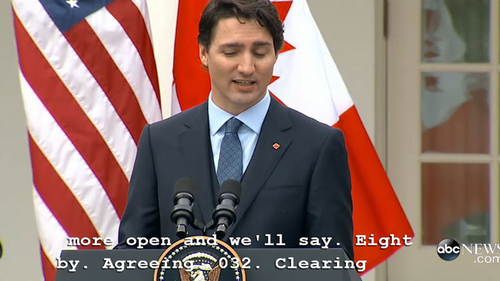
Frame from the broadcast
As a result, American viewers showed how Trudeau addresses President Barack Obama “Mr. Whitehouse” (White House).
“We also decided to make the board more open, and we will say. Eight in. Agreement. 032. Cleansing, ” - such meaningless phrases were broadcast in the translation of the Trudeau speech on one of the largest US television channels.
And that was only the beginning. Later, translated by the Prime Minister of Canada allegedly talked about the state of soda in Quebec and told President Obama that he would love to take timber trucks.
During the broadcast, Trudeau also “announced the Nazis' offensive,” and completed his speech by an absurd phrase: “We will not defeat the more so”!

Editor
Editor
Denis LevenIllustrator
Illustrator
Vitya ErshovPublication
August 15, 2025
Other materials
What unites Putin and Trump? Neo -measuring
Sociologist Alexander Bikbov - about ideology that defines our time

Putin says that the world needs "New Yalta"
What does it mean and why this cannot be allowed

What is Denis Kataev right right
The editor of the Allo, Macron channel Sasha Listratov disassembles his theses from the interview of Dudia


What are tariffs and why are they Trump?
The most understandable analysis from Doxa

Artificial intelligence is the technology of the future that simplifies the life of millions
Alas, at the cost of operation, inequality, slavery and harm of ecology
