
Translated material
Blessing, we will play in names
The Office of the Moscow Patriarchate pointed out the new “conflict of meanings” within the framework of his. Toponymic

Decommunization in the Dnieper. Photo: social networks
While Patriarch Kirill is on a planned summer vacation, the Russian Orthodox Church in public space is represented by the manager of the affairs of the Moscow Patriarchate, 50-year-old Metropolitan Grigory (Petrov), a hardware administrator, previously not marked with any vivid statements. But it was he who was destined to violate the smooth course of the church holidays.
On August 10, on August 10, the Metropolitan urged the state television channel to restore historical toponyms in the new regions of the Russian Federation, that is, in the zone of his own. According to the hierarch, in the days of the USSR, cities and streets were often given the names of people who "did not want Russia to be good."
In the current realities, these words sound not just as a return to the toponymic agenda 1990-1991. Since it was their new Russia's lands that were replaced by the Soviet names and symbols that were replaced in the process of Ukrainian decommunization, the words of Gregory sound like a front, as a denial of those “meanings” that the “Russian world” under the red flag carries to the Donbass and the Northern Black Sea region. Would he dare to state such a position without the knowledge of his boss? It is hardly.
Help "New":
Over the years of his Patriarchate (since 2009), Cyril replaced the five heads of the ROC key department - the department of the Moscow Patriarchate, and four of them over the past six years. The administration of the Patriarchate is the secretary of the Synod and oversees the interaction of the church center with the dioceses. The current administration of the Moscow Patriarchate, Metropolitan Grigory (Petrov) was born in 1974 in the Yaroslavl region, graduated from the Yaroslavl University and the Moscow Theological Academy. He became a priest in the Perm Diocese, where he held a number of administrative and teaching posts. In 2010, he moved to Moscow, worked in the Synodal Department for Prison Service of the Russian Orthodox Church and in the administrative secretariat of the Patriarchate. Since 2014-Bishop of Trinity and Yuzhnouralsky, since 2019-Metropolitan of Chelyabinsk and Miasssky, in 2021 he was transferred to the post of head of the Kuban Metropolis to Krasnodar. He actively advocated his support, assuring that with God's help of the Russian Federation he would defeat, and veterans who returned from the war zone will transfer their experience to the youth. On October 11, 2023 he was appointed managers of the Patriarchate, in April of this year received from Vladimir Putin the medal of the Order for Merit to the Fatherland.
Nominally, Metropolitan Gregory followed Putin, the propaganda line designated by Putin that "Lenin created Ukraine." Donbass and southeast of Ukraine assures the hierarch, "thanks to the policy of the Communists, they were abroad." And, of course, it is strange that the “return of Russia” to these territories returns there the names and images of these communists in the form of names of cities and streets, in the form of brand new monuments to Lenin.
The modern “Russian world”, obviously, has nothing to offer the surviving residents of the “liberated” territories as symbols of their new state identity, except for the old Soviet names and images.
But the same Vladimir Putin made it clear in his television show on February 21, 2022 that one of the tasks of the preparation was “the protection of the church” (of course, the structures of the Moscow Patriarchate in Ukraine) was.
As it has developed, my propaganda, including church, loaded it with all the new “sacred meanings”. Dmitry Medvedev wrote that the purpose of the special operation is no longer demilitarization: “Our goal is to stop the Supreme Lord of Hell, whatever name he uses - Satan, Lucifer or Iblis.” Of course, the Hierarchs of the Russian Orthodox Church could not help but accept such a serving, and Medvedev eagerly echoed the chairman of the “military” department of the Patriarchate of the Patriarchate of Metropolitan Cyril (Pokrovsky): “In Ukraine today there really is a war with Nazism, with satanism, with antichrist.”
But this is a rhetoric - let's look at the facts. In the context of the call of Metropolitan Gregory - to toponymic. After the adoption of a package on decommunization in Ukraine in 2015, a large -scale campaign was held to return historical geographical names, or to replace them with the Ukrainian people related to the history and shrines. The key in this package was the law "On the condemnation of the communist and national socialist (Nazi) totalitarian regimes in Ukraine and on the prohibition of propaganda of their symbols." (By the way, it would be nice to read the text of this law and look at the practice of its implementation.) Zealoists of Ukraine’s “denacing”.)
Even under Yanukovych’s rule, in early December 2013, the Euromaidan participants in Kyiv overthrew a monument to Lenin from the pedestal opposite the Bessarabian market. This became the impulse of the Leninopad campaign, which covered hundreds of settlements of Ukraine. For three and a half years, more than 1300 monuments to the “Founder of Ukraine” according to Putin were dismantled in the country.
Is it worth it to be surprised that in the territories controlled by the Russian Federation, Donbass, Zaporizhzhya and Kherson regions, the monuments to this “founder” are carefully restored, and in some places (for example, Melitopol, Genichesk, New Kakhovka, Starobelsk, Lisichansk, Mariupol and a lot more) are installed again. Obviously, this is
The systematic “memory policy”, which is pursued by new authorities in “new territories”. The “founder of Ukraine” becomes for them, perhaps, the main symbol of “Return of Russia”. Paradoxically, but the fact!
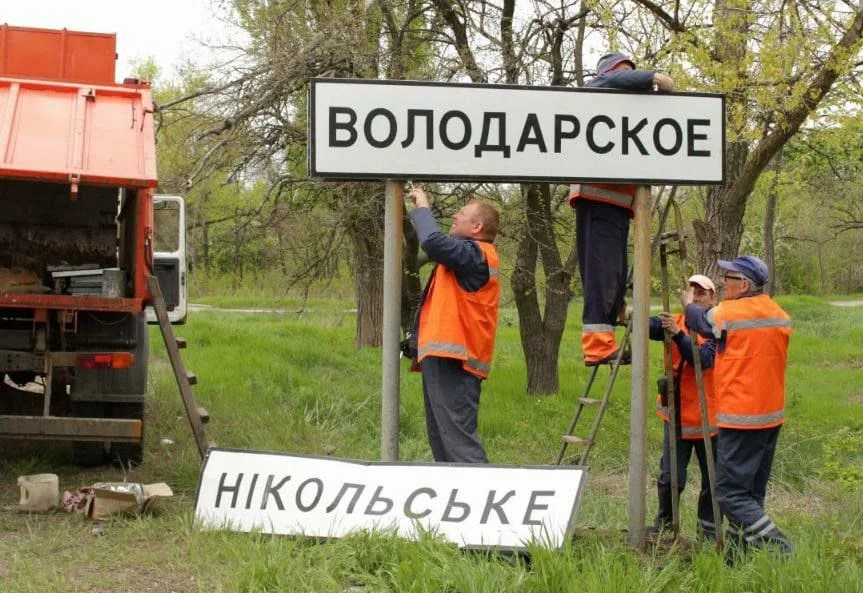
The practices of Ukrainian decommunization affected not only Lenin and his associates. Ukraine has returned their church, Orthodox names to many settlements and streets. However, after the transition of these places under the control of Russia, the Orthodox names were canceled and replaced by communist ones.
The most striking examples are the village of Nikolsky near Mariopol, to which the DPR authorities returned the name Volodarsky (in honor of the Bolshevik-Bundovian Moses Volodarsky), or the city of Pokrovsk, which Russian sources continues to be called the Red Army. Characteristic examples of this kind in the territory controlled by Ukraine: the Blagoveshchensk (former Ulyanovsk) district of the Kirovograd region, the Council of Council of Council of Council of Dnieper, the Voznesensky (former Ordzhonikidze) district of Zaporozhye or Pokrovsky (former October) district of Krivoy Rog.
Soon after the proclamation of the inclusion of the district center Mikhailovka, Zaporizhzhya region in the Russian Federation, in December 2022, the local administration issued an order for No. 64 on the return of the streets of the village and villages of the Mikhailovsky district of the names "Heroes, people worthy of proud of their exploits."
Saint Nicholas, the Mirlitan Wonderworker, one of the most revered saints in Russia and Ukraine, was recognized as unworthy. But the heroes, whose names returned to the streets of the district were all the same Lenin, Dzerzhinsky, Marx, Engels, Kirov, Kalinin, Sverdlov and Vorovsky. Svyato-Pokrovskaya Street Mikhailovki was renamed “50 years of Soviet power”, and St. Nicholas in the “Red Army Gryaznov”. After a couple of months, the administration, however, changed her mind and, having conducted an Internet survey of the inhabitants, returned the streets a part of the non-impaired names.
In the largest center of Russia controlled by the Zaporizhzhya region - Melitopol - a special “public council” was created to consider renaming issues. First of all, he perpetuated the memory of the NKVD General Pavel Sudoplatov, who was born in Melitopol in 1907 and became famous, in particular, by the murder of the leaders of the Ukrainian anti-Soviet underground of the Eugen Konovalz and Roman Shukhevich, the Primate of the Transcarpathian Greek-Catholic Church of the Bishop George Theodore Romzhi and the organization of the murder of the liva Trotsky. In the city center, a monument to Sudoplatov is now flaunting.
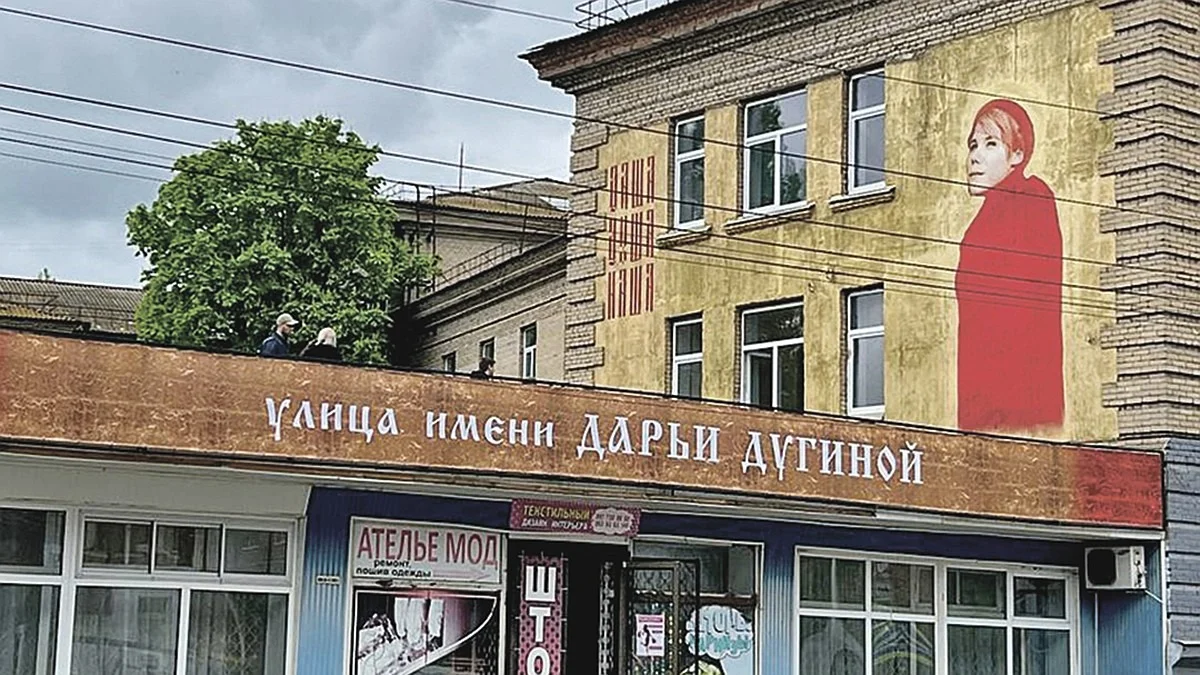
In Melitopol, the streets of Daria Dugina, the Russian Guard and Alexander Zakharchenko also appeared.
The rest of the renaming was proposed to be carried out "according to the Mikhailovsky model": Cathedral Square - to the area of the revolution; Pokrovskaya Street - in Lunacharsky, Petropavlovskaya - in Uritsky, Ukrainian - to the Soviet, and the hetman - to Lenin. It is reliably unknown what part of the plan was implemented: at one time the current names of the streets generally disappeared from the addresses of Russian institutions in Melitopol, and then the administration site itself ceased to open. The Russian service "Yandex.Martes" still gives Ukrainian names of Melitopol toponyms.
... The leadership of the Russian Orthodox Church, which was not the first time by the search for the constantly elusive “meanings”, was perhaps the main ideological problem of the current expansion of the “Russian world”. Since the Russian Federation in the strict sense of the word is not a national state with a developed civil society, it is not able to propose the national project itself. Behind its absence, it is limited to the mechanical relay of Soviet images/archetypes, which, as it were, “reproduce” the empire that we have lost, on the last - Soviet - a round of its historical development.
Whether in this symbolic structure there is a worthy place of the Russian Orthodox Church is a big question. Judging by renaming, it is not at all invited to this holiday of a “new life”. And the demarche of Metropolitan Gregory is a sign of a serious concern for the patriarchy leadership on this subject.