
Translated material
Garden for the oligarch, sex revolution in the outback, heroin Tbilisi
What are modern Georgian directors shoot about in anticipation of changes in the country
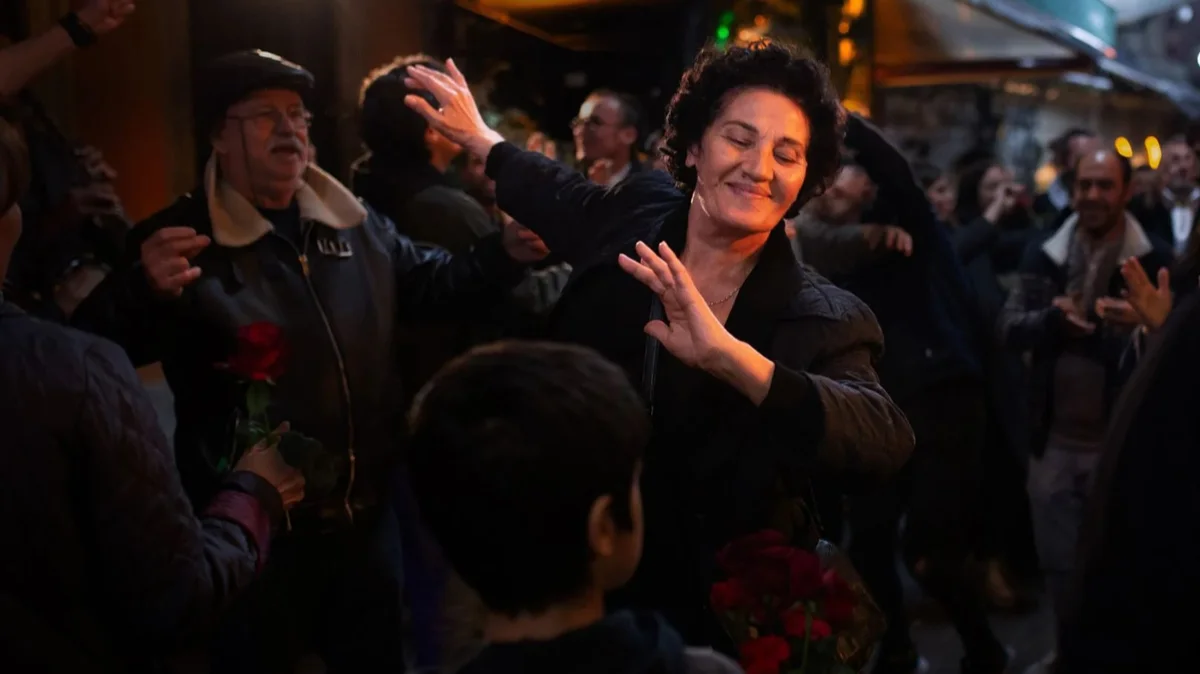
Shot from the film "Crossing", dir. Levan Akin, 2024. Photo: FILMKUNSTKINOS.de
While Georgia is experiencing a turning point in its history, its film industry also undergoes changes. Over the past decades, the country has managed to form a whole direction in European cinema, which can rightfully be called the "Georgian New Wave." Having joined European cinema financing programs, Georgian directors made films in co -products with France, Germany, Switzerland and other countries. This made it possible to ensure funding primarily to the author’s projects that acutely reacting to what is happening in society.
Since the mid-2000s, there has not been a single year when at least one Georgian film would not fall into the program of Class A film festivals-whether Berlin, Cannes or Venice. Such directors as Nana Ekwimishvili, Dea Kulumbashvili, Zazu Urushadze, and the curators of festivals knew many others, the world media wrote about them. And, most importantly, their films became events in Georgia itself - even if not as leaders of the rental, but as significant artistic statements that affect public consciousness. Already in 2022, the government replaced the leadership of the Georgian National Cinema Center - an organization responsible for financing film production. According to critics, loyalists of power were appointed to key posts. Now officials are not shy to resort to direct threats to those who are trying to make critical films, including criticism of Bidzina Ivanishvili. Thus, the Minister of Culture publicly accused director Mariam Chaii of “illegally changing the script” and threatened the consequences. The conflict between the film community and the government is amplified. State financing is increasingly turning into an instrument of pressure and censorship: uncomfortable authors simply do not receive support and are deprived of the opportunity to implement their projects. Some directors were forced to leave the country, others remained and continue activist activities, despite the risks. Vladimir Kocharyan talks about five Georgian films of the New Age, which transmit not only the bright colors of Georgia, but also the tension that hung in the air in anticipation of future changes.
"Alien House", director Rusudan Glurorjidze, 2016
Rusudan Glurorjidze, a director, whose last year’s work “Antiques” was presented at the Venice Film Festival and ended up in the center of political drama. The Antiques, which spoke about the deportation of Georgians from Russia in 2006-2007, was first recalled from the program in the lawsuit of Russian co -producers, and then, after appeal in the Venetian court, was returned to a competitive show. An amazing combination - a Georgian film with Russian producers - is not the first time in the career of Glurorjidze. Her tape “Alien House” (2016) was also a co -product of Georgia and Russia and even received the support of the Ministry of Culture of the Russian Federation, which surprises, given the political atmosphere in Georgia and attitude to Russia after the 2008 war.
"Alien House" transfers us to the Abkhaz village, surrounded by mountains, fog and endless rain. After the next military operations (a specific year in the film is not denoted), Georgian residents hastily left their once-inhabited houses. A new family is populated into one of these houses: an Abkhaz man with a Russian wife and children who also fled from the war. They are trying to settle in this abandoned space, where the presence of the former owners is still felt in every corner. Whether it is wardrobe items, clothes or cutlery - everything reminds of the recent existence of “strangers”.
The tragedy of previous owners, according to the wife of the protagonist, should not interfere with an attempt to build their own future. In the house neighboring from them, the Georgian family lives: two sisters and the daughter of one of them. They, like the characters of the classical play, roam their dilapidated housing and garden, trying to comprehend the consequences of the war and predict the future. And the future is already close.
It is difficult to build life in the conditions of a fog of a war enveloping the Abkhaz village - just like imagining who will come out with weapons in his hands from this fog to meet: a former owner or a new contender for a “alien house”.
This is not the only film dedicated to the Abkhaz wars. It is worth recalling the author’s drama “Mandarins” nominated on Oscar, the Zazhhadze or “Shindisi” Dito Qintzadze, working in a patriotic genre. In the “Alien House”, Rusudan Glurjjidze takes the side of the victim, showing that not only the dead and warring are becoming victims, but also those who fled. The unhurried and viscous rhythm of the film creates the feeling of “limb” - “gray zones” of the occupied territories.
"The Taming of the Garden", director Salome Jasha, 2021
We become witnesses of a surreal picture: Georgian fishermen meditatically throw fishing rods into the sea, as if not noticing a barge on which a majestic tree floats.
This documentary was not invented by the director Salome Jasha - this is a reality created by the oligarch and shadow ruler of the country Bidzina Ivanishvili. A politician governing the country in manual mode, the richest person of Georgia, embodies his dream - the creation of a heavenly garden filled with exotic birds, unique trees and plants. For this purpose, he sends his people throughout the country: they redeem or seize trees selected specifically for his private collection. Sometimes uproot from forests, sometimes from the territory of protected national parks. The houses of citizens also do not go unnoticed: the inhabitants of one of the village plots are offered to sell a centuries -old beech growing in their own yard. New roads are being built, complex technical solutions are being developed for transporting and preserving plants. All to realize the desires of one person.
Jashi draws a portrait of a man who not only created the political reality of modern Georgia, but now already changing its natural landscape. Filmed in an observation manner, the film reveals two storylines in front of the viewer. The first is the process of uprooting eucalyptus, magnolia and other trees that follow their transportation. We hear the conversations of workers discussing the scale of the authorities, its borders and asking the question, and why these trees are bought at all. The second storyline is dedicated to the inhabitants of the villages where the workers come. Someone rejoices at monetary reward, others doubt whether to part with the past for several hundred euros. Ultimately, almost everyone agrees: money is critical for poor rural residents.
Salome Jashi is a famous Georgian director who became famous not only for her successful documentaries and participation in large international festivals, such as Sundance, but also an active civil position. From such an author, one could expect a direct action film - with an explanation of the context, open exposure and moral assessment of what is happening. However, Jashi chooses a completely different optics. There is no expected image of the immoral oligarch, an alarming video and a sunset voice. We do not see Ivanishvili himself - this is not necessary.
The director retains the distance. With her detached position, she gives the viewer the opportunity to silently observe the large -scale and almost absurd process of creating a “dream garden”.
Final shots with perfectly well -groomed paths, exotic trees and singing birds become visual metaphor. On the one hand, they testify to the unlimited willpower of a person, on the other hand, the absence of the limits of his abnormal power.
"Drozd, thrush, blackberry", director Helene Naviani, 2023
Ethero - the main character of the film - lives in the provincial Georgian village, where the only way to pass the time is talk of tea devoted to the discussion of neighbors. She owns a grocery store where you can look behind hair dye, washing powder or just chat. Life flows measuredly: day after day, she repeats her small rituals: a walk along the blackberry glade, a piece of Napoleon cake, the opening and closing of the store. But once a murman enters the store - a loader who brought the goods. Passion flashes between them, they make love right in the utility room. This event forever changes the life of Ethero, who has lost virginity at the age of 48. They begin secret relations that are diligently hiding from the whole village. However, others feel that something is wrong. Looks after, conversations behind him, speculation-all this becomes a weapon in the hands of those who cannot accept that one of them dared for something hidden.
Director Helene Verenae filmed the novel “Drozd, Drozd, Black Black Sea” by the Georgian writer and feminists Tamita Melashvili. The subway left Georgia during the Russian-Georgian War of 2008 and received a bachelor's degree in the field of cinema at the University of Geneva. She took off her first full -length paintings - “I am a drop in the sun” and “wet sand” - she took off, already returning to her homeland. Both works were distinguished by a bright visual form and radical by the standards of Georgian society themes: from sex work to Quir-identity. In the new film, the Vventiani goes to the “Deep State” of the Georgian Patriarchal Culture - rural areas. This is a closed community, where everyone knows everyone, does not leave the main character the opportunity to break out of the norm of the decency that the collective “we” of the village imposes it. The same norm is broadcast by her own family - the Abuser father and brother, who, with the help of cruelty and insults for years, suppressed the will of Ethero.
An unhurried and melancholy film is not shy about the female body in the frame. The passionate bodily and emotional nudity of the main character is opposed to the conservative morality of society. At first, the neighbors blame her with the absence of a man and virginity - her very model of life seems “unnatural” to them. One of the neighbors even claims that its existence is useless for the state, because she did not give birth to a child. Ethero, in turn, refuses to become “normal”. The appearance of a secret love becomes a way of resistance to her and an act of emotional liberation.
"Days of streets", director Levan Koguashvili, 2010
In the frame - Tbilisi began the zero. Checks are a representative of a generation of middle -aged men who could not cope with the severity of the time after the collapse of the Union. Youth is behind, maturity has come, but the consequences of a violent youth are not released. One of them is drug addiction. The days of checks take place in the company of the same lost, who have not found themselves in an "adult" life. They, like schoolchildren, are wandering around the buildings of their Alma Mater-only now in search of heroin, not knowledge. Tragic irony: his son is studying in the same school.
Between attempts to pay off with the dealer, the checks constantly turns out to be a member of the grotesque comedy scenes that arise literally from nowhere - be it an unexpected attack by grandmothers, a stand -up accident or another fight with drug addicts. This chaotic life leads the hero to the trap, placed for him by the local mafia. Before the checks the choice is: to save your own skin or substitute the son of a childhood friend.
Director Levan Koguashvili, who graduated from the Moscow VGIK and New York Film School, is the author of several show films in the genre of tragicomedia. His debut work “Days of the streets” was shot after returning to Georgia. According to the director, the task was to convey the “emotional portrait of the city”, and drug addiction in the film acts as an image of the time in which the action takes place. The problem of the "lost generation" of men of the 90s is not unique to Georgia. Some of the post -Soviet countries were faced with the period when the main responsibility for the well -being of the family fell on women. Men, against the backdrop of political and social upheavals, were increasingly vulnerable to alcohol or drug addiction.
Georgia in the film appears as a corrupt country, pierced by a chain of non -cords. The abduction of people is a common practice, drug addicts arrange gatherings at the school courts, the schoolchildren themselves run with weapons, try to buy heroin, simultaneously rude to teachers.
Social reality, as if collected from criminal boulevard presses, contrasts sharply with the melancholy romance of the colorless winter Tbilisi.
Putting the film into a comedic tone, Koguashvili does not smooth out the corners and does not try to embellish the drama of what is happening. The comedy serves as a way to convey the recognizable feeling of “Georgian”-the same thing that at the subconscious level responds to the viewer, familiar with the classic of Georgian cinema of the 70s.
"Crossing", director Levan Akin, 2024
Levan Akin-a representative of the Georgian diaspora in Sweden, where his parents emigrated back in the 1960s. Building a career in Stockholm, he managed to work on local television and release two full -length films before creating the first picture dedicated to the Georgian context. This film was largely the revolutionary tape “And then we danced”, telling the story of the relationship between the two boys studying in the studio of traditional dance.
In a country with deeply rooted homophobia and a high level of hostility to the Quir-bums, the film caused discussions at all levels. The reaction was not limited only to condemnation from conservative politicians - attempts were made to attack cinemas, where sessions passed, threats to the audience sounded. In an interview, Levan said that he was originally planning to make a documentary about attacks on LGBT parades in Tbilisi, but later decided to make an artistic picture of the “secret life”, which are forced to lead the kvir-loves in conservative societies, as well as the duplicate between the “Internet people” and “people of television”.
The theme of the gap of generations smoothly passed to the next film by Levan Akin - “Crossing”, whose premiere took place at the Berlin Film Festival in 2024. The director transfers us to the coastal Georgian city of Batumi on the border with Turkey. The elderly Lia, the main character performed by the Arabuli, goes in search of her niece Tekla, who left his father's home many years ago due to a break with his family. Parents kicked her out due to trans-identity and for the fact that, in their opinion, she brought a shame on them. After the death of his sister, Lia decides to find Tekla and goes to Istanbul, where, according to friends, she has been living for several years. A random acquaintance is stuffed into her satellites - a young Archie, a rebel, tired of a hopeless life in Georgia. He is attracted by the proximity of Istanbul and the potential opportunities for earnings there. He does not know the language, but knows how to survive. This unexpected couple goes on a trip to the night Istanbul, penetrating into its least glossy side-the quarters of sex workers. It is there that the community of trans-female services is located. Tekla was seen for the last time it was here.
The tragic Baddy-Muy, created by Levan Akin, is saturated with the atmosphere of loss and at the same time-hopes embodied in the desire of Leah to find his niece. This search is not so much an attempt to restore the destroyed connection as the desire to regain justice in relation to Tekla, which, according to Liya, they “let down”. “I don’t know what I’ll tell her when I meet,” the guilt and the verdict are through this confession. It reflects the abyss not only between parents and abandoned textiles, but also between generations, desperately fighting for the right to their truth in modern Georgia.