
Translated material
Old money and new ethics. Kirill Kobrin about the impossibility of conversation

Kirill Kobrin
Prior to the beginning of a full -scale war in Ukraine and subsequently in the Middle East, the attention of the reading public often occupied cultural wars. The angry public was in a hurry to cancel the artists, writers and enlighteners of the past, whose biographies, by the standards of modern man, were not accurately. For example, Gogen, whose exhibition in 2019, in the London National Gallery, was accompanied by explications about how many years were the Hitians depicted on the canvases, with which the artist entered into sexual communications. "Isn't it time to cancel Gauguin?" -asked New York Times.
Trump's war and the second term of Trump took this discussion to the background, but the conversation about how to relate to an uncomfortable past is far from completion. In the “Sunday preaching” section, writer Kirill Kobrin, using the example of the founder of the British Museum, Sir Gans Slown, explains why the conversation between supporters and opponents of the abolition culture is impossible in principle.
I sat at the foot of the stairs leading up to the Hirosige exhibition. The staircase curls around a white round building with a green dome, which comes out of a large glass dome, the famous glass dome of the British museum. The white round building itself is located in the large courtyard of the museum, it turns out such an architectural nesting doll, one in the other. Here, until relatively recently, there was a reading room of the British library, in it a variety of people read books - the recording rules were the most democratic. Among the readers are the great revolutionaries of their time: Marx, Sylvia Pankherst, Ho Shi Min, Virginia Wulf, Lenin, Mahatma Gandhi, Sun Yatsen and others. From one side of the reading room is the Enlightenment Gallery, where the curators with the help of exhibits tried to illustrate Michel Foucault's reasoning about the system of Western ideas about the world known as enlightenment, or the Enlightenment. Another staircase embracing the reading room leads to an excellent exhibition about ancient India. In the large courtyard, the ancient Babylon and the Assyrian kingdom, ancient Greece and Samoa, the islands of Easter, the desert of Australia, and the whole world begin at the doors to other halls.
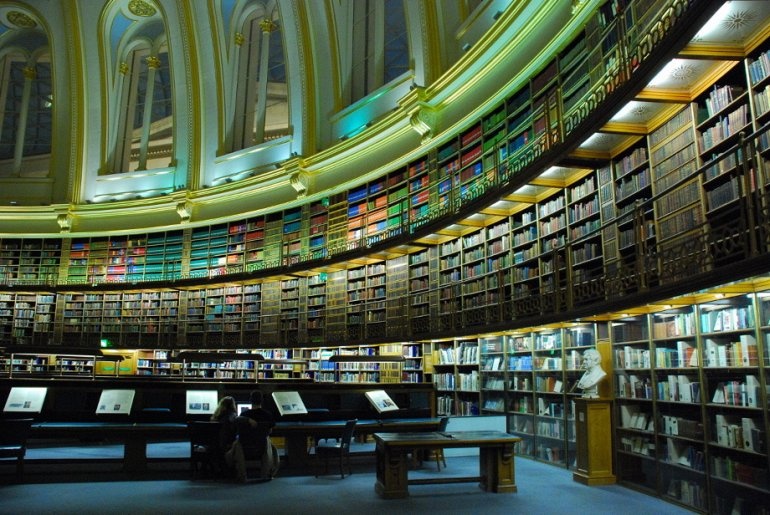
Reading Hall of the British Museum
The whole world here and gathered to stare at himself, but transformed by the museum: a variety of languages, faces, clothes. Crowds of tourists passed by the stairs, volunteering lovers of old Japanese graphics climbed the stairs, on the contrary - the audience of a slightly different kind, to the left of me on the steps of the stairs was a flock of teenager, whose motives were probably different from the above visitors of the British museum. I was sitting, waiting for a late companion and thinking about whether different reasons for visitors converge in one big overall reason.
Of course, the discussion of the Great Western canon, about imperialism, postcolonial imperatives and total decolonization is assumed further. The author will get from all sides, but he will not say anything intelligible, because he will be frightened, no matter how much he got even more, in full.
It would be better if the author did not say anything. After all, the situation is hopeless. Whatever you say - everything is bad.
No conversation on these topics is impossible. The author understands this perfectly. Therefore, the discussion of the big canon and so on will follow below, but about the impossibility of conversation. The British Museum is the most suitable place for this.
Subscribe to read the whole
Make a subscription Redefine.media to read Republic
Subscribe [you can pay for a Russian or foreign card. The subscription is extended automatically. You can unsubscribe at any time.]
Where are the money subscribers going