Date
Author
Разборы Продолжение следует
Source

Preserved copy
Translated material
With Tiffany to "Switch". How Russian diamonds feed war through Western companies
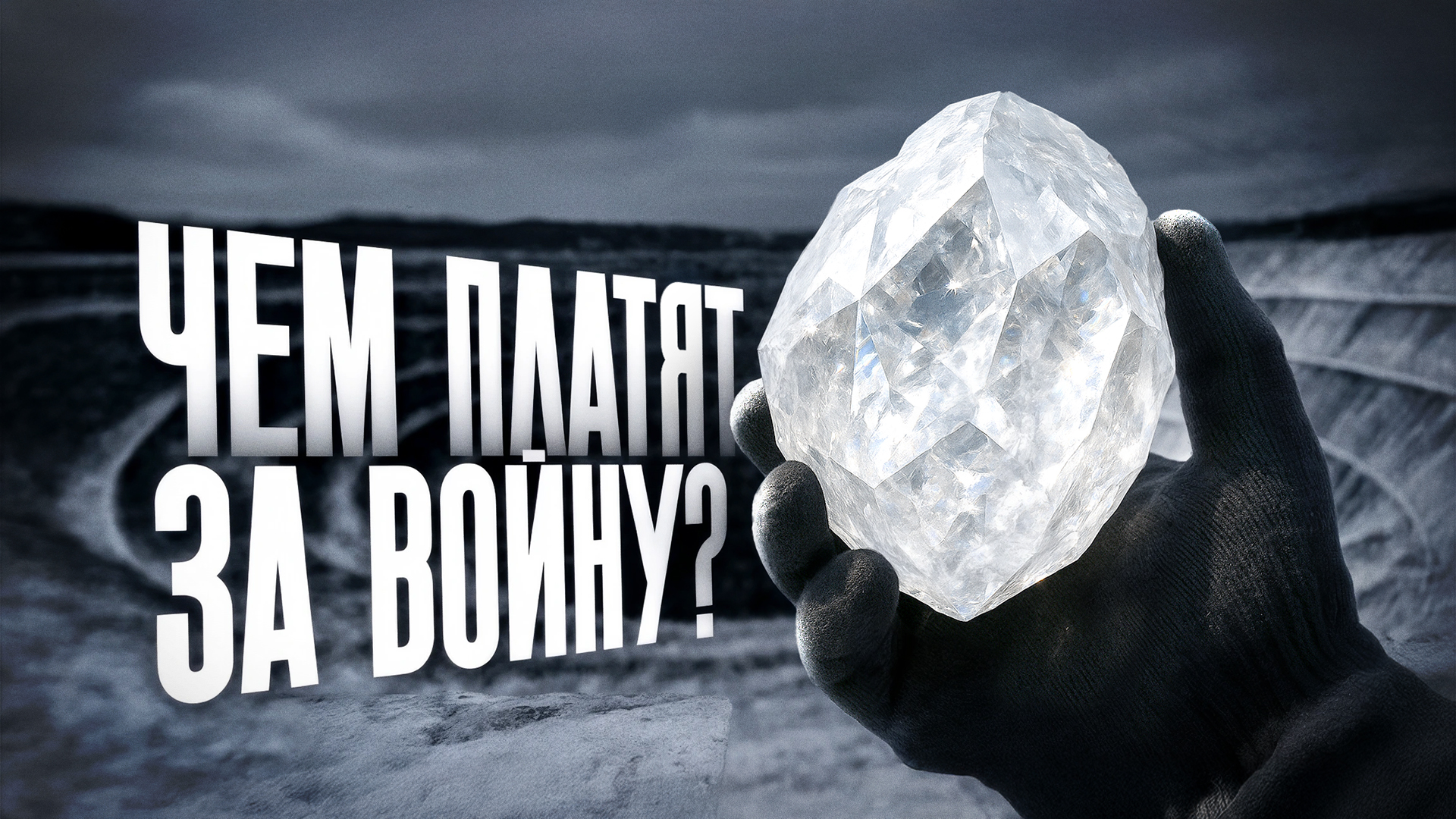
Despite the war in Ukraine and sanctions, in 2025 Russia remains a major player in the world market of precious stones. How Russian diamonds find themselves in the USA and the EU - Pavel Kanygin is dealing with the investigative project Arctida.
This message (material) was created and (or) widespread by a foreign media that performs the functions of a foreign agent, and (or) a Russian legal entity that performs the functions of a foreign agent “continued”You read the text version of the analysis
How many times have you heard this over the past three years, or such ? It doesn’t matter whether you live in Russia or left, watch Rain or Channel One, go to the premium taxi or get to work by metro-the idea that sanctions are ineffective have become a common place. Both economists and stairwell neighbors state this without blinking an eye.
The Russian authorities, at least at first glance, that water is with a goose. If anyone suffers from these sanctions, then these are ordinary people, and not those who are at the helm. First of all, because the sanctions introduced after the start of a large war, the Putin authorities and their counterparties have learned to very effectively circumvent - and, by and large, doesn’t give a damn about this. The ships of the shadow fleet turn off the transponders and carry Russian oil. Important components important for the Russian military -industrial complex fall into the country bypass ways. And today I will talk about how the world jewelry industry continues to trade in Russian diamonds. About how the world cannot or does not want to refuse minerals obtained in Russia. As a purchase of these beautiful glass continues to maintain bloodshed.
We prepared this issue in conjunction with the investigative project "Arctida" , and in it we will talk about how a simple school teacher became the owner of the largest company that supplies diamonds to the world market; How Armenia has become the most important player in this industry, and also why the world cannot abandon diamonds stained with blood.
The Nyurbinsky quarry is a huge deposit of diamonds in the middle of the Kimberlit field. There are about three hundred kilometers to the nearest city. Around - an endless taiga. And this is a scene from the great movie "Breakfast at Tiffany."
If actress Audrey Hepburn was fascinated by Tiffany diamonds not in 1961, but half a century later, she would probably look at the diamonds who came to the fifth Avenue from Yakutia. By the way, such a ring from Tiffany worth 189 384 euros and 95 cents.
But why are we going so crazy in diamonds? Why is this transparent pebble considered both the proof of love, and the symbol of prosperity, and the obligatory point in the wedding budget of wealthy people? Why is it so difficult to say: thanks, will I manage?
Because someone once did everything so that we could not.
How diamonds won the world
It was De Beers. A company with British roots and monopoly ambitions. It was she in the 20th century that turned diamonds into a super -dried marketing myth. Eternal love? This is not a psychotherapist - this is a jeweler. Their advertising campaign of 1947 was later included in the marketing textbooks, and the slogan “A Diamond Is Forever” turned diamonds into an obligatory attribute of the hand and heart proposal.
Until this moment, diamonds were actually just stones. Rare, yes, but far from sacred. They were given, collected, but did not compose legends that only through them you can really love. “De Beers” not just sold diamonds. They figured out how to sell the ritual. Idea. The myth that a man is obliged to spend two salaries on the ring. What if there is no diamond in the box, then the feelings are not the same. And at the same time, De Beers very carefully controlled the market: they regulated deliveries, bought competitors' companies, created the illusion of deficit. At some point, they were under control of up to 90% of the global turnover of diamonds. The company, by the way, was public and everyone could buy its shares.
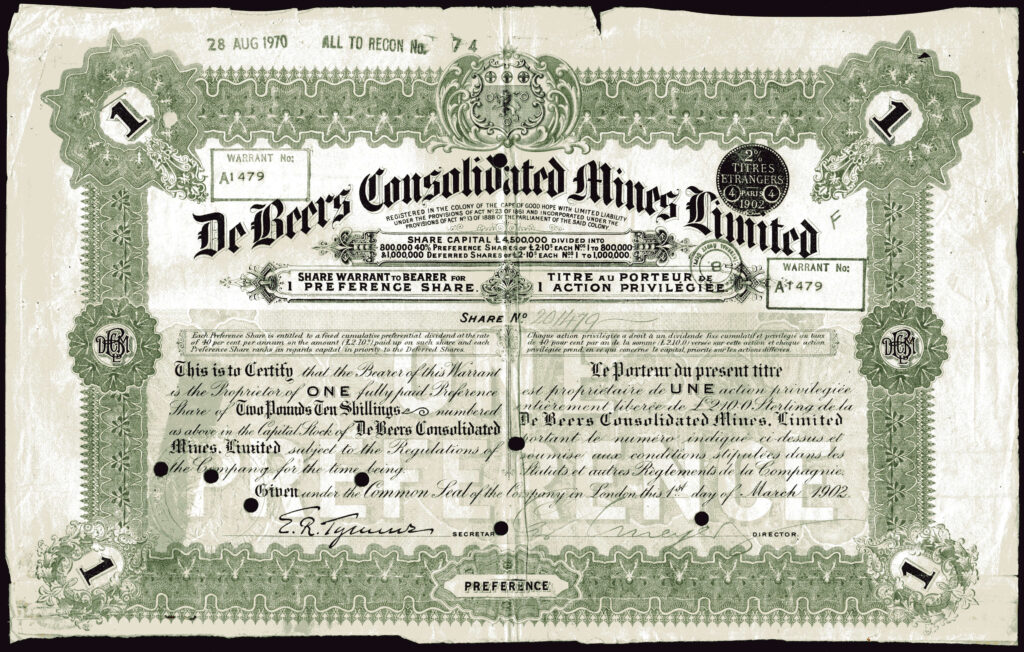

Here, for example, a 1902 privileged action with a equivalent of 2.5 pounds (in terms of today it is approximately 337 pounds or 400 euros).
But in the new millennium, the company began to lose influence. She faced many antimonopoly claims, which is logical. The extraction of diamonds has become more geographically diverse and more transparent. A global campaign began against “bloody diamonds”-obtained in conflict zones, for example, in Sierra Leone or Angola. It was these diamonds in the 90s that provided civil wars and the supply of weapons.
In 1999, the British non -governmental organization Global Witness released a report where she accused the diamond industry of financing wars. And in 2000, the UN report on Sierra Leone: it said that the rebels received from trade in diamonds up to $ 125 million a year.
Public opinion has moved. Hollywood looked at the industry in a completely different way. Instead of dreaming about the diamonds of the cold, Holly Golitli performed by a brilliant Audrey Hepburn, a weapon dealer, who is played by a no less cool Leonardo DiCaprio, was already hunting for a diamond in Africa.
The diamond industry in response launched the Kimberlian procedural scheme - the international certification mechanism, which was supposed to separate the "clean" stones from the "dirty".
The scheme was conceived as a filter: the participating countries promised not to sell or buy diamonds if they came from the conflict zone. But the Kimberlian scheme has several drawbacks. Firstly, it applies only to unprocessed diamonds, which means that it is worth clearing the stone of traces of the Earth and giving it to it-and its origin becomes almost impossible to track. Secondly, this filtering mechanism does not take into account state violence. Diamonds obtained, say, in Zimbabwe using slave labor under the protection of the army are formally clean. The rebels are bad. Repressive modes - acceptable. The Kimberlian scheme defines the military conflict as the struggle of the rebels with the legitimate government. It does not take into account repression, does not take into account the aggression of the state against neighbors, does not take into account corruption and seizure of the industry with elites. It is simply not designed for such cases.
Cartier and Tiffany leave Russia
Today, the diamond market has grown to tens of billions of dollars. And Yakutia, where those very Russian stones are extracted, is stably entered the three leaders in terms of prey. Diamonds wash, cut, polish, send. They pass after half the world before they find themselves in the window. Russian diamonds are still one of the highest quality, most coveted all over the world.
In 2012, the Russian company Alrosa began to cooperate with the legendary Tiffany & Co jewelry brand. Soon a long -term agreement was concluded, the parties were delighted with partnership. In 2013, ALROSA (deciphered by the Almazi - Sakha) reached an IPO, attracted more than a billion dollars of investment. By the end of the tenth, the company became the largest player in the market, mined more than a quarter of all diamonds in the world and increased momentum every year.
But February 2022. On the 24th, Vladimir Putin met with representatives of large business to reassure. Putin at this meeting also said: we remain part of the world economy. But, of course, everyone understood that the West would try to isolate Russia.
March 2022 - a month when McDonald's, Zara, BMW and Adidas left the country. Cooperation with Russian companies and jewelry brands stopped.
“Tiffany has stopped the supply of all unprocessed diamonds from Russia, as well as diamonds of Russian descent, regardless of where they are robbed and polished” is from an official statement. I broke off relations with Alrosa and Cartier. It seemed that the “Almazi - Sakha Almazes” lost the main markets - American and European. Where they live, their main consumers.
The share of Russia in the global diamond market in the region of 30%. That is, every third stone is obtained in Yakutia. At the same time, its share in the market for processed stones - that is, those very diamonds - only about 4%. And here it is very interesting to whom now we are selling our unsocrewed diamonds. As a rule, as a result, they find themselves in India, the world leader in the production of diamonds. And also China. But they find themselves there through an important intermediary.
In general, a good product always has a buyer, regardless of sanctions. Diamonds from Russia continue to enter world markets. First of all, through Antwerp.
Diamond capital of the world
This Belgian city is the Diamond capital of Europe. It has a whole diamond quarter. 84% of all unprocessed and 50% processed diamonds in the world pass through Antwerp.
There are no mines in Antwerp, there are no kimberlite pipes, there are no dust and explosions. Only neat office buildings with access through magnetic cards where people in gloves work. But it is here, in these clean offices, that stones get the price, name and ticket to a new life.
Of course, not every diamond has its name. Only outstanding - the size, shape, purity - get a name. Most often - in honor of a person, a natural phenomenon or by virtue of the geography of prey. “Kullinan”, “Our Light”, “Star of Yakutia”. My beloved is “a drop of the sun”. In general, it is a continuous poetry to read the Diamond Treasure Directorate as a booklet with the names of horses at the hippodrome.
Last year, one of the largest diamonds in history was found in Botswan, it is included in the first three. Almost 2.5 thousand carats, its cost is tens of millions of dollars, and they have not yet been given the name. But the reaction of the president of Botswan to the stone immediately became a meme .
Two larger diamonds are knocked out of the general list. The 342-chat crystal, which saw the light in 1980 and called ... "The twenty-sixth Congress of the CPSU." As you know, he received this name not in Belgium. But the recently obtained the largest jewelry diamond in the history of Russia. He is from Yakutia, amber color, and try to guess what it is called ... Okay, do not try. Diamond bears the proud name: "80 years of victory in the Great Patriotic War." Yes, yes, this is a name. Let's get back to Antwerp.
Diamond trade is concentrated in the diamond quarter - Diamond Quarter. Just a few streets next to the station. There are four diamond exchanges in this area-more than anywhere in the world. There are offices of more than one and a half thousand companies. From global traders to family workshops who are held on a single client, but for the third century in a row. Somehow in winter I walked around this quarter and for the first time I saw so many diamonds behind the bulletproof windows.
Safety here, by the way, as in the Ministry of Defense. Cameras, fences, armed patrols. Employees of private security agencies almost imperceptibly run around the district - and you will never know which of the passers -by carries a million dollars in the form of two tiny stones in the pocket. By the way, I recommend an excellent Uncut Gems movie with Adam Sandler about the difficult life of a New York jeweler.
Russian diamonds are one of the most valuable in the world market, and for many years Antwerp was their main window in the world. Officially, up to 35% of Alrosa exports passed through Belgian ports. Russian stones were sold here as “Clean Origin”, because according to the documents they are clean, mined not in the conflict zone, not under automatic. But reality, as we know, is more complicated.
In addition to the possibilities for trading, in Antwerp (it happened historically), diamonds can best treat. The city has become a diamond capital long before the industry has grown to a giant scale. Already in the 16th century, when the Netherlands, which then belonged to the territories of Belgium, were part of the Spanish crown, ships with stones from India began to arrive in the port of Antwerp. Then the diamonds have not yet been really polished. They were slightly polished and inserted into the crowns. But everything changed when Jewish masters-trusmen from Portugal and Spain who fled from the Inquisition moved to the city. They brought with them technology and a culture of working with a stone. Gradually, in Antwerp, the workshop system of cutting was formed, and the city became the main hub of Europe in the processing and sale of diamonds.
And although today part of the grinding has gone to India, Botswan and China, a prestigious cut in Antwerp still means a lot. Jewelry houses still mark their products as “Antwerp Cut”-this is a quality mark. But the main thing is why almost all diamonds of the world are still flowing into Antwerp-this is logistics and habit. Here are all banking services for stones. Here are lawyers, carriers, appraisers, certification laboratories. Here you can buy, sell, arrange, send and do not angry the tax. And all this is within the radius of four tram stops.
Therefore, following his logic by pressure on the Kremlin, Vladimir Zelensky in 2022 spoke to the Belgian parliament and separately asked the deputies to stop the import of Russian precious stones.
The ban on the import of Russian diamonds entered in January 2024.
"First Diamond"
The sanctions were introduced against Alrosa and its CEO Pavel Marinchev for the fact that the company has "long -standing partnerships with the Russian armed forces, since since 1997 it has been sponsored the submarine fleet of the Russian Navy." Although Marinchev also demonstrated in personal quality that he and Vladimir Putin are a whole.
The restrictions on diamonds from Russia were tightened in July 2024: since then, all diamonds weighing more than 0.5 carats must undergo physical testing of origin in Antwerp. However, the system based on the blockchain and intended for the complete transparency of the origin of the stones did not work. The timing of the launch of the system has been repeatedly postponed, and in the guild of the European Union jewelers in general doubt its realization. Now the EU plans to launch the mechanism since 2026. But, despite the efforts to create a system for tracking diamonds, in fact, everything is complicated. The Prime Minister of Belgium even spoke about this.
“That's it”, “Very soon”, “We are on the threshold.” But the system never earned.
In addition, in sanctions acts there are important reservations. The sanctions do not apply to the stones that were already located in the EU and third countries or were robbed in third countries before the prohibition entered into force.
This nuance has become a loophole that exporters began to use. When there is no transparent system of verification of the origin of stone, diamonds obtained in Russia easily go through friendly jurisdictions - Armenia, Emirates, India - and from there penetrate Europe and the USA in the form of “neutral” diamonds. And only then they get into instagrams of brides. Well, who, looking at such a video, will think about the origin of the stone on the ring. Most consumers are not so important .
And yet, let's analyze the path of “as prohibited” diamonds from Russia to world markets in detail.
As Arctida found out, in May 2022, even before the introduction of sanctions, the First Diamond Company was created in Russia. Her owner is Regina Sobol, a school teacher, also submitted in the documents as a former employee of the United Sales Company Alrosa. The first general director was Yevgeny Tsybukov, a former deputy director for sales in Alros Diamonds, the Moscow Grandmother's Unit of the main Alrosa. Formally, PBC is independent, however, its composition and activity indicate a close connection with a monopoly company in the diamond-use market.
And, by the way, Alrosa has three such gaskets. A little later, the Almaza Trade House and Trading Horizons were added to the PBK. They are also guided by the former employees of Alrosa, and everyone says that this is only a screen to continue the previous activities.
We will analyze in more detail the case PBK. Here is a blind on the knee site "The First Diamond Company". We read: “We successfully cooperate with the diamonds (so they call those who trade in precious stones) around the world, including the markets of the Middle East, India, China, Hong Kong, the countries of Southeast Asia and others. We consistently expand the base of loyal and reliable customers and form a reputation for a client -oriented business partner. ”
Indeed, the freshly built company quickly entered international markets. In fact, PBC became an instrument of Alrosa for the hidden export of diamonds bypassing sanctions. From January 2023 to March 2024, “First Diamond” exported diamonds for $ 290 million. This is 23 billion rubles. Compared to these figures, the official volume of Alrosa exports for the same period is tiny. 7 million dollars, half a billion in rubles.
The initial supplies of PBC went to Armenia, which did not join anti -Russian sanctions. Armenia has become a transit zone: according to the Center for the study of corruption and organized crime (OCCRP), almost half of the diamonds imported into the country come from Russia. Further, the products went to the UAE, India and China. Where the origin of the minerals closed their eyes.
There is a whole network of firms leading from Alrosa to KGK Group. KGK Group is one of the largest international players in the diamond industry. The company was founded in 1905, headquarters in Hong Kong. It has offices in 35 countries-in New York, Antwerp, Dubai, around the world. What else is important: KGK is a vertical company: "From deposits to a window." They get and polish, and sell. Pass intermediaries, control the chain, adapt faster. Until 2022, KGK publicly collaborated with Alrosa - long -term contracts for the purchase of diamonds were signed. After the start of the war, the KGK deleted all the information about their work in Russia from the site.
Но одно дело – минимизировать репутационные риски, а другое – реально разорвать отношения с давним и очень выгодным партнером. На второе, судя по всему, руководство KGK Group не решилось.
Я перечислю несколько контрагентов «Первой бриллиантовой компании». (Не забывайте, ПБК – лишь прокладка для «Алросы»).
Империал Даймонд – крупнейший контрагент ПБК. С 2023 по 2024 год они заключили более 100 сделок. Директор Империал Даймонд – Павел Винихин, бывший руководитель двух структур «Алросы».
Gloria Gems Trading – компания из Индии. Это третий по объему и частоте сделок партнер «Первой бриллиантовой». Она связана с компаниями из группы KGK, а также с фирмами в Бельгии и Эмиратов.
Mohit Diamonds – еще один индийский трейдер, закупивший у ПБК алмазы на сумму свыше 90 миллиардов рублей в 2024 году. По корпоративной информации, 20% продукции Mohit Diamonds продается в США, 8% – в Бельгию. Это говорит о реэкспорте российских алмазов в страны, прямо запрещающие такую торговлю.
Mohit Diamonds и Gloria Gems ведут от российской «Первой бриллиантовой» к KGK. Да, с введением санкций, дорога российских алмазов на мировые рынки удлинилась. Добавилось несколько промежуточных пунктов, наверняка выросли логистические затраты. Но все это – трудности преодолимые. И, как мы видим, преодолеваемые. «Алроса» при помощи ПБК продолжает торговать камнями.
Именно ограненные и полированные алмазы (добытые в России и обработанные в третьих странах) остаются уязвимым звеном: в этом сегменте сохраняются лазейки, позволяющие обойти все формальные запреты. Так что санкции против «Алросы», по крайней мере пока, носят скорее символический характер. Вся схема – от ПБК до международных трейдеров – построена на слабых местах международного контроля.
Казалось бы – все остались при своих и довольны. Но не совсем. Павел Маринычев, гендиректор «Алросы» жалуется – его компания переживает тяжелые времена. Но трудности эти связаны не с изоляцией, а с падением цен на алмазы.
Этот кризис достаточно глубокий. Если посмотреть по продолжительности, то уже второй год подряд мы фиксируем неизменное снижение цен. Мы сейчас, конечно, в таком достаточно непростом состоянии находимся… И наша задача, конечно, пережить, переждать этот период, дождаться, когда цены снова будут расти.
А начальник управления международного сотрудничества «Алросы» Петр Каракчиев говорит так: «Санкции, которые, как задумывали наши противники, должны были на нас серьезно повлиять, не достигают необходимого, по крайней мере, для них, эффекта» . И открытым текстом заявляет – технического решения для изоляции российских алмазов нет, а потому компания активно будет продолжать работу на международных рынках.
What do we have in the end? Экспорт российских алмазов из России в страны Европы продолжается (через более сложносоставные цепочки), несмотря на формальный запрет. Сеть компаний-прокладок, формально независимых, но на деле связанных с «Алросой», позволяет поставлять миллионы долларов на западные ювелирные рынки. Центральную роль в этом процессе играют трейдеры из ОАЭ и Индии, а также такие транснациональные структуры, как KGK Group.
На мировом же рынке – Маринычев прав – кризис. Низкие цены и значительные запасы, накопленные компаниями, делают добычу невыгодной. Она снижается, но цены не растут. У этого много факторов – и гигантские запасы индийских огранщиков, и обвал на китайском рынке предметов роскоши (кажется, за бриллиантами китайцы едут в соседние страны, где можно сэкономить), и даже последствия пандемии. Развивается и индустрия искусственных алмазов. Эксперты говорят, что поколение Z гораздо больше внимания обращает на экологичность и социальные условия добычи алмазов, а потому молодые люди часто предпочитают синтезированные камни природным минералам.
Но все же паники в индустрии нет. Уж очень хорошо постаралась «De Beers» и слишком глубоко в мировой культуре сидит идея: бриллиант – символ вечной любви. Даже и не знаю, хорошо это или плохо. Да, любви иногда требуются вещественные доказательства. Часто – однообразные, набившие оскомину. Цветы, письма от руки, украшения. Вроде бы пошлость, а в то же время – ничто не пошлость, когда влюблен.
Так что за невест во всем мире можно оставаться спокойными. Их пальчики по-прежнему будут украшать камушки, несущие след якутской шахты. Вот только женихам во всем мире этот знак любви будет теперь обходиться дороже.
To be continued.