
Translated material
Sleep on winter night
The premiere of the performance by Kirill Serebrennikov “Metel”, according to the story of Vladimir Sorokin, was held at the Salzburg festival. Says Natasha Kiseleva
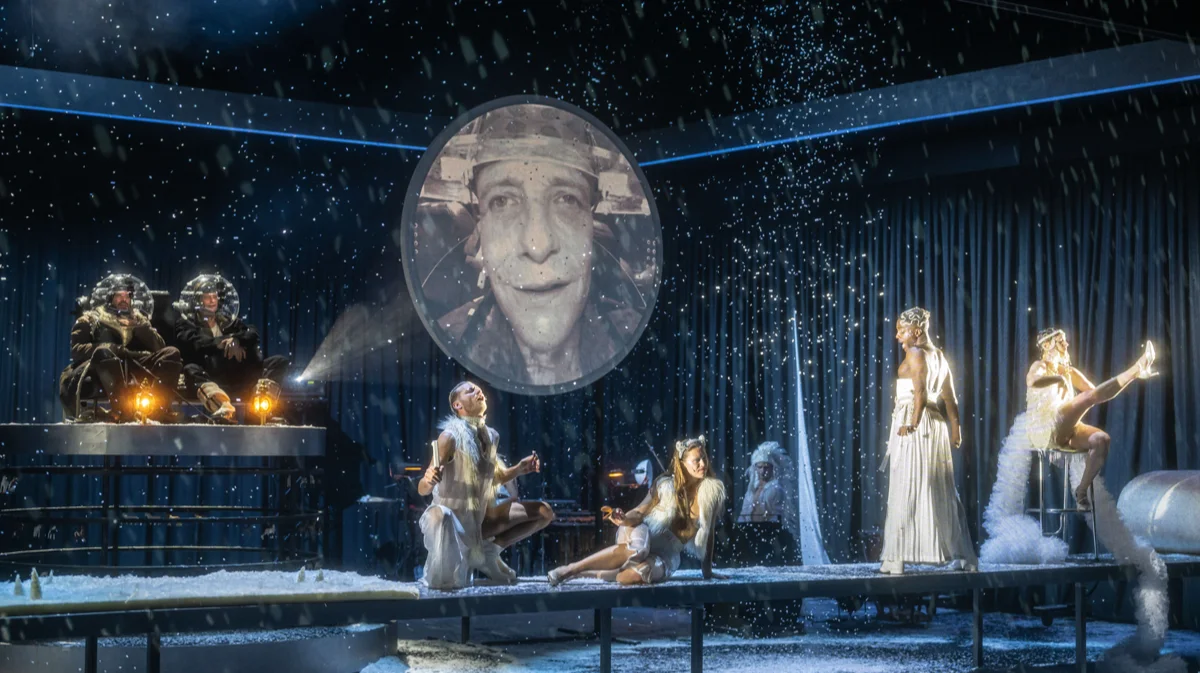
Photo: Franz Neumayr / Albert Moser / Action Press / Vida Press
A half an hour from the respectable Salzburg is a small town of Halline. There is a perner island in it, where in the 19th century a giant salt plant worked, and in the early nineties a huge galvanic hall was turned into a festival scene - for those who do not fit into the usual theatrical framework. It was here, where the walls remember the smell of salt and the hum of electric baths, Kirill Serebrennikov presented his “blizzard”.
The basis was the story of the same name by Vladimir Sorokin, stylized as Russian classics according to all the laws of metamodernism. The Zemsky doctor Plato Ilyich Garin goes to the far village to instill residents from the epidemic of the Bolivian “chernukha”, which turns people into zombies. There are no free horses and wagons at the station, but he manages to persuade Kozmu Kozma’s bakery, nicknamed Perchush, to carry him on a sled-samoches, drawn by fifty horses the size of a partridge. According to calculations, the road should take an hour and a half, but suddenly the blizzard begins.
The first on the way of wanderers is the house of Melnichikhi Taisiya Markovna. The fragile figure of the actress Barbara Shmykova is sharpened in a foam costume reminiscent of Venus Villendorf, the first artistic image of a woman in history. The monolithic archetype of a Russian woman skillfully sculpts from the Mill of Shmykov: rude and affectionate, imperious and humble, desperately looking for love in his hard share. A shy force lives in it, dualism incomprehensible to it, before which a doctor, nor a blizzard itself can stand either. It "drink more vodka. I’ll put you upstairs, and Kozma - on the stove ”sounds like a new version of the cultural code“ Bring us, boy, we fly home. ”
Mill, “this sweet woman”, Garina beckons, although all his thoughts are occupied by the lover of Nadin (she is played by the German actress Sonya Beiswenger), the classic “beautiful woman and in profile”, she is either a phantom, then a blizzard, then a sidom of a pre -war Berlin decadence. Then Shmykov will dissolve in the play: it will become part of the snowstorm, a snowman in a special clothing with a windbreaker, a nymph in Burleska with rhinestones on the nipples, will repel taps in an evening dress. But the hot embrace of the mills will still not let the viewer go to the end.
“For me, this is the most difficult performance in life,” says Varya, when we call up the next day, “we are all multi -artists here. Plus, I play in German, which I do not know. But working on this performance was a pleasure. With Cyril you are in maximum co -authorship, and not just fulfill the director’s task, it is very valuable and nutritious for the artist. It creates an atmosphere in which it is impossible not to open up. ”
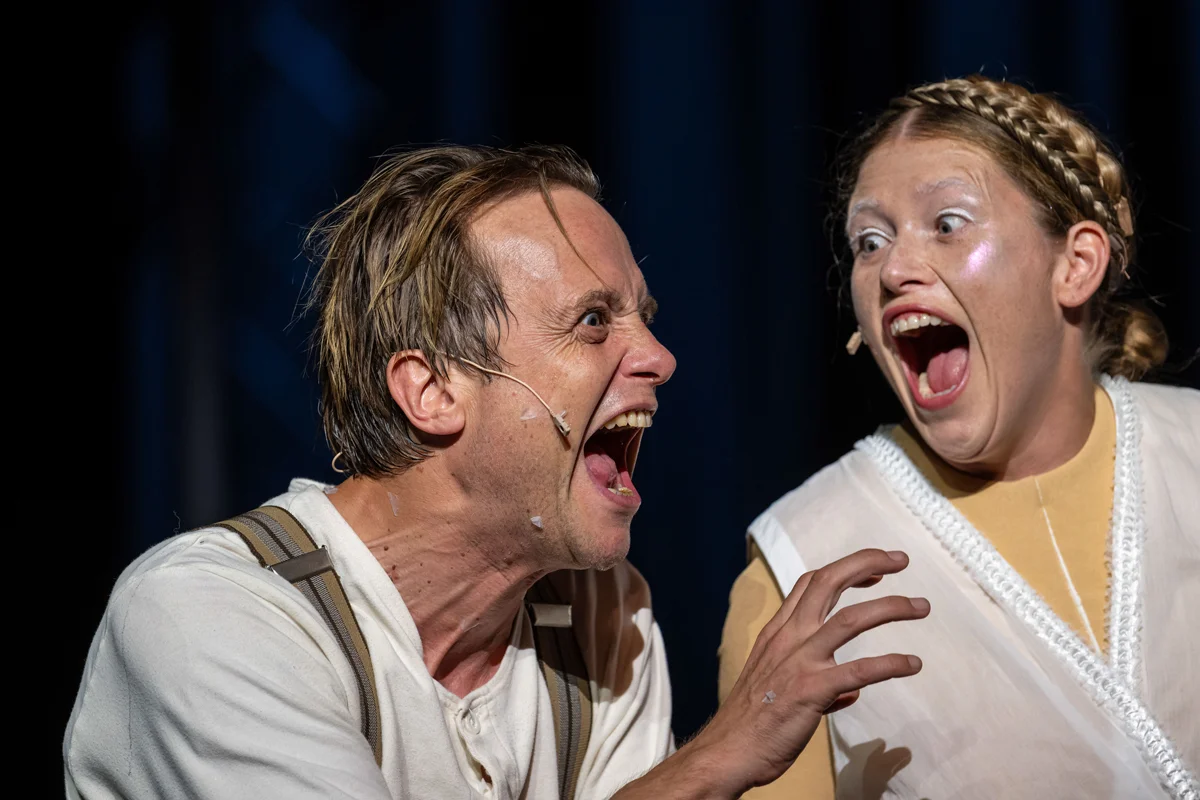
And in the story and in the play, a blizzard is one of the characters. She sings songs in German and speaks with the doctor, she is played by one actress, then several at once, and sometimes everyone who is on the stage. Theatel provokes, seduces, knocks down the path, calms, experiences, hugs, deceives and ultimately kills. At some point, it becomes a theatrical language (already with a small letter), because there is no other explanation of multi-formatism impending on the viewer. This is a storm of genres, including cinema, puppet cartoons and medical experiments.
The story of Sorokin was published in 2010, and Serebrennikov revised her into a play under the storm of a new reality - including his own, so Plato Ilyich has a German.
The cast, like the whole team, is also Russian-German.
The role of Dr. Garina is played by August Dil, a world star and a reference example of a classical German acting school, one of the most powerful in the world. It is famous for a combination of psychologism and respect for the actor: a deep study of the role retains the distance between the artist and the character. In a recent interview, we talked about this with the quartermaster of the Berlin Comic Opera. Before us is a master of loud silence. It was this ability that made it for several minutes in the “inglorious bastards” of Tarantino cult: in the stage of the tavern, Major Gestapo is extremely polite and relaxed, but the viewer has frost on the skin. He was also arranged by Woland in Master and Margarita Lokshin, the devil appears in the smallest details. Or in the "Secret Life" of Terrens Malik, where Dil plays a real person, the hero of the resistance of Franz Jaherstetter. A farmer from Upper Austria, who refused to swear to Hitler and serve in the Wehrmacht, was executed by a guillotine. Dil almost does not utter speeches, everything is clear without words.
But in the "snowstorm" we see the artist of a completely different structure - merciless to ourselves. His acting game resembles a rabid and torn sixth symphony of Mahler: he explodes and spreads into fragments in each scene, I seem to have not seen such self -destruction even among Russian artists. When the travelers get to the “vitaminers” and the doctor accepts the “new product”, the foster shift of the stopwatch is launched on the screen - four minutes of a narcotic trip. And in real time, Dil lives this trip so that I want to run out of the hall and call him an ambulance. After a second, he is already joking that the goods are excellent and he will take two, and in the burning scene at the stake he will smash again. It was impossible not to ask the director how he achieved this metamorphosis.
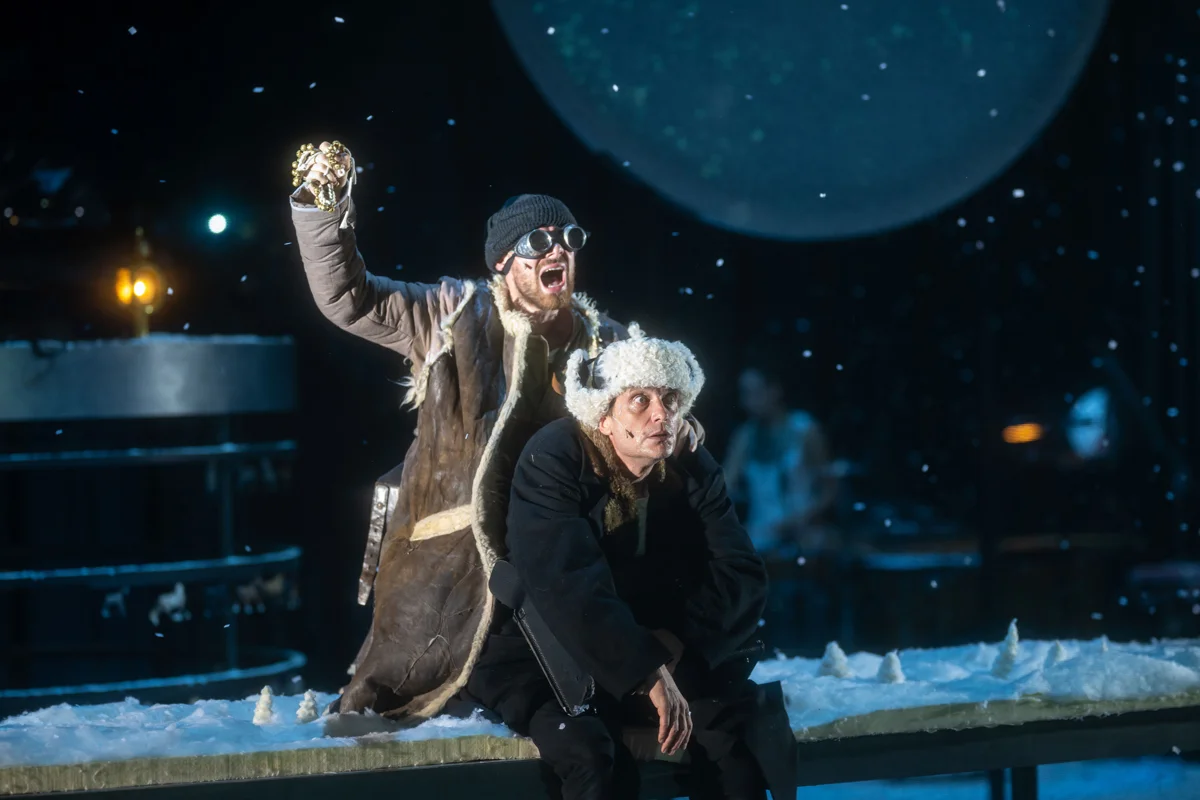
“Augustus received an injection of the Russian theater school, his first big role was Treplev in Chekhov’s“ Seagull ”,” Serebrennikov explains. - He worked a lot with serious classics, for Peter Stein and other masters, where the German tradition and the Russian psychological school met. But I would say this: there is a school named after August Dilya, there is a school named after Philip Avdeeva. Each large artist claims his own school, just as every director is his own system. Both Philip and August, they are about “to be”, and not “seem”. We coincided with this. An amazing paradox: in such a conditional business as theater, we are looking for authenticity and truth. Even when I wrote the play, I understood: it will be the perfect Match, because we have three in this sense one group of blood. ”
Between the actors on the stage, a really tangible chemistry: two opposite characters merge together, confrontation of the elements. The role of the coachman Perhushi is the most difficult even for such a chameleon as Avdeev, whom the European public has managed to love over the past three years. After the premiere, Philip jokes that his main acting task was just to survive:
“From the point of view of endurance,“ blizzard ”is like a three -hour cardio training, but also with a huge volume of text: you need to be the most included.”
Perkhusha holds the whole performance in the winter sheepskin coat, and each time, being behind the scenes, the actor is saved by ice. In Salzburg there was heat at thirty degrees. Philip, of course, is modest: his level of game changes the very hierarchy of roles. Perkhusha ceases to be a secondary character and comes to the fore with the doctor and the blizzard itself. In fact, in the play two main characters - he and Garin. After the premiere, the leading actors of European theaters approached Serebrennikov to ask them to introduce them to Avdeev and they could thank him personally, this is worth a lot.
Music in the play exists on equal terms with the elements.
The score of the composer Alexander Manotskov gives a vote of snowstorms in the songs in German and bursts into the numbers of the Berlin cabaret of “roaring twenties”, sheds the tears of the audience in a piercing song to the mother of Serebrennikov’s poems. Actor Mikhail Polyakov performs it a chapel in Russian, like an ancient folk tuning:
*Better if you, touching,
I didn't give birth to me
It would be better to death, mother,
Yes, sentenced.
Brued B at sunset
You, Chudila,
Brown B, for God's sake
In the black grave.*
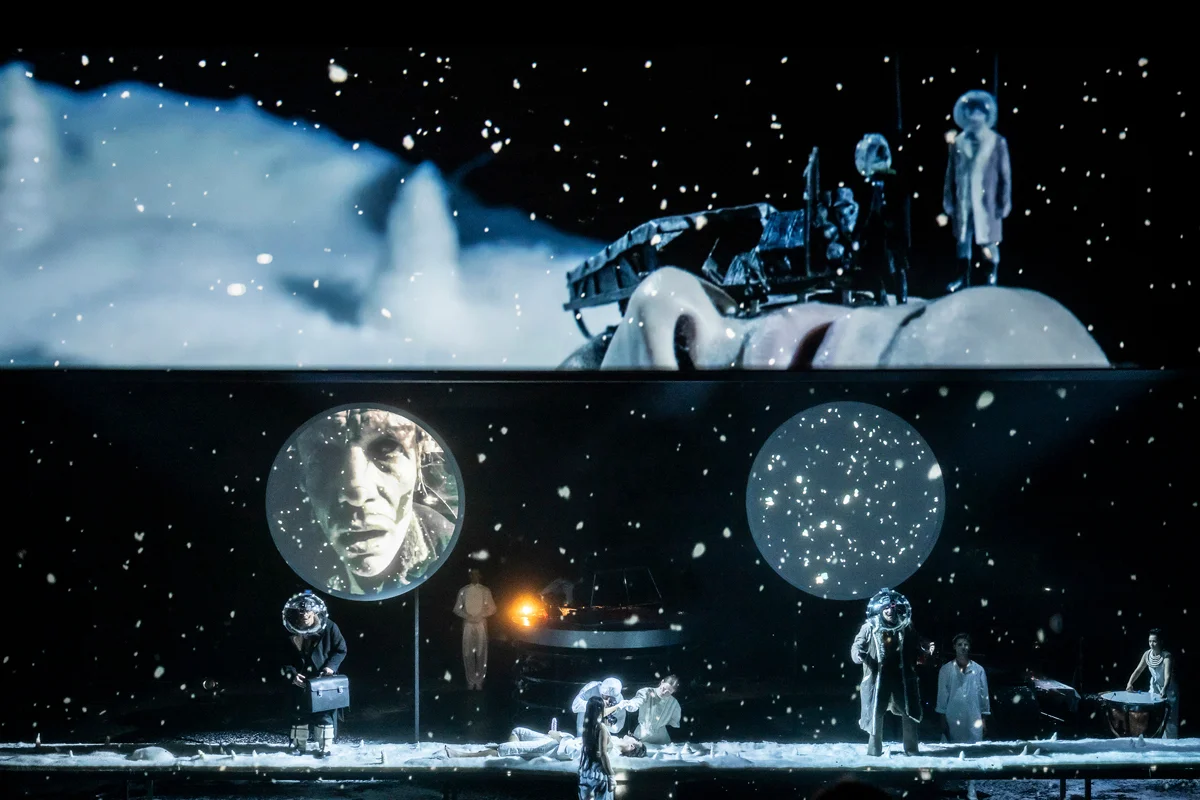
The European viewer will see global and universal topics in the “blizzards” - the loss of control and landmarks, very relevant now for everyone, without exception, and the spoiled theatrical astes will find new forms and levels. The performance was created in the co -products of the Salzburg festival and the Düsseldorf Drama Theater (Düsseldorfer Schauspielhaus) , where the “blizzard” will go in September after festival shows.
We discussed the audience potential of Meteli with Birgit Leners , the German playwright of the performance and a member of the Hudsel Drama Drama Drama Drama:
“In the text of Sorokin there are many references to the Russian“ blizzard ”tradition, the experience of incomprehensible Russian endlessness and spontaneous power of nature. Of course, there is no such experience in a small and densely populated country as Germany. As Perhusha says, in the German analogue the word “dumbbell” does not exist. In my opinion, interest and even craving for such artistic works in Europe are huge. This is not only a search for beauty and ambiguity with Serebrennikov, in his works he always seeks to push the boundaries of the genre. For the viewer, this is an artistic expedition to unknown spheres. ”
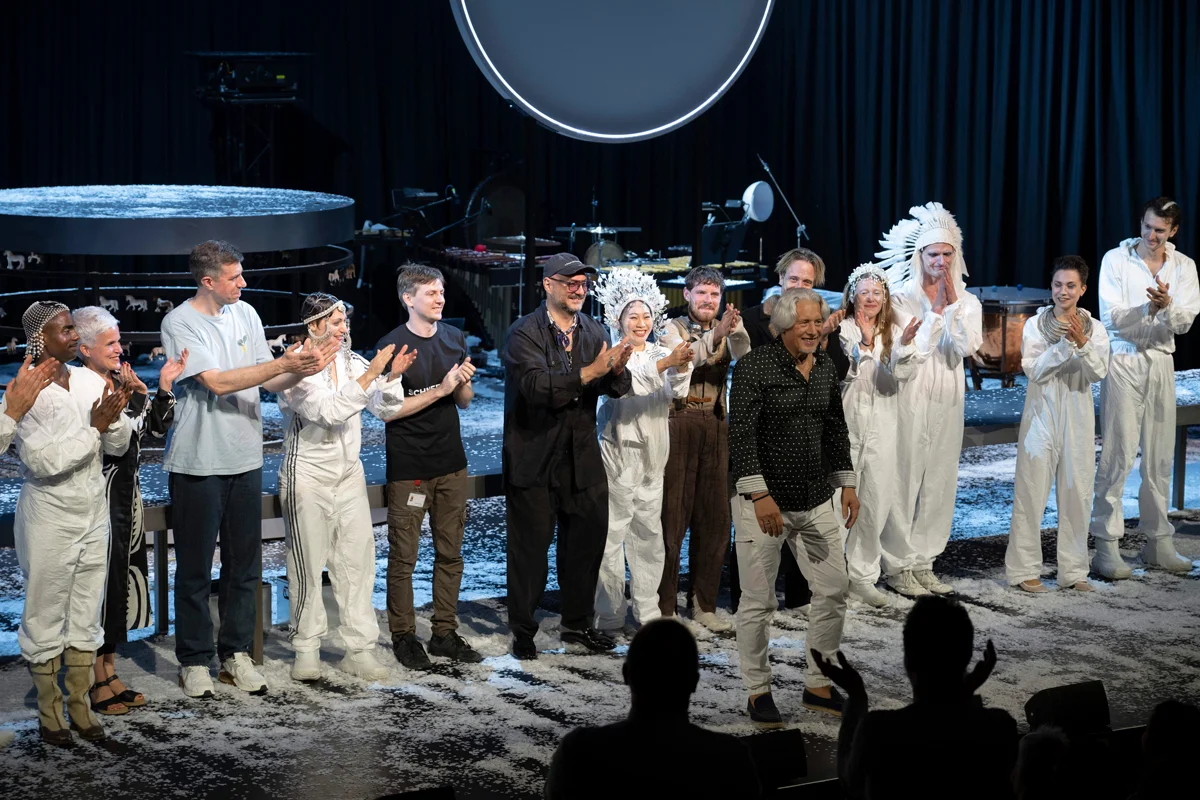
These words are confirmed by a long standing ovation at the premiere and Sold Out at all shows in Salzburg.
For the anti -war Russian audience, which was formed in these three and a half years in Europe, there is another layer that Sorokin did not think about fifteen years ago and which, perhaps, does not consider the European public. One of the most important dialogues of the main characters sounds like this:
Garin: Kozma, tell me, brother, what is the most important thing for you in life?
Perhusha: Main? I don’t know, the master ... The main thing is that everything is okay.
Garin: What does it mean - okay?
Perkhusha: Well, so that the horses are healthy, so that there was something to buy bread ... Yes, and so that withoutilment.
Garin: Well, well, let's say that your horses are healthy, you yourself are also healthy, there is money. What else?
Perkhusha: And I don’t even know ... I thought to have an apiary somehow. If only there were three houses.
Garin: Suppose you started an apiary. What else?
Perhusha: And what else do I need!
Garin: Is it really not that you are interested in anything else?
Perhusha: I don't know, master.
Garin: Well, so that you want to change in life?
Perhusha: In his own? And nothing. We are happy with our lives.
The Zemsky doctor, I recall, ek -through the sake of vaccination from “chernukha”, turning people into zombies. But today this is not a fantasy, but reality - this epidemic is called this: “I don’t know, the master, what else can I want, we are satisfied with our lives.” And she reached an uncontrollable scale, more terrible snowstorms. In fact, now we are all to some extent collective Plato Ilyich Garin, who have lost the way along the road to the village of long, we make our way every day it is not clear where on self-propelled sleighs drawn by horses the size of a partridge. It remains only to believe that the blizzard will end, and the road will really bring somewhere.
The shows at the festival in Salzburg are on August 16 to 26, in Dusseldorf - September 11, 12, 14, October 31, November 14.