Date
Author
Видеоотдел «Новой газеты Европа»
Source

Preserved copy
Translated material
Graceful land
How did Venezuela create a dictatorship with the help of Russia? The premiere of the film "Novaya Gazeta Europe"
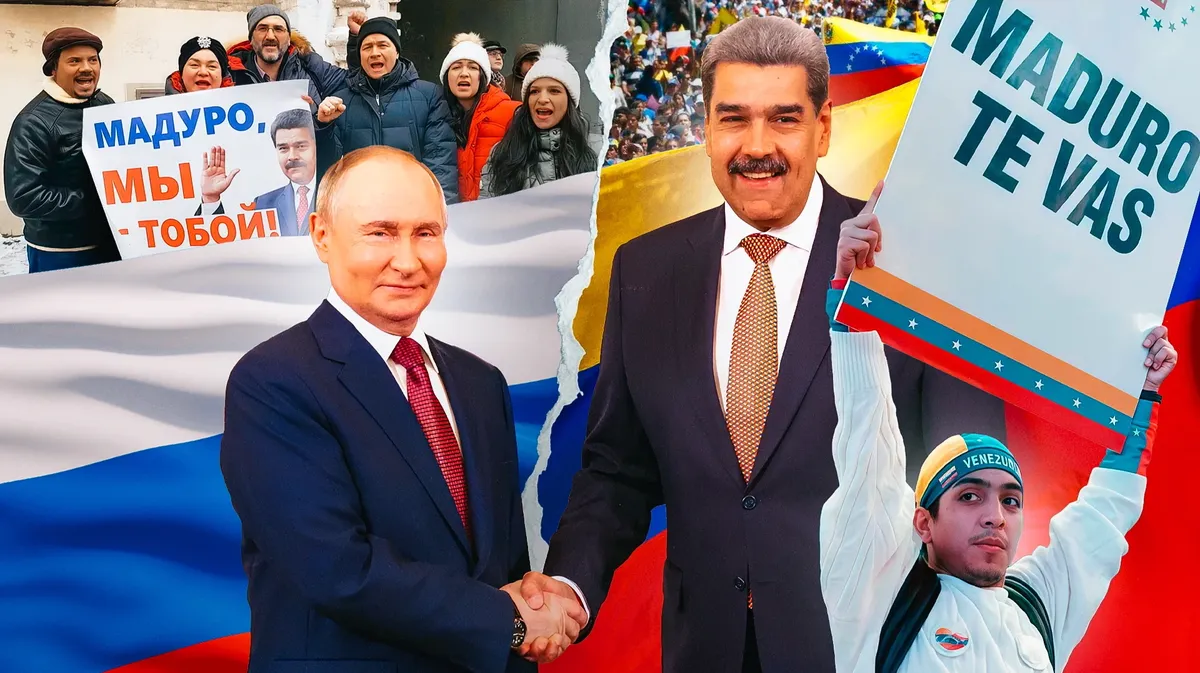
On September 8, Venezuela President Nicholas Maduro announced the mobilization of 25 thousand military for the protection of the border. The reason was a confrontation with the United States, which worsened after Donald Trump ordered a boat belonging to the Venezuelan cartel in the Caribbean.
The day after the announcement of the mobilization of the military to protect the border, Maduro appeared in an interview with RT. In it, he actively speculated about the causes of attacks on his country by the United States and called Russia one of the flagships of a multipolar world. The friendship of Moscow with Karakas is important to both countries, and Putin helps Maduro to stay in power, sending weapons and supplying the regime with technologies to survive opponents. The correspondent of Novaya Gazeta Europe, Kirill Buketov, went to the United States to talk with politicians, activists and simple refugees about how Venezuelan society copes with the emigration of more than a quarter of the population and how Putin helped Maduro to destroy the country and simultaneously enriched both his and alien elite. The film is entirely available on the channel of Novaya Gazeta Europe.
Protests and repression
In the summer of 2023, Maria Korina Machado conducted a campaign to collect signatures for the nomination in the presidential election next year. One of those who supported the leader of the Venezuelan opposition was Joannelis Figeroa. On that night, the house with her husband and four children came to the house, the security forces came.
“They put a gun to my son’s head. It was terrible, I screamed. I thought they would shoot my child. They [security forces] said that I was protesting against the government. After that, they turned my house and demanded $ 150, ” says Joannelis.
The girl paid money to the security forces for three months, but in November a bribe in order not to be killed, increased to $ 500. Yoannelis did not have this money.
Thousands of people who wanted to vote in 2024 for opposition candidate Maria Korin Machada, were in prison or disappeared after the visits of the security forces. The situation of Yoannelis was even worse: her family members work officials in the Venezuelan government. They knew that the girl did not share their views, and her participation in protests could damage their career under Maduro.
In Venezuela, repressions against disagreements have been taking place for several years. According to the UN and on other estimates , since 2014, about eight million people fled from the Latin American country. Shortly before that, in April 2013, Maduro came to power, launching a wave of repression.
Now almost every fourth Venezuela lives abroad.
After the security forces began to extort more money from Joannelis, she collected things, sold what she could, and fled from the country that evening. She decided to head with her family in the USA.
“The neighbor dropped us at the terminal, and we went to the border with Colombia. There, in Colombia, we stopped for two days at my sister, waiting for a transfer of money, and then went to the jungle, ” says Johnelis.
To get out of South America, Venezuela migrants need to go through the Dariven gap between Colombia and Panama - it is called the most dangerous border in the world.
In addition to impassable jungle, in which it is easy to get lost, animals are dangerous for migrants. The “gap” is controlled by cartels requiring the entrance fee: for example, Yoannelis paid $ 3,200. Ten days later, she and her family managed to reach Mexico, along the way to which the girl was forced to pay bribes to border guards.
By the time of crossing the border with Mexico, Yoannelis had no money left. Within eight months, they, together with their husband, earned in low -paying positions that allowed the family to move from village to village north. After several months of waiting in an attempt to obtain permission to official entry into the United States, she decided to illegally cross the border.
“We drove from Mexico City to a small village where we sat on the La Bestia train - a train with a zero level of security. We had to climb on his upper and stay on him all the way. If you fall, you will die. I tied the children and attached them to the pipe. I did not sleep, because the children could slip, fall and die. We saw how three people fell and died, ” says Joannelis. In the end, the family was in the United States, where about a million Venezuelans already lives.
One of those who oppose Maduro and remains in the country despite repression is the politician and activist Hesus Armas. He heads the organization “Citizenship without restrictions”, which fights for access to water for residents of Karakas. The lack of complete digitalization in Venezuela helps him to hide from the regime.
“I have to move from home to house every four to five days. I can't use the machine. I cannot move like an ordinary person. In addition, I have to change my number. I have a SIM card that is not connected with my name. There are more than 200 people like me, and we adhere to strict security measures so as not to be captured by Maduro, ” explains Armas.
Later he was seized and secretly taken out at night. In December 2024, the Venezuela authorities confirmed the detention of Hesus, and two days later they transferred him to the El Gelicoid prison-an unfinished shopping center where torture is practiced. According to the stories of former prisoners, there are no light, water, toilets, soul and beds, and people periodically die. For six months now, no one knows what is happening with Armas, and his friends and relatives are trying to achieve information about his condition.
Putin is in touch
On August 3, 1498, Christopher Columbus in an attempt to find gold sailed to the shore of the Paria Peninsula (part of the territory of modern Venezuela). He called the found territory "Blessed Earth" (Tierra de Gracia). After 500 years, Venezuela really managed to become a fertile land. Oil and other natural resources generously provide a state treasury, Maduro uses an endless oil stream to withhold power.
The main ally in this resource trade is Russia. The Kremlin supplies a huge amount of weapons to Venezuela, for Moscow, Karakas is the largest buyer throughout the continent. Almost a hundred T-92 tanks, Su-30 fighters, Mi-35M and Mi-17 fighters were sold to Venezuela.
The total amount of contracts has been exceeding $ 10 billion for six years. In December 2018, Russia sent two Tu-160 supersonic bomber to Venezuela to conduct exercises with the participation of local pilots.
A noticeable achievement of cooperation between Venezuelan and Russian elites is a Kalashnikov assault rifle. In 2006, Hugo Chavez posed for cameras, holding AK-103 in his hands-a special modification that Izhmash made for the Venezuelan army. He wanted to bring the main Russian machine gun to the country from his first visit to Moscow in 2001. And five years later he managed to do this.
Cooperation between Russia and Venezuela is also at the political level: they developed a strategy for mutual support, which officials do not even hide. For example, since 2000, Venezuela has never voted against Russia's projects in the UN General Assembly, but spoke for all 36 Russian resolutions, mainly in combating Nazism, cybersecurity and intervention in internal affairs.
The same applies to 59 resolutions on human rights in which Russia has participated since 2000 - Venezuela has always held a position identical to the Kremlin. In resolutions against Russia there is the same picture: in Syria there were 10 of them, in Georgia - 12, in Crimea - 7, and everywhere Venezuela vanesul voted identical to the Russian Federation.
Now the main projects of Karakas and the Kremlin imply cooperation in the nuclear energy, and attempts to introduce Venezuela into the BRICS, and raising the largest banners of victory in the world.