
Translated material
There is always the one who ruins the frame
How and why the Armenian authorities are trying to take control of local cinema

Monument to the film "Men" in the Saryan Square in Yerevan. Photo: Oksana Misirova
Over the past 30 years, the Armenian film industry has experienced a lot of shocks. The collapse of the Soviet Union, the Karabakh wars and the economic crisis of the 1990s led to the fact that over the decade, the entire cinema network of the country was practically destroyed. Over the same period, the number of films shot barely reached two dozen. At the beginning of the zero, the situation began to gradually improve, but now the numbers look quite modest. Today in Armenia six cinemas work in Yerevan and one room in Vanadzor, Gyumri, Kapan, Berde and Kajaran - the level of moviegoing is comparable to Georgia, but is noticeably inferior to Estonia, comparable in terms of the population of Estonia with its 50 cinemas and 80 screens. Nevertheless, this turned out to be enough for a small, but active industry, making a bet on low -budget comedies and love dramas.
If in the early 2000s five to six films were shot a year, today the number of premieres has grown to 15 full-length paintings annually.
It is noteworthy that, according to the data on cash fees in the Armenian film distribution in the mid -2025, the first three positions are occupied by local films, bypassing both American and European innovations in popularity. The cinema state support system was reformed after the 2018 revolution: the reorganized “National Cinema Center” began to integrate into European joint financing systems and prepare a legislative framework for this. From this moment, the practice of co -products with European state and private funds began to develop in Armenia. The similar reform took place in neighboring Georgia 10 years before, which ultimately led to several generations of filmmakers working with European producers and actively presented in the competitive programs of the leading world festivals. In 2025, Armenian cinema was involved in the Berlin Film Festival, and Tamara Stepanyan became the opening film of Locerno. In 2023, the documentary "1489" Shokagat Vardanyan received a reward at one of the largest documentary cinema views - IDFA in Amsterdam. Although not all these successes can be directly connected with the activities of the cinema center, the dynamics of recent years suggests that the Armenian copyright cinema has chosen a course on integration into European cinema.
However, the reform carried out last year, within the framework of which the government again reorganized the film center to the film fund and began to change legislation in the field of film production, caused resistance to the professional community. The authorities began to rebuild the film distribution system by introducing rental certificates and creating ethics commissions designed to evaluate the “moral correspondence” of films. Now a number of measures in the field of financing are being prepared, which, according to critics, can turn the government into a monopoly filmmaker. The proposed bill, according to his opponents, is able to seriously undermine the independence and creative freedom of the industry, to jeopardize the work of private film studios and international cooperation. The combined unions of filmmakers as part of the working group prepare a package of amendments to the document.
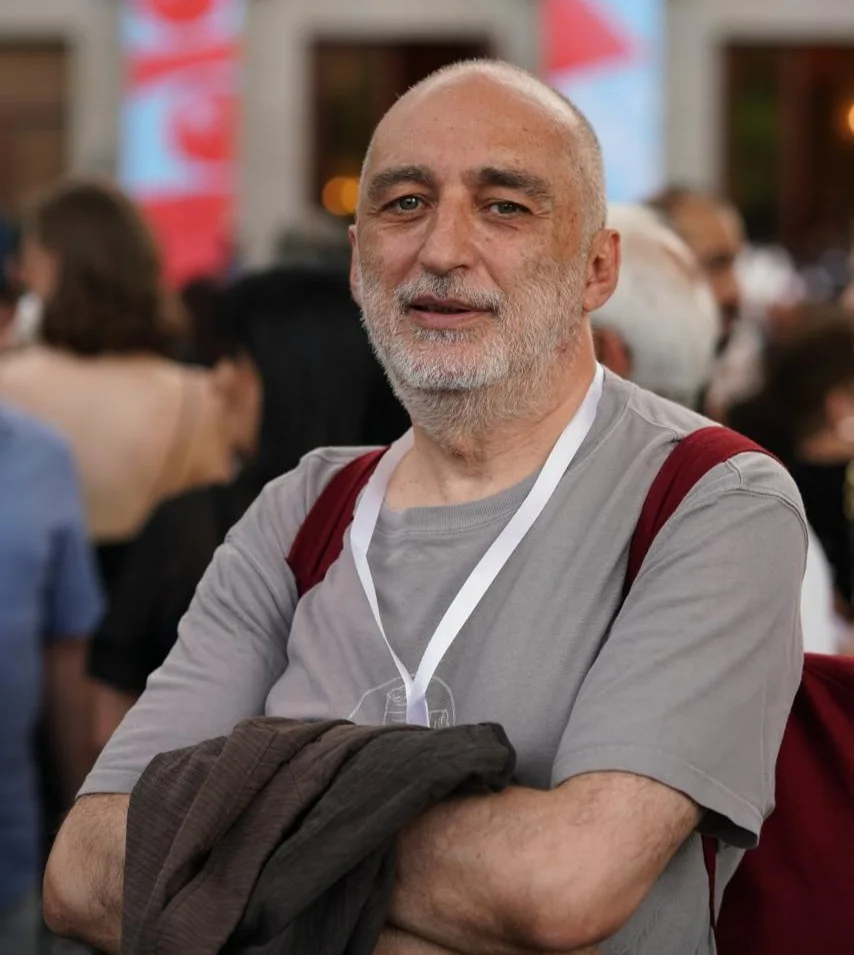
"New" spoke with producer Melik Karapetyan about the state of cinema in Armenia, his possible future and the choice between integration into Europe and strengthening the role of the state.
- Let's see the background of the question. What was this cinematography law adopted in 2021?
- The reforms themselves in film production began in 2018, when the conditions for obtaining financing and the participation of international partners were enshrined. If you evaluate this period, then it can be considered positive. The question is rather that new edits are offered and what are the conditions under the laws after 2024.
The state creates a situation in which he has a privileged monopolist producer represented by the film fund. It is the film fund that will independently create films. In addition, it is proposed to take part of the rights from film companies. This contradicts European practice: in Europe there is no tradition of transferring rights to the film to state organizations in exchange for financing. In fact, this can close our way to European funds. We will not pass according to the criteria for the transparency of financing, as well as author's freedom, which are important when working with organizations from the European Union.
- If we recall the amendments adopted earlier this year regarding the control of the issuance of rental certificates and the appearance of commissions that should control not only for films, but also for any festival film screen, does this not look like an attempt to create a censorship mechanism?
- The law on rental certificates, in my opinion, does not work: cinemas still show films without them. Since the republic does not have its own film rolling companies, it is not clear who should receive these certificates at all. If the film fund has a desire to make a movie, then what is the film fund as an organization, whose goal is the distribution of state financing?
As for censorship, in the cinema, I often hear similar fears. Censorship is prohibited by the Constitution, and so far we have not seen it in practice. Another point: if earlier the decision on financing was made by members of the professional commission - industry specialists, theoretically independent - now the final word remains with the board of directors of the film fund. In this case, it is not clear why experts are needed in the commission. For some visibility?
- What reaction followed from the community of filmmakers?
- Representatives of the film industry, participating in the discussion of the law, were outraged by the fact that, despite the negative decisions of the commissions, no changes were made in his final version. Months of consultations and discussions were actually ignored. Associations and guilds of cinema workers made open criticism. Currently, a public group has been formed, calling for the Ministry of Culture and Sports to return to the discussion and cancel the adopted amendments.

- What, in your opinion, causes such actions by the authorities of Armenia?
- It seems to me that this is a manifestation of the incompetence of people involved in the legislation. Many of them, unfortunately, have no experience in film production and do not understand how European cinema functions. And I believe that this is the only opportunity for us: while we cannot make films on our own, we need European partners to make the author’s cinema in Armenia. In Georgia, this scheme gave excellent results.
Everything that the government does seems strange to me. This is like a Bolshevik approach when the state itself creates films and has a large state film studio. This fact shows that officials do not understand the reasons why the state allocates money, and the criteria for evaluating films. But the problem is actually not only this. This is also the problem of our cinema community, which, in my opinion, all these years have not learned to engage in lobbying. Instead, we go up with each other and spend a lot of time and effort on it.
- Despite this, we can say that in general, the state of Armenian cinema is improving?
- I think for such a small country as ours, making 15 films per year is a good indicator. Moreover, most of them are created without state funding and counts exclusively on payback at the expense of the audience. The genres of these films are most often simple comedies, but there are also historical bayopics dedicated to significant persons of the past. With a small number of cinemas, it is difficult for them to take risks, so they repeat the proven model: to remove an inexpensive comedy and try to recoup it.
The problem, however, is in another: in the country there is practically no system work with data on film distribution. Statistics on the sold tickets, the number of cinemas and the number of films released over the year is simply not available. As a result, we, in fact, do not understand what is happening with us. How can you make plans and develop if you don’t even know how many films in the country are produced annually?

- In parallel with this, in Armenia there are many vivid documentary works that critically describe life in the country and are increasingly obtaining recognition on global filmings. Why did this genre become a haven for copyright cinema?
- On the one hand, documentary projects are cheaper, on the other hand, they give the authors the opportunity to show individuality. As the director Tamara Stepanyan once said,
"Documentary cinema is a movie of a trauma person." The authors tell stories that deeply excite and disturb them.
But only in the country there is actually nowhere to show a complex movie, not only documentary. We do not have distribution systems for such projects, and TV channels do not take them.
When we released our Chnchik production project several years ago, the cinemas did not show much interest in him, despite the premiere at the prestigious festival in Busan. It was difficult for us to get even a few sessions. In addition, the problem of disseminating information about the film arose: we do not have specialized media devoted to cinema, and film critics in destroyed state does not have its own platform and financing.
When the viewer does not have access to a complex movie, the very opportunity to create it is gradually fading away. In addition to financing problems, there are difficulties with technical training and originality of topics. It is still difficult for the authors to go beyond the limited circle of plots and worldview. For comparison: in the same Georgia, a breakthrough in cinema became largely possible thanks to the reforms of Mikhail Saakashvili, including a sharp transition into English. This allowed us to speak the same language with Europe and adopt international experience. However, Georgia has traditionally treated cinematography more seriously: there, its representatives are able to turn everyday problems into high -level artistic images. Almost all of their paintings are created within the framework of European co -products - otherwise it is almost impossible to survive for a small country.
- Can the situation arise that the new legislation will only aggravate the problems of Armenian cinema?
-We had outstanding directors, but many, especially young ones, left the country in the difficult 90s. For example, Anna Melikyan and Masha Sahakyan, who later became famous Russian directors. The same emigration took place in the USA and Europe. In recent years, a lot of work has been done, which gave the first results within the country. The appearance of Armenian films this year at large festivals is not an achievement; To form an interest in our cinema and create a new wave, you need to go a long way. Our industry, in fact, is in its infancy. And the decisions that the government make do not reflect our reality, they do not meet the requests that puts the cinematic community. Spectators do not need a Gosmonopoly for cinema, they need complex stories talking about the world around them. This is confirmed by the success of the film by Shokagat Vardanyan on the film locations and the attention of the republican media that it had.
Vladimir Kocharyan