
Translated material
Great Complete and rebellion against rebellion
Fernando Bothero: “When I start writing a dictator, I have to get around with paints very gently”

Fernando Bothero. Photo: Boris Horvat / AFP / East News
Two years ago, Fernando Bothero, one of the most famous and commercially successful contemporary artists, passed away. The painting of the Colombian Picasso is presented in the meetings of the largest world museums, and its sculptures are decorated with the streets of New York, Barcelona, Yerevan, Almaty and other cities. Bothero works are recognized immediately due to the attractive completeness of the characters. In his paintings there is no dramatic conflict or tragedy. Their "recipe" is calm, harmony and goodwill.
The path to recognition was thorny. The general public fell in love with Bothero much earlier than the professional community. Art critics and critics for years refused to accept his works seriously, but the artist stubbornly sailed against the art-Mainstream. Bothero paintings and sculptures are easy only at first glance. In many ways, his work is a reaction to sharp changes and shocks that survived the world in the twentieth century. Sorin Brut talks about the fate of Bothero and the ideas of his works.
Emigrant in space and time
An early interest in culture played a cruel joke with the future artist. At the Jesuit school of Medelin, where he was born, they considered his essay to Picasso to impermissiblely “secular” and immediately expelled a freethinker. As a child, Fernando was fond of Corrida and even studied at Matadora. But then the craving for creativity overpowed-the drawings of 16-year-old Bothero were already published by the popular El Columbiano newspaper. A few years later, a novice artist was lucky: he won the second prize at the IX Columbian Art Salon, sold all the paintings from his exhibition and received money for education. Bothero went to Europe to see the originals of his favorite works, which he knew only from reproductions.
The old light made it possible to dive into the boiling environment of contemporary art, but Bothero neglected it. His attitude to the current currents will continue to be at least wary, and his interlocutors will become a master, tested for centuries.
He preferred a visit to the Prado Museum at the Madrid Academy of San Ferno. In Paris, he did not get out of the Louvre. To get to the works of the masters of the Renaissance scattered through the Italian cities, he traveled the whole country on a motorcycle.
Italy Fernando was especially impressed by Pierro Della Francesch, Paolo Extreme and Giotto. Generalization and geometry of images, monumentality, emotional restraint - these features of Bothero idols will eventually become elements of his own handwriting. For several years, the artist absorbed the cultural wealth of the Old World. I wanted not so much to find the original manner as mastering skill. Such a priority is also a sign of mismatch with modernity, which appreciated the novelty and author’s style above professionalism. His artist will work out, but first will survive a great disappointment.
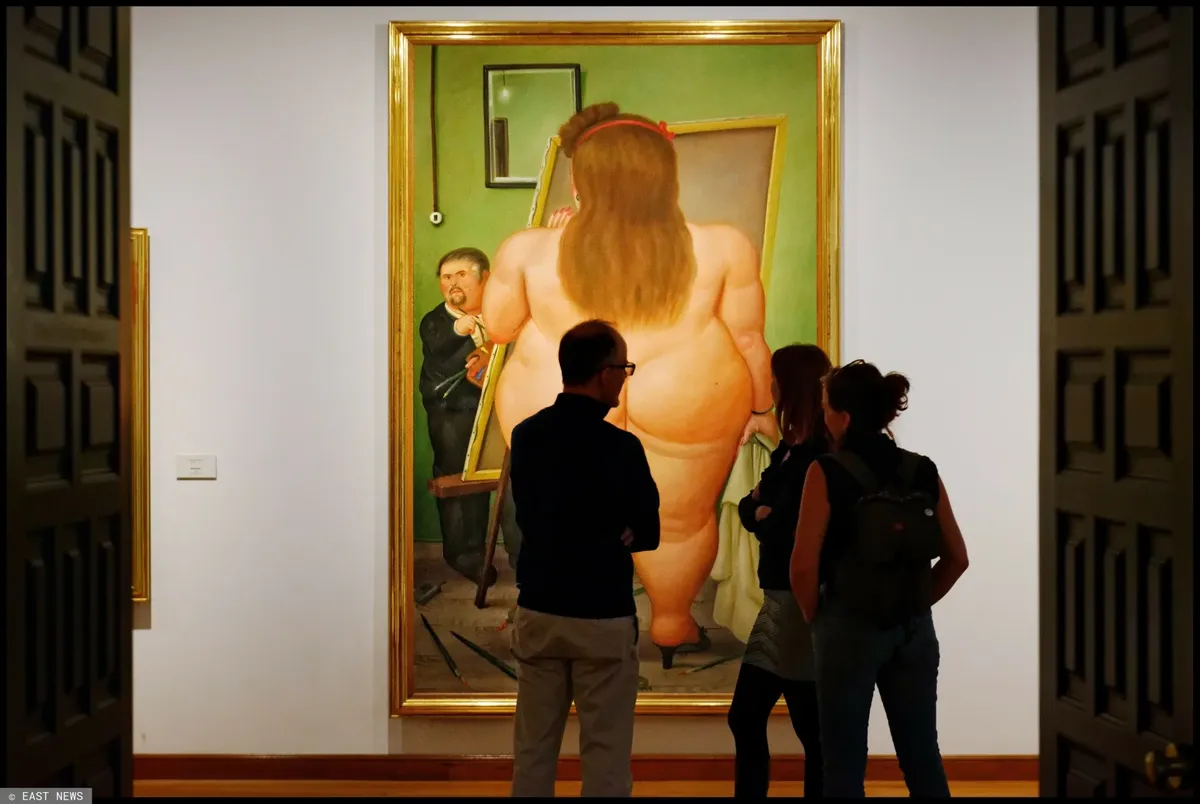
Returning to his homeland in 1955, he puts up new paintings-and suffers Fiasco. The audience is not at all interested - he considers the work of Fernando as old -fashioned and alien to the Latin American spirit. Not a single buyer was found on the works of the author who once gave the hopes of the author. For several months, Bothero even had to earn money by selling tires. In 1956, he married and immediately went to the progressive Mexico, where the name Frida Kalo recently thundered, Rivera and Sikeros were created. It is believed that Bothero's breakthrough occurred there. This is partly true, although many constituent elements of the author’s manner were found before - in the Italian revival.
In Mexico City, Bothero writes "still life with Mandolina." The tool on the canvas seemed to be swollen and swollen, and its wide hole clenched to two slots. So the artist realized that the desired monumentality of the image can be achieved by exaggerating the volume and at the same time reducing some details. This is an important component of the aesthetics of mature work Bothero.
His “branded” full people will certainly have small eyes, noses and mouths, and the decoration of corporate ladies and objects in their hands will be miniature.
In the second half of the 1950s and in the 1960s, the artist has several exhibitions in the United States. At home, they monitor his successes and are already considered a star of contemporary art - they even appoint a professor at the National University of Colombia (at 26). Nevertheless, at the end of 1960, Bothero decided on emigration in the United States, where only a few are known to his name. I had to pay for the risk almost immediately - the marriage broke up. The painter was in a foreign country almost without money and language, in the early years in New York, he did not have and suffered from loneliness. However, good luck also happened. In 1963, the Museum of Metropolitan showed the famous Mona Lisa. Bothero often rewritten classic canvases in his own way. Among them was Mona Lisa at the age of 12. The resourceful director of the Museum of Contemporary Art (MOMA) acquired the work of the Colombian and immediately put it up - this funny dialogue with Leonardo da Vinci attracted attention to Bothero.
However, the New York art community was in no hurry with hospitality. The press and the public liked the artist, but critics did not constrain themselves in expressions. So, one of the authors called the typical character of the picture of Bothero with a fruit conceived by Mussolini in the womb of an uncouth peasant woman. Partly hostility was explained by the artist’s reluctance to fit into the American trends-the Colombian kept away from the fight of abstract expressionism with pop art and stubbornly defended his own vision of art.
From the second half of the 1960s, his affairs still went uphill-popularity grew both in the States and in Europe. Then the Bothero style finally took shape, gravitating to neopimitivism. In the early 1970s, the Personal Personal Exhibition goes on a large tour of the cities of Germany. The fashionable American Gallery "Malbore" begins to cooperate with him. Gradually, Bothero becomes not only known, but also rich. The Latin American boom in literature also played into his hands. Then Fernando began to systematically engage in sculpture.
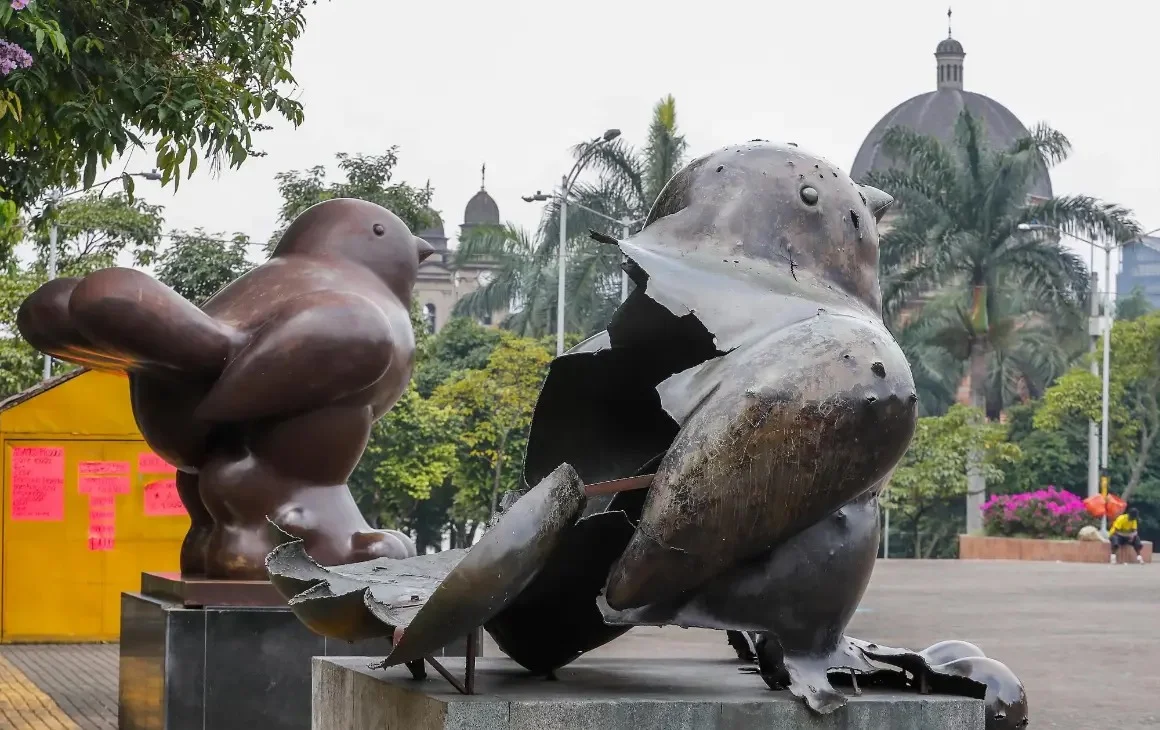
In the life of the artist there were tragedies. In 1974, his little son Pedro died, and then a second marriage broke up. Bothero later married the Greek artist Sofia Varya and lived with her for 45 years. Partners passed away in 2023 with an interval of several months. In 1994, when Bothero arrived in Bogota, he was almost abducted by terrorists. A year later, next to his sculpture “Bird of the World” in Medelin, an explosion occurred, which claimed the lives of 27 people. At the request of the artist, the work crippled by explosives remained in the same place, and next to it appeared its exact copy. The attacks on Bothero were connected with one of his sons - a major Columbian politician. For a long time, Fernando could fly to his homeland for only a few hours due to a terrorist threat.
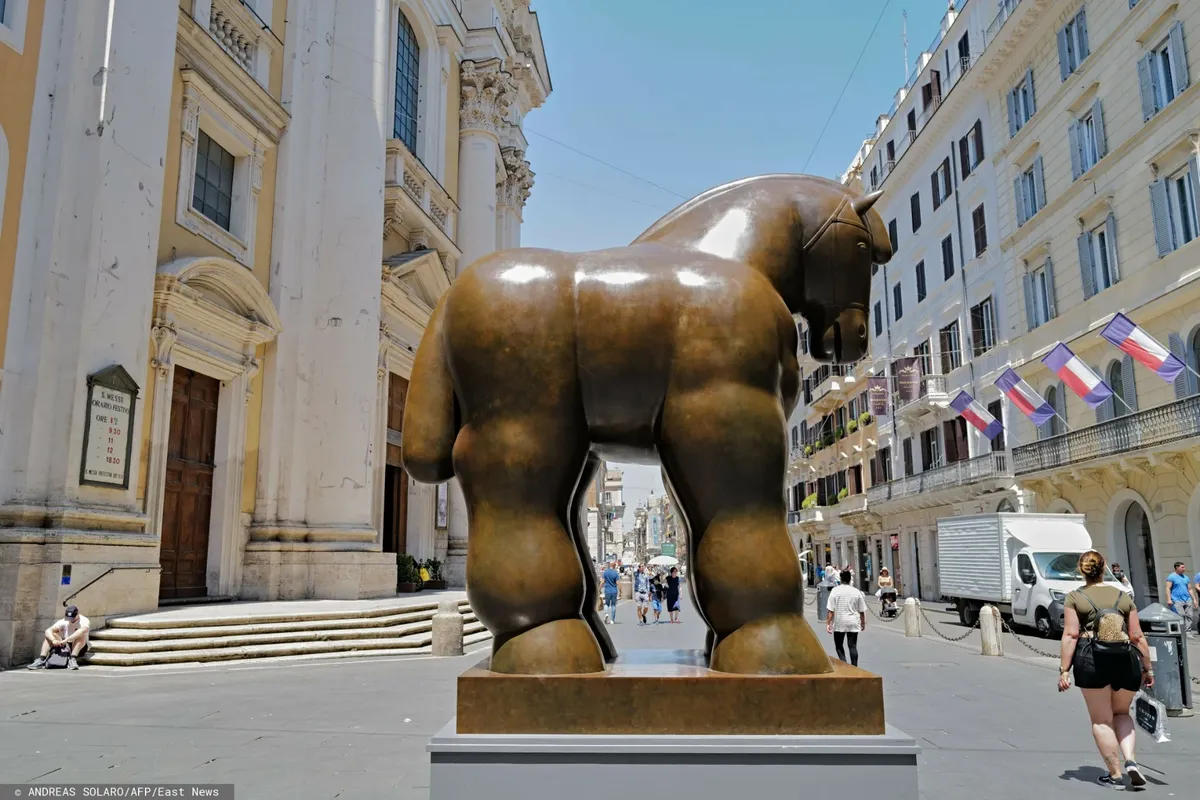
But creative recognition was only growing. His work was exhibited by the main museums of the world. Monumental sculptures were exhibited on the Champs Elysees in Paris, Avenue Park in New York, Boulevard Castellan in Madrid and the Roman Forum. Bothero himself worked daily. All his houses were equipped to solve various creative problems. The artist also moved between them according to a strict schedule. So, in Monte Carlo, the master was engaged in graphics (spring), in Tuscany-sculpture (summer), and in New York and Paris-painting (autumn and winter).
Equality. Balance. Love
Completeness is the constant of the arto art. Everyone is corporate in his works - men, women, children, pets, objects in still lifes. Even the mountains and crowns of trees are softened by roundness. The heroes of the artist are emphasized inherently - sometimes contrary to biography and status. The Pope Leo X (variation on the topic of the portrait of Raphael) looks like a giant child who is confused by unexpected attention to himself. The generals from the military junta, who should inspire horror, resemble the twin brothers of the brave soldier Schweik. Bothero’s slightly unpretentious, eccentric puffs are presidents, intellectuals, even archangels and saints, as well as demons. Its ballerinas are not elegant in the generally accepted sense, and the Matadors are far from the stereotypical macho athletes. Jesus Christ on the Ecce Homo canon (1967) is also not canonical - bruises and bruises are depicted on a “human, too human” body.
The artist’s works for this feature are often called caricatures. But there is no ridicule in them. Rather, Bothero rejects the very principle of idealization, repeling the individual from his own nature. The artist affirms equality in co-dodgy. But, having unleashed the ideal, he re -gives the characters monumentality. So the creature in its imperfection gains significance.
The heroes of Bothero are alien to the stormy passions and in general every tear. The emotional spectrum varies from quiet joy to quiet sadness. The feeling of peace reinforces the rounded forms of bodies.
Exaggerated outwardly, internally the characters of the artist, on the contrary, are balanced. They seemed to have caught the rhythm of the world and, in accordance with it, built their own balance.
Bothero is not a happy owner of pink glasses. In his paintings, Pablo Escobar, Latin American dictators and torture appear, which the American military were subjected to Iraqi prisoners (the Abu Graib series). Bothero writes the scenes of violence with restraint. The executioners are the same "rounded" people. It is important here to understand the logic of the artist, who explained: “When I begin, for example, to write some dictator, I have to treat the colors very carefully and gently-in a sense, this is a love action. Painting turns hatred into love. ”
Riot against the rebellion
One of the important elements of Bothero creativity is the numerous variations of classic paintings processed in his manner. The artist has his own “Monas of Lisa” (several), “Arnolfini couple” along Van Ayka, portraits “Following Pierrot Della Francesca”, Perifraza Van Gogh, Caravago, Rubens and, finally, there are many “dialogs” with Velazquez and Pierre Bonnar. In his own way, rewriting the masters of the past, Bothero breaks the stereotypical perception of the masterpiece-removes it, re-reviving and spiritualizing it.
The painter acts as the antipod of his contemporary Andy Warhol. The ancestor of the pop art played according to the rules of time, took the role of a “converieur artist” and created “circulation” works. In fact, he visualized that the philosopher Walter Benjamin called the loss of aura technically reproduced art. Bothero, on the contrary, tries to return the liveliness of a classic with a copy of the classics.
The fullness of his heroes is an attempt to solve the same problem. Their flesh is full of life juice. The skin swells from hidden natural power. Bothero people are “fertile” in their organics.
The work of the Colombian is often called, as it were, ignoring the era. But rather, he answered her challenge. He just rebelled in his characteristic manner - he did not shout slogans, but stubbornly bent his “opposition” line. One of the leitmotifs of culture of the twentieth century is the conflict of man with nature and himself. In part, he expressed himself in a radical attitude to progress and attempts to rationally rebuild both society and the individual. Each collective utopia, whether it be communism or national socialism, had its own variation of a “new person”. The personal utopia of the American dream essentially different from them less than aesthetically. External and internal nature was rejected for the sake of ideal, and life was subordinate to the logic of the struggle for it and against the inert, unkind world order.
The art of Bother is a rebellion against rebellion. With one hand he debunk the ideal, with the other-returns the “prodigal son” home, to a co-derivative existence.
The artist denies the attitude to the fight and speaks of the complex path of conscious adoption of life in its imperfection and fragility. Hence the balance and the enlightenment of his reality grow.
The quiet conflict of Bother with the progressive mainstream is especially noticeable in its sculptures inspired by Paleolithic Venus, Egyptian art and Greek archaic. Those who have found a place in megacities, they look miraculously surviving statues from an ancient temple - alien in a new life. However, the townspeople like it - and this is not surprising. Bothero sculptures show a world living according to more humane laws. I would like to break out of the “suicide race” in the shadow of cold glass high -rise buildings. The artist’s works act like himself: at their point of space, they turn aggressive dynamics into a harmonious dialogue with reality. But the metropolis is also tried to appropriate them - makes the islands of harmony to resting the gaze, which will soon focus on the far, requiring the conquest of the goal.
Sorin is brot