
Translated material
“Dossier”: Navalny could have been poisoned for the first time in 2017
According to investigators, on trips between Moscow and Kirov the politician was followed by a group of at least seven FSB officers
The first attempt to poison Russian opposition leader Alexei Navalny could have occurred at the beginning of 2017 in Kirov, during the retrial of the Kirovles case. This is stated in the investigation of the Dossier center.
Court hearings in the Kirovles case began on December 5, 2016, and a week later Navalny announced his intention to run for president in the 2018 elections. In February 2017, the politician was sentenced to five years probation and a fine of 500 thousand rubles. With an outstanding criminal record, Navalny could not participate in the elections.
In order not to miss new texts from “Layout”, subscribe to our telegram channel
Navalny was monitored by a group of FSB officers
According to Dossier investigators, a group of at least seven FSB officers followed the politician on trips between Moscow and Kirov. It included officers who later participated in the operation to poison Navalny in Tomsk in 2020. It is assumed that the special services began preparing for an attack on Navalny in the fall of 2016. In particular, on October 18, Stanislav Makshakov, the future leader of the Tomsk group, and his subordinate Mikhail Kuklev came to Kirov.
Already in December 2016, Navalny was accompanied by FSB officer Sergei Filippov. Since January 2017, he was joined by employees of the Institute of Forensic Science and the Second Service of the FSB: Alexey Alexandrov, Konstantin Kudryavtsev, Alexander Samofal, Alexey Krivoshchekov, Valery Sukharev and Roman Mezentsev.
The second service of the FSB specializes in ensuring public order and security.
The first signs of poisoning and versions of the investigation
The Dossier notes that the participation of seven employees and two more possible performers at once was an unprecedented case. This suggests that it was during this period that the intelligence services could have used Novichok for the first time.
In 2020, Navalny himself recalled a strange episode from one trip in 2017. “An hour after takeoff, I broke out in a cold sweat and felt very, very sick. It's so bad that I'm about to die. Since I was all wet, I barely made it to the toilet, where I washed my face with cold water. I sat for 15 minutes, and everything went away,” the politician said.
According to the Dossier, the surveillance stopped only towards the end of 2017, when FSB officers known by name stopped appearing near Navalny. But investigators do not rule out that they could have been replaced by other officers, whose identities have not yet been established.
From the Kirov case to the poisoning in Tomsk
In August 2020, Navalny was poisoned while visiting Tomsk. He spent some time in a coma and subsequently received treatment for a long time in Germany. Experts found traces of a Novichok-type toxic substance in his body.
Navalny claimed that he was poisoned on the orders of the Kremlin. The investigation conducted by him and his associates established that a group of FSB officers was allegedly involved in the poisoning. Russian authorities denied involvement in the assassination attempt.
Death of Navalny in a colony on Yamal
After completing treatment in January 2021, Navalny returned to Russia, where he was immediately arrested at the airport and was never released. At the beginning of August 2023, the Moscow City Court sentenced the politician in the so-called “extremist case” to 19 years in a special regime colony. Navalny served his sentence in a colony on Yamal.
The Russian Federal Penitentiary Service for the Yamalo-Nenets Autonomous Okrug announced the death of Navalny on February 16, 2024. According to the department, the politician “felt unwell after the walk, almost immediately losing consciousness,” and resuscitation efforts did not produce results. The politician's mother was unable to receive his body for several days.
On September 17, 2025, the widow of the politician Yulia Navalnaya stated that his supporters managed to obtain and transport samples of Navalny’s biological material abroad. Two independent laboratories concluded that he was poisoned, Navalnaya claims, but she does not provide details.
“Layout” previously found out that Colonel Stanislav Makshakov, who was called the head of the group for the Novichok poisoning of Alexei Navalny, was appointed head of the FSB Institute of Forensic Science (military unit 34435, NII-2). According to the Unified State Register of Legal Entities, Makshakov took charge of the institution on April 23. Before that, he served as deputy director of the institute.
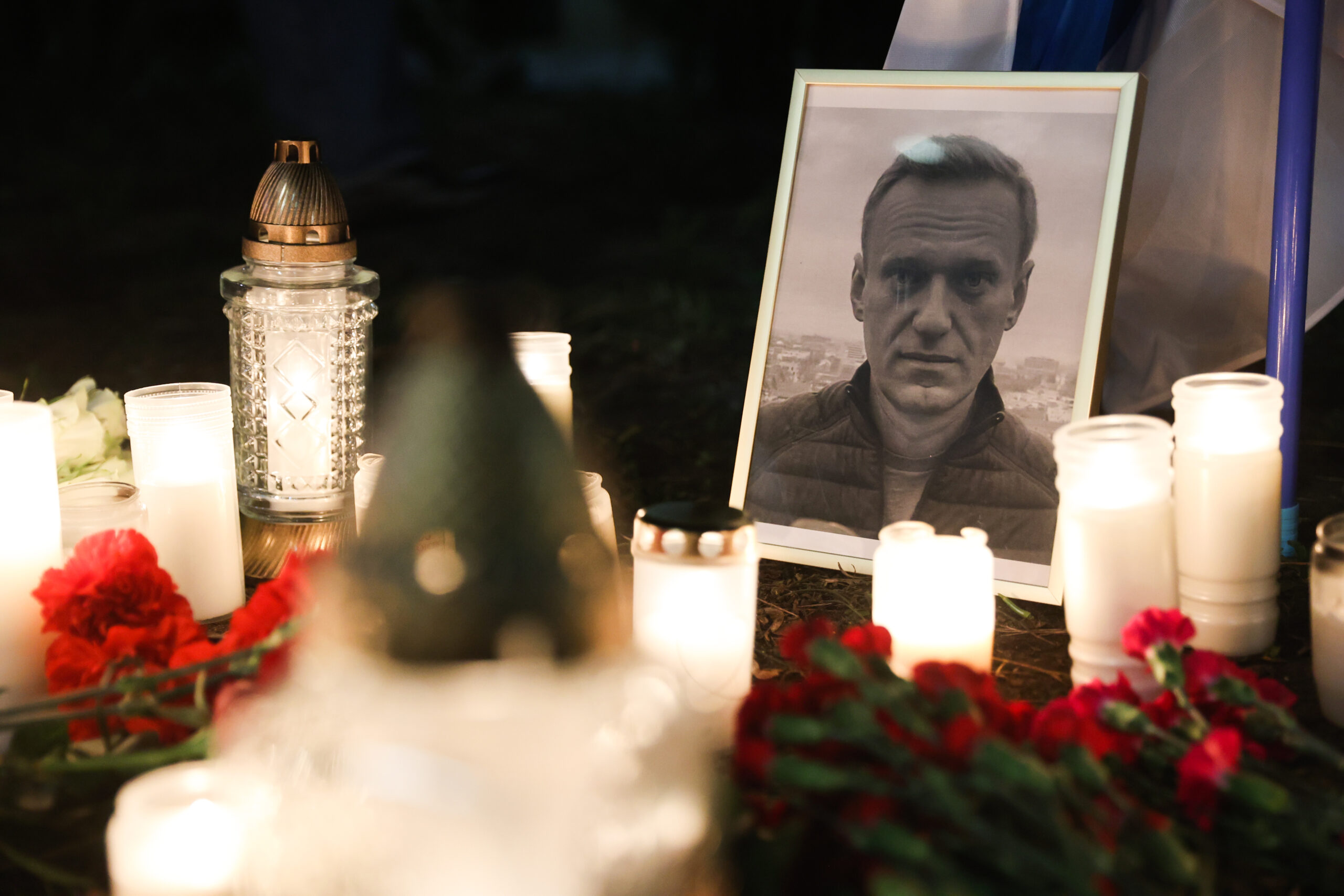
Photo: A spontaneous memorial in memory of Alexei Navalny under the Russian consulate in Krakow. Jakub Porzycki/NurPhoto via Reuters
Support “Vestka” - it’s important and safe →