Date
Author
Отдел культуры «Новой газеты Европа»
Source

Preserved copy
Translated material
“The very concept of “emigration” is already outdated”
The Dar Literary Prize was announced by a foreign agent. We asked its founder, writer Mikhail Shishkin, what he thinks about it
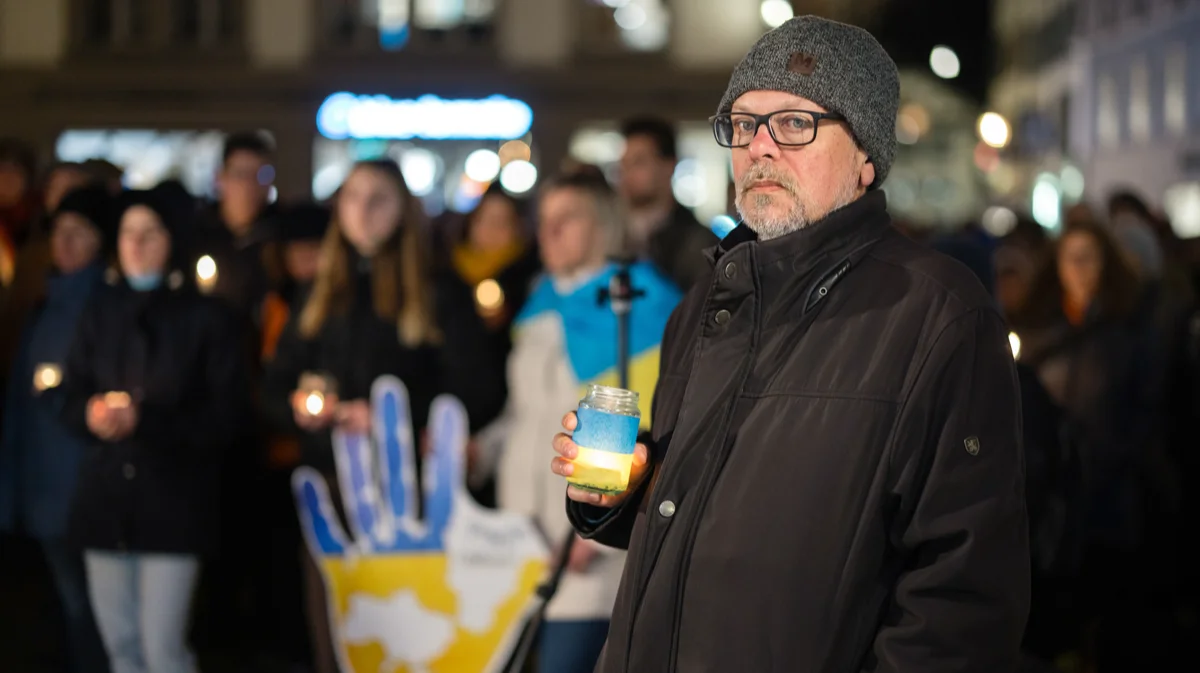
Mikhail Shishkin during a peaceful rally against the war. Photo: Philipp Schmidli/EPA
— On the Russian-language Internet, everyone is now joking that if literary prizes are now declared “foreign agents,” then it is not far from books as such, genres of literature, and even varieties of vegetables and fruits being declared foreign agents. How does leadership in this field make you feel?
— Another “confession” from a fascist state—dubious leadership, don’t you think? I would just ignore all the words they emit there. These are their internal affairs, in which there is no desire to interfere. These people who support the war - last night they bombed Kyiv again, killed a 12-year-old girl - these are my enemies. Such “recognition” from enemies only means that we are doing everything right.
— Such a legal status is still an unpleasant thing, making it difficult to work, especially with those people who remain in Russia or are associated with it. In our last conversation , you said that one of the goals of “The Gift” is to maintain connections between those writing in Russian both in Russia and abroad. Will your goal setting change now?
— Goal setting will not change in any way, but circumstances have changed.
Recognition of the prize by a foreign agent will affect authors from Russia; they will be afraid to nominate their works for the competition. All this was quite expected. All this has already happened in the “most reading country in the world.”
The authors wrote in the USSR and published under pseudonyms in the free world. And publishing houses there don’t have long to lead an independent existence anyway. They'll come for everyone.
— You have already warned your colleagues from Russia to participate at your own peril and risk. How will you build relationships with them now? Asking for nicknames? Not accepting money from Russia? (One of the important parts of the “Gift” award is paid reader voting, where the winners receive the amount “gifted” to them by readers. - Ed.)
— In the 21st century, I want to talk about personal, not collective responsibility. Nothing has changed, and if authors want to participate in the award, then who can stop them? It’s just that those who stayed there ended up in a time machine and returned to the USSR. The writer decides for himself whether to publish under a pseudonym or under his own name. For some, this may be an act of resistance. We didn’t accept money from Russia anyway.
—Aren’t you afraid of a drift towards the “emigrant” premium in this regard?
- No, we are not afraid. The world of Russian-language literature today is radically different from the “emigrant community” of the 70s of the last century. The Internet has created a fundamentally new space for the existence of culture and literature in the Russian language. Young authors from Russia now have access to the whole world through their devices, all the libraries of Europe and America, all museums, all concert halls, all books from all publishing houses - but when I was a young author at the end of the Soviet Union, everything was completely different, we were in a closed Soviet barracks. And free literature in Russian now is not at all an “emigrant” phenomenon. Writers working in Russian live in Israel, America, Ukraine and all over the planet. And these are not “emigrants”, and not Russian writers, and they do not make “Russian literature”.
The concept of Russian literature, tied to territory and coated with “patriotism,” remains in textbooks; it is tied to the literature of the past. We have entered a new era of transition from “Russian literature” to literature in Russian.
And I am very pleased that now new independent publishing houses are opening all over the world, book fairs and festivals are appearing, and the SlovoNovo forum of free culture is developing. The very concept of “emigration” should already be included in the dictionary with the mark “obsolete,” like a stagecoach or a telegraph. Borders have disappeared, the world has become open. Global changes occurred: the territory and culture were divided. Liberation from the “curse of imperial territory” is a chance for the free development of literature, among other things.
— Your award is so far the only new literary award that has been extended for a second season. How do you evaluate the results of the first season? Didn’t the “scandals” - with Denis Beznosov and Maria Galina’s refusal of the prize - in some way, be fruitful for the publicity of the prize?
— We live in a world of hype, where attention is often drawn to events with a negative sign. You didn’t write about the fact that the award starts its second season on September 1, did you? And they turned to us because “Dar” was declared a “foreign agent.” Let's change reality together, try to notice important events in everyday life, and not reproduce scandals.
— As of September 2025, how do you assess the literary process in the Russian language as a whole: is there a demarcation of the flows “here” and “there”, are readers in contact?
— Readers know no boundaries. Just like books. During times of stagnation, books penetrated the “Iron Curtain”; everyone could read those books that were important to them. What can we say about the Internet era? And it is important to understand that the prize does not control the literary process and does not in any way influence the appearance of brilliant novels. Brilliant texts do not visit our planet every year or every decade. The goal of our award is to support publishers, writers, and readers now, today. The Gift Prize is just one of the tools that can help preserve the dignity of literature in Russian. There should be many such tools.
— What are your plans for the future?
- We continue.