
Translated material
Very “tolerable” amendments
During the second and third readings, the St. Petersburg initiative on “territorial development” was significantly changed. And it became worse than it was
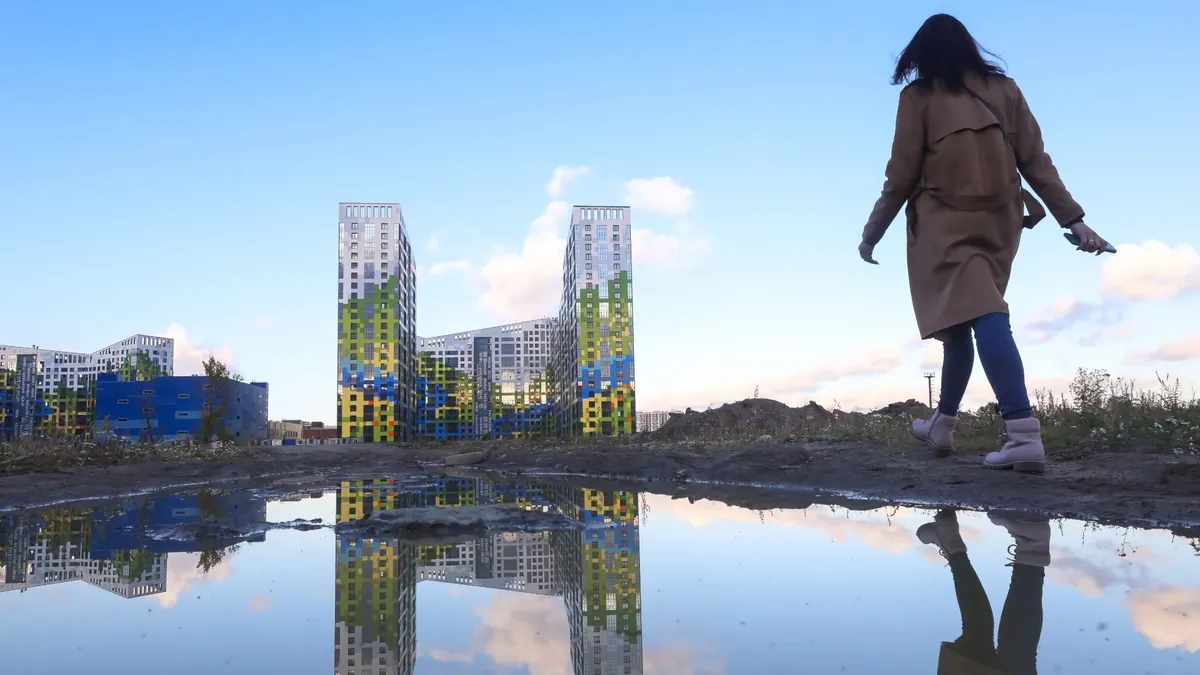
Photo: Roman Pimenov / TASS
In March, Novaya talked about support in the first reading of the initiative introduced by the Legislative Assembly of St. Petersburg - about the correction of the mechanism of “integrated development of territories” (CRT).
The proposals of the St. Petersburg deputies could alleviate some of the concerns of citizens who believe that the CRT can significantly violate their rights. But during the second and third readings (the law was finally adopted on June 11), the St. Petersburg initiative was significantly “corrected.” And you can’t say that it’s for the better.
Let us recall that the KRT scheme, described in the Town Planning and Housing Codes, provides that multi-apartment residential buildings included in the KRT are demolished, tenants receive other apartments, and homeowners receive monetary compensation, but they can also demand other housing instead of money.
Here two questions turn out to be extremely important, which the St. Petersburg deputies wanted to regulate: how exactly does a specific house get included in the decision on the CRT and where will other housing be provided?
For the first question, the Town Planning Code states that within a certain period, which is established by regional law, general meetings of homeowners must be held in apartment buildings. And in order for a house to be included in the CRT, two-thirds of the residents must vote for it at the meeting. Also, the house falls into the CRT if the meeting does not take place: this is the “principle of silence.” But it is known that holding a general meeting is not very easy - and if it does not take place, for various reasons, the house ends up in the CRT, even if a significant part of the residents do not want this and do not intend to leave anywhere.
The proposal of the St. Petersburg deputies was simple: to establish in the Town Planning Code that if the general meeting did not take place, then the house is not included in the CRT. And it is included only with the clearly expressed will of a qualified majority at a general meeting of homeowners.
In the first reading, the State Duma supported it. But then, as often happens, “big work” began on reworking the document. In the interests of certain lobbyists. And as a result, in the Town Planning Code, instead of a clear indication that “by default” a house is not included in the CRT, a different wording appeared. That “by default” the house falls into the CRT, unless “the law of the constituent entity of the Russian Federation regulating relations in the field of urban planning activities establishes other rules for the inclusion of these apartment buildings in the decision on the integrated development of the territory.”
Let's decipher:
the question of whether a house can avoid the CRT if a general meeting in the house did not take place must now be decided for each region personally - by the corresponding regional law.
And only if this law directly states that “by default” a house is not included in the CRT, will it be so.
If the rule that “by default” a house does not fall into the CRT was enshrined in the Town Planning Code, it would undoubtedly be better. Because it is far from a fact that in all regions the same principle will be enshrined in law. And also - because if the governors speak out against this principle, the likelihood of its establishment (taking into account the balance of power in almost all regions) is reduced to an infinitesimal value.
The second question - about where other housing will be provided (here we are talking only about owners) - is also very important: as a rule, even those who are ready to participate in the CRT do not want to move far from home and from the familiar and familiar urban environment.
In St. Petersburg, territories built up in 1958–1970 with so-called “panel Khrushchev buildings,” five-story (with rare exceptions) houses, are initially considered for CRT. But sixty years ago these were the city outskirts, and now the city has moved much further, and “Khrushchev’s” neighborhoods - low-rise, quiet and green, with shops, schools, clinics and transport accessibility - are convenient for many. Therefore, residents, even agreeing to the CRT, demand guarantees of resettlement as close to their previous location as possible. No further than within the boundaries of “your” municipality.
Initially, the St. Petersburg parliament proposed that throughout the country the “geography of settlement” should be determined by regional laws.
Then the norm changed, and now Article 32-1 of the Housing Code states that “a regulatory legal act of a constituent entity of the Russian Federation - a federal city of Moscow, St. Petersburg or Sevastopol may provide for requirements for the location of an apartment building in which the owner is provided with residential premises.”
A normative legal act can be either a regional law or a decree of the regional government, and in the second case, the decision will be made only by officials. And residents are justifiably afraid that the relocation framework may turn out to be quite “flexible” - so that the new place of residence will be far from the previous one.
In St. Petersburg they say that these frameworks will be set as follows: housing will be provided in the same municipality or in one of the neighboring ones. The preposition “or” - given that there are also large municipalities - means that in this case new housing may be on the very edge of the city. And this obviously will not please the residents.
Is it true,
Now no one in the Northern capital can say exactly when the CRT will begin.
The city law on CRT, which in 2022 caused serious criticism from residents of Khrushchev, was “frozen” twice, waiting until the federal legislation could be amended. Now it has been “corrected”, but it is not a fact that the “freeze” will not happen again, because next year there are elections for both the federal and city parliaments, and in such years they usually try not to “launch” controversial topics.
In addition, so far, as they say, there is no queue of investors ready to participate in the CRT and face both the possible dissatisfaction of the residents of these territories and the need to solve their problems in the process of the CRT.
The new parliamentary season in St. Petersburg has begun, and it will soon become known whether the “freeze” will be extended. If not, then city legislation will need to be changed quite quickly. And here it is important to what extent deputies will listen to residents who do not want abstract “territorial development”, but a concrete improvement in the quality of their lives.
Vladimir Maksimov