
Translated material
Oh times, oh Moliere
Premiere of “The Cabal of the Saints” at the Moscow Art Theater. Chekhov

Scene from the play “Cabal of the Holy One.” Photo: Arina Antonova / TASS
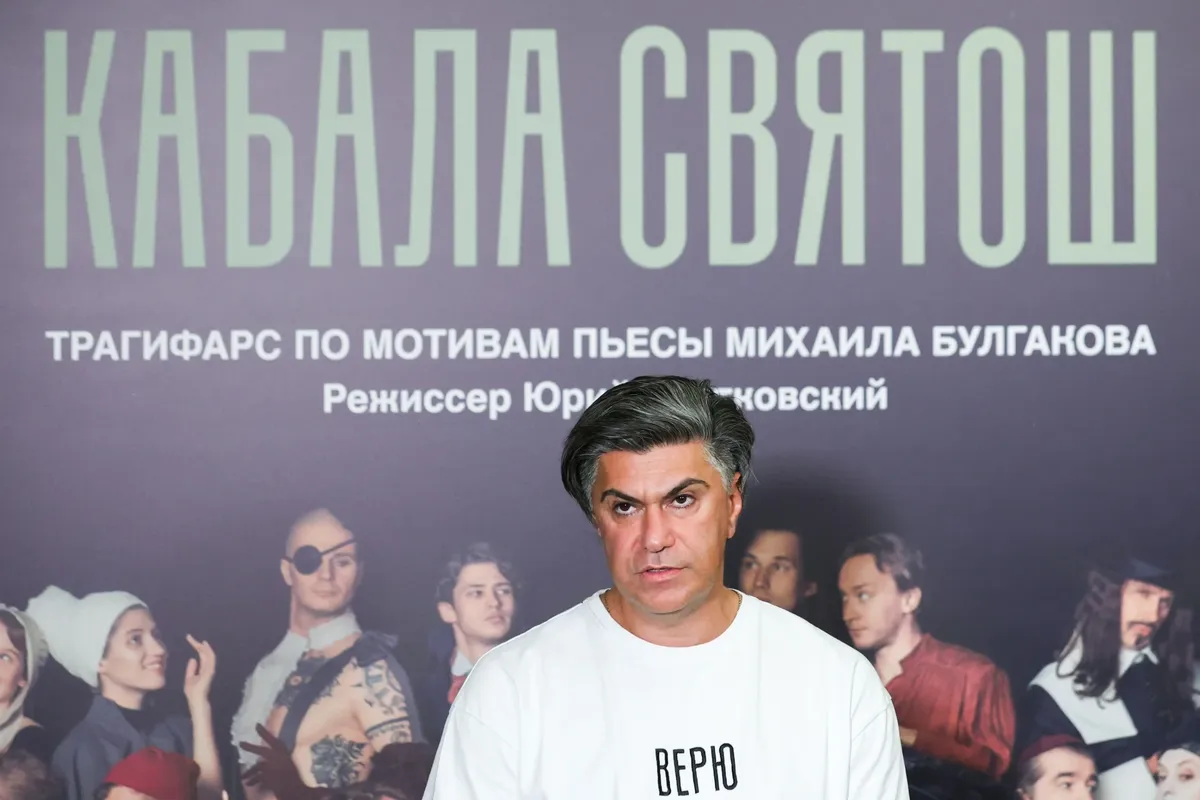
At the Moscow Art Theater. Chekhov released one of the most anticipated premieres of the season - the tragic farce “Cabal of the Saint” by Yuri Kvyatkovsky, or that very “performance with Tsiskaridze”, which in the program chose to hide behind the pseudonym Maxim Nikolaev. Many people were attracted to this premiere precisely because of the former Prime Minister Bolshoi in the role of King Louis XIV. But, as always, we were interested in the eternal conflict between power and the artist, which the authors of the play tried to look at from a modern point of view.
The production resembles a patchwork quilt. A piece from the Soviet Moscow Art Theater, a fragment from the French Palais Royal, an episode from Moliere’s childhood and his, already in adulthood, dinner with King Louis XIV. Here Bulgakov (aka Register, aka Author), performed by Ilya Kozyrev, either simultaneously translates from French, then comes to join Molière’s troupe, being more talented than all his students combined, or argues over edits in his play.
In this performance, allusions to the modern agenda “coexist” with Descartes and Seneca - such as “Let's make France great again!” - and the underdresses: they say, we are the Moscow Art Theater, and not that theater from the boulevard.
Within the performance, the actors maneuver not only between lines of memorized text, but also between improvisations. They improvise on sensitive topics, and this also adds intrigue: how will this or that fragment be rebuilt for the next show? True, it is difficult to say that all the transitions are built logically and thought out - this patchwork quilt is rather sewn on a living thread.
To make “The Cabal of Saints” sound sharper and become closer to the modern “clip” viewer, the play of the same name was deprived of some characters, and the text itself was “edited” with fragments of the novel “The Life of Monsieur de Moliere” by the same Bulgakov, “Reflections on First Philosophy” by Descartes, “Moral Letters to Lucilius” by Seneca, the essay “On slavery and freedom of man" by Berdyaev, a sermon by Savonarola, "Confessions" of St. Augustine, "Visions of Hell" by St. Teresa of Avila, "I Cannot Be Silent" by Tolstoy, a transcript of remarks for the rehearsal of the play "Molière" in 1935 and a memo to Stalin and Molotov regarding "The Cabal of Saints."
The result was, on the one hand, a test of the audience’s horizons, and on the other, a theory about how “culture needs to be kept in check, or better yet on a chain,” confirmed by documents from the Moscow Art Theater’s history (in 1930, “The Cabal of the Saints” was first banned from production, but in 1936, after five years of rehearsals, it was nevertheless released under the name “Molière,” and after seven shows it was closed. More The productions of Adolf Shapiro had a happy fate: in 1988, he produced the premiere at the Moscow Art Theater, where Moliere was played by Oleg Efremov, and in 2001 - by Oleg Tabakov). The role of Moliere is often played by the artistic directors themselves. At one time in Maly it was Yuri Solomin, and at the Satire Theater it was Alexander Shirvindt. So in the premiere of Yuri Kvyatkovsky, Moliere is played by the artistic director of the Moscow Art Theater Konstantin Khabensky, who emotionally gives his best in this role.
His Jean-Baptiste de Moliere, an aging actor and playwright-plagiarist, accepts the rules by which they play around him and acts not only on stage, but also in life. It is customary to sycophancy in front of Louis XIV - he will. In the eyes - a farcical “I love you, king!” and artificial glorification of his nobility and greatness. Moliere takes it as an honor to make the royal bed and makes deep bows in front of the huge gilded figure of the king, from which the fabric of his frock coat hangs down and a frill falls about five meters away. Behind the scenes, the actor says the exact opposite about the king. “A man without principles writes to us about conscience. Moreover, he writes for those whom he despises,” this is how his named son accurately characterizes Moliere. But to everyone who wants to condemn Jean-Baptiste, he will show a huge dish that will blind moralists with rays of light reflected as in a mirror.
Accustomed to acting, Moliere does not seem to see how cruelly he treats his loved ones - as if they were not living people, but performers of roles in his play.
“You are a friend,” Jean-Baptiste says to his once-lover Madeleine Bejart (Alexandra Rebenok), before trading her for young Armande (Olga Petrova). Moliere also treats his devoted servant Jean-Jacques Boutun (Igor Khripunov) cruelly, who out of anger brings down a barbell from somewhere on the grate on the master’s head. But both women and servants exist somewhere in the background for Moliere. The main thing is the theater and the favor of the king, who supports this theater. “Fear the mercy of kings,” Archbishop Marquis de Charron (Ivan Volkov) warns him.
The performance looks impressive and expensive. The detailed costumes by designer Igor Chapurin and the stage decoration exude luxury, which is in keeping with the era of Louis XIV. The chief artist of the Moscow Art Theater, Nikolai Simonov, set the stage with giant golden heads of babies, hid smaller heads behind glass cabinets, and gave the shape of the heads to royal bushes. A heavy burgundy curtain works with the space of the stage, thanks to which the characters find themselves either in a cramped backstage or on the spacious stage of the Palais Royal.
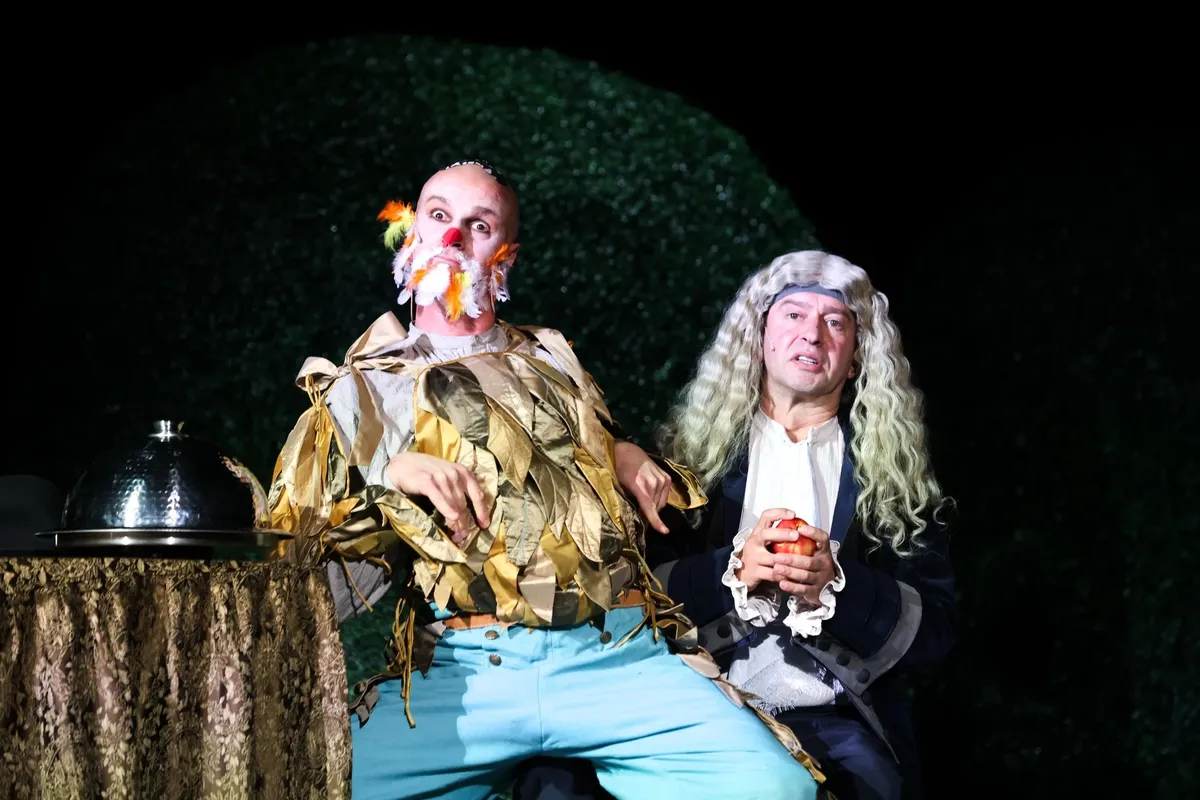
The whole thing is not complete without special effects (a barbell falls onto the stage, sparking, and a torture wheel is brought there for intimidation) and circus tricks. Andrey Kislitsyn, who collaborates with Cirque Du Soleil, is responsible for the latter. In the play, he appears on stage in two roles: the Royal Jester, who, like a chicken, pecks crumbs from the floor and drawlingly pronounces “Lyudoooviik,” and the Charlatan with a harpsichord, playing the instrument without touching the keys. From under the lid of this icy harpsichord, as if from a coffin, Zachariah Muarron (Sergei Volkov) will soon appear.
In the first minutes of his public “birth,” Moliere’s future adopted son will look the least like a human being. Infernal, with incredible plasticity and an otherworldly voice. This is a creature generated by the theater, its spirit or even a demon. Having disentangled himself from the strings, in a few minutes he plays all the classics of the world theatrical repertoire - from Shakespeare’s “to be or not to be?” to Chekhov's “everything in a person should be beautiful.”
A talented actor, Zacharia Moirron becomes the leading actor of Molière’s troupe, and at the same time playfully seduces his young wife Armande, calls his adopted father “a hypocrite to the core” and argues that “theater is the work of young people” and it “must be done honestly.” He will betray Moliere, it seems, without fully understanding how he did it so easily.
There was no wording “for insulting the feelings of believers” in Molière’s time, but it was precisely for this that the Marquis de Charron hated the comedian—he saw an insult to the church in the play “Tartuffe.” “Without faith, without a higher goal, we are doomed to chaos and decay,” de Charron is sure.
Without particularly relying on the will of God, the archbishop takes the playwright's fate into his own hands. Obsessed with the idea of depriving Moliere of royal support, de Charron is not even afraid to contradict the monarch.
On the side of de Charron, the mother of Louis XIV, Anna of Austria, played by Pavel Vashchilin, also plays. “Every word on stage has weight,” she inspires her son. But the queen is interested not so much in supporting the archbishop as in the absolutist power of the monarch, on which Molière’s work casts an undesirable shadow. And in general, there are too many people of art at court, and she already knows: “give free rein to the artist, and he will turn everything upside down,” so it is better to keep culture on a chain. Motionless, like a statue, the queen does not appear on stage herself - she, standing on a cart, is taken out from behind the scenes. Anna of Austria personifies that firm and unbending power that cannot be overcome by anything human.
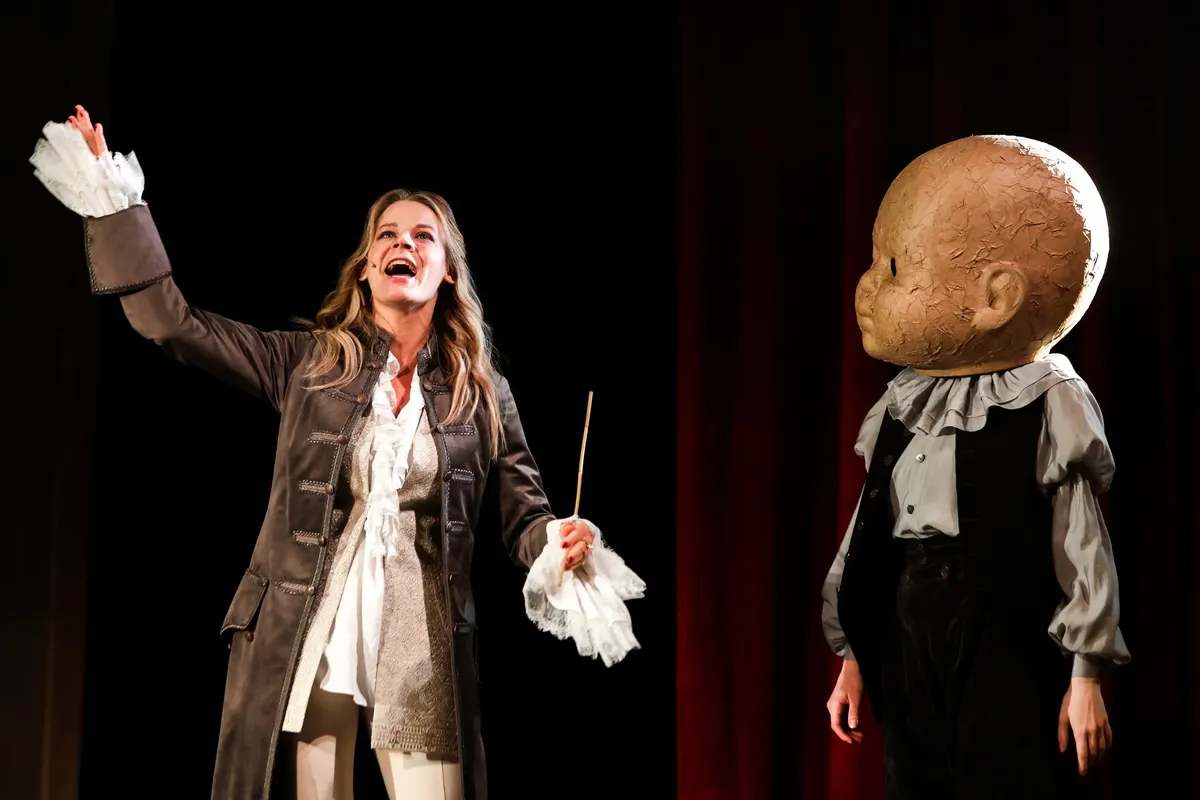
It is amazing how such a strong-willed queen managed to raise the flexible and much more lenient Louis XIV. He gravitates toward irrepressible luxury and patronizes art; does not worry about anything and categorically declares: “When the king wants, the law adjusts.” He is not stupid and does not fall for the manipulations of intriguers, so the informer Muarron, instead of the theater, only receives an offer to join the royal service - the detective police.
The performer of the role, Nikolai Tsiskaridze, is given a special place in the play - he, as befits a royal person, is removed from everyone and is above everyone. His word is worth its weight in gold, which is why he speaks little and slowly. His gestures are more expressive than words: he makes a couple of movements and it’s as if he’s stepped out of a historical canvas. He is one, but there is so much of him that he is enough to embody the whole of France.
“The Cabal of the Saint” by Yuri Kvyatkovsky “takes on” strong male images. The women - with the exception of Anna of Austria played by Pavel Vashchilin - lose. Olga Petrova's Armanda performs the role-function of Moliere's wife, so that the outline of the narrative does not fall apart. Alexandra's Madeleine The Child is more multifaceted, but often plays on one note, which is reminiscent of her previous roles. By the way, Madeleine Bejart remains an actress even after her death, turning her own funeral into a theatrical tragic farce.
The finale also turns into a farce, when everyone, one after another, incited by the king, begins to ask for forgiveness, existing on the border between the role and their own “I”. Marquis de Charron - for mercy lost in the pursuit of piety; some for saying that France is not suitable for free-thinking people.
Anna of Austria literally reproduces the words of the apologetic visitors to the “naked party,” who “dropped into the event like that for five minutes,” and calls on them to “think with your own head, if you have one.”
Konstantin Yuryevich de Moliere asks to be excused for this performance, since in the pursuit of success he, a people's artist, has blurred the line of what is permissible. Only the crafty and charming Sun King does not repent of anything: “I don’t apologize to anyone, but I forgive everyone.” And he adds: “After us there may be a flood,” apparently voicing the general thought of authorities at various levels.
It’s difficult to say to whom (and whether) the authors of the play express their sympathy, and this is the main thing that the premiere “Cabal of the Saints” lacks in order to consider it an artistic statement. But it does not cancel the production as a phenomenon of modern Russian theater; it brings Yuri Kvyatkovsky to the theater arena as a strong director of great form, who knows how to create complex blockbuster performances, where there is both artistic value and the potential for long-term success with the viewer.
Margarita Usoltseva