
Translated material
Provoking creativity
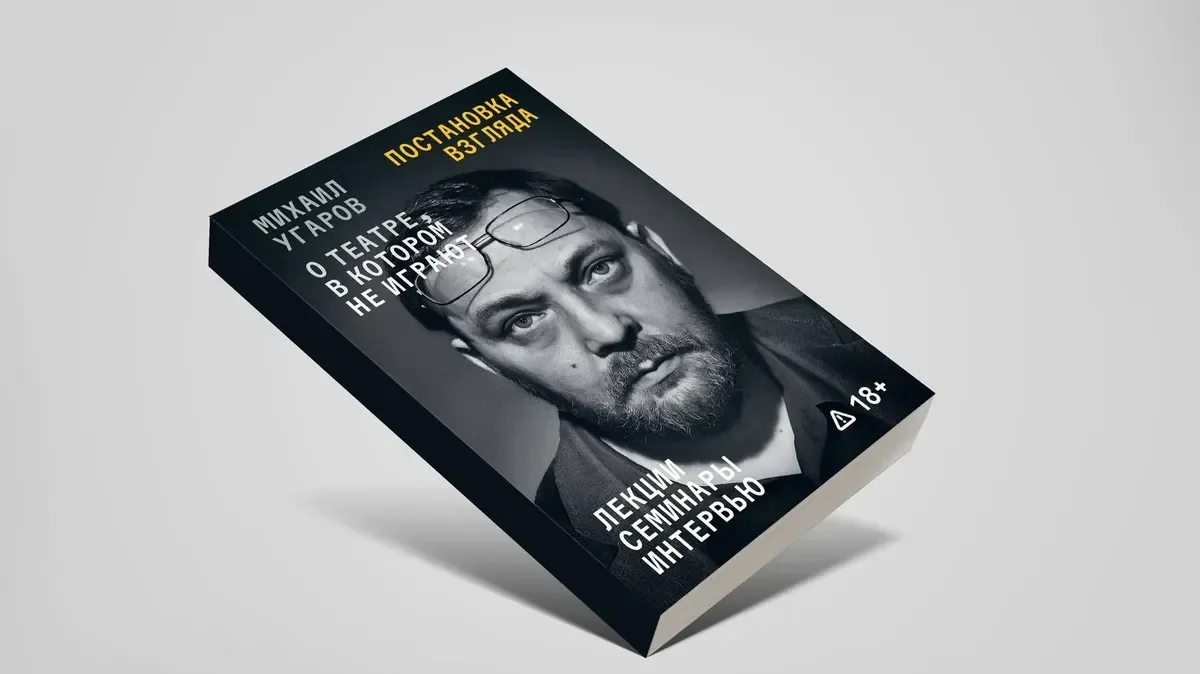
Mikhail Ugarov’s book “Staging the Look. About the theater where they don't play. Lectures, seminars, interviews"

Mikhail Ugarov. Photo: teatrdoc.ru
Playwright and director Mikhail Ugarov is known among theater people as the creator of the New Drama movement, the inventor of documentary theater, the co-founder of Teatra.dos - a Moscow theater institution, which for almost 20 years was not just a metropolitan theater, but a center of attraction for professionals and spectators who were interested in live theater “in pursuit of reality.”
In the introductory chapter to the book, its compiler, theater critic Elena Kovalskaya, writes that to the question “what is this book about, there are several correct answers. We can say that this is a lesson in skill from Mikhail Ugarov, a man who radically changed theater, drama, and at the same time cinema in Russia at the beginning of the 21st century. But we can also say that it is about a once outlandish type of theater, which intended not to be a copy of reality, but reality itself. “The theater in which they don’t play” was the slogan of the Moscow “Theater.doc”, which, of course, is constantly mentioned in this book. The third option, and again correct: this book is about a reality that is supposedly obvious, but in fact is mysterious, mysterious.”
“The audience sits on stage, the actors have nowhere to play ”
It seems to me that this book is about Mikhail Ugarov, because it’s not for nothing that it begins with “Chronology”. This is a kind of biography compiled on the basis of his diaries. Ugarov died of a heart attack in Moscow in April 2018. He was only 63 years old.
It was a very bright and brilliant life of a theater reformer and powerful playwright, who wrote many plays that were successfully performed in metropolitan and provincial theaters. At the same time, Ugarov was self-taught - he did not graduate from either a theater university or a literary institute. In 1978, Mikhail moved from Arkhangelsk to Kirov, where, together with his first wife Marina Kirpicheva, he joined the theater troupe of young spectators as an actor. He got bored with acting, he stopped participating in performances and worked for several more years as the head of the literary department of the theater, and in 1986 he entered the Gorky Literary Institute. In Moscow, Ugarov met playwright Elena Gremina, who soon became not only his wife, but also a faithful comrade-in-arms, with whom they wrote scripts together, participated in the Lyubimovka festival of young dramaturgy, and together created Teatr.doc.
“Chronology: main events from the life and work of Mikhail Ugarov” is especially interesting to read today - it mentions theatrical events of the late 1990–2000s, and mentions the names of famous directors and playwrights of the Russian theater. All of them - actors Oleg Efremov, Oleg Tabakov, Kirill Serebrennikov, Vladimir Mirzoev, playwrights Mikhail Roshchin, Maxim Kurochkin, Evgeny Kazachkov, Yuri Klavdiev - were familiar with Ugarov and collaborated with him in one way or another. Of course, the events from the “Chronicle” are for the most part connected with the “New Drama”, the development of documentary theater and do not concern what was happening in those years in the so-called traditional dramatic theater.
But according to Chronology, it is interesting to observe how the shagreen skin of freedom in the independent theater is narrowing.
To be fair, it must be said that Ugarov and Gremina managed to do a lot until the authorities took over their theater.
Those who have been to Teatr.doc know that the theater team produced at least 10 performances every year. And almost every one of them became an event. These are “Oxygen” and “Crimes of Passion”, in 2006 - “Democracy.doc” (a play with the participation of actors and spectators and a subsequent discussion about the paths of democracy in Russia), in 2010 - “Hour Eighteen” about the death in prison of Sergei Magnitsky, and in 2011 - “Two in My House” based on Gremina’s play about the home imprisonment of a Belarusian politics of Vladimir Neklyaev.
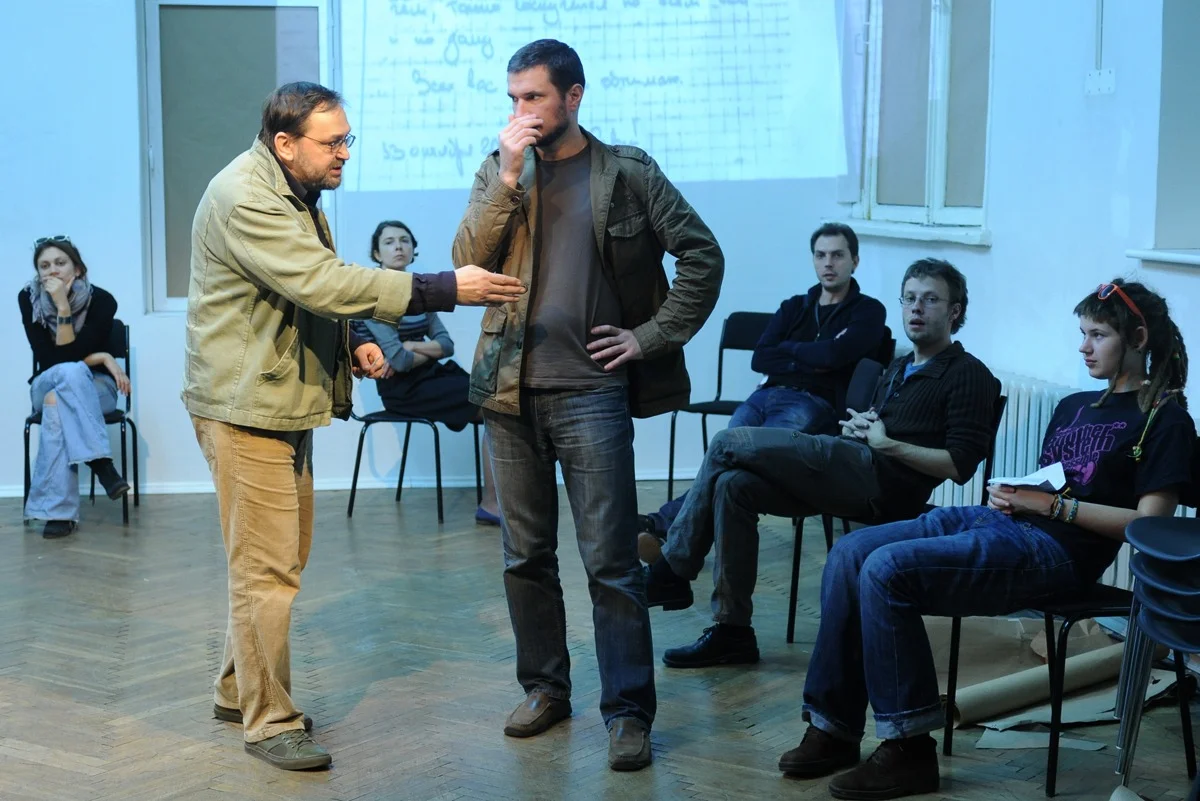
In 2012, another hit of Teatra.doc was released - BerlusPutin.
MARCH 17, 2012
Mikhail Ugarov writes in his diary:
“Today at Teatr.doc there were two evening performances of BerlusPutin. It’s impossible to get there, the audience sits on the stage, the actors have nowhere to play. The principle of updating the text works: today Sergei Epishev was broadcast on NTV, Kulistikov and “Anatomy of Protest” - to the laughter of the audience. At the finale, as Kulistikov ordered, everyone was given plastic dollars from Hillary and cookies. In the finale there was long applause to the song “Rabfak”. Some theater people told me that this is not theater. Certainly. This is more than theater."
"The Theater That Moves"
In 2014, Ugarov completed the film “Brothers Ch” about the family of Anton Chekhov based on the play by Elena Gremina. Filming lasted only a month. At the Center. Sun. Meyerhold hosted the premiere of Ugarov’s play “Masquerade Masquerade”. “Theatre.doc” has several screenings of documentary plays: “Testimony” about the events in Taksim in Istanbul, “Maidan Diaries” and Sergei Sokolov’s play “Race” about the murderers of lawyer Stanislav Markelov and Novaya Gazeta journalist Anastasia Baburova. “Teatr.doc” received the “Golden Mask” award for the performance “Akyn Opera”.
In the same year, the tenant of a semi-basement in Trekhprudny Lane, where Teatr.doc worked for 12 years, unexpectedly terminated the lease agreement under the pretext of “illegal redevelopment.” And on December 30, the screening of the Ukrainian documentary “Stronger than a Gun” was disrupted; the police and a film crew from the NTV channel came to the theater. The reason was that the film was shown without a distribution certificate; Elena Gremina was summoned to the cultural department of the Ministry of Culture to check the statutory documents.
The second time the theater’s charter documents were checked by the prosecutor’s office in 2015, after the production of the play “Bolotnaya Case” about the events of May 6, 2012. As a result, the owner of the premises on Razgulay, where Teatr.doc moved from Trekhprudny Lane, also terminated the lease agreement with Elena Gremina, and the theater again began to look for premises, and the accounts were frozen. In 2017, Teatr.doc celebrated its 15th anniversary in yet another new premises - on Maly Kazenny Lane.
FEBRUARY 5, 2017
Ugarov wrote in his diary:
“For me, this is my whole five lives, with dying and birth. My first performance in the Doc is a complete adventure based on the three-page libretto by Sandrik Rodionov “The Moldovan War for a Cardboard Box.” We did this together with Ruslan Malikov. It was a wild performance, with an unknown theatrical style, simply savage! And now I remember it as a classic. When the police broke into Trekhprudny, when they welded the doors, it seemed to me that it was all over. Dozens of volunteers who were building a new theater brought me back to life. It became clear that the theater is people, and not a box. The second exile (from Razgulay) was no longer scary. But five lives still passed, and their scars remained. But we made a theater with our own face, unlike anyone else, which everyone knows.”
"Fearless Ugarov"
On December 31, 2017, Ugarov wrote three short phrases in his diary, which very succinctly define both his and Elena Gremina’s mood at that time: “It was a terrible year. Such a consistently black year. I have everything."
In his diary for 2017, Ugarov also mentions a criminal case against Kirill Serebrennikov, Alexei Malobrodsky, Sofia Apfelbaum and Yuri Itin. This “theatrical affair” shocked everyone then, and, of course, the dock workers. It was clear that an attack on independent theater was beginning. And “Teatr.doc” was definitely engaged in political theater; Ugarov and Gremina, “in pursuit of reality,” increasingly chose those plots and themes that traditional theater could not afford.
Elena Kovalskaya writes in the preface that Ugarov “had a lot of fearlessness,” it seemed that he was really not afraid of anything. It seems that the only thing he was afraid of was that his beloved wife, Elena Gremina, might be imprisoned - after the troubles associated with the production of the play “Bolotnaya Case”, he told me about this. And in his texts on social networks, in interviews, he said everything he thought, without lying, both about the authorities and about society. Ugarov explained the “political nature” of his theater’s performances by the fact that they must react to reality; the Dokovites are concerned with presenting the viewer with a real picture of life, contrasting it with television and glossy pictures.
However, Ugarov did not consider himself an oppositionist. “Everything I do at the doc Theater and write may sometimes seem oppositional, but this is just an appeal to the norm. It seems to me that this is all we need to do. In our country, with its deviance, with perversion at all levels, an appeal to the norm can threaten with accusations of extremism.” Shortly before his death, in 2018, he again returned to the topic of “norm” and added: “And the norm has already disappeared over the horizon.”
“Provoked creativity”
I deliberately give so many quotes from Ugarov so that you feel the intonation of the book “Staging the Look,” the largest part of which consists of lectures, seminars and interviews with Mikhail Yuryevich. Ugarov began conducting seminars at the School of Documentary Film and Theater, better known as the Marina Razbezhkina School, in 2010, and the book includes meetings with students up to 2017.
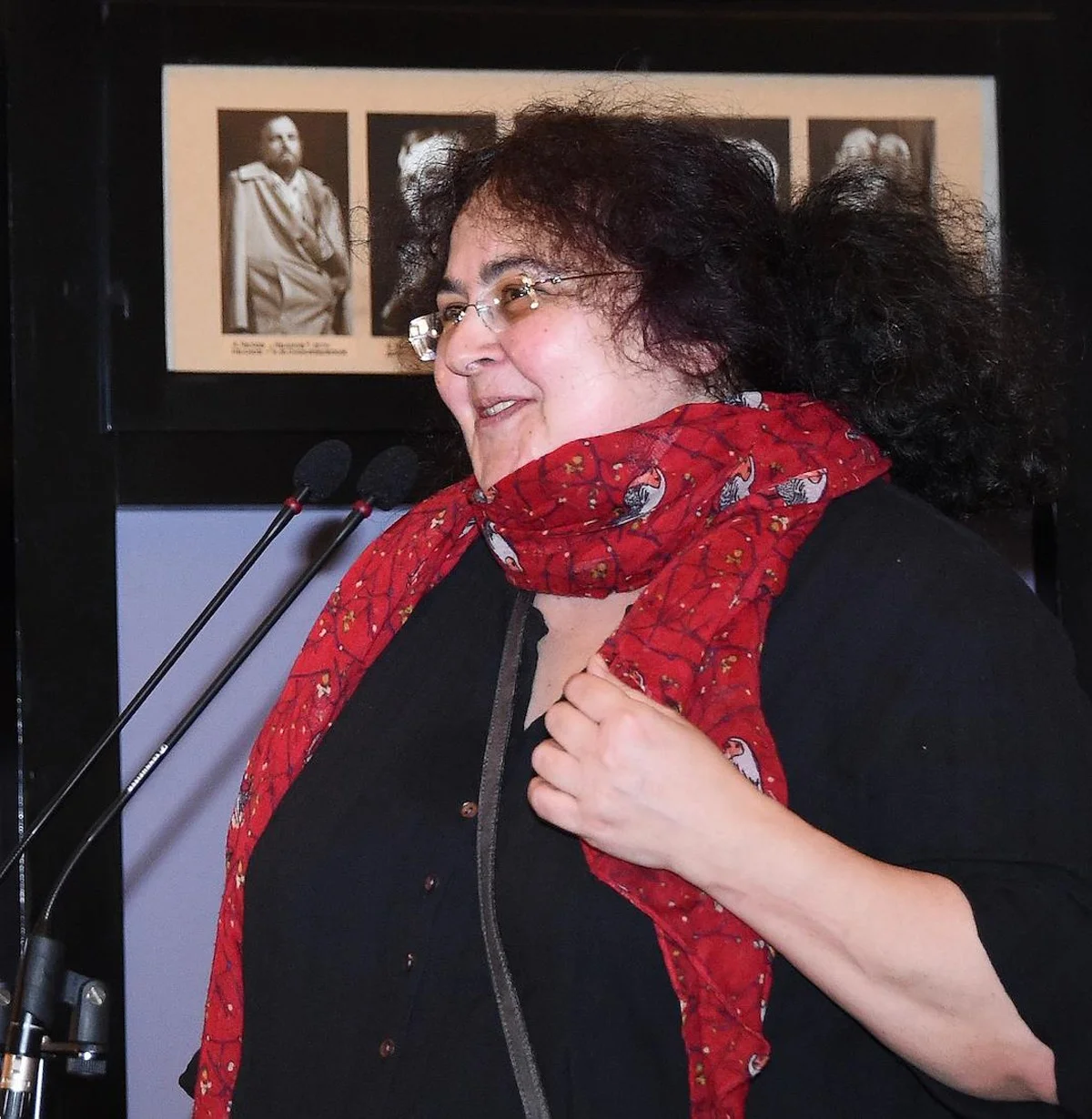
The reader will also find in the book Ugarov’s lectures for playwrights at the Creative Writing School. In the preface to these texts, Natalya Osipova, co-founder and director of this school, explains what Ugarov’s course was about: “It cannot be reduced either to dramaturgy, or to documentary theater, or to post-drama. Any term kills the main thing that Mikhail Yuryevich did - he provoked creativity. He himself did not like terms, because a term is something dead. He, of course, had his own dramatic language, his own school, but I have the feeling that he continued to search for new forms, a new language, continued to hunt for reality. Perhaps the main thing was his smoking at webinars, his provocations, the phrase “Natasha, I hate you,” when I suggested doing something new, and then: “Well, you understand that I hate and love - it’s the same thing.”
This is very true: “Ugarov provoked creativity.”
And all his lectures and seminars published in the book are about this. Reading Ugarov’s texts, you discover abyss of meanings, and although the exercises that he suggests to the listeners of his lectures to complete seem impossible, you still want to try to do them, like, for example, this homework - “Contact”:
HOMEWORK “CONTACT”
“Make contact. Go up to a person of any gender and age and ask him a strange question: “Tell me, what city am I in?” Of course, the person will be surprised and say something like: “Are you crazy? In Moscow." Then you will have to come up with a story why you don’t know that you are in Moscow, and this story will need to be told in such a way that it draws the person into dialogue. He will ask questions, and then he must make contact and tell a similar story himself: “I had such an incident in Khabarovsk...”
This is how Mikhail Ugarov taught future playwrights to feel the energy of living language.
As for the “gaze setting” that Ugarov studied with students, in the “anti-dictionary” compiled by Ilmira Bolotyan based on the statements of Mikhail Yuryevich, this concept is given the following explanation: “Gaze setting is one of the pedagogical techniques of Mikhail Ugarov and Marina Razbezhkina. In practice, it often consisted of a series of exercises during which students prepared their own stories (or looked at others) in order to find the most relevant or interesting point - “zoomed in.”
Mikhail Ugarov died on April 1, 2018 from a heart attack, Elena Gremina survived him by only a month and a half.
The publishing house "NLO" published a two-volume edition of their plays several years ago. The book “Staging the Look” is the next attempt to get closer to the “ocean of ideas and meanings” called “Gremina - Ugarov”.
And since “Teatr.doc” has always been a theater for everyone, and not just for directors, actors and playwrights, for everyone who is interested in modern life, who is interested in theater that shows reality and changes this reality with its existence, then Ugarov’s book is a book for everyone, and not just for professionals.