
Translated material
From folklorists to anarcho-communists
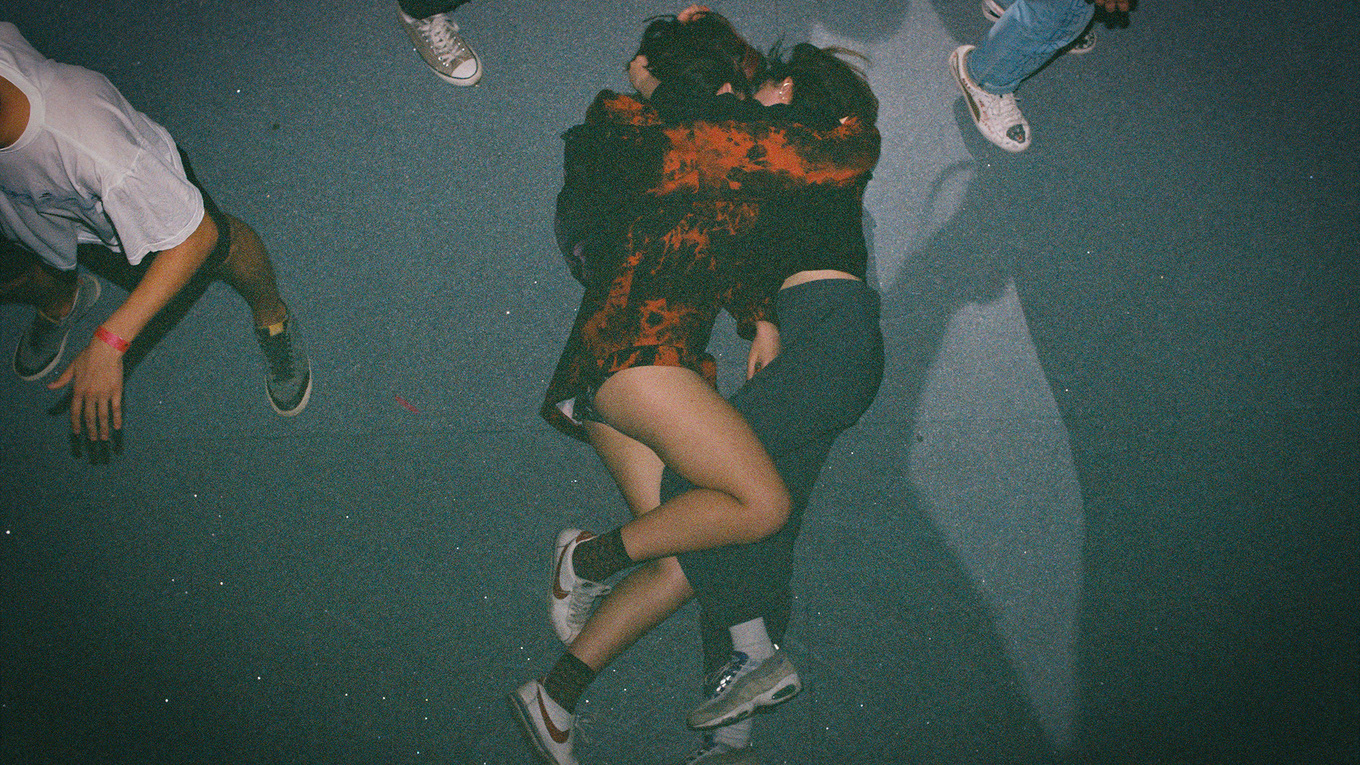
What does Moscow youth culture look like in 2025? Report by Anastasia Anisina
Culture is sensitive to the militaristic shift and the strengthening of the repressive apparatus in Russia. But, like a tree through concrete, informal associations find somewhere to grow. We tell you what is happening with youth culture in Moscow in the fourth year of hostilities in Ukraine and the strongest ideological pressure within the country.
"Dope"
- Oh, great! We haven't seen each other for five years.
- We met a month ago, dude.
- It’s terrible, there are still the same people here as yesterday.
The industrial zone near the Semenovskaya station in Moscow begins with the freight railway line; the rails cut the street and go into the greenery. To get to the concert, you need to walk along the railway through the checkpoint and deeper into the labyrinth of warehouse, production and office buildings.
The oblong room on the second floor is accessed via a fire escape. It hosts events of anarchist youth associations on the topics of horizontality in a team, communitarianism and neurodiversity. The space was created by enthusiasts for their own. This night there will be an association party with the self-explanatory name “Dur”, which surprises even the organizers themselves from the site: the space is accustomed to calmer and more intellectual events.
— And if I know N* [names removed for security reasons], will you give me a discount?
- Everyone here knows him. And we, unfortunately,” the organizers answer at the entrance.
I had to pay a thousand rubles. “Chpok” - stamp on your hand, and forward, past the bar, along narrow corridors, towards the noise of the audio system.
There is only one stage at the party, and at most five of the most seasoned partygoers roam around it, those who are able to withstand the sounds of obsessive industrial noise. The rest of the guests of the event traditionally huddle in the smoking room on the balcony - the event does not involve other leisure areas.
A couple of guys discuss loudly and at length the situation of queer people in modern Russia, Prigozhin’s rebellion and their father’s business, while sipping Ashkyudi.
“Now I’m scared to appear there [where exactly is unknown. — Approx. auto ].
- Well, don’t say that you’re a lesbian, and everything will be fine.
- It's still scary.
They are not going to leave the smoking room, and there is nowhere to go, except downstairs, where the largest company has gathered - free riders.
- ABOUT! He shot a hundred ["shot". — Approx. ed. ], we need another hundred,” screams a guy in dark, baggy clothes.
“And I made a thousand at one party, got drunk in 20 minutes and went home,” the face control officer agrees with him.
The guys at the entrance are dressed in drain style ["drain" is a reference to emo and goth culture, the style is inspired by the Swedish cloud rappers Drain Gang . Characteristic features: black color, layering, chains, deliberate sloppiness. — Approx. ed. ]. Most are already quite drunk. Although, perhaps they are just imitating a drunken appearance for coolness; many of them look underage.
The association “Dur” has been holding parties since 2022, and the first one happened two weeks before the start of a full-scale war in Ukraine. After six months of silence, the parties resumed, but with promotion in the spirit of the times. The text of one of the commercials reads like this: “And we dance boogie-woogie in a fascist dictatorship! Dance while they give it." Over the three years of Duri’s existence, mostly grassroots and little-known artists played at the association’s parties, but at the peak of their popularity, the legendary Pakhom even performed at one of the promotional group’s parties.
At the beginning of its journey, “Dur” gathered crowds of informal young people, using large venues and inviting performers of different genres. But the closure of local clubs and other factors have significantly reduced the size of the parties: “No Cure will come here for another 50 years, and it’s fucked up that there’s really no exchange,” says one of the party organizers. — The conformity of Muscovites who don’t want to walk from the metro for more than five minutes, the lack of a culture of supporting groups and parties, there are no loud arrivals, places are closing... one after another - and the anamnesis turns out to be a bad picture. It’s cool for ordinary dudes to go to a bar in the center, the DJ is playing, he’s not playing - don’t give a damn, in fact they came to get drunk.”
“I know that I will meet all my friends here”
Another site is familiar to every activist in the capital. Evenings of reading letters to political prisoners, lectures by human rights activists, meetings of left-wing communities and psychological support groups are held here. In addition to activist events, there are handicraft clubs and film screenings.
Today there is a charity fair in support of the project. All proceeds from the sale of books, clothing and handicrafts will go towards paying rent and maintaining operations.
A political quiz is taking place in the basement. The questions are not easy: you need to remember all Putin’s doubles, be able to identify the fictitious and real posts of Dmitry Medvedev. There are stacks of literature on the tables. There was also a place for archival issues of Novaya Gazeta from 2021, now rare.
At the entrance, two students in identical camouflage jackets, strewn with badges and patches with state flags and rock band logos, came out to take a breath:
— What kind of patch do you have on your right shoulder?
— This is the flag of the Republic of Fiume. Its constitution was drawn up jointly by communists, anarchists and fascists. It was cool that...
“...they were handing out cocaine,” the camouflage partner picks up.
— Yes, and there were free brothels. They engaged in air piracy: on holidays they scattered bags of powder from the plane.
“I know that I will come here and meet all my friends: guys from the activist community, colleagues from Memorial, acquaintances from school,” says Alexey, an intelligent-looking man in glasses with square lenses and modest sportswear. — There are no such places in Moscow anymore, except perhaps the monument to Okudzhava on May 9, on the birthday of Bulat Shalvovich. For 40 years in a row, on this day people have gathered at the memorial, singing and reading poetry. It’s valuable when there is such an opportunity to gather among like-minded people.”
A guy in a black leather jacket with badges of the Yabloko party and the punk band Pornofilmy in line for vegan waffles skillfully performs a trick: “If you pull out the jack of spades, you donate 100 rubles, the queen of hearts gives me 50 rubles.” I had to transfer a hundred, but for the site it wouldn’t be a shame to send more.
“There is already too much negativity in the world”
“Corporations are Babylon, SAGA is a non-profit enterprise, make some noise for that independence, friends!”
Crowds of young people gather around an improvised stage with a remote control right on the roof of a pickup truck on Bolotnaya Square. Entrance to the party is free, but most casual passers-by prefer to watch what is happening from a safe distance - the Patriarchal Bridge connecting the island and the Cathedral of Christ the Savior. On Sunday, party guests naturally prefer sipping beer on the carpets at the side of the stage to physical activity. Only the most energetic ones dance. Mostly playful hip-hop plays, but there is also jazz from a saxophonist from Texas, and a jungle DJ set from Brazil. The audience of the party is fashionable millennials with a focus on American clothing style: hoodies with prints, sneakers and caps.
Exactly a year ago, in the art cluster on the site of the Red October factory, filled to capacity with pretentious, expensive establishments, musicians suddenly began to appear. They exhibited a DJ right on the street, opposite the SAGA coffee shop, a project of electronic musician Andrey Lee (“Director of Everything”). Crowds of young people gathered around. “I returned from a hot country and decided to set up a turntable right here - and it started a fire. “I can’t find words,” says co-founder of the SAGA project, DJ and musician Pasha Vonda from the stage. Today the team is celebrating the project’s anniversary on a grand scale; friends of the owners are performing at the open air all day long.
Over the course of a year, a micro-coffee shop with two seats has gathered around itself an association of artists organizing free open-air parties, and on the floor above, an audio bar of the same name with vinyl records opened (audio bars, or listening bars in English, are establishments in which the emphasis is on listening to high-quality music, and sound is one of the main elements of the interior). “SAGA is a community. The main values for us are freedom and positivity,” says Lala, co-founder of the project. — We recently returned from South Africa and brought a lot of cool music. Life is too short to set limits for yourself, and there is already too much negativity in the world.”
“There’s a lot of techno now. I don’t really like night parties, now I see myself in someone else, and that’s why the style of music that plays at “Saga” is just super,” says Laran, a choreographer and street style dancer. Laran appears to be around twenty-seven and wears loose clothing with interesting details, such as a knitted bucket hat. “You can dance to it and have a great time.” All the people are cool, interesting, it’s interesting to even just watch them from the sidelines. It gives a cool feeling of being in the space. Since the guys have a cool place [from English. "place". — Approx. ed.] for example, it immediately comes to my mind to organize some kind of dance event here.”
By sunset the party grows, taking on a festival look. Next up are the headliners “ Cassette ”, MC Senechka and “ Director of Everything ”. The crowd burst into screams to the artists' favorite tracks, and the guys from the company of street dancers, who had been hiding their professionalism from the public all day, finally got very drunk and went to tear up the stage with their low breaks.
“The uniqueness of our project is, first of all, in the people and the love that we put into this business,” says Andrei Li (“Director of Everything”), one of the founders of Saga.
- Why do people come?
“Because they feel at home here.” They are interested in seeing people like them. Something in my soul responds, you know?
— Why is it important for you to remain independent from corporations?
— When you invest a part of yourself, it is very valuable in a project. And of course, we would really like to collaborate with some corporations. But the sincerity that we broadcast is exclusively ours. And it is not so easy to find partners who share these values. Everything is built purely on our enthusiasm and love for this business.
— Why are the parties free?
— It seems to me that for Moscow this format is now more relevant than ever, firstly, and secondly, we have a 100% summer playground. And somehow we didn’t even think about the need for a paid entrance. In general, we are for maximum openness, so that people who walk along the bridge, along “Red October”, can simply see, hear something, something touches them, and they can easily come in and immerse themselves in our vibe, in our “Saga”.
“The smell of lilac floated through the city, How beautiful you were.”
The courtyard of the Orthodox school on Maly Zlatoustinsky is unusually lively. Here, a company of 50–60 young people celebrates Friday evening at the “last concert” of the group “ Iva ” and “Mountain Tea” . As band member Lyosha Nikolaev will later tell you, there will, of course, be more concerts, but this is such a long-running joke: calling each concert of the Iva group the last.
Lyosha was born into the family of a priest, he has seven brothers and sisters, and he began studying music from childhood. Young people teamed up at a friends’ wedding to play covers of popular folk and pop songs, and then it dragged on and “Iva” appeared.
“The smell of lilac floated through the city, how beautiful you were...” the lead singer of the group “Iva” Ivan Sakharov sings Valery Zalkin’s song. The people sing along in chorus, and there is a feeling that for a few seconds everyone around becomes some kind of family to each other. “I kissed your knees and said thank you to fate.”
The audience of the concert is young people in loose clothes made from natural fabrics, sometimes with ethnic motifs. Most of the guys consider themselves to be part of the folk community, study folk songs and folk dances and go to evenings - traditional evening gatherings of young people. One way or another, everyone knows each other.
“The folk community is not some kind of party that you need to fill out a document to join. It's just a community, and it can be completely different people. Once you get acquainted with folklore, delve a little deeper into it, and you immediately find yourself in this community. And then - depending on your luck, with which companies you will listen and analyze materials, learn songs,” says Lyosha Nikolaev.
Violin, accordion and double bass merge in euphony, and people drink herbal tea in an improvised corner or sip wine from their throats. “Mountain Tea” immediately follows “Iva”, Lyosha “jumps” from double bass to guitar and microphone. The genre of association is not easy to define. “Folk, maybe black. The closest style is probably blues,” says Lyosha. In Mountain Tea he is the frontman of the group.
“I don't want to work. I’m absolutely tired of working,” the lines of a hooligan song sound, and the warmed-up audience gradually peddles away.
“I was very lucky because I ended up with my parents at the Family Circle festival [an annual festival of traditional culture. The organizers of the festival are the Folklore Union of the Yaroslavl Region. — Approx. ed. ], when I was nine years old, or something. Since then I try to go there every year. We had a group of young people who also hung out at this festival, and they all became my best friends,” says Lyosha.
In the 2020s, the folk community began to actively grow. “The story of the war and the abolition of Russians in the West or the abolition of non-Russians in Russia stirred up many people and forced them to look for their own. Some people came to this through very patriotic sentiments, and others through an attempt to figure out what we are,” says Nina Vagaitseva, a folk musician, folklore collector and blogger from St. Petersburg. Nina talks about folklore on her blog on Instagram (Meta is recognized as a banned organization in the Russian Federation).
In Moscow, large-scale parties are held twice a year - on City Day (September 7) and on May 9 on the Patriarchal Bridge. The organization happens spontaneously, people just know that it will happen, and gather in the late afternoon for songs and dances. Despite the fact that no one approves the event, the party has never been dispersed. “Lately, everyone has apparently realized that everyone is gathering in one place. And the police come, walk around, see what’s happening, see that everything is fine, and leave,” says Nastya Vlasova, a member of the folk community “Evening Moscow Partnership.” Nastya and her folklorist friends organize parties all over Russia and create a folk camp for young people.
“For most, it is the feeling of unification that is important, because now people sing together very little. And folklore provides the opportunity for co-creation, the feeling that we are together. You can sing a song with a person you haven’t seen for six months, and even if you run away, this contact will take place and it will turn out to be of very high quality,” says Nina Vagaitseva.
“For me, a folk club is, first of all, about communicating with people. This really makes me very happy, because the feeling when you sing a song in good company... well, it’s so hard to convey, to formulate...” says Lyosha Nikolaev.
Moscow is becoming dehumanized at every step: public areas are thinning out, independent spaces are closing, and people are leaving. But as long as there is a need to look for oneself, community and creative fulfillment, young Muscovites will continue to look for ways to self-organize, create and have fun together. As long as they give it.