
Translated material
Ukrainian prisoners convicted in Russia are tried again - for the second and sometimes even the third time. Research "Mediazone"
Since the first year of the war, trials of Ukrainian soldiers and officers have been going on in Russian courts and in annexed territories. They are tortured, kept in unbearable conditions without communication with the outside world, and then sentenced to enormous prison sentences. But that’s not all - as Mediazona found out, many prisoners are being tried for the second time, and some for the third time. We found and studied in detail 51 repeated cases against servicemen of the Armed Forces of Ukraine, but the real scale of this practice is probably much greater.
What we thought and what we couldn’t find out
Mediazona studied press releases from the Investigative Committee, the Prosecutor General's Office, reports from state news agencies and court files. We turned for clarification to the press service of the Southern District Military Court and to those of the lawyers of the captured Ukrainians whose names we managed to find out. Most of the defense lawyers refused to talk to journalists, and those who agreed asked for anonymity.
We learned about the sentences handed down in Donetsk mainly from press releases of law enforcement agencies - the Supreme Court of the DPR began publishing case files only in December 2024; there is no information about many cases on the court’s website.
At the same time, from the messages of the Investigative Committee and the prosecutor’s office it was often unclear what kind of punishment was meant - final according to the totality of sentences or only according to the last of them.
In one press release the deadline was mixed up, in several the articles of the charge did not correspond to the cards on the court website.
In three cases, checking press releases and court records, we were unable to find out the full names and patronymics of the accused.
Some of the military men mentioned in this text could have already been exchanged - there are no official lists in the public domain.
All this forces us to consider Mediazona’s calculations as obviously incomplete. We are sure that there are actually many more repeated cases against the Ukrainian military than we were able to find.
How is a term determined based on the aggregate of several sentences? According to Article 70 of the Criminal Code, when imposing a sentence based on a cumulative sentence, the court “partially or completely” adds the unserved part of the previous one to the new term.
Therefore, the final sentence is not equal to the sum of the sentences imposed in the first and second cases - in most of the cases described in this text, the second sentence, despite the severity of the charges, increased the term by only a few years or even months.
At the same time, the punishment for the totality of sentences cannot be more than 30 years, and for several serious articles, including “terrorism” - no more than 35.
This does not apply to a life sentence: partial or full addition of any term to life gives a life sentence.
All of the sentences mentioned below, except for life sentences, involve serving a term in a maximum security colony; therefore, for the sake of brevity, the text omits clarification of the regime in each specific case. Life sentences are served in special regime colonies.
Donetsk
At least 26 Ukrainians were convicted twice by the DPR Supreme Court. Most often, these prisoners were charged with murder or attempted murder (Article 105 of the Criminal Code), damage to someone else's property (167 Criminal Code), cruel treatment of the civilian population and the use of prohibited means of warfare (356 Criminal Code). As a rule, the second time they were tried on very similar charges and the same articles.
One of these cases can be considered indicative of the practice that has developed in Donetsk: sentences were passed on ten Azov fighters, each of whom was then tried for the second time, and some for the third time.
Artem Vyshnyak, Sergei Gaikovich, Dmitry Kucheryavyi, Dmitry Klusenko, Evgeniy Lavrenko, Ivan Nozhechkin, Sergei Samokhval, Semyon Severin, Denis Fedirko and Egor Yakovenko were among the Ukrainian soldiers who left the besieged Azovstal plant in Mariupol on May 18, 2022 and on the orders of the command surrendered to the Russians.
On March 22, 2024, the DPR Supreme Court sentenced them to terms of 22 to 22.5 years in a maximum security colony on charges of cruel treatment of the civilian population, attempted murder of two or more persons motivated by hatred, and damaging someone else’s property in a generally dangerous manner. This is how the investigation qualified the mortar attacks on a residential area “on the western outskirts” of Mariupol, which the Ukrainians allegedly carried out between March 7 and April 15, 2022.
Already in August 2024, the Donetsk Supreme Court received a new case against Klusenko, Lavrenko and Fedirko. On December 20, they were again sentenced to 24.5 years in prison each. According to the investigation, on March 13, 2022, three military men fired high-explosive fragmentation mines at the village of Agrobaz of the Donetsk People's Republic, as a result of which “a private residential house and outbuildings were damaged.” Klusenko, Lavreno and Fedirko were charged with the same charges as the first time.
On June 16, 2025, Nozhechkin and Yakovenko were sentenced to 25 and 26 years, respectively. According to the prosecutor's office, the commander of the mortar battery Nozhechkin gave the order to shell the village of Agrobaza in March 2022, and Yakovenko carried it out. “As a result, two private houses, in the basement of which civilians were hiding, were damaged. People managed to escape." The qualifications of the charges were exactly the same as in the first case.
On June 26, 2025, Vyshnyak, Gaikovich, Samokhval and Severin received from 23 to 23.5 years for “shelling the village of Berdyanskoye, Mangush district of the DPR” in March 2022, as a result of which four houses were damaged. Unlike the first case, this time they were also charged with attempted murder of a minor or a person in a helpless state; the rest of the charges have not changed.
Non bis in idem
The prohibition of repeated punishment for the same act is one of the basic principles of modern law, known as the rule non bis in idem (Latin): “Do not [punish] twice for the same thing.”
In Russian legislation, this principle is enshrined, in particular, in Article 50 of the Constitution and in Part 2 of Article 6 of the Criminal Code.
In the case of ten prisoners from Azov, the second sentence added a term of one to four years, which is generally typical for the practice of the DPR Armed Forces. The maximum difference between the first and final punishment among cases known to Mediazona is that of the marine Yevgeny Ermolenko, who received 17 years in November 2023 and 25 years in October 2024.
Only a few repeated cases against Ukrainian prisoners of war convicted in Donetsk do not fit into this picture.
For marine Maxim Chernushenko and military paramedic Vitaly Matvienko, the final sentence for the second sentence was no different from the first. Chernushenko was sentenced in October 2023 and in February 2024 - both times to 25 years. The same thing happened with military paramedic Vitaly Matvienko. In November 2023, he was sentenced to 30 years. Exactly the same term is indicated in the second verdict, handed down in August 2024.
In at least eight cases, the second sentence handed down to Ukrainians by the DPR Supreme Court was lifelong.
Two more prisoners were sentenced to life imprisonment immediately, and the final punishment in the second case only repeated the first sentence. This was the case with the commander of the engineering and technical company Alexander Svinarchuk (the first sentence in November 2023 , the second in May 2024 ) and the marine Dmitry Shalar (in December 2023 and exactly a year later - in December 2024 ).
Only Azov driving instructor Alexey Kyrkalov, after a life sentence in May 2023, received a shorter sentence at the second trial: in September 2024, he was sentenced to another 18 years in prison.
Rostov
Those Ukrainians convicted in Donetsk who served in Azov are often retried in the Southern District Military Court in Rostov-on-Don under articles on training in terrorism (Article 205.3 of the Criminal Code) and participation in a terrorist community (Part 2 of Article 205.4 of the Criminal Code). This is a standard qualification in cases against Azov and Aidar fighters, units that are designated as “terrorist organizations” in Russia.
The accusation in such cases is often without any specifics - it is only said that the prisoner “acquired knowledge, practical skills and abilities during classes in physical and psychological training, first aid, studying the rules of handling weapons, explosive devices, explosives and objects that pose a danger to others” or “voluntarily joined [Azov] by concluding an appropriate contract, was provided with military uniforms, firearms and ammunition, as well as other equipment necessary to participate in hostilities.”
As Memorial stated , in fact, prisoners from “Azov” and “Aidar” “are charged with the fact that they, as part of a unit of the Armed Forces of Ukraine, served in military service on the territory of the state of which they are citizens.”
Mediazona found 12 such repeated cases, most of them were received by the YUOVS in the summer of 2025. For those prisoners who have already received a second sentence, their sentences increased slightly, although the especially serious “terrorist” offenses charged against Azov fighters carry a sentence of up to life imprisonment.
The first case against Leonid Glushchenko, Evgeniy Goryainov, Artem Filin and seven other servicemen from Azov was submitted to the Supreme Court of the DPR on January 29, 2024. According to investigators, in February-March 2022, they “conducted indiscriminate ‘fan’ shelling from a towed howitzer of residential buildings and civilian infrastructure in the DPR settlements of Stary Krym and Lebedinskoye.” As a result, “five households were damaged and their owners suffered significant damage.” Civilians, as the Investigative Committee admitted in its press release, were not harmed.
According to the case file on the website of the DPR Armed Forces, the military was only charged with attempted murder of two or more persons motivated by hatred, but press releases from the Investigative Committee and the prosecutor’s office also indicated other charges: the use of prohibited means of warfare and damaging someone else’s property in a generally dangerous manner. Already on March 18, 2024, ten prisoners were sentenced: from 26 to 27 years in a colony.
New cases were opened against at least three of them - Glushchenko, Goryainov and Filin - for participation in a terrorist community and teaching terrorism. In the YUOVS they were tried separately. Дело Горяйнова поступило в суд 8 июля, процесс еще идет. Filin and Glushchenko have already been sentenced; their total terms have been increased to 28 years.
The Investigative Committee announced the first verdict against Artur Sivitsky and his two colleagues in August 2023. The press release stated that they “fired more than 50 targeted shots from firearms” at a car containing civilians in Mariupol, “believing that they supported a special military operation and adhered to pro-Russian views.” The passengers managed to escape, and the three defendants received 20 years in prison.
A press release about the first verdict of the DPR Supreme Court against Igor Kim appeared in the SK telegram channel in November 2023. According to the department, Kim carried out “deliberately illegal orders to fire mortars at residential buildings and civilian infrastructure.” As a result, a civilian received a shrapnel wound, “civil structures were damaged,” and “private households were destroyed.” The Donetsk court sentenced Kim to 24 years.
New cases against Kim and Sivitsky were received by the YuOVS on the same day, June 18, 2025. They were sentenced at different times: 27 years for Kim and 28 years for Savitsky.
On August 27, grenade launcher Andrei Barabanov was sentenced in Rostov to 27 years. The first sentence that the Supreme Court of the DPR handed down to him in September 2023 was reported only by state agencies - as TASS writes , Barabanov then received 22 years. According to the prosecution, in April 2022, he “shot a random passerby” in Mariupol.
Bogdan Beznosko was sentenced in Donetsk to 25 years; the investigation believed that his mortar crew fired at a residential building in Mariupol in the spring of 2022. On September 29, a military court in Rostov sentenced Beznosko to 28 years in a new “terrorist” case.
The verdicts in the repeated cases against Anatoly Kilyushik , Maxim Melnikov , Daniil Ovcharenko and Artem Sinelnik, which were submitted to the YUOVS in the summer, have not yet been made. In the Supreme Court of the DPR they previously received sentences from 23.5 to 27 years.
Случай Дмитрия Юдина нетипичен. On May 28, he was sentenced in Rostov to 19 years in prison, and two months later the DPR Armed Forces received a second case under articles of cruelty to the civilian population, the use of prohibited methods of warfare and murder. On August 8, this case was returned to the prosecutor, since “factual circumstances indicate that there are grounds for classifying the actions as a more serious crime.”
It is unknown what exactly Yudin is charged with; there is no information about him in open sources. The Donetsk lawyer representing Yudin’s interests told Mediazona that the prisoner, in addition to Ukrainian, also has Russian citizenship, so he is “also charged with treason,” but the lawyer did not discuss “such moments,” since he “took an oath.”
Why and who needs this? What do lawyers think?
According to defense lawyers who agreed to talk to Mediazona, repeated cases are a convenient way for security forces to improve reporting. In addition, in the eyes of the Russian authorities, the sentences of captured Ukrainians have a symbolic meaning - “so that someone is to blame for the death of every civilian, for the destruction of every house.”
“Sticks are sticks,” lawyer A., familiar with this practice, succinctly answered Mediazona’s question about repeated cases against already convicted Ukrainian prisoners. She believes that life sentences in such cases are “not an end in themselves,” and therefore the terms for the totality of sentences are increased slightly.
“I think there are different jurisdictions there. As a rule, 356th is the investigative jurisdiction of the Investigative Committee, and 205th is the investigative jurisdiction of the FSB, and everyone wants to throw a stick,” argues A. “Report: here, we investigated, look.”
«А мариупольские дела — специальные, — добавляет она. “They are needed so that someone is responsible [for the death of every] civilian, for the destruction of every house.”
Donetsk lawyer B., who represents another Ukrainian military officer by appointment, explains the appearance of repeated cases by the fact that the investigation will eventually learn additional details of old events. According to B., jurisprudence is “one of the most inexact sciences,” and judicial practice “may vary a little in each subject” and depends on the “inner conviction” of the court, which “no one tells.” B. participated in one more of the cases described in this text, but in a conversation with Mediazona he could not even remember who exactly he was defending: according to the lawyer, he has many cases in his work with “similar plots” in which “only the faces can change.”
Lawyer V. told Mediazona that the initiation of repeated cases against prisoners pursues a political goal - “the formation of judicial practice related to the atrocities of Ukrainian nationalists, their oppression and extermination of the pro-Russian population of Donbass.” She believes that in this way the Russian authorities are trying to “justify the invasion” and consolidate in the verdicts the propaganda image of Ukraine “as a nationalist and pro-fascist state.”
Convicted twice in absentia
Mediazona knows of at least six cases in which Ukrainian military personnel were tried in absentia several times. The criminal prosecution of the two prisoners continued after Russia returned them to Ukraine in an exchange.
The commander of the 1st separate marine battalion, hero of Ukraine, Evgeny Bova, was sentenced in absentia by the Supreme Court of the DPR three times to life imprisonment three times. According to the prosecution, he gave orders to kill civilians and shell residential buildings in the Novoazovsky and Telmanovsky districts in 2019 and the Mirny village in Mariupol in 2022.
The name of Denis Zhuchkov from Azov was mentioned in the list of military personnel published by the Ukrainian Channel 24 who returned from captivity as a result of the exchange on September 21, 2022. After this, in Donetsk, Zhuchkov was given two sentences in absentia: 16 years in the case of cruel treatment of prisoners, and then life in prison on charges of shooting up a car with civilians, including children.
Sometimes trials in absentia against Ukrainian military personnel are conducted by the 2nd Western District Military Court in Moscow. Last December, its employees hid the case files on terrorism-related charges, making it difficult to analyze the court file.
However, Mediazona found out that the commander of the 27th rocket artillery brigade of the Armed Forces of Ukraine, Dmitry Khrapach, after a life sentence in absentia handed down in Donetsk, was once again sentenced in absentia to life imprisonment by the 2nd ZOVS in the case of missile strikes on the Belgorod region.
The commander of the 19th separate missile brigade, Rostislav Karpusha, also received life sentences in the 2nd ZOVS in June and September 2025 for directing the shelling of the Kursk region.
The commander of the 7th tactical aviation brigade, Evgeny Bulatsik, apparently was tried in absentia three times: in April 2024, he received 18 years for ordering the bombing of an oil loading station near Bryansk, and then, together with Karpusha, a life sentence. At the same time, from the press release of the Investigative Committee it followed that Bulatsik had previously been sentenced to life imprisonment once for a “similar missile attack” on two districts of the Kursk region.
The prosecutor's office announced the first verdict of the DPR Supreme Court to marine Oleg Zavaletsky in November 2023. Его обвинили в убийстве «пяти мирных граждан и одного раненого военнопленного» и осудили на 30 лет колонии. Судя по картотеке суда, Завалецкому позже вынесли еще два приговора — в декабре 2024 года и апреле 2025-го . Информации о первом из этих дел «Медиазона» в открытых источниках не нашла, о втором писала Генпрокуратура — по обвинению в расстреле случайного прохожего военный получил 24,5 года колонии, но уже заочно.
В октябре 2024-го он вернулся в Украину по обмену и в интервью рассказал о пытках на следствии. «Принцип у них такой. Где гибли гражданские от рук РФ и рядом были мы — значит, и вину можно повесить на нас. Сначала я искренне отказывался, но потом избивали меня и других. Чтобы это прекратилось, я сказал: ок — и подписывал, что только можно», — вспоминал Завалецкий.
Осуждены трижды
Против еще шести украинских военных, как обнаружила «Медиазона», возбудили по три уголовных дела. Четверым из них уже вынесен третий приговор.
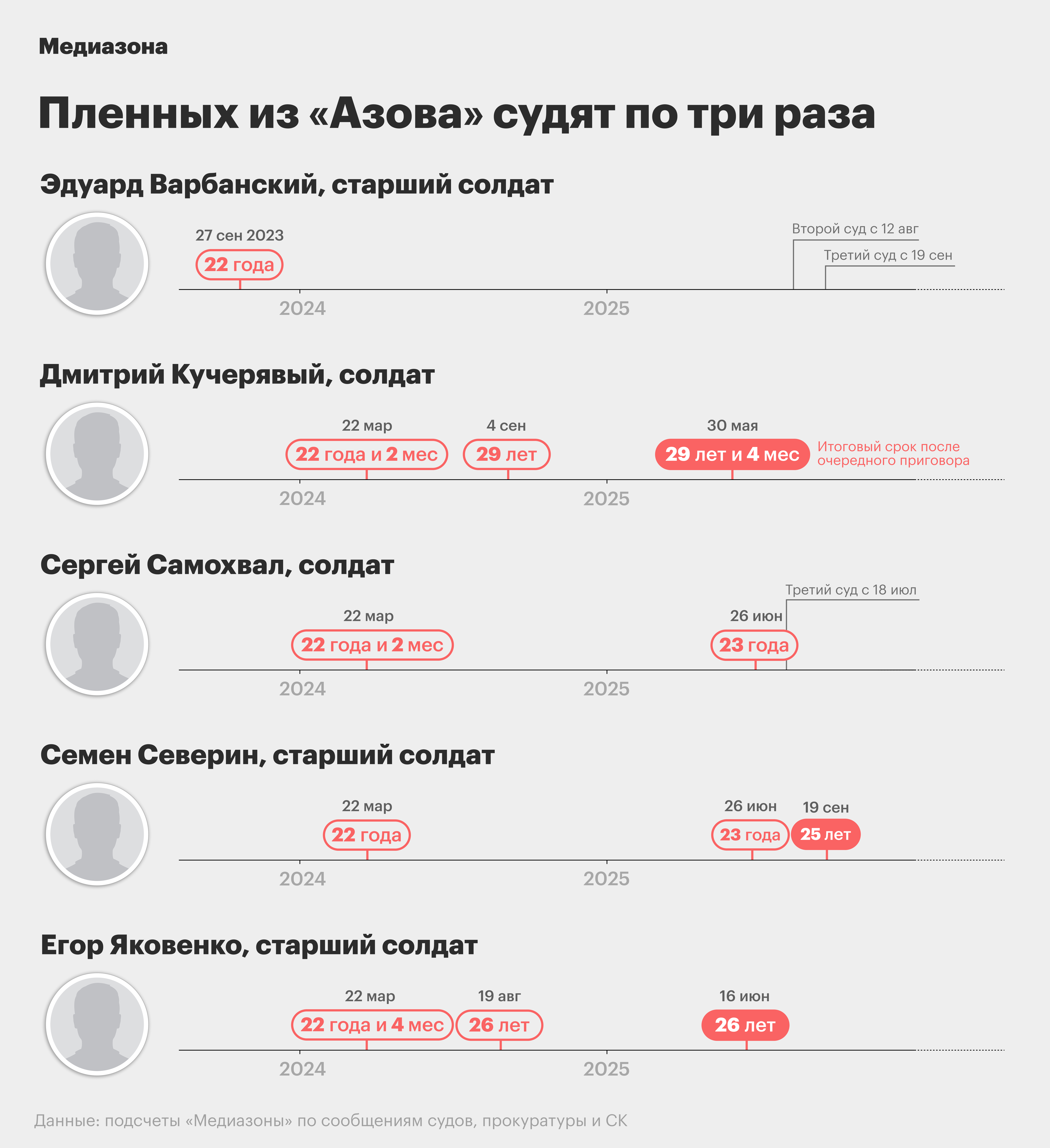
Дмитрий Кучерявый, Сергей Самохвал, Семен Северин и Егор Яковенко были среди десяти военных, которых ВС ДНР 22 марта 2024 года приговорил к срокам от 22 до 22,5 лет (об их деле уже говорилось в начале этого текста — в главе «Донецк»).
В октябре 2024 года в Верховный суд поступило второе дело против Северина, Самохвала и еще двух военнопленных, которых судили вместе с ними в первый раз — Артема Вышняка и Сергея Гайковича. В этот раз украинцев приговорили к срокам от 23 до 23,5 лет.
В Ростове-на-Дону Северина и Самохвала судили уже отдельно друг от друга. Дела против них ЮОВС начал рассматривать в июле 2025 года, обвинение было стандартным: участие в террористическом сообществе и обучение терроризму. Самохвалу приговор еще не вынесли , а Северина 19 сентября приговорили к 25 годам.
Егора Яковенко и Дмитрия Кучерявого во второй раз судили в Ростове. Яковенко приговор вынесли 19 августа 2024 года, увеличив срок с 22 лет и 4 месяцев до 26 лет. Кучерявому, как писал «Мемориал», дали 29 лет. Он участвовал в заседании по видеосвязи из ИК-10 в Саратовской области.
28 апреля 2025-го третье дело против Кучерявого принял к рассмотрению Верховный суд Донецка. На этот раз военнопленного обвиняли в том, что он «в марте 2022 года совместно с сослуживцами произвел минометный обстрел села Бердянское Мангушского муниципального округа Донецкой Народной Республики». Жертв не было, признавала прокуратура: «Супружеской паре удалось укрыться от осколков и разорвавшихся мин, а три жилых дома получили повреждения». Уже 30 мая Кучервяому вынесли приговор, суммарное наказание составило 29 лет и 4 месяца.
16 июня донецкий суд в третий раз признал виновным Яковенко, сочтя доказанным, что в марте 2022 года тот «совместно с сослуживцами произвел обстрел» села Агробаза. В результате, говорилось в пресс-релизе, «два частных дома, в подвале которых укрывались мирные жители, получили повреждения, а людям удалось спастись». Срок Яковенко увеличили до 26 лет.
47-летнему командиру роты морпехов Леониду Онупко Верховный суд ДНР три раза подряд назначал пожизненный срок. Согласно пресс-релизам СК и Генпрокуратуры , обвинения против Онупко связаны с его «преступными приказами» об убийстве мирных жителей Мариуполя, из-за которых 11 человек погибли, а один смог спастись.
Минометчика из «Азова» старшего солдата Эдуарда Варбанского в сентябре 2023 года донецкий суд приговорил к 22 годам по делу об «обстрелах жилых кварталов села Бердянское», где было разрушено здание школы.
31 июля СК сообщил об окончании нового расследования. Согласно пресс-релизу, Варбанский «в марте 2022 года совместно с иными военнослужащими произвел прицельный обстрел из миномета жилых домов, гражданских и социальных объектов» Бердянского. Его второе дело поступило в Верховный суд ДНР 19 сентября.
Чуть раньше, 12 августа, еще одно дело против Варбанского по стандартным «террористическим» статьям принял к рассмотрению Южный окружной военный суд в Ростове. Приговоры по обоим делам пока не вынесены.
При участии Аллы Константиновой, Сергея Голубева и дата-отдела «Медиазоны»
Редактор: Дмитрий Ткачев