
Translated material
Game of classics
Following in the footsteps of the exhibition “Art Russia Classics. New look" in Gostiny Dvor

Fair of contemporary academic art “Art Russia. Classic. New look" in Gostiny Dvor. Photo: Anton Velikzhanin / Kommersant
Last week, Gostiny Dvor hosted for the first time a contemporary art fair called “Art Russia Classics. A new look." The organizer and main sponsor is the Synergy corporation, which founded the Art Russia forum in 2018, within which the fair of the same name has been held for more than five years.
This year, the organizers decided to add another one to the main event held in the spring, which presented a more classical view of contemporary art. Two weeks after Cosmoscow - the main event of the year in the art industry - the fair in Gostiny Dvor showed an alternative picture of what artists can do today.
When talking about fairs held under the Art Russia brand (in this case transformed into “Art Russia”), it is important to understand that this brand was created in many ways as a counterweight to the establishment of Russian contemporary art with the largest galleries, foundations and artists. Unlike the extremely exclusive Cosmoscow, which is impossible to get to “from the street” and whose stands are provided exclusively to galleries (as a rule, already recognized ones), the organizers of Art Russia have created an environment that is, in a sense, more democratic in its approach, which has attracted many emerging and independent artists.
It is not surprising that this approach caused a negative reaction from the largest players in the art market, so the attitude towards this fair in expert circles can hardly be described as anything other than condescending.
But it cannot be denied that the idea of a large fair in Gostiny Dvor with a not very high entry threshold turned out to be promising in its own way. Of course, this same approach has become the reason for an extremely motley aesthetic (in the eyes of critics, even kitschy) and a very average overall level, which, perhaps, does not allow us to recognize the Art Russia project as a separate phenomenon of contemporary art. But this fair has nevertheless become a noticeable phenomenon for the art industry in recent years.
At the same time, of course, we should not forget that the Synergy corporation and university have many connections with the Russian state, so the independence of the Art Russia project is rather conditional. However, in the conditions of the modern Russian art market, probably not a single major art project of this kind could call itself fully independent. “Art Russia Classics. New Look”, which became an offshoot of the Art Russia fair, was organized with the support of the Russian Academy of Arts, and one would expect that this fair would show the most striking examples of contemporary academic art - conservative, traditional and reminiscent of the familiar “classics”.
Contemporary art, as typically understood in Russia (and beyond), rarely speaks the same language as the majority of potential viewers and rather appeals to a niche audience of experts, gallerists, critics and collectors. Another thing is the exhibitions of classics of the 19th and 20th centuries, which invariably attract full houses. If we translate into the language of cinema, then contemporary art in most cases is art house, and classics are blockbusters (it is no coincidence that this word has been used in relation to the most successful museum exhibitions in the last 10 years).
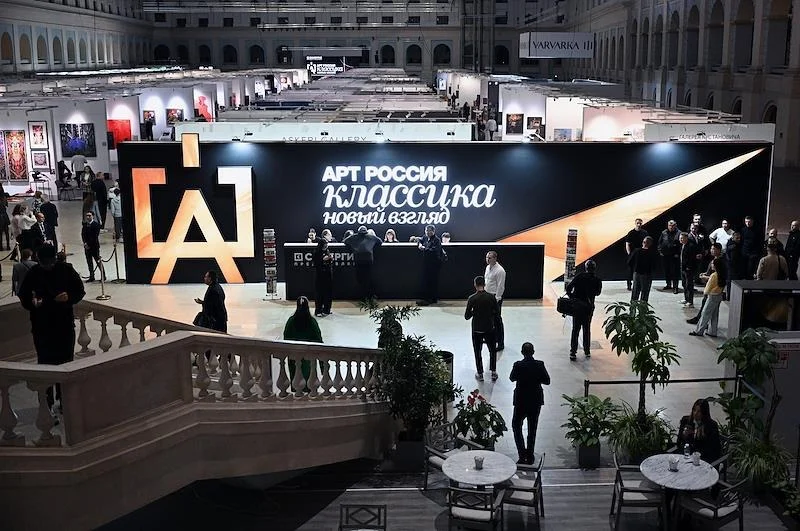
The organizers of the fair at Gostiny Dvor apparently wanted to prove that potential blockbusters appear in art today, but it seems that all four days of the fair taken together were unlikely to cause the same excitement as, for example, the last two days of Kustodiev’s exhibition at the Tretyakov Gallery.
However, comparing the “new classics” with the old ones is generally a thankless task, and it is much more interesting to consider “Art Russia” against the backdrop of the same Cosmoscow, which took place in early September. On the one hand, it’s stupid to argue with experts: of course, the average level of work on Art Russia is significantly lower than on Cosmoscow. On the other hand, when visiting both fairs, it was difficult to escape the feeling of being equally detached from reality by both contemporary “current” and contemporary “academic” artists.
Both of these definitions are perhaps best used in quotation marks, since the relevance of most of the Cosmoscow artists is as questionable as the academicism of many of those whose works were shown at Gostiny Dvor.
In general, the concept of “academic art” after the 19th century, that is, after the national academies of art ceased to be truly influential institutions, became, in fact, conditional. At the same time, even that contemporary art that is considered mainstream today does not always deal with modernity as such.
And at the latest Cosmoscow, almost entirely imbued with the spirit of neutrality and caution, this was especially noticeable. It would seem that “Art Russia Classics,” with its emphasis on the traditional and conservative understanding of the essence of fine art, could more openly record those phenomena that dominate modern Russian reality, where everything traditional and conservative (at least in a very theoretical understanding of the ruling regime) is in every possible way nurtured and glorified. Nevertheless, it turned out to be quite difficult to understand anything specific about Russia in 2025 from the works that were exhibited at the fair.
And yet, some signs of modernity are reflected in the exhibition at Gostiny Dvor. Thus, at the stand of Marina Romakhina, corresponding member of the Russian Academy of Arts, there was a gallery of portraits consisting of 11 non-random people. According to the accompanying text, “only 11 people in the world reflect the fate of the planet and all humanity.” What kind of faces looked at the fair visitors from these portraits? Along the edges, opposite each other, are the current presidents of the Russian Federation and the United States, and in the middle are the nine heads of state of the BRICS members. This really is a dream football team. The young artist, who spends 18 hours a day at her easel (as reported in the summary of one of her online interviews), apparently works literally tirelessly to reflect “the fate of the planet and all of humanity” in these portraits. Some spectators, passing by the stand, asked each other: “Did you recognize everyone?” Answering this question on my own, I honestly admit that only half of the heroes of the stand are familiar to me by sight and the lack of captions for the portraits did not contribute to their recognition. But there is no doubt: “each of them is the future of his people, and together they are the future of all people on earth,” as it is said in the same accompanying text.
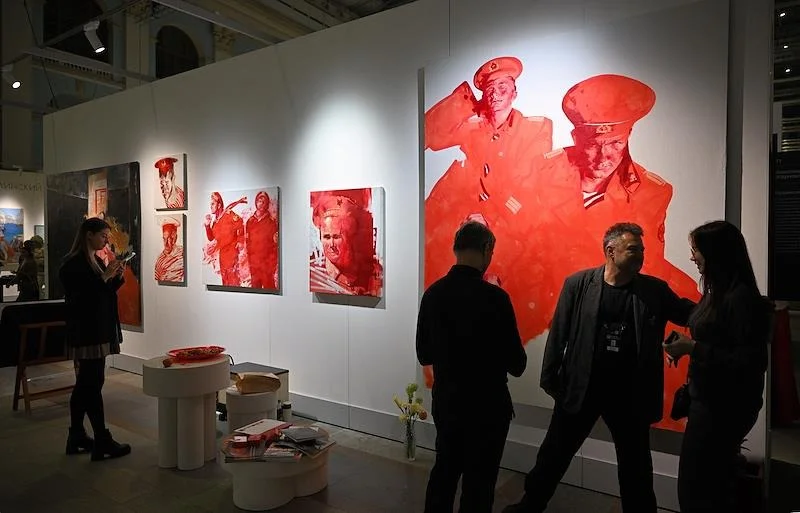
Marina Romakhina’s stand was mentioned in most publications about the fair, but it would be a mistake to consider it representative of all the “new classics” exhibited at Gostiny Dvor.
Of the 70 stands located at the fair, perhaps only this one at least somehow touched on the modern political situation, while the vast majority of the paintings were devoted to much more abstract topics - mainly a variety of landscapes and images of everyday reality.
For example, still lifes by artist Viktor Ponomarenko, in which vegetables and fruits typical of this genre are replaced with products from McDonald's. It is curious that the refusal of any hints at the new localized name of the American brand seems to emphasize the removal of these works from the modern Russian context. And in this sense, even a very small stand from the state foundation “Defenders of the Fatherland” with 11 paintings created by veterans of the Northern Military District does not stand out from the general background, since it also repeats a familiar set of images: a couple of landscapes, a couple of portraits of military personnel, a couple of sketches on the topic of historical memory (in the best traditions of school essays). And of course, nothing even remotely reminiscent of Vereshchagin.
Due to the almost complete absence of obvious connections with modernity, it was not at all surprising to find works by artists from the 70s and 80s on some of the fair's stands. It must be admitted that many of the paintings in the exhibition, painted in recent years, could equally well have been created 40–50 years ago. But does this mean that these works will become new classics? It is doubtful, since among the real classics whose paintings were shown at the fair, one can safely name only Tatyana Mavrina. Otherwise, it seems that the term “classics” is understood by artists and fair curators not in a value sense (as examples of art that will remain for centuries), but rather in a marketing sense: a classic today is something that is similar to classics from museums (however, this similarity is, in essence, superficial).
While most of the fair's artists tried to approach the classics through the genres of landscapes, portraits or still lifes, some did this by turning to historical themes. Thus, the young artist Yuri Ashikov presented the project “The Romanovs. Cultural Heritage", which he has been working on for about five years.
Portraits of the imperial family, made in different techniques, could even arouse some interest among some viewers (at least they were made more skillfully than the “portrait gallery” of Marina Romakhina), but I was much more attracted to this stand by the quote from Nicholas II placed above the paintings: “I go crazy when I think about the prospects of Russia, we will become the Greatest people, the Greatest state, everything in the world will be done with our permission.” It really is: “God forbid I go crazy,” as the poet said.
The imperial theme, oddly enough, did not manifest itself much at the fair, except perhaps at one more stand (the stand of the Empire gallery with a collection of antiques does not count). Several paintings by the notorious Alexei Belyaev-Gintovt, Dugin’s comrade-in-arms, Eurasianist and herald of the concept of “atomic Orthodoxy,” were shown at the Vellum gallery stand. Interestingly, last year these same works could be seen at Cosmoscow, but then the decision of the gallery’s founder, Lyubov Agafonova, to exhibit them led to a conflict with the organizers of the fair, and they have presumably since ceased cooperation.
Gintovt’s monumental paintings at this fair, perhaps, looked more organic than at last year’s Cosmoscow, but they did not become a real symbol of the exhibition.
Still, little could compare in terms of adequacy to today's era with the stand of the tireless Marina Romakhina.
However, if you look a little from a distance, the fair “Art Russia Classics. A New Look” turned out to be quite adequate to our times. Of course, not in the sense that it showed works of modern art that would at least somehow reflect the reality around us - not at all. However, in the very idea of the exhibition, fascinated by the image of the “classics”, in the ritual repetition of the words “academic”, “traditional” and “conservative” and, finally, in the flight of most artists into ready-made forms taken from the past - in all of this, it seems, one can see a much stronger connection with the present moment than in Cosmoscow’s timid attempts to somehow fix the acceptable elusive modernity within the censorship framework.
Therefore, no matter how contemptuously authoritative art critics may treat the fair from the Synergy corporation, in a sense it speaks quite honestly about the state of contemporary art in Russia. Even though this, most likely, was not part of the organizers’ plans.