
Translated material
Хотите сгенерировать видео с героями всех любимых мультфильмов? OpenAI's new AI model makes this possible (although it violates copyright)
А привязанная к ней соцсеть Sora подсаживает пользователей на ИИ-мусор
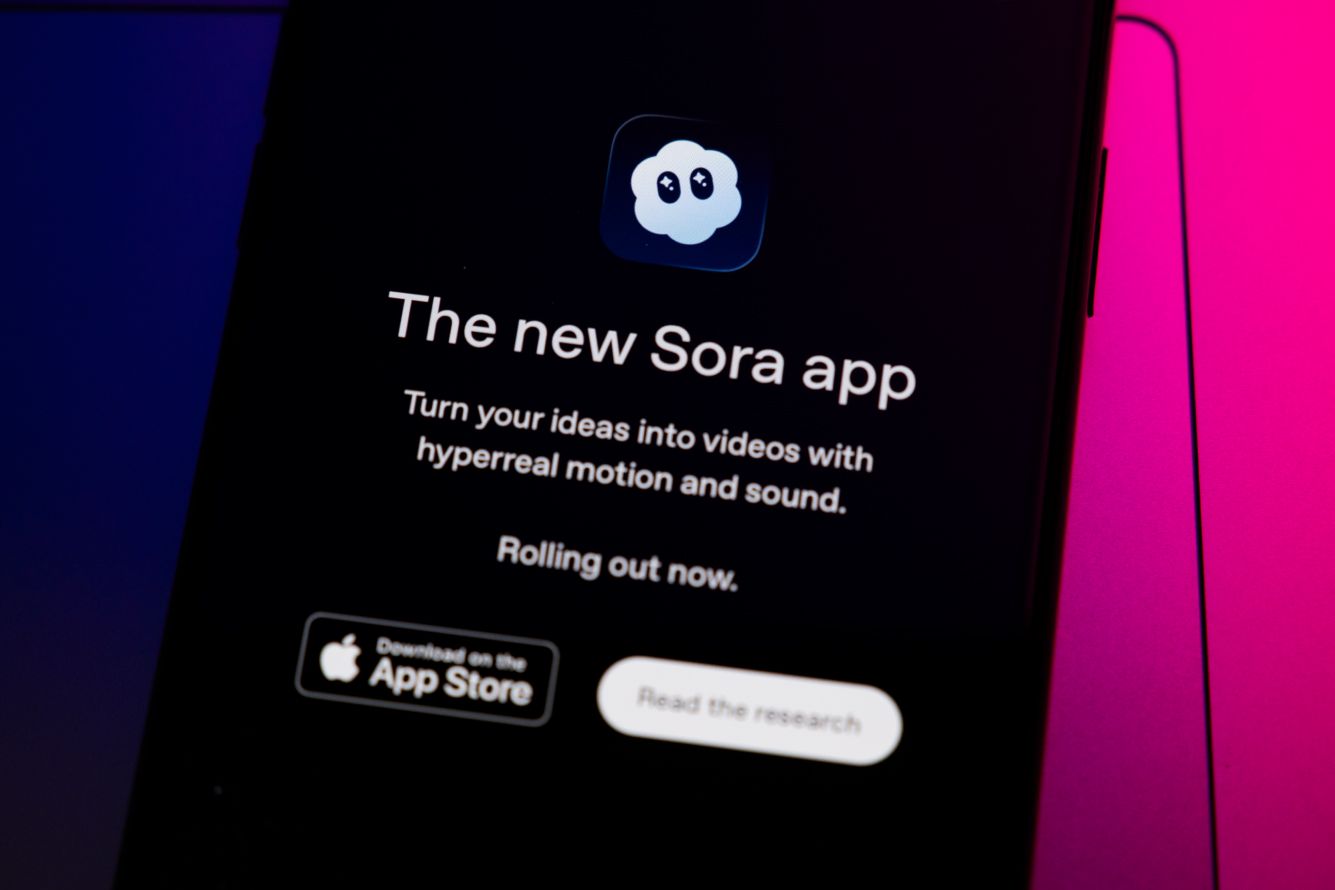
At the end of September 2025, OpenAI released a new artificial intelligence model, Sora 2, which can be used to generate short videos based on a text prompt . In addition, the developers presented a separate Sora application for iOS - a social network whose feed consists entirely of videos created using AI. Essentially, this is a TikTok clone, the content in which is suggested by a special algorithm. Meduza talks about what Sora 2 can and cannot do, and why the new OpenAI application is criticized.
In the official announcement, OpenAI compares the first version of Sora, released in December 2024, to what GPT-1 turned out to be for text generation. According to the developers, this was the first video creation model that actually worked and met the basic requirements for this type of AI. Например, обеспечивала постоянство объектов в кадре. Sora 2 is already GPT-3.5 compliant and is capable of performing tasks that until now were considered difficult, if not impossible, for video generation models.
OpenAI claims that Sora 2 better “understands” the laws of physics and can create more realistic videos. It is also capable of executing complex user instructions while accurately maintaining the state of the virtual world. In addition, the developers noted that Sora 2 supports synchronization of dialogues and sound effects with video sequences. Finally, the model can transfer objects from other videos into the generated environment - including people and animals - accurately reproducing not only the appearance, but also the voice.
In addition to Sora 2, the company also introduced a new Sora mobile application for iOS devices. For now it is only available in the US and Canada, but OpenAI promises that the list of countries will expand in the near future. Despite the fact that at the moment you can only get into Sora by invitation (which is already sold on eBay), it topped the top free applications in the American App Store.
Sora is a social network with the ability to generate videos. Based on a text prompt or an image, the application creates a short video that can be shared with the community. Other users, having seen the video in their feed, can modify it, also with the help of AI. For example, changing the style from realistic to cartoonish or adding yourself to the video. It is this last feature, according to testers, that makes the application truly unique among its competitors .
OpenAI uses its own recommendation algorithm to create a video feed in Sora. The developers claim that, unlike the creators of other services, they do not have the goal of keeping the user in the application for as long as possible. Равно как нет и планов по агрессивной монетизации. Over time, if Sora becomes more popular, OpenAI only plans to add the ability to pay for the generation of additional videos to partially offset the cost of computing power.
Sora 2 работает лучше предшественницы, но все равно часто ошибается. Например, не может правильно посадить человека в автомобиль
Даже в самом анонсе Sora 2 содержится множество оговорок. Да, модель реже деформирует или телепортирует объекты в кадре, чем раньше. But the developers admit that it is still very far from perfect and makes mistakes quite often. Users who have already tested Sora 2 also note that the system does not generate text well (especially long and complex ones), does not always cope with counting objects in the frame, and sometimes blurs the faces of real people added to the generated environment. However, many of these errors can be corrected with more accurate and detailed prompts.
The promotional videos created by OpenAI itself look convincing, although in some places their artificial origin is noticeable. In some cases, objects fall into each other, in others they slightly violate the laws of gravity or do not move very naturally. However, after several days of active testing, the users themselves have already learned how to make good videos, demonstrating the potential areas of application of Sora 2.
For example, the new model can be used to create compelling car advertisements.
Или правдоподобные трейлеры для фильмов. True, they are very short - the duration of the videos is limited to ten seconds.
If you want, you can even force the head of OpenAI, Sam Altman, to change his profession and advertise clothes as a model.
Или переосмыслить понятие «котокафе».
Sora 2 works best with stylized videos (for example, animation or video games), where there is no need to adhere to extreme realism.
Но есть задачи, которые почему-то полностью ломают новую модель. Sora 2's most famous hallucination at the moment is the inability to get a person into a car. The neural network generates videos in which people ignore doors or fall through them, climb through a window, or simply become deformed.
Новую модель ругают за то, что она нарушает все возможные копирайты. And the Sora app combines the worst of AI and social networks.
Many journalists and experts were more alarmed than impressed by OpenAI's recent announcements. Primarily because Sora 2 not only opens up new opportunities for creating deepfakes, but also obviously violates the copyrights of film companies, animation studios, game developers and many other creators of unique content.
The issue of copyright infringement by neural network developers has been discussed for several years now. The last time such a discussion arose was in March 2025, when OpenAI added an image generator to the GPT-4o model. Social networks were immediatelyfilled with pictures in the style of famous animated series. Particularly popular were images stylized as cartoons from the Japanese studio Ghibli. After the release of Sora 2, users began experimenting with similar videos.
Then OpenAI representatives claimed that their image generator does not copy specific works, but only imitates different styles of artists. Neal & McDevitt intellectual property lawyer Evan Brown acknowledged that the concept of “style” is not protected by copyright, so the company is not technically breaking the law. In the case of the new video generator, OpenAI went a little further, allowing users to use any image as a reference. А в некоторых случаях достаточно и простого текстового промпта.
In early October, after the launch of Sora 2, Sam Altman announced that the company would make two important changes to the model's operation. First, he promised to give copyright holders more control over the content generated. It is likely that OpenAI will be willing to exclude certain materials, preventing the generation of videos with them, as The Wall Street Journal previously wrote .
Secondly, Altman is willing to pay royalties to copyright holders whose content is used to create the video. True, the company has not yet figured out exactly how to make money from AI videos and what monetization model to use.
Another complaint from journalists against OpenAI is related to the new Sora application, which not only legitimizes the existence of so-called AI garbage, but also, contrary to the promises of the developers, opens up new opportunities for retaining users on social networks. Vox editor-in-chief Brian Walsh notes that never before has the company's mission to create AI that benefits humanity been so divergent from its actual products as in the case of Sora.
According to the journalist, the new application combines the worst side of large language models with the worst aspect of modern social networks. The former, according to him, have the ability to draw users in and cause addiction, the latter offer them to scroll through endless feeds with meaningless videos, which, among other things, have destroyed people’s ability to concentrate.
“It’s like taking heroin and mixing it with... I don’t know, is there a drug that is highly addictive, makes you stare blankly at the screen and lowers your IQ by several dozen points? Героин, только с еще большим количеством героина?» Walsh asks.
Scrolling through an endless feed full of AI garbage is somewhat of a hallucinatory experience, writes The Economist. But the real value of the Sora app and the underlying Sora 2 model lies elsewhere. Such systems are capable of solving visual and spatial problems without special training, gradually processing static generated frames, clearing them of unnecessary elements and arranging them in accordance with the prompt.
As a result, the neural network learns new techniques, such as determining the contours of an object, the publication notes, citing research by Google DeepMind . Раньше для такой задачи требовалась специализированная система. In the future, video models can become universal basic systems for computer vision . And there is a chance that the Sora application, with the help of hundreds of thousands or millions of active users, will help achieve this goal.
Mikhail Gerasimov