
Translated material
Secrets of immunity
Why was the Nobel Prize in Medicine and Physiology given?

Osaka University professor Shimon Sakaguchi (center) arrives for a press conference in Suita City, Osaka, Japan, October 6, 2025. Photo: Jiji Press/EPA
The 2025 Nobel laureates in physiology or medicine are American scientists Mary Brunkow (Institute for Systems Biology, Seattle) and Fred Ramsdell (Sonoma Biotherapeutics, San Francisco), as well as Japanese scientist Shimon Sakaguchi (Osaka University). The researchers received this award for their discovery of peripheral immune tolerance, a mechanism that prevents immune cells from attacking their own tissues and prevents the development of autoimmune diseases.
This research, carried out over decades, laid the foundation for a new field of knowledge and stimulated the development of new treatments for, for example, cancer and autoimmune diseases, the Nobel committee said in a statement.
Ours and others
The immune system is the main guardian of our health, its function is to recognize strangers: various viruses, bacteria, cancer cells - and fight them off. To do this, the thymus (thymus gland) produces T-cells, on the surface of which there are special receptor proteins: by binding to antigens, they work as a kind of sensors, allowing you to distinguish between your own and others. And the correctness and adequacy of the response is controlled by a special mechanism - immune tolerance, which, simply put, prevents you from shooting yourself in the foot.
But sometimes this still happens: there is a malfunction in the settings, as a result of which the immune system perceives its own tissues as foreign and begins to attack them - this is how, for example, autoimmune diseases such as multiple sclerosis, type I diabetes or rheumatoid arthritis arise.
A cytokine storm during Covid or an allergic reaction is from the same series: the immune system fights too intensely against a stranger, and as a result, its own cells and tissues come under attack.
In case of cancer, the control system fails in the opposite way: the immune system does not fight its cancer cells, but, on the contrary, perceives them as healthy, allowing them to live and divide further.
Questions arise: how exactly does the immune system distinguish between friend and foe? Who is to blame for the fact that she sometimes makes mistakes? And can this be fixed?
Issues of tolerance
For a long time, it was believed that the process of formation of tolerant immune cells, that is, those that do not respond to the body’s own antigens, occurs exclusively in the central organs of the immune system (thymus and bone marrow). This is a kind of filter that filters out the “wrong” immune cells at the stage of their maturation and destroys them. But, apparently, it does not always destroy, since multiple sclerosis and cancer exist.
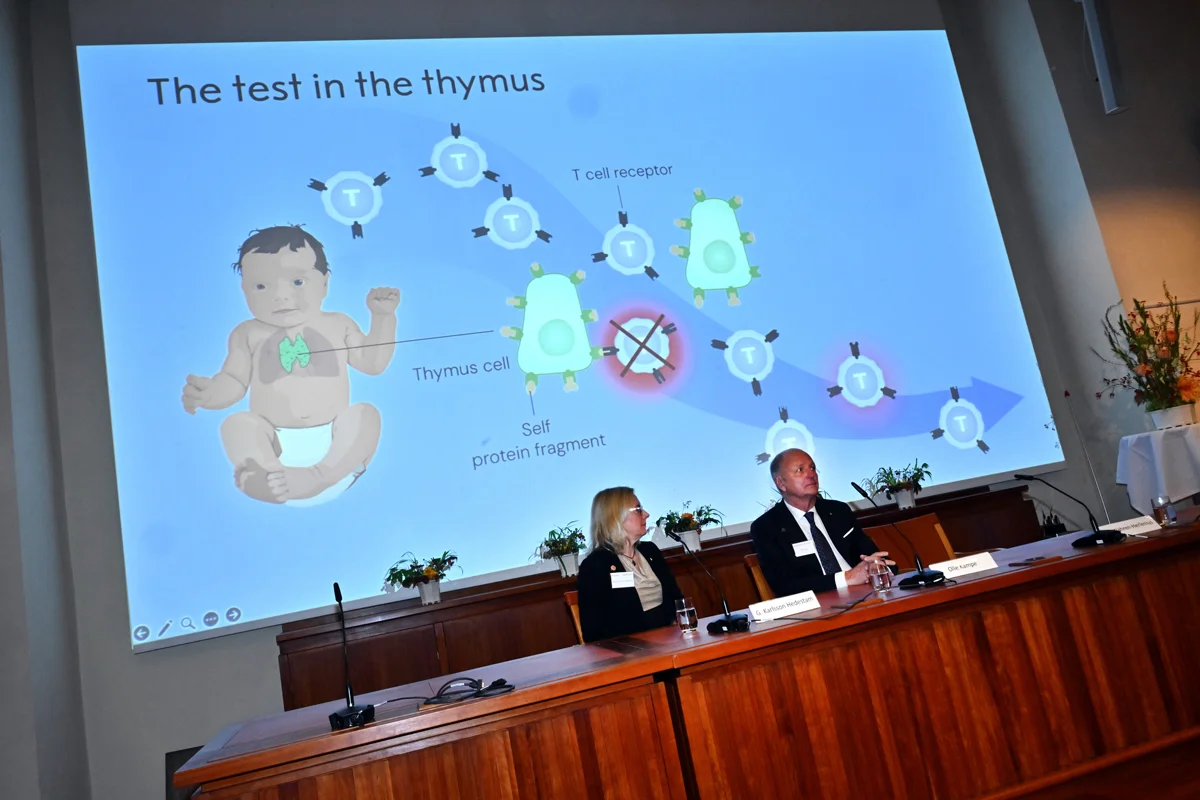
At this stage, science stalled for some time, until in the 1980s, Shimon Sakaguchi, inspired by the contradictory results of the research of his predecessors, began studying the thymus and its role in the training of T cells. After conducting a series of experiments on mice, the scientist discovered a curious thing: the immune system has a reserve set of immune cells that block erroneous attacks. In 1995, Shimon Sakaguchi introduced a completely new class of T cells - regulatory ones, which did not attack foreign agents, but suppressed the activity of other immune cells. This mechanism was called peripheral immunological tolerance because it acted outside the central organs.
Main culprit
At the same time, Mary Brunkow and Fred Ramsdell conducted their research - they studied the causes of the development of severe autoimmune pathology in mice due to radiation exposure. By carefully examining gene by gene, scientists discovered the culprit of this condition - a certain defective gene from the FOX group. Genes from this group play key roles in many biological processes, including cell cycle regulation and immune control.
It turned out that this gene, called FOXP3, is also present in the human body. And later, scientists discovered that IPEX syndrome, a rare genetic disease associated with an autoimmune reaction in which the body's immune defense mistakenly attacks the body's own cells, is also caused by this gene.

Target for manipulation
A few years later, Shimon Sakaguchi was the first to provide evidence that the FOXP3 gene is required for the formation of regulatory T cells that suppress the immune response.
“This discovery has changed the way we look at many diseases and continues to do so,” says Anne Pesenaker, an immunologist at University College London.
Current research shows that people with autoimmune diseases either have insufficient regulatory T cells or are unable to function normally. In oncology, on the contrary, there is an excess amount of them, as a result they inhibit the necessary immune response. So, according to the researchers, regulatory T cells and the FOXP3 gene are promising targets for the development of therapeutic drugs that will control the immune system. In some cases - so that it attacks the cells, in others - to stop this attack.