Translated material
Guns instead of beds
What is important to know about the new Russian budget? We explain on graphs
Photo: Maxim Shipenkov / EPA
The Russian government submitted to the State Duma a draft law on the federal budget, and along with it a document with a long title “Main directions of budget, tax and customs tariff policy for 2026 and for the planning period of 2027 and 2028.” It describes how much the federal treasury and all federal subjects will spend in total. This document shows that the authorities are raising taxes, spending reserves and increasing debt almost exclusively for war.
The first part of the budget analysis is available here . New Europe noted that the Russian authorities were in a trap: without military spending, the economy would collapse, and with it it would continue to slowly die.
What will they save on?
On average, Russia’s military budget over the next three years will quadruple by 2021 and 2.4 times by the first year of the war. And the growth rate of major non-military socially important expenses over the same time is much lower (except for the environment and housing and communal services, which we will discuss below).
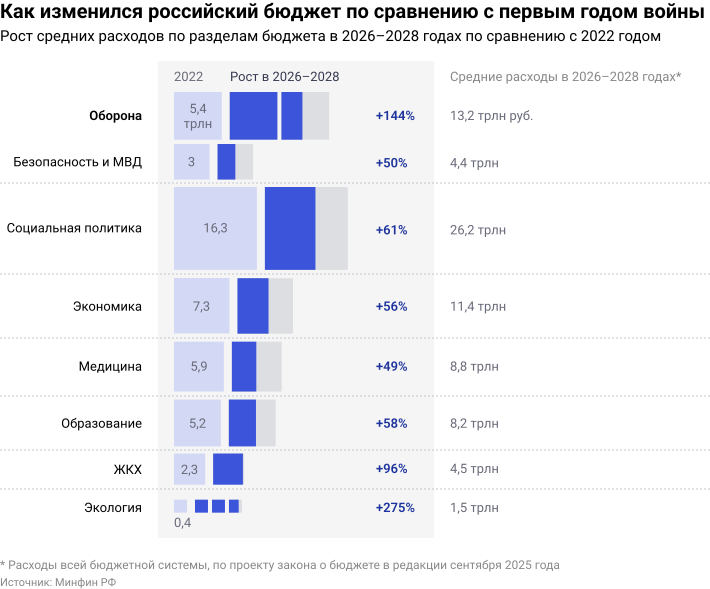
For example, expenditures of the entire Russian budget system on education and medicine in nominal terms over the same time are growing by only 50–75%. This is not enough, and huge problems are accumulating in both segments due to lack of funding. The number of hospital beds in Russia has been decreasing annually by about 20 thousand since 2012, and in 2024 the shortage of doctors and nurses increased by almost 7% to 98 thousand people. Due to a shortage of school teachers, teachers are overworked , parents complain about “double” classes, and schools are forced to introduce second and third shifts.
Allocations for social policy will increase by slightly more than 60%. It is from this section that the indexation of maternity capital and various benefits is financed, and the Social Fund is also subsidized, fees to which alone cannot ensure the payment of pensions. From 4 to 5 trillion rubles of the “pension hole” will be closed annually by the federal budget in 2026–2028.
Expenditures under the heading “National Economy” will increase by approximately 56–58%. From it, for example, the authorities finance the space program, civil aviation and other transport, road construction, allocate subsidies for oil refining and invest in various programs of technological sovereignty and import substitution.
In real terms, it is impossible to talk about an increase in “peaceful” budget items by tens of percent: there is an actual freezing of these expenses against the backdrop of a manifold increase in spending on the military-industrial complex.
All of the listed items will increase in the next three years by 2022 by an average of 49–61%, and the total accumulated inflation in 2022–2028 may be at least 59% (based on data from past years and a conservative forecast of price growth in the coming years).
That is, in real terms, the social sector will experience a decline or slight growth if we compare what will happen in the next three years with 2022. And this means: everything that was taken from Russians and businesses in the form of increased taxes in 2024 and will be taken further, goes to war.
What we thought
We calculated the average annual level of expenditures planned in 2026–2028 for the main socially important sections both for the entire budget system (federal budget, regional budgets and extra-budgetary funds) and separately for the federal budget. We then compared these figures with the same expenses for the pre-war year 2021 and for the first year of the start of the war - 2022.
Two exceptions
However, in two sections of the budget system - environmental protection and housing and communal services - rapid growth in spending is promised, comparable to the military. Here, spending on average over a three-year period will increase by 2–3 times compared to 2021 and 2022. But there is a problem that makes it difficult to believe that these segments will be flooded with money: this is the “low base” effect.
Expenditures on these two items themselves are very small, especially on the environment, on which 400–500 billion rubles were spent per year in 2021 and 2022. Now they will spend an average of one and a half trillion. But most of these funds are spent not on solving pressing problems such as recycling waste, fighting oil spills or preventing forest fires, but on something completely different.
Oddly enough, it follows from the budget law that approximately 90% of the money from the “Environmental Protection” section is spent on subsidies to automakers. And only a small part of them is directly related to the environment and goes towards reducing emissions into the atmosphere.
“This “ecological” budget is fake - about 74–80 percent of the federal (budget - New-Europe) goes to purposes that have nothing to do with the environment and its protection,” a Russian ecologist, who asked not to be named, is indignant in a conversation with New-Europe.
For housing and communal services in 2021–2021, a little more than 2 trillion per year was not spared, and in 2026–2028 it was promised to allocate twice as much. But even the officials themselves and pro-government experts say that current state investments in public utilities are not enough for its reliable and safe operation. As of 2024, the total wear and tear of utility networks in Russia is about 40%, in some regions it reaches 80%. Because of this, the number of accidents is growing: in the winter of 2023–2024, according to New Europe calculations, there were at least 557 of them, and outages of heat, electricity and water then affected about 3 million people. At the same time, in 2028, housing and communal services costs will generally fall by 2 percent by 2025.
Growth on paper
If you look at how the authorities promise to finance the social sector in the next three years, the illusion of a significant increase in spending arises. For example, from the budget law it follows that in 2028, expenditures of the entire Russian budget system on the economy, medicine and social policy will increase by a quarter by 2025, and on education by a third.
But a significant part of this indexation in the next three years will be eaten up by inflation: in total for 2025–2027 it could amount to at least 16% - this follows from the consensus forecast of 33 economists surveyed by the Bank of Russia. In reality, the rate of price growth may be higher.
Let us recall that in 2024 alone, inflationreached 9.5% precisely because of high military budget expenditures and the concomitant increase in the deficit.
All these factors will not go away in the coming years. And in recent years, including 2025, the rate of price growth each timeturned out to be approximately one and a half times higher than what the Central Bank and the government expected.
That is why a small increase in social spending “on paper” is a good way to hide its underfunding, according to two experts with whom New-Europe spoke. “A jump in inflation will eat up this indexation,” says one of them, an economist from Russia (we are not naming him for security reasons).
At the same time, the chronic shortage of money in socially important sectors against the backdrop of a growing bubble in the military-industrial complex lays down serious economic risks for the next years and decades. “Military spending, especially if it is not associated with new technologies or some kind of innovation that can then be applied to the civilian economy, creates GDP growth, but does not create the potential for increasing labor productivity in the future,” Alexander Kolyandr, an employee of the Center for European Policy Analysis (CEPA), told New Europe. “And investments in infrastructure and human capital increase labor productivity and provide greater returns in the future,” he sums up.