
Translated material
Walk with Sinyavsky. Dmitry Bykov* - on the centenary of the main nonconformist of Russian literature
October 8 would have been the 100th birthday of Andrei Sinyavsky, a philologist, writer who published literary works under the pseudonym Abram Terts, dissident and political prisoner, long-time editor of the Syntax magazine, which he published in Paris with his wife Maria Vasilievna Rozanova. Sinyavsky is in every sense a unique figure for Russian literature. In part because he was one of the few supporters of democratic forces who sharply condemned the shooting of parliament in 1993, and a year before his death in 1996 he said that Yeltsin is a greater evil than the communists. Dmitry Bykov talks specifically for Republic about how to understand and why to read Andrei Sinyavsky today.
It is impossible to say that I knew Sinyavsky, because no one knew him - he was a very special person and is unlikely to be completely human. Even those who were friends with his peer Strugatsky Sr., a completely open and even sociable person, still did not understand how the Strugatskys “did it.” Yes, I visited the Sinyavskys in their Parisian house and in the Russian apartments where they stayed, but people with whom I would not want to have anything in common today also gathered at their table, the Vigilyanskys, for example.
I had several frank, as it seemed to me, conversations with Andrei Sinyavsky, but I think he was truly frank only with his wife, several prisoners and several church fathers, also probably not entirely human. My right to talk about him is supported not by personal acquaintance, but by the fact that I read him quite a lot and thoughtfully, that is, I read almost everything he wrote, and loved him very much. Is it possible to love? This is what he said: “What kind of devilish faith in your own holiness must you carry in your soul in order to deprive other people who disagree with you of the ordinary right to love their homeland.”
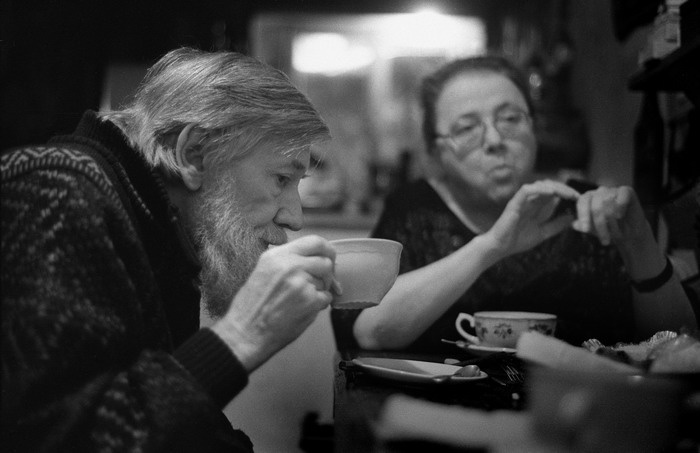
Andrey Sinyavsky and Maria Rozanova
Well, this absolute alienation of most of the rest of humanity, the “Pkhents” alienation (we’re talking about Arbam Tertz’s story “Phents.” - Republic ), which is too clear to me, probably gives some rights, otherwise how would I have become an outcast? No publications, no literary awards, which many in Russia could not forgive me for, can in no way cancel this. So forgive me.
“Emigration is a drop of a nation’s blood taken for analysis”
The centenary of Andrei Sinyavsky is not celebrated in Russia in any way, and this is understandable. Among the forbidden prose writers of the Soviet Silver Age - the seventies and early eighties - he remained probably the most misunderstood and unread. Even Friedrich Gorenstein seems more accessible, at least recently. Understanding Sinyavsky requires the reconstruction of an extremely complex context. Recently, this context has been illuminated for me personally (although, I think, for my regular reader) by two important circumstances.
Firstly, the next, albeit not round, anniversary of the October events of 1993 forced, as always, to recall the then split of the entire Russian intelligentsia and, especially against the backdrop of this split, the reconciliation of the Sinyavskys with the editor-in-chief of Continent, Vladimir Maximov. The fact is that in literary emigration, as in all Russian life, there were two poles - archaists and innovators. There was a prohibitionist one (Solzhenitsynsky) and there was a liberal one. Archaists, conservatives and moralists united around “Continent”, although there were also people of a completely different type - Brodsky, Gorbanevskaya. Perhaps they felt where the strength was, and perhaps they sympathized with Maximov and Solzhenitsyn personally. And there was another pole - hooligan, and clearly more intellectual, avant-garde: Pyatigorsky, Bakhchanyan, Natalya Rubinstein, Zinnik, Limonov, and “Syntax” in general.
It’s not for nothing that Sinyavsky said that emigration is a drop of the nation’s blood taken for analysis.
“Continent” scolded the Sinyavskys furiously, Maksimov and his circle did not disdain even gossip about the Sinyavskys’ collaboration with the GB, which was a fake that the GB prepared, and Marya Vasilievna, having investigated this issue, found evidence.
In October 1993, on Maksimov’s initiative, the unthinkable happened. Sinyavsky and Maksimov did not reconcile, of course not, but they united briefly to condemn the so-called shooting of the so-called parliament. It seems to me that this is the most ambiguous episode in Sinyavsky’s life, and as far as I could observe, Marya Vasilyevna Rozanova, my absolute ideal of a woman, wife and publisher, never fully accepted this reconciliation. (I can only judge from my personal impressions). In the last interview, two years before her departure, I asked directly: “Can she say that she forgave Maksimov and stood in solidarity with him?” She answered ironically: “No, my Christian feelings do not extend that far.” Now, it seems to me, we can definitely say that Sinyavsky was then politically and humanly wrong, but literary impeccable, Abram Tertz could not do otherwise - he always went against himself, including himself.
The second circumstance: I received seven years in absentia, which made me remember the sentence to Sinyavsky and Daniel: Sinyavsky in 1966 received seven (Marya Vasilyevna scratched him out three months before the end of the sentence), Daniel - five. My favorite game of searching for analogies makes me remember that at the same time as me, Anna Mongait* was sold in absentia for five years, which makes her, as it were, a little Daniel. Bykov and Mongait - Sinyavsky and Daniel, adjusted for the scale of the era. “Parrot on a pole - Kartashev on Gerberg.” Funny.
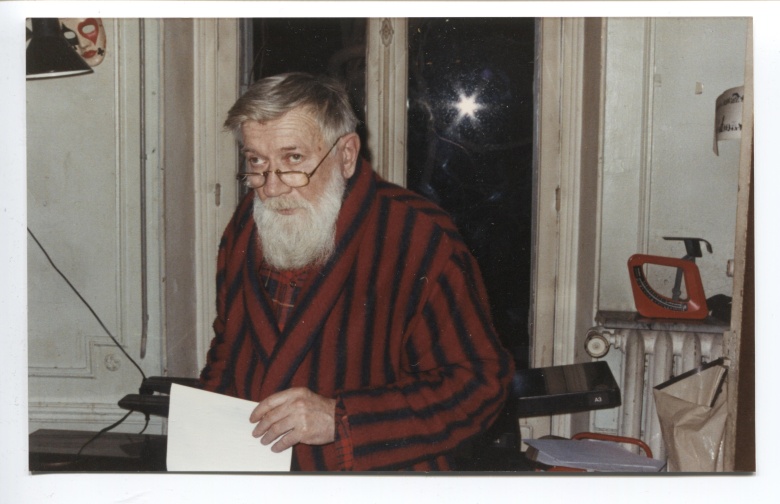
Andrey Sinyavsky in the edition of "Syntax", 1991
Andrey Chernov
But speaking seriously, Sinyavsky repeatedly reminded that a writer is not a writer if he is not declared a criminal. He must break the canon, otherwise what is the point of creativity? Of course, it is not necessary to receive a term, this is, so to speak, sick dirt (see “What to do”, second dream), but if the writer is not proclaimed an alien and a traitor, if he is not an enemy of the people and society, if he is not a Recluse and not Six-Fingered, not Phents, all that remains is to throw him out to be trampled upon by people.
A nationwide celebration of the centenary would be as aesthetically alien to Sinyavsky as the title of Hero of Socialist Labor.
He managed to provoke disproportionate, illogical hostility. Daniel, even though he was a Jew, never called anyone like that. Sinyavsky - outwardly meek, even offering a cigarette with a pleading intonation, bearded, looking like a gnome, a woodsman, a brownie - inspired not even hostility, but disgust, jerking and withdrawing, like an exotic insect, ugly, dangerous and at the same time suffering. There is an alien who is beautiful, like the man from the star Jeff Bridges, sometimes he is cute and cute, like Spielberg, and there is someone like Phentz - a “clumsy invalid”, in addition, confident in his beauty and perfection:
“And I’m not a bastard! If it’s just someone else, then should we immediately swear? There is no point in measuring my beauty with my ugliness. I'm prettier than you and more normal. And every time I look at myself, I am clearly convinced of this. What else can I do on Earth if not admire myself?”
This foreignness was discerned in him by everyone, but especially and primarily by people of small intelligence, who most of all yelled at him, wrote indignant letters, cursed him for “Walking with Pushkin,” from which they read one and a half quotes. Such people have especially developed intuition, animal, spinal, and restraining instincts do not work very well. I personally saw how a woman with the appearance and manners of a kind school teacher yelled at him before his evening at the Central House of Writers: how dare he - “Russia is a bitch”? Sinyavsky, with the same manners of an experienced lecturer, patiently and even embarrassedly explained that this was a metaphor. With the same intonation, he spoke at his trial, in the last word : “Is it really necessary to explain obvious things again?”
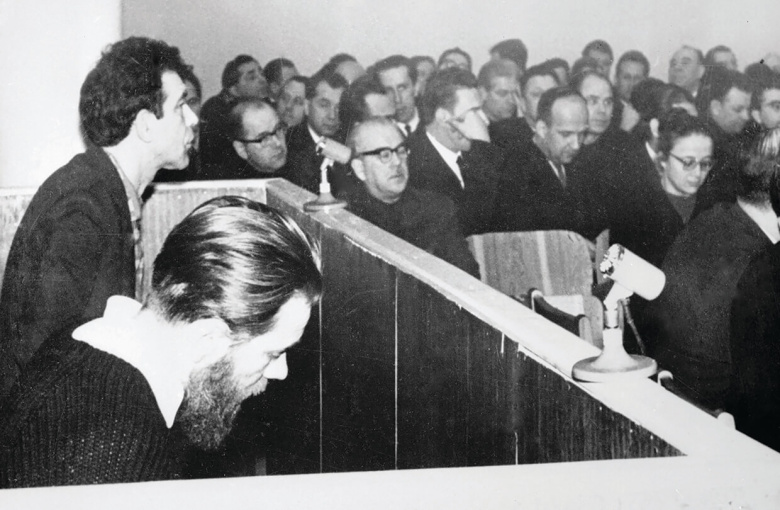
Andrei Sinyavsky (in the foreground) and Yuliy Daniel in the dock. Moscow, February 10–14, 1966
Photo: Sakharov Center
The problem is that they are far from being so obvious: after all, Sinyavsky was not judged for the fact that he published abroad. Well, yes, well, it’s a sin, but many have been published abroad since the times of Zamyatin and Pilnyak. After all, it was not for metaphors, in fact, that he was given a sentence, and Daniel not for the dystopia “Moscow Speaks,” but for the fact that in their prose there really was an unearthly chill. The alien Phents, in the world Andrei Kazimirovich Sushinsky (genuinely Andrei Donatovich Sinyavsky, all self-portrait), was not at all disingenuous when he admitted that an artist of this type is precisely his own main theme. He is a man of modernity, and a modernist is precisely what he describes himself, and is a mystery to himself. Why is any imposed, prescribed emotion so disgusting to him? Why is he drawn to grimace at funerals and cry at weddings?
He really succeeded in mockery better than any pathetic, sentimental, speculative passages in which the socialist realists ate the dog: “If only I could cry as I tell my story, otherwise I somehow learned to laugh, but I don’t know how to cry,” admits Phents. Why does a naked woman not excite him, but terrify him, why does his homeland not evoke sacred awe in him (apparently because he has another homeland: art, Sinyavsky explained, this is the eternal, true homeland of the artist, he yearns for it, tries to evoke its heavenly image).
It’s more interesting to think about why he did it this way, why he turned out so different. And he wasn’t the only one, he was just lucky, or unlucky, to get under the microscope.
“They will seal me in a large glass jar and put me on display in the zoological museum. And as they pass in lines, they will begin to shudder with fear and, in order to cheer themselves up, they will laugh impudently and stick out their disgusted lips.”
This is what they did, first after their arrest and exposure, then after the publication of “Walks,” and then posthumously. At least they repented before others, even before Sakharov, who was also defiantly a stranger. But Sinyavsky was not cleared by death, especially since he, with unexpected persistence, did not want to admit his guilt.
Probably the point was that these modernists, genuine Soviet people, were very few in number, or they learned to disguise themselves very well. Next to Sinyavsky it is only possible to place people who are also celebrating their centenary this year: another science fiction writer, Arkady Strugatsky, and another stylist, Yuri Trifonov. In part, perhaps, Okudzhava (whose centenary last year in Russia, thank God, was also celebrated very modestly). Maybe Ales Adamovich, who was born two years later and also combined a philological education, work as a literary scholar and critic with the writing of prose and even apocalyptic fiction. This one, if he had lived to see the mature Lukashenko, would definitely have escaped into exile or would have been imprisoned on principle, but he was lucky to die in ninety-four. Something tells me that centuries may not notice it at all - such events will unfold throughout the world by then.
Subscribe to read in full
Subscribe to Redefine.Media to read Republic
Subscribe [You can pay with a Russian or foreign card. The subscription is renewed automatically. You can unsubscribe at any time.]
Where does the subscribers' money go?