
Translated material
Aerial gymnast. Dmitry Bykov* watched Sobchak’s interview with Arestovich
An interview with Alexei Arestovich, a futurologist and former adviser to the office of the President of Ukraine, was published on Ksenia Sobchak’s YouTube channel. Republic columnist Dmitry Bykov*, who always spoke warmly about the hero of the show, explains why changing shoes in the air is better than crawling on your knees.
Watching Arestovich’s interview with Ksenia Sobchak is quite painful, just as it would probably be painful to watch the interview of Louis Ferdinand Celine, who came to Russia in 1936, with Yuri Olesha, who admired his prose and accused him of extreme cynicism. This would be a conversation, and the goals of the interlocutors would be the same as now: for Selin, to show off his ugliness, disgusting opinions, and anti-Semitism as brightly as possible (as today Arestovich flaunts Putinism), and for Olesha, to once again demonstrate his loyalty and buy himself a little more life. Olesha would have sneered at Selin in every possible way, and it would still have been clear that he was conducting this conversation from the position of a slave, a dependent. Celine would solve his problems, and it would still be clear that he is a great writer and at the same time a completely crushed person.
Both would convey to the reader the same idea that their writings convey even more clearly: in our time it is impossible to be a man, there is no worthy position, you are not alone, reader.
In general, everything is repeated, including an era that does not presuppose a normal niche: neither dignity, nor humanity. Even the dead are not protected from posthumous blasphemy. You look at Arestovich and Sobchak and see two no longer young people (he is 50, she is soon 45), to whom a lot was given already at the start, and both did not manage themselves in the best way. Both cause well-deserved disgust among most compatriots, and the number of views cannot be said to go off scale. Sobchak is annoying in itself, and has always been annoying, such are her manners and aura. Arestovich is especially infuriated by the fact that until recently they treated him well, hung on every word of his consolation and even got hooked on his broadcasts with Feigin*.
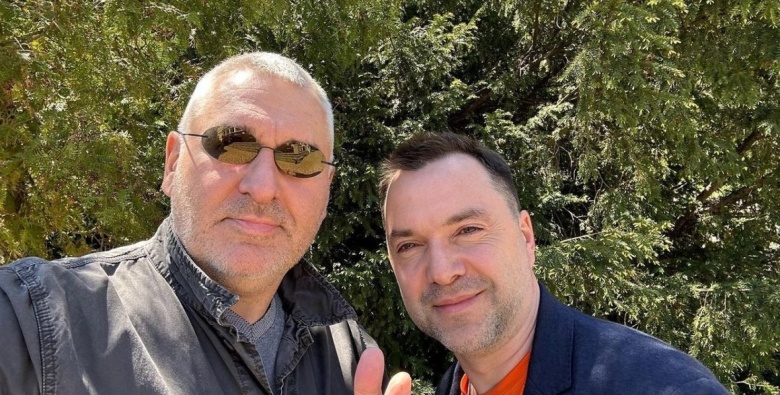
Photo: video screenshot / YouTube
So, in the attitude of Ukrainian viewers towards him there is a considerable amount of self-loathing - an emotion that he really hoped to awaken in them, but for a completely different reason. Here, however, the main question arises: does anyone, including those at home, treat these spectators, who so decisively condemn both interlocutors, without disgust? “Quentin, why haven’t you made anything better than Pulp Fiction?” - “Did anyone take it?” (I suppose I think I did, but the anecdote is wonderful in itself).
Has anyone managed their life well?
Is the position of a living hero even possible in modern times? Even a dead person feels embarrassed here - why did he die? He could have stayed abroad and fought there. And if I stayed abroad, they would say: why are you alive?! The era is like this: it does not imply a niche for a hero or a model. It presupposes a niche of a public personality that irritates everyone: the niche is broken, the human race is stratified.
Subscribe to read in full
Subscribe to Redefine.Media to read Republic
Subscribe [You can pay with a Russian or foreign card. The subscription is renewed automatically. You can unsubscribe at any time.]
Where does the subscribers' money go?