
Translated material
Your honor and fate
A collective portrait of a “respected court” against the backdrop of the case of ex-judge Momotov: rudeness, poker in offices and a career through acquaintances
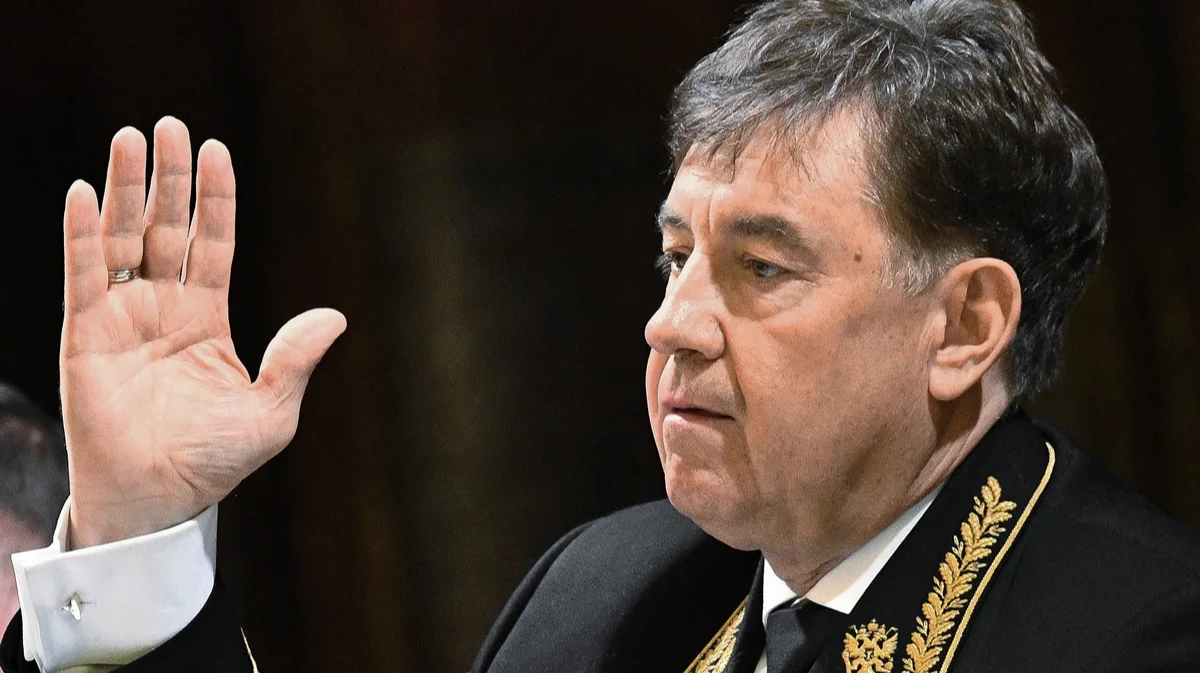
Victor Momotov, 2023. Photo: Ivan Vodopyanov / Kommersant / Sipa USA / Vida Press
Every lawyer knows: addressing a judge by his first name or patronymic, “poke” or “poke” is unacceptable. The only correct addresses are “Dear Court” or “Your Honor” (Article 158 of the Code of Civil Procedure of the Russian Federation, Article 257 of the Criminal Code of the Russian Federation, Article 144 of the Code of Administrative Offenses of the Russian Federation).
However, the authority of the judicial system in Russia has long been in question. Incompetent, corrupt, or lacking objectivity due to pressure from above, judges sit in their offices for years dispensing justice. What treatment do they deserve?
Lawyers and former students shared with Novaya-Europa their experience of interaction with the judiciary: how judges insulted participants in the process, swore, and the former dean of the university, ex-judge of the Supreme Court Viktor Momotov allowed students who had difficulty reading from sight to study in budget places.
District Court. “Why aren’t you a man?!”
In accordance with Art. 3 of the Federal Law “On the Status of Judges in the Russian Federation”, a judge, when exercising his powers, as well as in off-duty relationships, must avoid anything that could diminish the authority of the judiciary, the dignity of a judge or raise doubts about his objectivity, fairness and impartiality.
Irina (name changed) worked as a lawyer in a real estate agency. The Prikubansky District Court of the city of Krasnodar considered a claim to recover payment from the client under an agreement for the provision of paid services for the search of real estate that the client purchased.
The defendant insisted that he found the apartment himself and refused to pay. The district court judge, after listening to Irina, gave the floor to the defendant. He explained that he did not specifically sign the apartment inspection report, since he found the apartment himself. The man cited correspondence with the former owner of the apartment as an argument, and also asked to interview the seller who could confirm this.
“The judge interrupted the defendant mid-sentence,” says Irina. — He shouted rather rudely: “Aren’t you a man, or what?!” Come on pay!”
According to Irina, the defendant was simply dumbfounded. The agency representative herself felt terribly awkward. The decision was made in favor of the real estate agency. Immediately after the end of the trial, the judge called Irina over, handed her a card with a phone number and quietly explained that he had land that he needed help selling. Thus, he apparently hinted at providing a free service to find a buyer for his property.
But according to the logic of the same judge, if he does not pay for the service of finding a buyer, but asks for it in return for the decision he made, which no one asked him for, then he is... not a man? Who then? "Dear Court"? It is unlikely that it meets the requirements of Article 3 of the Federal Law “On the Status of Judges in the Russian Federation.”
Irina conveyed the judge’s request to her director. They did not call the judge back.
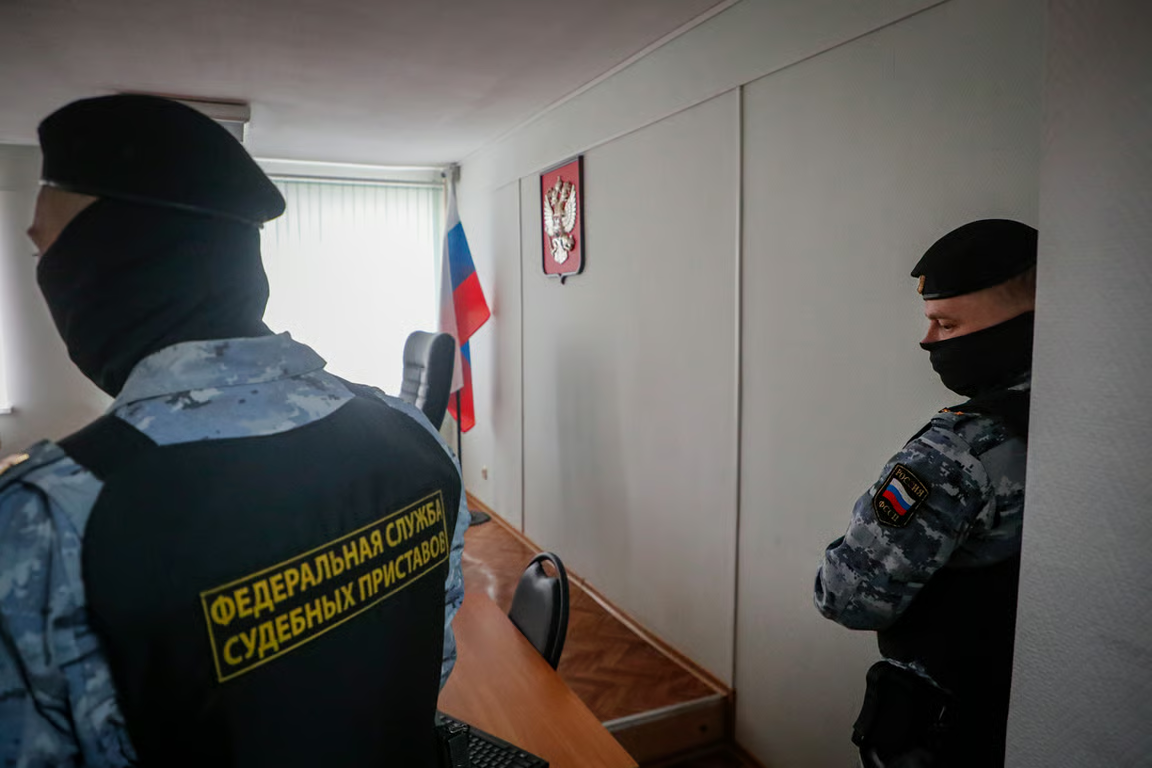
Arbitration. “Do you want to put me in some unpleasant position?”
When it comes to the Arbitration Court, there is hope that the professionalism, level of education and upbringing will be much higher. Alas, this is not always the case.
Individual entrepreneur Mikhail (name changed) was the defendant in the arbitration dispute. The case was considered by Stanislav Dub, judge of the Arbitration Court of the Krasnodar Territory. Mikhail did not appear at the first meeting: for family reasons he was in Sochi. The hearing of the case was postponed to a later date. Mikhail arrived for the second meeting.
The “respected court,” represented by Judge Stanislav Dub, asked why Mikhail was absent.
“I said that I was in Sochi on personal business,” says the entrepreneur. - And the judge was blown away. He started shouting: “I work here, and you go skiing and have fun?!”
Mikhail tried to explain that he was there for personal problems, and did not spend time at the resorts of Krasnaya Polyana, asked not to talk in such a tone, but the judge did not let up.
“Even the lawyer sitting opposite me blushed with shock,” Mikhail recalls. “He interacted with her quite rudely because she submitted a copy of the document to the file, which was difficult to read. But he still called her “you”.
Perhaps the honored lawyer of Kuban, Judge Dub, had not been on vacation for a long time at the time of the hearing of the case and wanted to be in the place of the defendant so much that he was unable to control his emotions. He resigned in 2024.
It is worth noting, however, that there are cases where the inappropriate behavior of a judge led to him losing his seat. So in 2018, a video with an audio recording of a conversation between Alexey Shevchenko, judge of the Arbitration Court of the Krasnodar Territory, appeared on the Internet.
“...You can complain to the President of the Russian Federation Vladimir Vladimirovich Putin, whore. Now, damn it, I dropped everything and started looking, damn it... Do you want to put me in some kind of position that is unpleasant for me? You ask the representative of the defendant, she is local here, has anyone succeeded here or not. That's it. Therefore, damn it, if your stupid creditors, damn it, can’t come to an agreement, well, that means, damn it, I will command the parade, as Ostap Ibrahimovich Bender said..."
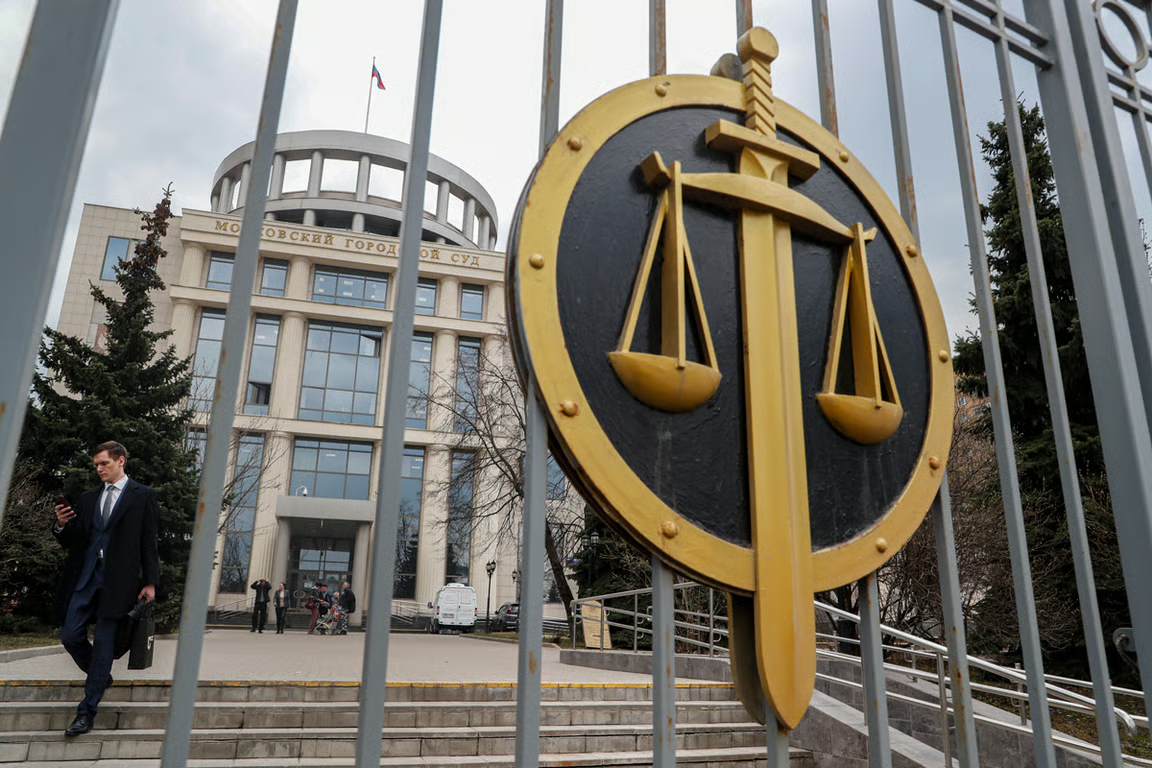
The judge later tendered his resignation and apologized, admitting that he had no right to behave in such a manner. However, the Qualification Board of the Krasnodar Territory refused to dismiss the judge at his own request and deprived him of his powers for committing a disciplinary offense, which excluded Shevchenko from being nominated again for the position of judge. Lawyers who repeatedly attended his trials noted that he was a very competent specialist, but his manner of communication raised questions.
"Bandler's grunt"
The question was discussed at legal forums: what to do if a judge behaves rudely? Complain to the chairman of the court? Or apply to the Qualification Board of Judges? Although this makes sense only if the fact of unacceptable behavior is recorded. Otherwise, it’s the applicant’s word against the judge’s word.
Many lawyers advise remaining calm, not giving in to emotions, and thinking first of all about the interests of your client. But there are those who advise resorting to meditation or, for example, using Richard Bandler’s technique, nicknamed the “Bandler grunt.”
It lies in the fact that during a stressful situation you need to growl, and this must be done while inhaling. The sound produced resembles a grunt. By doing this exercise, you can break the chain of negative emotions, reducing stress levels (the editors do not confirm the proven scientific nature of the method).
The first caveat: the court may interpret your grunting as disrespect. The second nuance: tolerating the rudeness of a judge while grunting at the same time is disrespect for oneself. It's sad what some lawyers are willing to do.
The judges do not always behave well, but the requirements for the participants are high. Part 2. Art. 297 of the Criminal Code of the Russian Federation provides for criminal liability for contempt of court, expressed in insulting a judge. The punishment provided for by the Criminal Code ranges from a fine of 200,000 rubles to six months of arrest. And “dear court” may even suspect a disrespectful attitude because of... an envelope.
In 2019, the judge of the Arbitration Court, Andrei Garbovsky, was sent an envelope with documents, which contained a reproduction of the painting by the Dutch artist Gerard David, “Fleining a Corrupt Judge.” The judge, when making a ruling on setting a date for the court hearing, demanded an explanation from the applicant about the envelope sent in order to consider the issue of whether there were grounds for a fine for contempt of court.
The applicant explained that it was not he who chose the envelope, but the courier. The judge decided not to impose a fine.

Poker in court
Usually, before receiving the position of a judge, a lawyer works as an assistant: gaining experience, skills, and knowledge. It happens that assistant judges are literally forced to spend the night in the courthouse, loaded with cases. There are opposite situations.
Three law students completed an internship in the district court of the Southern Federal District. The students were distributed among three assistant judges, who were expected to train them and delegate light duties to them. Both students and assistant judges sat in the same office.
One of the students, Marina (name changed), says that her fellow student, who was doing an internship with her, casually mentioned that she was studying poker as a hobby. All three assistants are young men. Having heard about poker, they began to persuade them to teach them the rules.
The next day, Marina’s classmate brought a suitcase with chips and cards and taught everyone how to play during lunch. However, even after lunch they began to lock the office: they played and drank a little.
- And so almost the whole week. The assistants did the job in a hurry, freeing up time for poker,” says Marina. — In the corridor, the plaintiffs and defendants were waiting for documents, knocking on the door, but they were simply ignored.
Why do future judges behave this way in the courthouse? Aren't you afraid of getting caught? Apparently, the fact is that many of them initially have connections and funds and are confident that after some time the position of a judge will be theirs.
Law Faculty and Budget
The formation of a circle of chosen ones begins at the university. In the period from 2007 to 2010, ex-Supreme Court judge Viktor Momotov, whose more than 100 properties were confiscated on October 14 by decision of the Ostankino Court of Moscow as part of the anti-corruption process (according to the Prosecutor General's Office, the value of the assets is at least 9 billion rubles), was the dean of the law faculty of Kuban State University (KubSU).
During this period, Alexandra (name changed) was an applicant. In high school she was an excellent student and spent two years preparing with tutors for exams to enter a budget-funded place at the Faculty of Law of KubSU. Alexandra scored a high score on the exam, but it was not enough to enter the budget. Parents had great difficulty raising funds so that their daughter could still study at the commercial department of the faculty.
During her studies, Alexandra learned that several people “through acquaintances” were studying in government-funded places. The students themselves talked about it without hesitation. In her course there was a guy who, due to physical or psychological characteristics, wrote, read and spoke poorly, but studied on a budget. It was known that his relative worked in the judicial system.
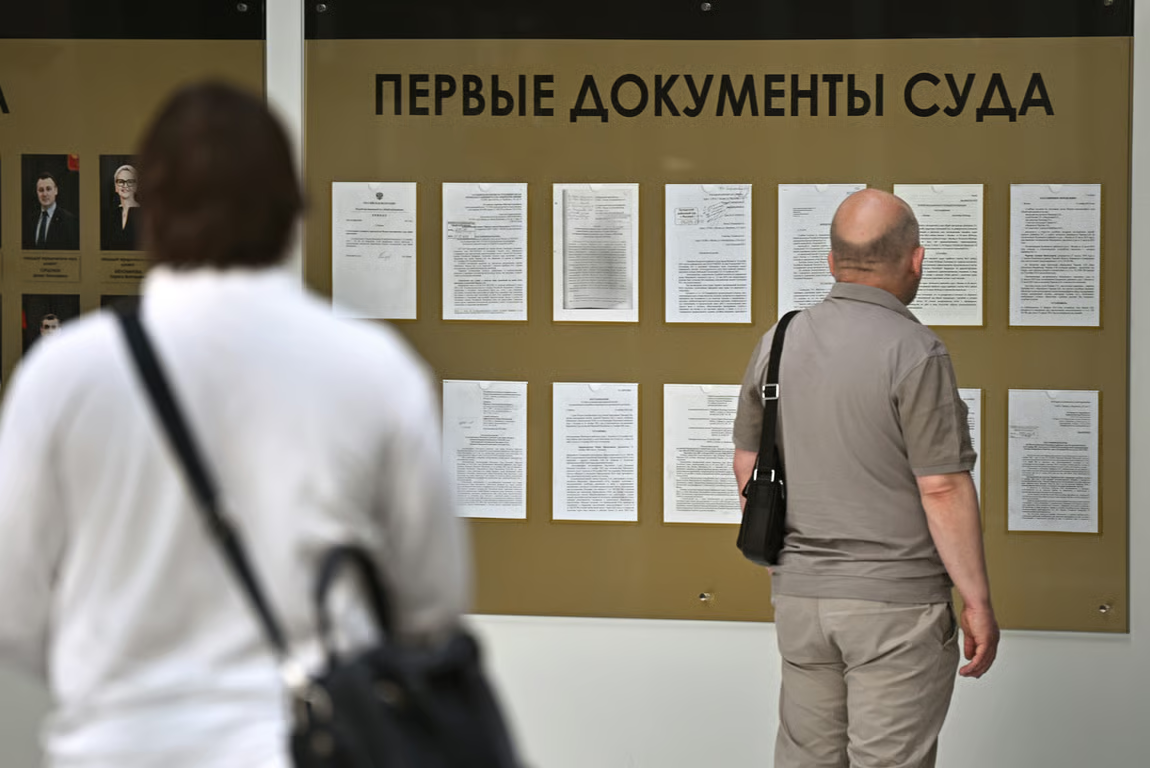
“He just sat in classes, and during exams and tests he went up to the teacher, called his last name - a code word - and received a test,” says Alexandra. “Perhaps I didn’t get the position I deserved.” But I was upset to see how budget places were given to students who could barely sight read.
Alexandra says that, of course, she does not blame her classmate: he was hardly aware of his situation. But his family could afford tuition, while Alexandra’s parents saved every penny.
“I saw this guy later - he worked on a photocopier in a law office. And was it worth taking someone else's place? - she is indignant.
Alexandra works as a lawyer. Even as a student, she realized that the position of a judge, just like a notary, is something in the realm of acquiring the status of a nobleman: either by inheritance or for a lot of money.
“There were students who misspelled the word “law,” but now they are judges, because mom or dad organized a place for them,” she says.
According to Alexandra, many “well-connected” students studied well, became excellent specialists, and competent judges. However, if they are ordered from above to make a certain decision, they will have to do it, otherwise they will lose their jobs.
Career teleportation of Judge Momotov
The former dean of the Faculty of Law of KubSU, Viktor Momotov, under whom it was possible to take the exam by calling the desired surname, became a judge himself in a curious way. Author of a dissertation on the topic “Birch bark letters - a source of knowledge of Russian law of the 11th–15th centuries.” have not served a day as a district or magistrate judge, although the latter is a common practice before taking office.
Already in 2010, by resolution of the Federation Council, Momotov was appointed to the position of supreme judge. In 2016, at a meeting of the IX All-Russian Congress of Judges, he was elected Chairman of the Council of Judges of Russia. This is not even a career leap, but teleportation.
In legal circles, it is believed that the former chairman of the Regional Court, Alexander Chernov, who is called the “father of Kuban justice,” contributed to Momotov’s appointment to the post. Chernov received his nickname not only because he worked in the Krasnodar Regional Court for 25 years, but because under him the Regional Court made the “necessary” decisions, even if this went against the current legislation. He legalized illegal transactions and acquired property through dummies. Some Russian law firms providing services throughout Russia stated directly on their websites that they do not work in the Krasnodar Territory, since it has “its own justice system.”
Let us recall that in August 2025, following a claim filed by the Deputy Prosecutor General, the Krasnogorsk City Court of the Moscow Region decided to turn Chernov’s property into the income of the Russian Federation. Among those seized from him are 87 real estate properties, several agricultural holdings, a business share worth 10 billion rubles and 3.1 billion rubles from the property sold. Chernov was left with an apartment in Krasnodar.
After Chernov fell out of favor, his protégés, including Momotov, also suffered. Among the judges who had connections with Chernov is the “golden judge” Elena Khakhaleva, who is wanted and became famous after the scandal with her daughter’s expensive wedding with the participation of celebrities.
What awaits the former head of the Council of Judges of the Russian Federation, Viktor Momotov, is currently unknown: will his property be confiscated and left alone, like Chernov, or, like Khakhaleva, will he be forced to go on the run?
Judges and conscience
Can a judge in Russia work honestly, according to his conscience, and respect the law? Even with a great desire and desire to comply with Art. 3 of the Federal Law “On the Status of Judges” - it will not work: if a judge is given an order “from above”, he will either have to carry it out, or he will be forced to sign a resignation letter.
Konstantin Aranovsky, a former judge of the Constitutional Court (CC), often expressed dissenting opinions on the decision of the Constitutional Court. For example, he declared the right of persons with dual citizenship to own the media, as well as the admission of suspended prisoners to elections.
Let us note that in 2014, Aranovsky supported the decision of the Constitutional Court to recognize as constitutional the treaty on the admission of Crimea and Sevastopol to the Russian Federation. However, during the adoption of amendments to the Constitution of the Russian Federation, he was absent - shortly before the meeting he went on sick leave.
In 2020, at Putin’s initiative, the State Duma amended the Law on the Constitutional Court, depriving judges of the right to publish dissenting opinions on decisions.
In 2022, before the Constitutional Court was to consider the legitimacy of the issue of annexing the annexed Ukrainian territories, Aranovsky resigned. Probably, the former judge knew what decision would be made regarding the annexed territories. Due to changes in legislation, he did not have the right to express a dissenting opinion.
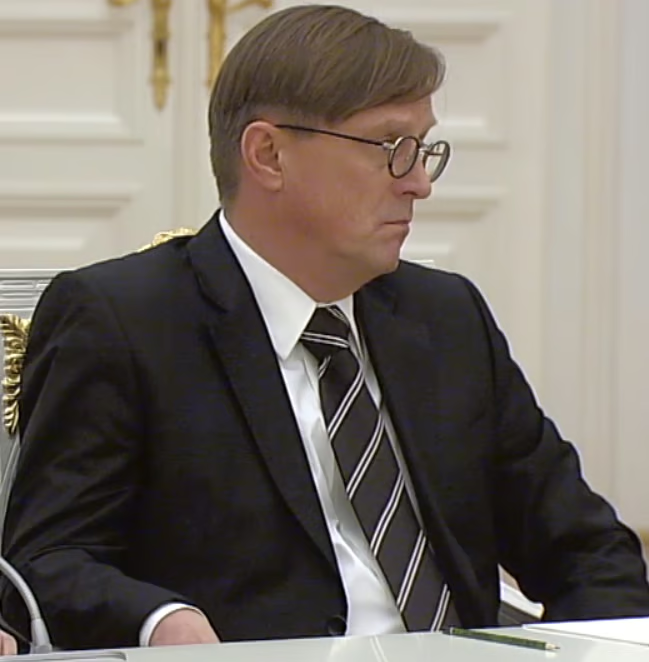
Aranovsky himself did not comment on his own resignation. Ekaterina Mishina, a former adviser to the Chairman of the Constitutional Court, Vladimir Tumanov, spoke about her colleague’s resignation in an interview with the BBC News Russian Service:
“The only member of the court who did not participate in the shameful approval of blatantly unconstitutional amendments to the Constitution. This is the most high-profile resignation since the beginning of what the authorities persistently call a “special military operation.”
There were also resignations that were less publicized in the media, most likely motivated by the fact that the judge did not please the powers that be.
For example, judge Tatyana Leskina worked in her position for more than 20 years. In 2016, she did not refuse to accept a statement from citizen Nikolai Suvorov, who demanded Putin’s resignation, calling him an “enemy of the nation.” The meeting was scheduled for April 28. Already on April 15, the qualification board of judges of the Saratov region satisfied Leskina’s application for termination of her powers. This is hardly a coincidence.
In the summer of 2014, the judge of the Kirovsky District Court of Yekaterinburg, Sergei Mamaev, resigned. Shortly before this, he and two colleagues submitted an application to the qualification board of judges with a complaint against the chairman of the court, Yuri Levkin. Mamaev sought to initiate a criminal case against the boss. He accused Levkin of drunkenness, harassment, and connections with crime. The result of the struggle: Mamaev and his colleagues wrote a statement of their own free will.
“Fighting the system is not easy, as you understand. Every single one of the debaters “resigned” to honorable retirement or were fired. But no one put pressure on me. I left of my own free will,” Mamaev commented to Ura.ru.
“Get in and you won’t be in jail”
Если взглянуть на все истории вместе, становится понятно: формально «уважаемый суд» существует только на бумаге. На практике система полна неравенства, личных связей и человеческих слабостей. Судьи могут грубить, помощники — бездельничать, будущие карьеристы учатся обходить правила еще в вузе. А чтобы оставаться честным судьей, придется вовремя снять с себя полномочия и перестать им быть.
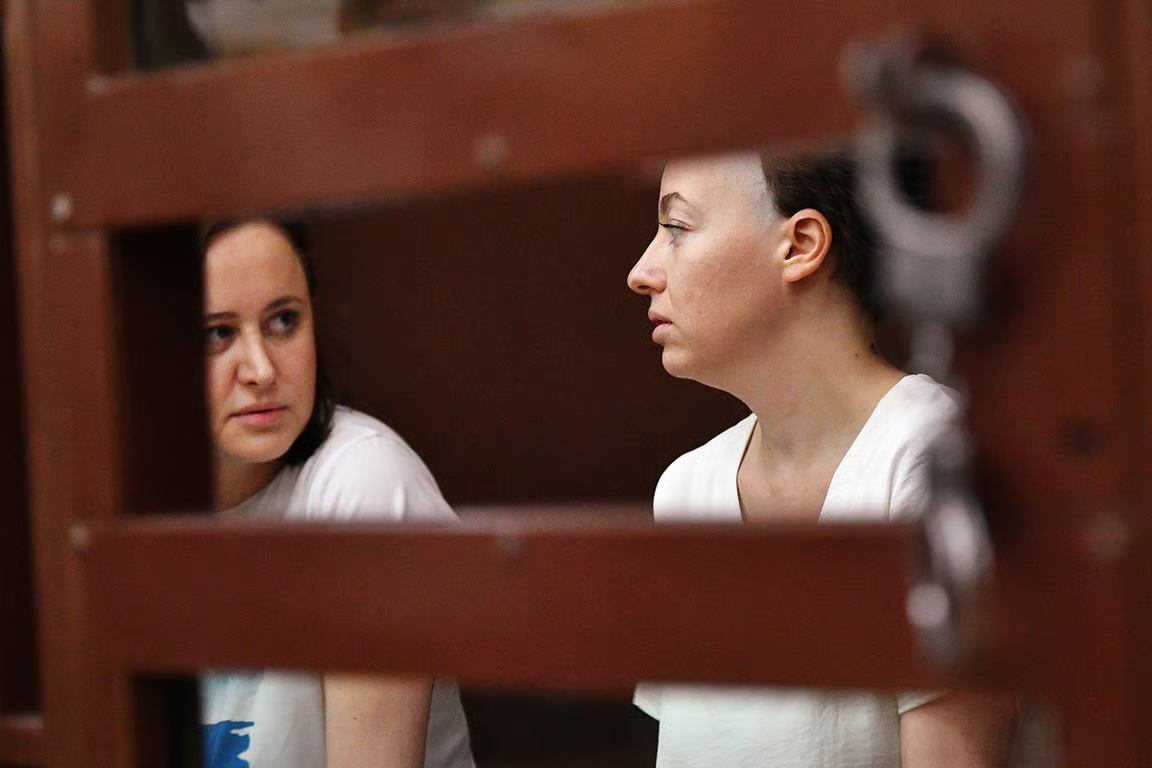
Но самое страшное, что люди, называемые «Ваша честь», выносят абсурдные приговоры, отправляя людей в заключение: шесть лет тюрьмы за пьесу драматургам Светлане Петрийчук и Евгении Беркович, семь лет тюрьмы за антивоенное высказывание муниципальному депутату Алексею Горинову, семь с половиной лет тюрьмы из-за постов о войне и убитых мирных украинцах инженеру Игорю Барышникову, восемь лет тюрьмы за посты в канале на 15 человек медсестре Ольге Меньших… По данным «Мемориала», сейчас в РФ 672 политических заключенных.
В песне группы АИГЕЛ «Ария судьи» рассказана история о реальной судье Верховного суда Татарстана. Дела рассматривают в составе трех судей. Судья, которой в песне дано вымышленное имя Фируза, проголосовала за отмену приговора молодому парню, так как, по ее мнению, вина не была доказана. Двое других судей проголосовали за то, чтобы отправить молодого человека в тюрьму. После Фирузу вызвал председатель и обвинил в том, что ей дали взятку, раз она не согласилась с коллегами-судьями; угрожал судом, тюрьмой.
Суди, знай, и не судима будешь, поняла, Фируза?
Сиди, знай, и не съедена будешь, поняла, Фируза?
Сади, знай, и не садима будешь, поняла, Фируза?
Иди и больше так себя не веди, Фируза.
Ты же не хочешь проблем?
Ты же не хочешь проблем?
Ты же не хочешь проблем?
«Ваша честь» не хочет проблем.