
Translated material
Non-working days and years
Russia's civil economy is in crisis: factories are cutting hours and cutting wages
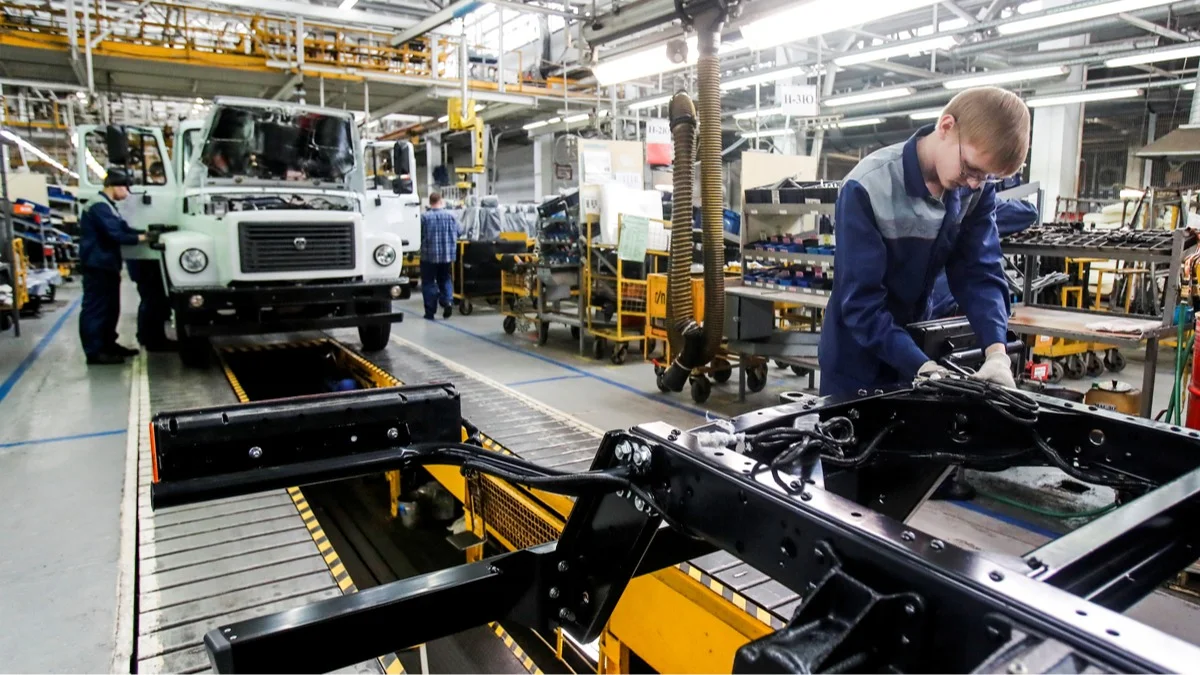
Employees of the Gorky Automobile Plant (GAZ) in Nizhny Novgorod, April 16, 2019. Photo: Maxim Shemetov / Reuters / Scanpix / LETA
Large Russian enterprises send employees on vacation, introduce a shortened work week, and sometimes cut staff. Those who managed to keep their jobs talk about salary cuts. There is a crisis in the country that not everyone can cope with. And, according to economists, this is just the beginning.
Four days for a “citizen”
“The work doesn’t stop for a minute. The workers say: they have learned the tank so well that they can assemble it with their eyes closed,” this is how propaganda talks cheerfully about the everyday life of Uralvagonzavod workers. The plant is part of the Rostec corporation and is now the country's largest manufacturer of armored weapons.
But if everything is in order with the tanks, they even plan to increase their production, because the war in Ukraine continues, then the civilian products of the plant - freight cars - have ceased to be popular. Transportation on Russian Railways has decreased (New Europe wrote about the reasons in detail).
By the end of the year, they are expected to decrease by another 7–9%. And new, not at all easy times are coming for the plant. From December 15, in order to save money, the working week is being reduced to four days, with a corresponding reduction in employee salaries.
“This is caused by a drop in demand for the production of civilian products. Despite temporary fluctuations in the rolling stock market, Uralvagonzavod continues to operate steadily due to its versatility,” the plant’s press service commented on the transition to a shortened week.
Before the war, the company employed 20 thousand employees, and then every year the plant hired another five thousand people. And that’s all for the implementation of the state defense order. The transition to a shortened week will specifically affect civil production. Thus, management plans to reduce wage costs. Workers from the carriage production were asked to be transferred to “other directions, secured by orders,” the press service reported. Retraining for new working professions has been organized for them.
— I have been working in the workshop for 15 years. And yesterday we were allowed to look at the salary statements. People are simply shocked: salaries are 15 thousand, but they will be even lower.
No bonuses or compensation. And they will pay, like, for household work, 139 rubles per hour. Do you think management has reduced their bonuses? It’s unlikely,” Sergei, an employee of the car assembly workshop, told Novaya-Europa (his last name is not given at the request of the hero).
But the Chelyabinsk Electrometallurgical Plant (CHEMK) has been sent on a four-day work trip since September. The reduction in working hours at the enterprise was explained by the instability of exchange rates - a strong ruble reduces export revenues, the general negative situation on the ferroalloys market and a drop in demand. The transfer to a four-day work period affected 1,200 employees.
“Minus one working day a week is minus 20–25% of the salary. According to estimates, workers will lose from 17 thousand rubles (with a salary of 75 thousand). Of course, people are unhappy, but you know how? Quietly, at home, in the kitchen, with the door closed,” the CHEMK employees complained .
Many large enterprises have already resorted to reducing working days in order to reduce wage costs. Back in March, the Uralasbest plant in the Sverdlovsk region switched to a three-day workday. Also, due to the fall in demand for products, the Serov Ferroalloy Plant reduced working hours as part of the anti-crisis program. Since October, the Zlatoust Metallurgical Plant has gone on a four-day leave.
Transport workshop: only old people left
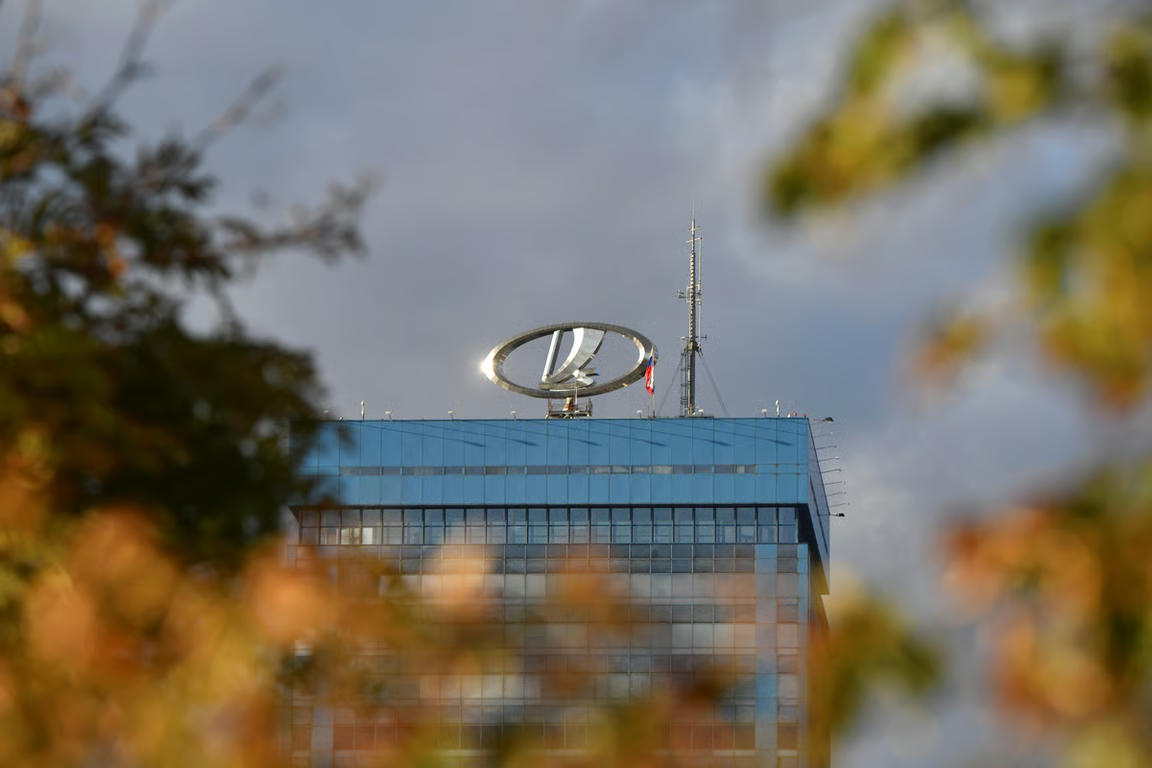
Automakers also decided to try the proven method: AvtoVAZ, GAZ and KamAZ announced the transition to a four-day week.
At the Gorky Automobile Plant, a four-day work week was introduced on August 1 and explained that “in the context of a high Central Bank rate and the unavailability of financial instruments for purchasing cars, the market decline in the first half of the year amounted to almost 40% in the segment of medium-duty trucks, 30% in the segment of light commercial vehicles and 60% in the bus segment.”
The KamAZ press service reported a crisis in the market for trucks over 14 tons. At the end of the first half of the year, the market shrank by almost 60%. In the summer, more than 30 thousand trucks accumulated in the warehouses of importing companies, which are not sold, even despite dumping prices. Here, too, we went on a shortened week from August 1st.
And at AvtoVAZ, the four-day period began on September 29 and can last up to six months. As the head of the plant's trade union, Sergei Zaitsev, reported, if the situation with car sales improves, the four-day working week will be abolished. AvtoVAZ employees are already leaving en masse. However, the trade union denies this. According to Zaitsev, there is still normal turnover at the plant.
However, the situation at the enterprise is difficult, one of its employees, Nikolai (name changed), told Novaya-Europa:
— I have been working at VAZ for several years. Salaries - 60-80 thousand rubles. Engineers get the most, and workers get the least. Moreover, office workers, who, by the way, are the majority here, have higher salaries. My salary is 50 thousand, and in recent years it has been indexed, but not significantly ( in September, the median salary in the Samara region reached 66.7 thousand rubles. - Ed. ).
According to Nikolai, most of the workers are people of pre-retirement age or pensioners.
“There are only old people left, young people don’t come here: why do they need it, for that kind of money?” It would be better if they sold it to the Chinese already. Well, the management can't handle it. The equipment is old, there are not enough people. The communications are rusty, the pipes are leaking, they are patching in one place and breaking in another,” Nikolai complains.
Another AvtoVAZ employee says he plans to leave the plant in the near future:
— My schedule is two to two, normal. There are not enough people at the plant. I am a mechanic, but sometimes I perform both my own and other people’s duties, which often have nothing to do with me at all. Nobody comes to work for us for such pennies. I know many guys want to leave because of low salaries. You could say it's a line to be fired. Some people go to Moscow to work at factories that make military products, others just go to work as a mechanic at some kind of car assembly plant. Anything is better than sitting here.
Plywood plant closes
Reuters analyzed the trend, and, according to its data, the transfer of employees to part-time work, sending on unpaid leave and layoffs are occurring in many industries - from railways and automakers to metallurgy, diamond mining and cement production.
From October until the end of the year, the largest cement producer in Russia, the Tsemros holding, switches to a shortened week. All this is to avoid cuts amid a sharp decline in the construction industry and rising cement imports. The company, which includes 18 factories and over 30 quarries for the extraction of non-metallic materials throughout Russia, employs 13 thousand employees.
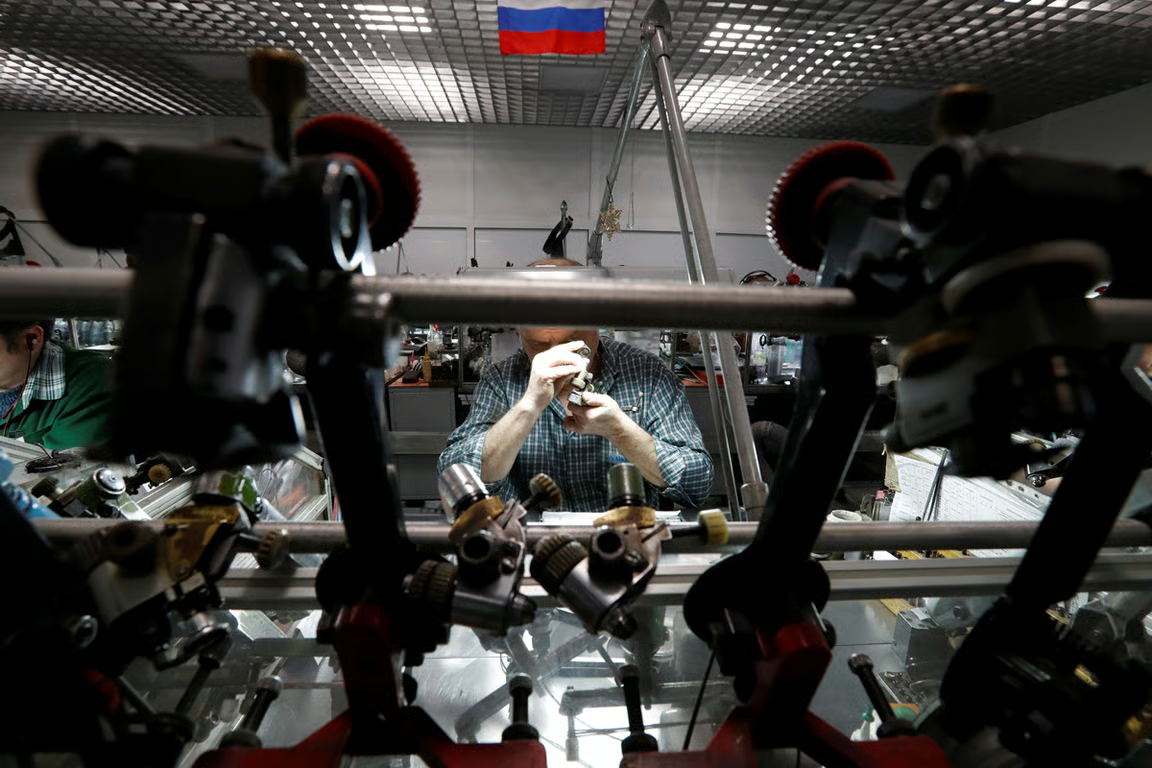
The largest Russian employer, Russian Railways OJSC, which employs about 700 thousand people, required central office employees to take three additional days off per month at their own expense. Back in the summer, they began sending employees on unpaid leave. From January to September 2025, loading on Russian Railways decreased by 6.7% compared to January - September last year. Almost all categories of cargo were in the red: coal, coke, cement, petroleum products, construction materials, industrial raw materials, grain. The world's largest diamond producer, Alrosa, also cut employee salaries by 10%. Work at two of its fields was also suspended. A number of enterprises in the metallurgy, mining, woodworking and coal industries are reducing the working week, personnel or production.
Sveza, one of Russia's leading wood and paper producers, closed its plywood plant in Tyumen in September due to a sharp drop in demand. 323 people lost their jobs. The main factors are a fall in demand for plywood in the domestic market due to a slowdown in construction, rising logistics costs, rising prices for raw materials and the strengthening of the ruble, which hit exports.
“Give me some coal” is no longer necessary
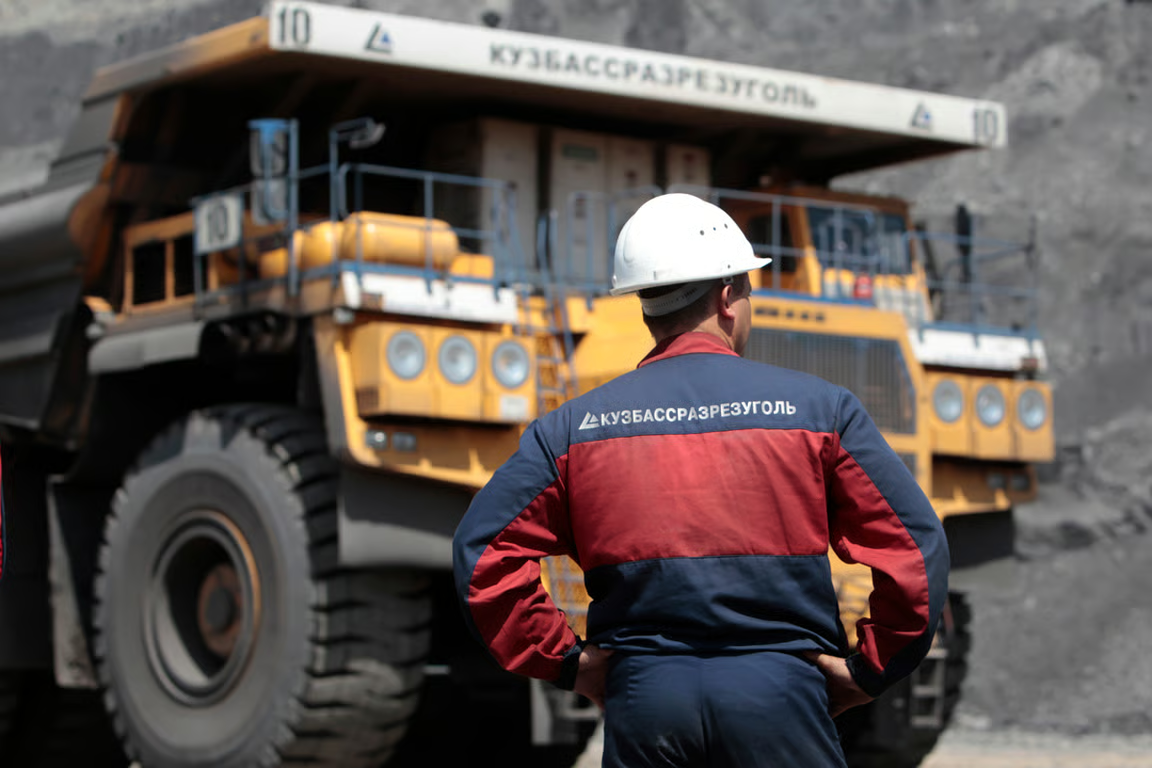
The coal industry, which employs about 150 thousand people, was also hit hard. Deputy Prime Minister Alexander Novak sent a letter to Vladimir Putin back in April, saying that the financial condition of the industry was deteriorating: 30 enterprises employing approximately 15 thousand employees, producing about 30 million tons of coal per year, were under threat of bankruptcy.
According to Rosstat, the net losses of coal companies in January-July doubled the entire year of 2024 and amounted to 225 billion rubles, 65% of enterprises are unprofitable.
The crisis has seriously affected the economy of Kuzbass. According to the “Regional Economy” report from the Central Bank, as of September 2025, 25% of investment projects in Kuzbass are frozen or postponed. Over seven months, 110.3 million tons of coal were produced, which is 7% less than a year earlier. Exports from the region in June-July decreased by 5.6%, supplies to the domestic market decreased by almost 8% compared to the previous year due to a drop in demand from metallurgists.
In September, Kuzbass authorities reported the closure of 18 out of 151 enterprises. The number of vacancies in the industry also decreased by 40% by the beginning of the year.
“I’m from Kuzbass. They excavated the entire taiga using cuts. Everything was turned into a big hole. The entire south of Kuzbass is like a lunar landscape. Now almost everything has been abandoned; coal is no longer needed. My brother-in-law works at BelAZ in one of the open-pit mines. Now he has been sitting without pay for two months, there is nowhere to take the coal. People are sitting without wages, and almost everyone is under debt, almost everyone has a mortgage. There are no words, people are completely hopeless. But no one needs this. Quit, they say, but where to! Your problems. Bastards! — social media users comment on the crisis in the coal industry.
“The adhesive plaster is purchased in China!!!”
There are also cuts in the metallurgy industry: almost all enterprises are laying off support staff.
“ No coal, no coke, no coke - there will be no ferrous metallurgy, and therefore there will be no pipes, rolled metal, etc., there is nothing even to make tanks from, everything is heading towards complete collapse, the oligarchs are withdrawing money abroad, as before, and people will live without pensions and social payments, thanks to Puta and his gang! “ - they write on social networks (hereinafter in the quotes the spelling and punctuation of the originals are preserved).
YouTube users under a video about another closed enterprise talk about their experience:
“ In Pervouralsk, the new pipe and pipe industry is on its last legs .” “ In Yekaterinburg, at the Electrokhimiya Research and Production Enterprise, I finished it a few days ago. The enterprise also feels the breath of death on itself (by the way, the salary also used to be 100-120, but now it’s 50-60.) That’s how it is .”
There are problems everywhere - in pharmaceuticals, in the oil industry, and in furniture production.
“ Verapharm” in Voronezh is also on the verge... There, since Soviet times, they have been producing adhesive plaster that cannot be peeled off, but now they have not signed a contract with it.... The adhesive plaster is purchased in China!!!!!! Everything..... .. Which doesn’t hold up at all... ”
“ I work in the IT department in the oil industry. It feels like the nuts are being tightened. New people are not accepted, paid substitutions have been removed, and promotions also seem to be going badly. But they are not cutting it .”
“ We are engaged in the sale of furniture fittings and the production of furniture. We closed 24 branches across Russia and laid off about 180 people. All because of sanctions .”
“ I work for a large transport and logistics company. Since July we have been practically without work on a shortened working week. Salaries, naturally, fell by half. Those who are quickest leave on their own. I think that by the new year there will be layoffs or we will close altogether ,” users share.
“A person is ashamed to be unemployed”
Today, there are no industries in the civilian sector of the economy that would feel comfortable, economist Igor Lipsits tells New Europe.
— The Russian economy is now collapsing in the civilian part. It is impossible to find a thriving segment. The huge construction industry is in decline. They need cheap labor, but they don't want to pay wages. And they are now importing Indians. Formally, hiring is underway, but at the cost of lowering the average salary level and expelling Russian citizens from jobs. They wrote to me that they transferred the Tikhvin Freight Car Building Plant to a three-day work week. Because the railroad business is down, traffic is falling, the cars are not needed, so they are being transferred to a shorter week, with a corresponding drop in wages, says Lipsitz.
According to him, directors of large enterprises practiced methods such as a shortened work week or indefinite vacations back in the 90s:
— The Russian model of the labor market is that very often unemployment is hidden. In the 90s, people were not fired, but transferred to a shorter work week or sent on unpaid indefinite leave. And people didn’t leave their jobs. This is the sphere of psychology: a person in Russia is ashamed to admit that he is unemployed, so he tells everyone that he works, but so far they have not paid him a salary.
Formally, he is connected with the enterprise, he has a work book somewhere. It seems that the length of service is ticking, which is also good for retirement, although there are no pension contributions. And this psychological model is well understood by the directors of Russian companies.
Now a new phenomenon has been added: enterprises need to demonstrate prosperity in the Russian economy. But growing unemployment disrupts this picture, the economist says.
- Any director understands: there is no need to fire people - transfer them to a shortened week, then it seems like there is no unemployment in the country, everything is fine, the management is happy with you. This is not from a good life. It’s just that the director is looking for an option for which he will get less punishment. He doesn’t look into the future, God bless you, what is the future, what is the strategy, now everyone lives one day at a time. I held out, survived this quarter, completed the year without going bankrupt—that’s already happiness. That's how everyone lives. And if you fire 20 percent of the staff, both the minister and the plenipotentiary representative will give you a slap, the FSB and the tax office will come and do something that is better not to tell. But the working collective does not go on strike, does not make a fuss, does not organize strikes, and sadly signs an agreement to switch to a four-day week. And this misfortune is spreading like an infection throughout all large factories,” Lipsitz notes.
Towards revival through hunger strike
This situation can continue until enterprises go bankrupt, he says. So far, there is no improvement in the economic sector.
— For a revival to begin, there needs to be an increase in demand in the economy. Let's imagine that the war has now stopped. Will there be an economic boost in Russia again, as happened in the 90s? The picture with oil today is lousy. The US Department of Energy promises the price of Brent oil to be $52 next year. And Russian Urals oil will be 40–48, it turns out. With such money there can be no economic recovery. And even if Russia stops fighting, it will continue to support military spending for a long time. Oil revenues, whatever they may be, will still go to the military-industrial complex. And the civilian complex will get nothing.
There will be no improvements, there is not a single objective factor for economic growth, agrees former State Duma deputy and human rights activist Evgeny Stupin.
- This will continue, enterprises will go bankrupt. We also see objective factors that reduce economic growth, and this is the key bet. There is no doubt that this will continue. How will people behave? We see that they either quit or wait for improvements, but they will not happen. Looking for another job? But there is no work. This is a dead end, cuts are everywhere - in logistics organizations, in Russian Railways.
According to Stupin, the only option is collective struggle: strikes, complaints, active work of trade unions:
“There is no other way out, people will come to it.” This is a difficult path. Now the situation is developing in the Primorsky Territory. At the Luchegorskaya State District Power Plant, people could not get their salaries paid, so they came to the boss’s office and stayed there overnight. And the prosecutor’s office immediately took up the matter and paid the money. It will happen, we're not going anywhere. Some people can afford to leave Russia, but for the majority the only option is a collective struggle.
According to him, it is very difficult for the authorities to stop the strike. Especially if it is “Italian,” says Stupin: “Well, you can’t officially go to a rally - you sit down and do nothing.” And do not fire such a person. If he just goes to work, it is difficult to fire him under the employment contract. And if you also write a “Hunger Strike” poster, take a photo and post it on social networks, the effect will be stunning.