
Translated material
To the throat of a song that is not your own
What threatens street musicians who dare to perform in St. Petersburg
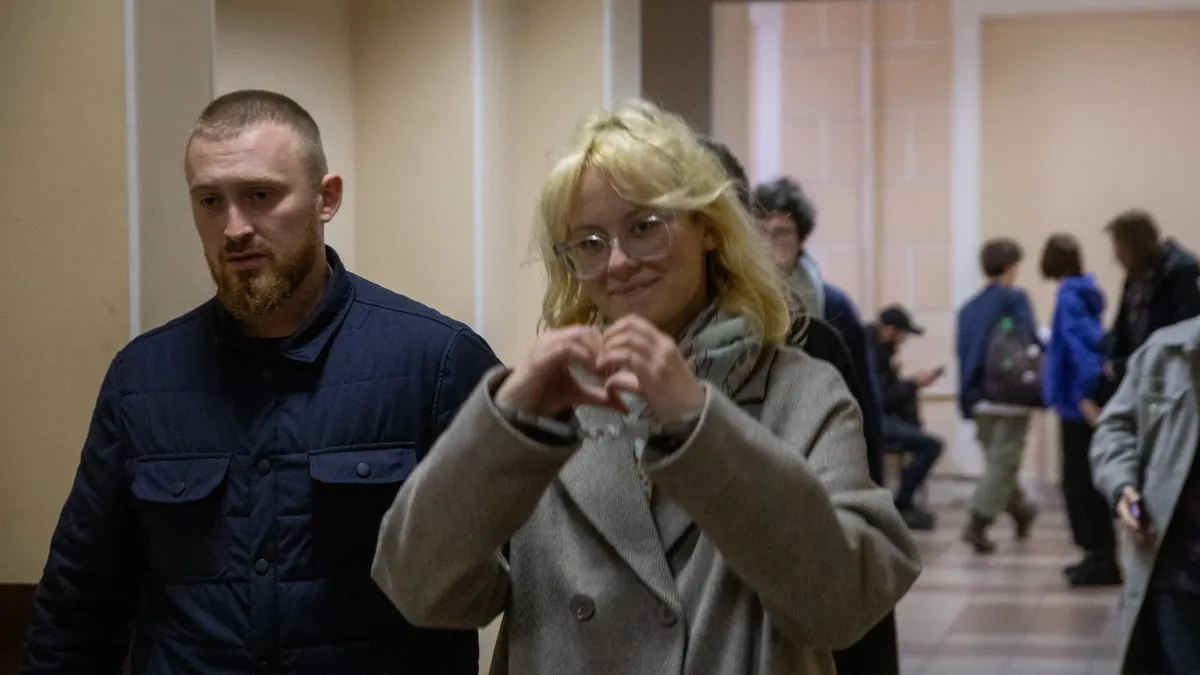
Singer Diana Loginova (Naoko) in court. Photo: Alexey Dushutin / Novaya Gazeta
The widely publicized story of the detention and arrest of three street musicians in St. Petersburg - singer Diana Loginova (Naoko), drummer Vladislav Leontyev and guitarist Alexander Orlov - became not only the first case of application of Article 20.2.2 of the Code of Administrative Offenses to musicians, but also a clear demonstration of the flawedness of the city law on the regulation of performances by street musicians, which introduces a licensing procedure for these performances.
Protocols were drawn up against the members of the Stoptime group because of their performance on October 11 at the Ploshchad Vosstaniya metro station. Musicians who regularly perform on the streets of St. Petersburg perform compositions including those who have been declared “foreign agents,” and this has caused discontent among pro-government activists.
But formally, all three received arrest for periods of 12 to 13 days not for this at all, but under administrative article 20.2.2 of the Code of Administrative Offenses - about “organizing a mass simultaneous stay of citizens in public places that is not a public event,” which “created obstacles to the movement of pedestrians or vehicles or access of citizens to residential premises or transport or social infrastructure.”
Judging by what the St. Petersburg media are saying, the “interference” in access to the “transport infrastructure facility,” namely the metro station, was created for the only citizen who wrote a statement to the police that the approximately 70 people gathered significantly interfered with him.
Musicians are charged with
“from 20:30 to 22:00, being in a public place near the lobby of the Vosstaniya-2 metro station, they organized a massive simultaneous presence of citizens ... in the amount of at least 70 people, using sound amplification equipment, without coordinating this cultural event in the prescribed manner with the administration of the city of St. Petersburg.”
Whether they could have organized more obstacles to access to the metro is a big question: it was late in the evening, and October 11 was a Saturday—there could no longer be an influx of passengers rushing to the metro. And 70 people listening to music is not such a crowd that can seriously interfere with those wishing to enter the subway. During rush hour, much more serious interference occurs at the entrance to this and other St. Petersburg metro stations due to the huge number of people wishing to use it. But it never occurs to anyone to demand administrative punishment for these interferences...
The musicians explained in court that they did not “organize” anything, that the movement of citizens was not interfered with, and that there were no complaints from them (the citizens), including from the owners of nearby shops and establishments, and that the venue for the performance was chosen in advance because it was free.
It didn’t help: the court gave them almost the maximum punishment (the limit for this paragraph of the article of the Code of Administrative Offenses is 15 days of arrest).
In addition, a protocol was drawn up against 18-year-old singer Diana Loginova under the article on “discrediting the army.
Performances by street musicians in St. Petersburg (as in other cities) are quite frequent, including near metro stations, but I can’t remember examples of musicians being accused, much less sent to arrest, under this article (of course, the content played a role here). But this story is also important as an illustration of the rules of street performances that the city adopted at the end of 2022.
Then the St. Petersburg administration decided to “regulate” the performances of street musicians. And it established a licensing procedure for performances: musicians must submit an application for one of the places permitted for performances within 10 to 20 working days and wait for approval. If it turns out that the place is already taken, they may be refused (however, the application register is not open and public, and it is impossible to find out in advance whether the place is already taken). And a whole series of bureaucratic formalities, failure to comply with which may lead to refusal.
Everything is very similar to the procedure that applies in St. Petersburg when holding public events, and when the law was discussed, Yabloko deputies said:
this design will inevitably lead to the same thing - when for “undesirable” notifications there were always reasons for refusal due to the fact that someone else allegedly filed a notification earlier at the same place and time.
Was there an alternative?
Of course, and quite close: the order that exists in Moscow. You can go to the website of the Moscow City Hall project “Street Artist”, which displays all the venues for holding concerts in the city, get acquainted with the information in advance which venues are free and which are occupied, and then submit a notification request for a free place and time, without the risk of being refused.
The corresponding amendment of Yabloko - on the introduction of an order similar to the Moscow one - was supported by the factions of A Just Russia and New People, as well as part of the communists, but was not supported by United Russia and the Liberal Democratic Party, and the amendment was not adopted.
The law was criticized by the frontman of the AuktYon group Oleg Garkusha, singer Maxim Leonidov, St. Petersburg bard Mikhail Novitsky and musician, director of the Garkundel art center Dmitry Podosenov, who said that the proposed standards are “short-sighted and irresponsible” in relation to music performers and require improvement. But this didn't affect anything.
Representatives of Smolny then promised that they would see how the law would work, and perhaps implement the Moscow scheme, but for three years they did not do this. So the order remains, which gives, as the opposition initially said, not the freedom for musicians to perform, but the freedom for officials to prohibit these performances.
And one more thing: city legislation provides for punishment for violating the rules of performances by street musicians. The only penalty for this is a fine. For citizens - up to five thousand rubles.
But a different article was applied to the Stoptime participants, allowing for administrative arrest. And it's not hard to see why.
Vladimir Maksimov