
Translated material
As if nothing happened
About Daniel Kelman’s “Chiaroscuro”, Guzeli Yakhina’s “Eisen” and the artist’s responsibility for the context in which he lives

Photo: Vlad Nekrasov / Kommersant
There is something cinematic in the story itself - how the small, recently opened émigré publishing house Fresh Verlag was able to publish a bestseller by one of the most famous German-language writers, Daniel Kehlmann, and how one of the most anti-totalitarian and anti-fascist modern novels was published there in Russian. In the afterword to the novel, translator Alexandra Berlin says that when Kelman invited her to translate his new book, she was upset: since 2022 she had not worked with Russian publishing houses. But Kelman did not want to transfer the manuscript to another translator. Then they began to look for workarounds: and so “Chiaroscuro” ended up in Fresh Verlag - both in Russian and in an excellent translation.
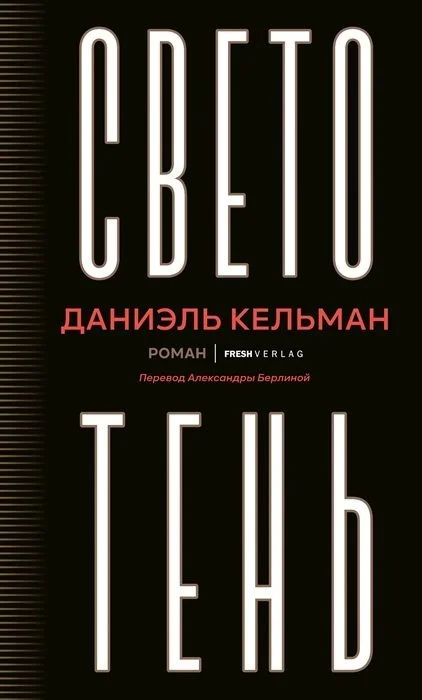
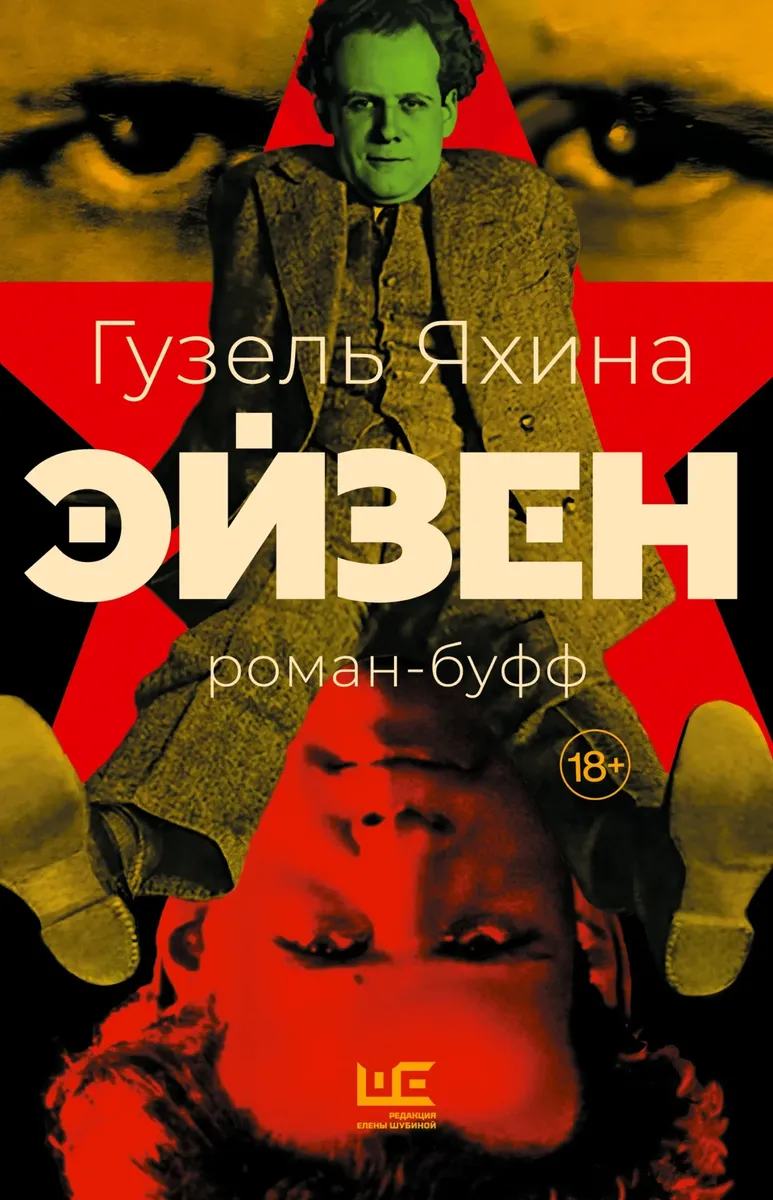
There is also something cinematic in the fact that in the same Russian language - only on opposite sides of the border - two high-profile biopic novels about contemporary directors living and working under dictatorship were published in a short time: the aforementioned “Chiaroscuro” - about Georg Wilhelm Pabst and “Eisen” by Guzel Yakhina - about Sergei Eisenstein. These two novels are not only similar thematically and genre-wise, not only were they published within the same year, but they also ask the same question: “Can an artist live in an ivory tower?” And even more than that: they answer the question in approximately the same way.
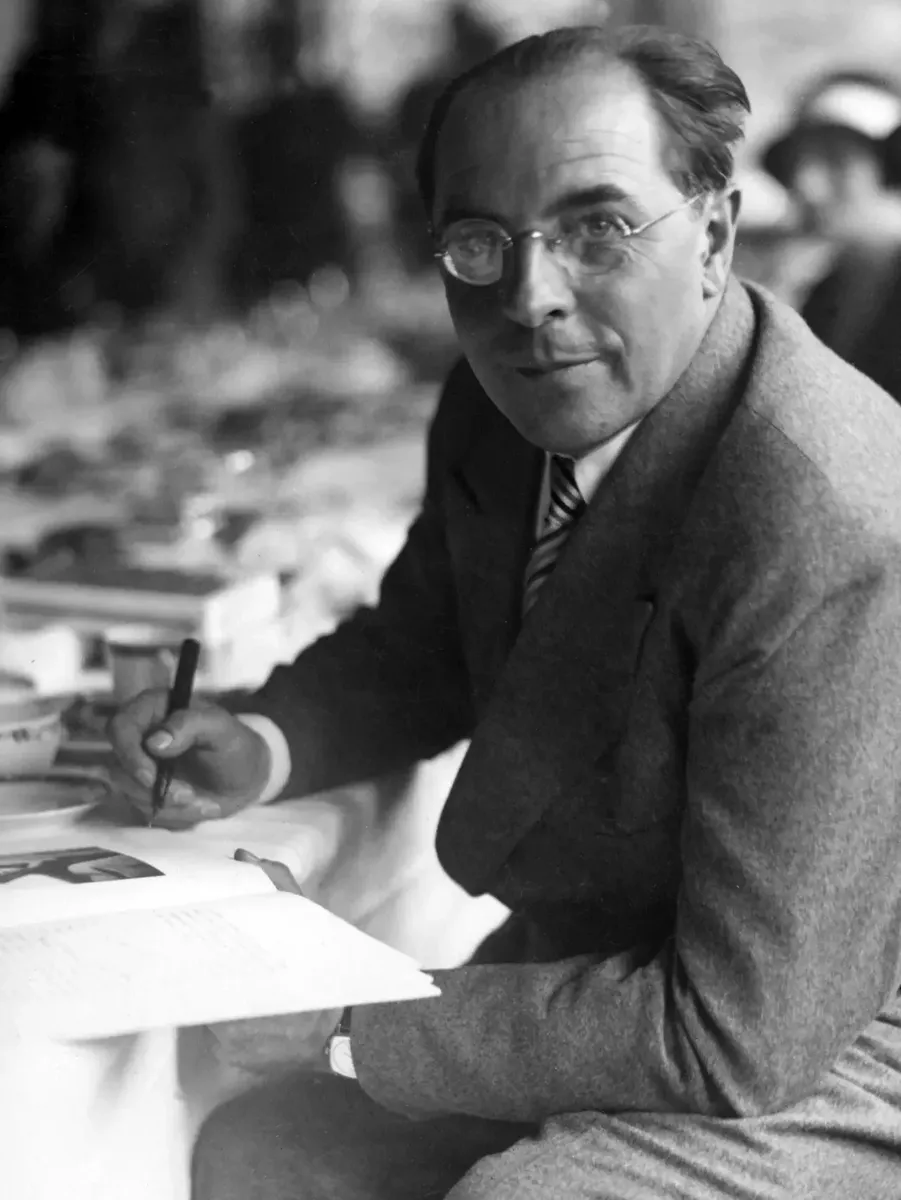
What and how “Eisen” was written—everyone has already read it in six months. And “Chiaroscuro,” as already mentioned, describes Pabst’s biography—more precisely, the segment of it that he spent working for the cinema of the Third Reich. Pabst had no intention of working for the Reich - he filmed in Europe, and after Hitler came to power, he refused to return to Germany, then he tried to work in Hollywood - however, without success, then he went to Vienna for a short time to visit his mother, and there he was caught by surprise by the war, the Anschluss, and the status of a prisoner of war. This, at least, is the official version of his biography - in the novel version there are much more penumbras.
For example, reading Kelman's text, one cannot be absolutely sure that he went to Austria because and only because his sick mother sent him a short letter asking him to return: Pabst was not naive, he knew that his mother suffered from dementia and was unlikely to have written the note consciously - if she had written it at all.
And he also knew about everything that was happening in his homeland, which Nazism had come close to - “there is hell in my homeland,” he told his fellow filmmakers in broken English. And he also knew that he was doomed: once a great European director in Hollywood, obsessed with commerce and the search for a Modern Hero, no one needed the tongueless non-commercial Pabst. He was a refugee who had no right to make a mistake, and therefore did not want to make a deliberately failed movie about a hero of his time (but in the end he did). He rushed around everywhere with a single idea: to make a film about a huge, rich liner sailing in the middle of the ocean, which suddenly receives news that a world war has begun:
“I have an idea,” he said. - Rich and poor on an ocean liner, a salon, an orchestra, refined morals, tea and cakes, liqueurs - and suddenly a radio message: war has been declared!
— Another war film?
- No. And yes. But most likely not. The radiogram is false. But a war is really taking place on the liner. Passengers fight with each other, unite in groups, arm themselves, maybe someone even dies, maybe not, it’s important not to go too far here. I'll have to think about it. And then it turns out that it was all a mistake. Illusion. And then - this is the most important thing, Greta! - everyone starts playing the cheap comedy of civilization again. It’s like nothing happened.”
But the idea doesn’t take off anywhere—everyone, especially Hollywood, which is far from European problems, prefers and understands the “as if nothing happened” state, and no one wants to hear about the war, or film, or watch. And then Pabst, who is in danger of going from great back to assistant, returns to his homeland, taking his wife and child with him. His wife will not forgive him for the latter: not for taking her with him, but for taking their son with him - the boy adapts to the Nazi environment record-breakingly quickly and after a couple of years he will boast of the right to wear a Wehrmacht uniform.
This, in fact, is the entire plot structure - that part of it that can be retold. Everything else is pure psychologism and pure cinema: a text imitating the language of cinema, the properties of which were described in detail by other reviewers and the translator herself, so I will not dwell on it in detail. This merging of literary and cinematic text in the novel is important:
it’s just that for Pabst himself, very soon the line between reality and cinema disappears, he himself begins to constantly act, checking every gesture, every movement and every intonation, as if he were a director, a cameraman, and an actor at the same time.
It is difficult to say what it is: professional deformation, fear of arrest, or an attempt to escape from real life - but what is interesting is that in the novel about Eisenstein, Yakhina uses the same technique: for the demiurge Eisen, the whole life becomes a set of scenes and plans that need to be edited correctly.
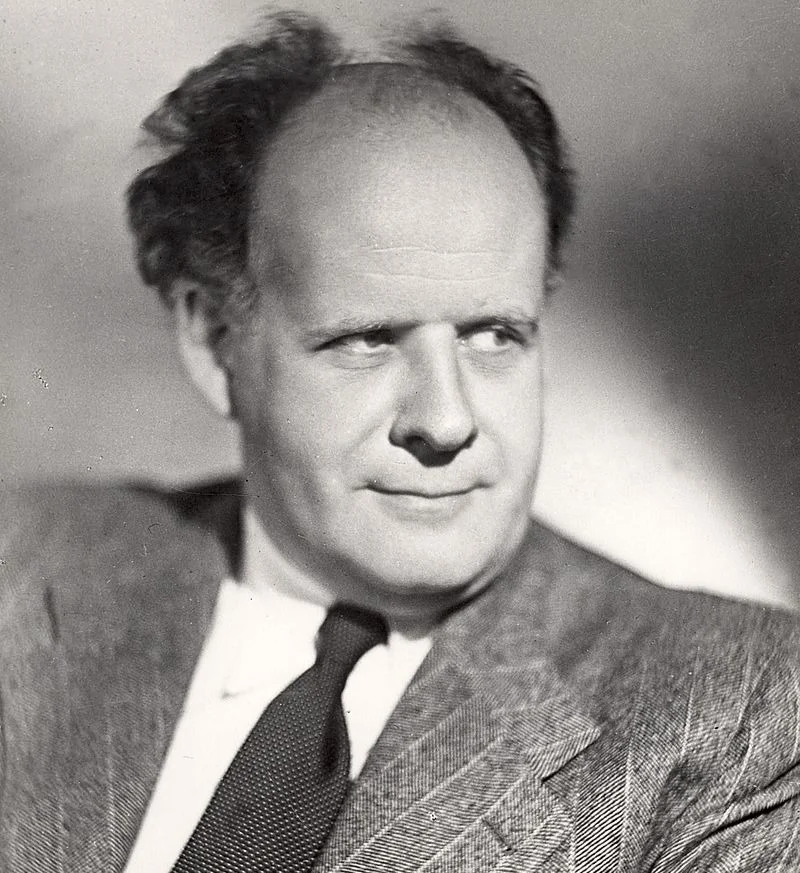
And here both novels begin to pose questions to readers that force these texts to be compared, connected and compared. For example, this - in general, hackneyed, but eternal: can an artist be free in an unfree country? Yakhinsky Eisen, at first glance, may well: “My will be done!” - he thinks while cutting a film of Fritz Lang’s film brought from abroad. It is he, Eisen, the editing artist, who is a god, because he is able to write into the film text any meanings that he wants. And in this he is stronger than both director Lang, whose creation must submit to his scissors, and General Secretary Stalin, who will have to see in the film what Eisen wants to show him. And it doesn’t matter that in parallel with his rapidly boiling work on the next film - Yakhina often does this editing - the arrests of Babel and Meyerhold are taking place:
they still haven’t come for him, which means he can create freely.
Kelman's Pabst, at first glance, also does not experience serious oppression - on the contrary: he is great again, he has money, people and pavilions at his service again, and in general, if he does not want to speak out about politics in his work, no one is forcing him to do so:
“Passers-by stopped, raised their right hand, and Pabst, in order not to stand out, did the same - only for a second, his shoulder twitched, he felt defiled to the core. It’s hard, Keutner said quietly as they sat down in his living room, but on the other hand, it’s not so hard. The UFA has remained remarkably apolitical; no one is prevented from doing their work, even banned screenwriters continue to write under pseudonyms. Of course, you have to watch every word, especially since the war began. But when you get used to it, when you know the rules, you feel almost free.”
“Almost freedom” is, of course, not freedom in the full sense, but it’s not that this “almost” doesn’t suit many: well, yes, they took the conditional Eisen or the conditional Pabst “for service, like a Mosin rifle” - so what: they let you shoot. You can live and create as if nothing had happened. Almost artists are quite happy with this situation - however, only if it is almost Eisen or almost Pabst.
Because for the full-fledged Eisen and Pabst, the ideal artist and director will forever remain Fritz Lang - a man of art without discounts, who made a name for himself in Europe and transferred it to Hollywood without loss, who did not become dependent on commerce and never worked for state propaganda for a day.
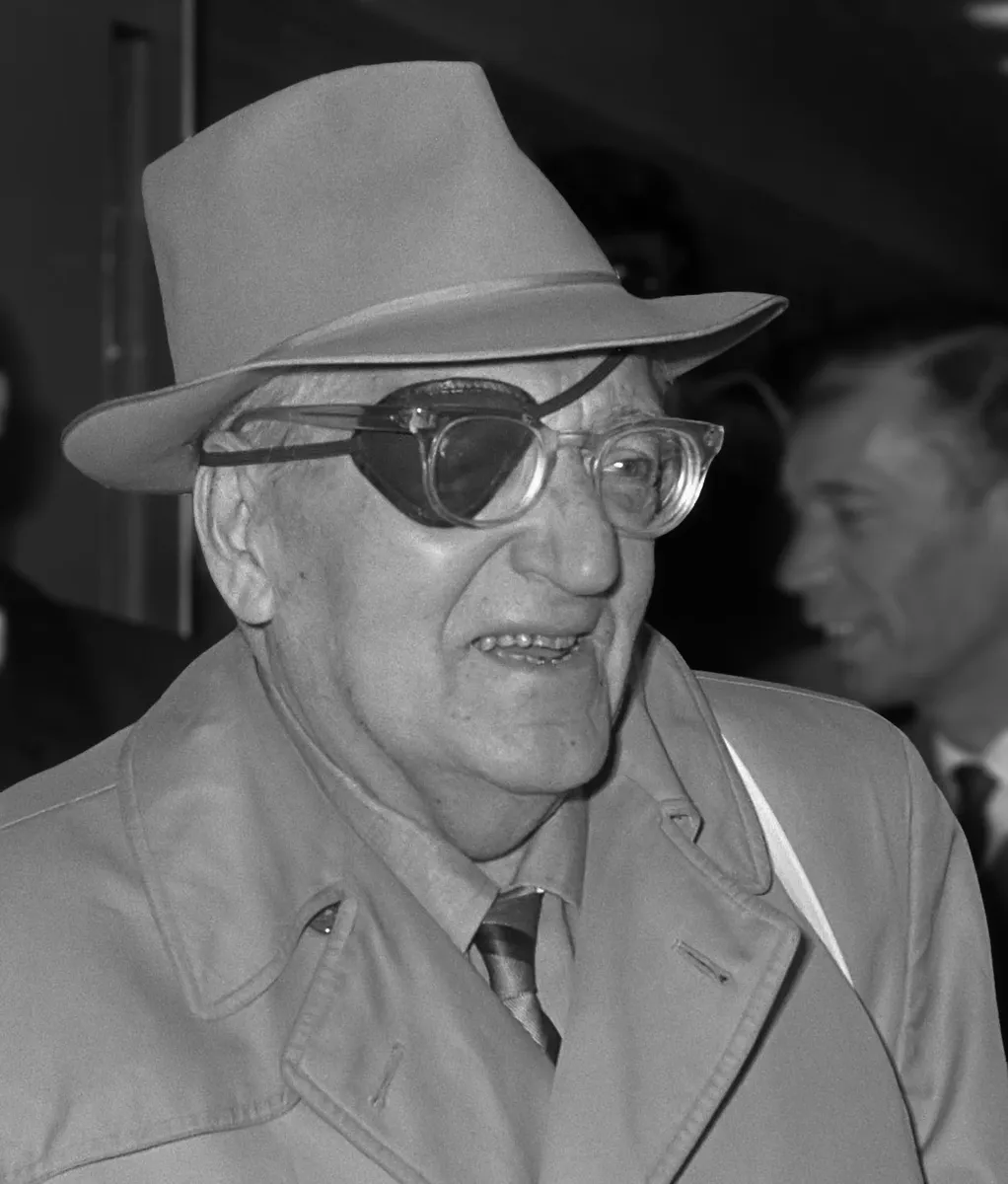
Lang's name appears equally often and to the same superlative degree on the pages of Yakhina's novel and on the pages of Kelman's novel - and remains the name of a being of a higher order in both, the name of creative freedom as such, distant and unattainable.
Both novels - Chiaroscuro and Eisen - are about the fact that a real full-fledged artist cannot be content with any “almost”:
if he is not free, he must either free himself completely or find a convincing justification for his unfreedom.
It is difficult to formulate unambiguously what such a justification is for Yakhinsky Eisen, but in the case of Kelmanovsky Pabst everything is spelled out very clearly: he finds justification for his creativity in the fact that not a single person was harmed on the set of his films, and most importantly, in his very lack of freedom. My art serves murder and repression, but I continue to do it simply because I was forced, and if I were independent, I, of course, would not do anything like that - that is his philosophy. But artists of this type usually prefer not to think about the fact that, in fact, they were not really forced - because if you think about it, the feeling of their own legitimacy evaporates quickly:
“He says: even though the whole world now believes that you are with us, you won’t deceive it.
- How can the whole world... You said it yourself, I’m a prisoner of war!
My Virgil smiled. Then he showed... what exactly? I didn’t immediately understand: at my tailcoat, at the red plush upholstered chair, at all the luxurious furnishings.
- You forced me! - I exclaimed so loudly that two ancient ladies in pearls turned to us indignantly.
“You know this, and I know this, but besides us, even here in the hall, no one knows - do you think that at home they will believe you after all your entertaining humorous jokes on the radio?”
“But you made me write them, old man!”
- Well, I forced him. I didn't cut off your limbs. We would have remained ordinary prisoners of war. No Adlon, no cigars. Everyone is the architect of his own happiness, old man. Your home is now the Reich."
And here’s another question that both novels ask: does the artist generally control the meanings that society reads from his work? One of the central scenes of Chiaroscuro is the premiere of Pabst's Paracelsus, a film about a medieval alchemist who went against the ignorance and cruelty of his contemporaries and treated the sick using scientific knowledge rather than “traditional values.”
“Paracelsus” was filmed under Hitler - and apparently, German society then saw in this film the glorification of the Fuhrer, whom it considered the prototype of the main character. But both in Kelman’s description of this film and in the original Paracelsus itself, if we look at it with today’s eyes, the plot looks exactly the opposite - as the most anti-fascist statement of all that could have been created in the circumstances in which Pabst found himself:
“Then something incredible happened. Tavern. People were sitting at tables, a thin jester was dancing in the center... Visitors to the tavern could not take their eyes off the dancing jester. Some shook their legs, some nodded their heads, some beat time, some twitched their shoulders to the rhythm of the music. It looked completely natural and normal, and it seemed just as natural and normal that here and there someone got up and repeated a few steps after the jester - but then more people began to get up, and more, and now no one could resist, no one sat, the dance engulfed everyone. There was not the slightest fun in her, there was no joy, no freedom. The dancers jumped forward and back, left and right, twitched with their whole bodies, wriggled, as if giving vent to passions, but strictly in unison and with despair in their faces. No one deviated one iota from the general rhythm. Paracelsus entered holding a sword. For some time he watched everyone dance, then, assessing the situation, he sharply shouted something. And the dancing really stopped. It was as if a clownish madness had flowed out of the people. They froze, more indifferent than frightened, sat down again, took hold of their mugs, they still looked a little numb, a little embarrassed, but in general it was as if nothing had happened. I rubbed my eyes. This is not a cheap turn of phrase: I actually raised my hands and touched my trembling eyelids. What was that?
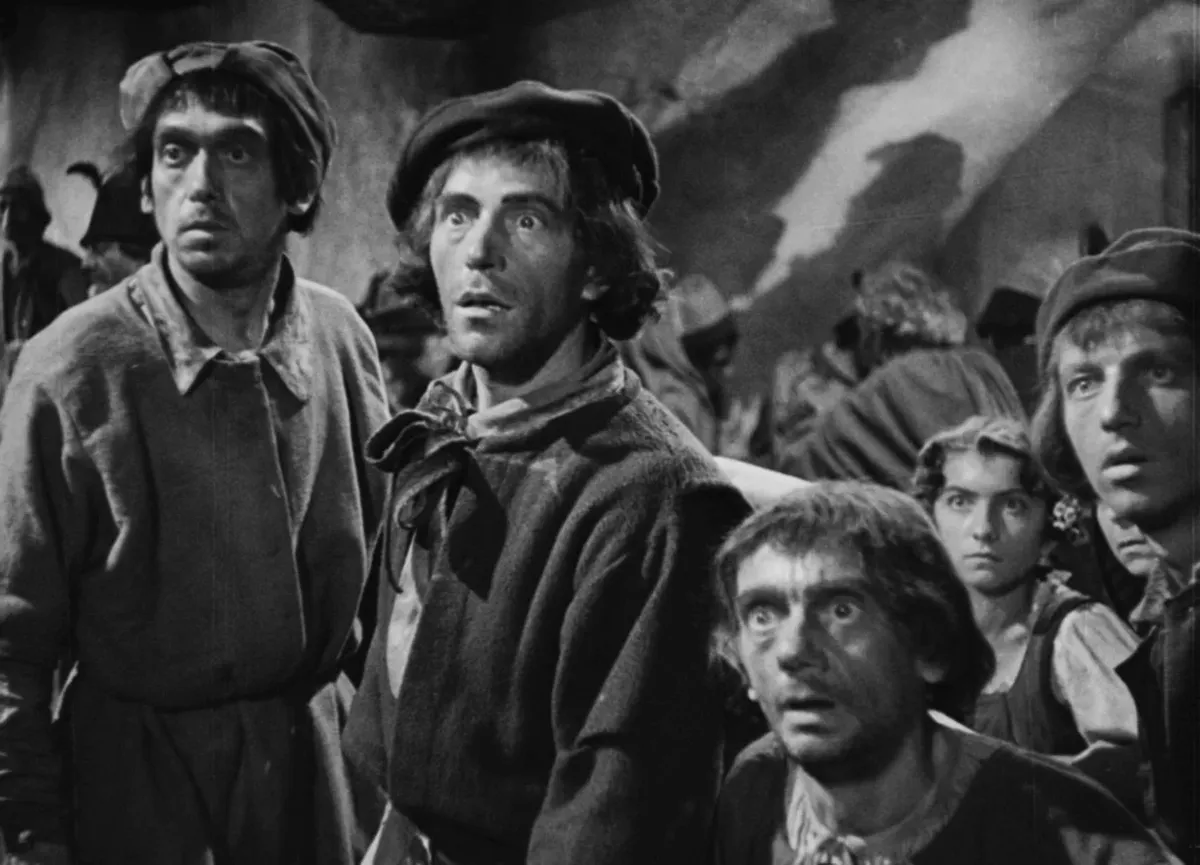
Kelman rounded the corners a little: in the film it is clearly visible how the movements repeated after the jester are painful and convulsive, and the entering Paracelsus shouts not just “something”, but a very clear “No!” This “no” stops the general madness - and the plague, the carrier of which was the jester.
And one can imagine what efforts of imagination it took for the Germans of that time to see in this the director’s agreement with the party line - and to behave as if nothing had happened.
An even more confusing answer to the question of whether it is possible to make a work of fiction a clear social statement is provided by the novel about Eisen. On the one hand: an order comes from above for a film glorifying the first revolution on its twentieth anniversary, and the executive Eisen takes on “Strike,” which will later be shortened to “Battleship Potemkin.”
Serving ideology? Definitely. But only a very sophisticated viewer’s imagination is capable of discerning the glorification of the revolution and civil war in a film in which a baby carriage rolls down the Odessa stairs onto the soldiers’ bayonets. Moreover: “Potemkin” - not the novel, but the real Eisenstein - became, if not one of the symbols of pacifism, then a very noticeable sign of it: it was shown in Japan after the nuclear strikes on Hiroshima, it was one of the first to be allowed in Portugal after the overthrow of the Salazar regime.
But the novel Eisen is far from simple and easy-going: “Ivan the Terrible” is a film that was initially propaganda in its very idea and also a commissioned film, but at first glance it does what it should: a strong, hard hand restores order in his kingdom, fights with all sorts of traitors for the sovereignty of the country. This is the appearance by which a film must be judged and approved by a leader. This is written in the text spoken by the actors.
And in the subtext - in gestures, in mise-en-scenes, in editing and in light contrasts created by cameraman Moskvin (the constant epithet “master of chiaroscuro” is usually applied to him) - there is something else: the movie “is not about Ivan the Fourth, not about a historical figure with his character and deeds,
and about the Monarch - about all the kings and padishahs, and pharaohs, and emperors, who ascended the throne in the radiance of hope, and came down as a despot and tyrant with bloody hands and a blackened soul, for such is the fate of everyone invested with absolute power.”
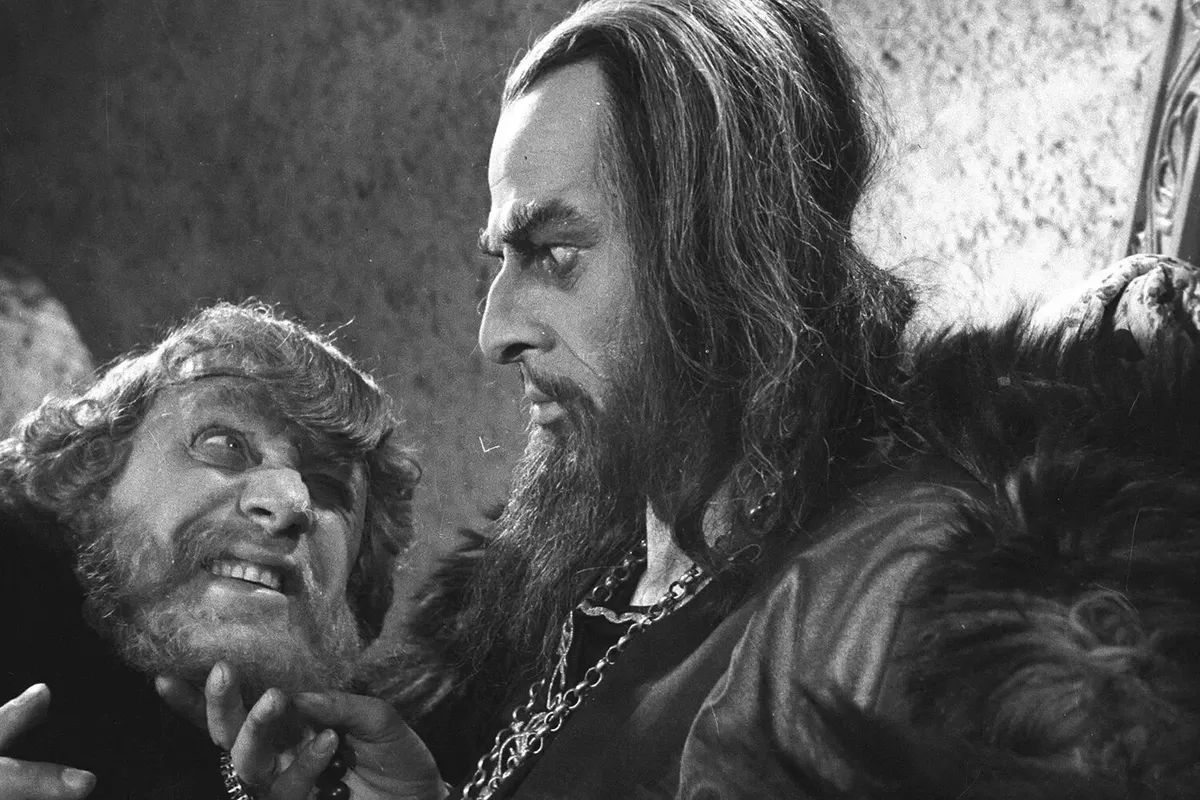
But Stalin and Soviet society, of course, did not want to see this in the film. Society continued to live as if nothing had happened. At least until the second part of the film, in which everything turned out to be expressed much more directly and which therefore was not released.
Both artists—whether novel or real—were not responsible for their creations and for what ideology these creations would serve at different times of their existence.
Being read correctly is not at all the responsibility of the author, and this is perhaps the only unambiguous answer that the novels of Kelman and Yakhina give to all the questions posed. But he cannot not depend on the context in which the author creates.
It is the mass of viewers who have the right not to want to watch and sponsor films about a liner that does not need any iceberg at all to sink - it will go down because of bloody fights on the first class deck. It is viewers who may refuse to look at themselves and look for meanings in works of art that are useful to them at the moment. They have the right to live as if nothing happened.
But an artist has no right to engage in art as if nothing happened. Responsibility for the context will always lie with him, and the only thing he can hope for, agreeing to continue to realize his calling in such conditions, is the art of working with chiaroscuro: with halftones, with shades of meaning and significance, with the shadows that his heroes cast. Hoping that someday it will still be read correctly.
QUOTE
“Then the man spoke. Pabst didn't understand a word. He nodded. What was left for him? From his first day in Hollywood, he tried not to show how bad his English was. Encouraged by a nod, the man continued, and this time Pabst was able to understand that he was praising a film about cowboys, or perhaps about a woman in love. Pabst also realized that he had either recently watched this film or not yet. Either he was producing, or he was going to produce.“Wonderful,” said Pabst. - Great.
He knew that this word was always appropriate in a conversation with Americans, just as it was always useful to praise their shoes.
So, Pabst said, taking another drag from his cigarette, he had an idea, a big idea. Great. Luxury ship, ocean. Suddenly an announcement: war! Quarrels, passengers everywhere, violence too. The tension is very high!
He closed his eyes for a second. He hoped that his English would somehow come into its own when he spoke, but nothing of the sort happened. But the idea for the film War Has Been Declared was really great. The collapse of civilization in miniature: elegant ladies and gentlemen from all over the world are in high-society harmony, but then mistrust creeps in, scandals begin, factions are created, people fall into blind rage.
Он видел мужчину, бегущего с ножом по лайнеру, и кровь, капающую с его рукава, видел треснувший иллюминатор и двух женщин в бальных платьях, дрожащих на корточках за перевернутым столом в когда-то изысканном салоне, и видел апофеоз фильма: низкого лысоватого человечка с посеревшим лицом (играет пусть Петер Лорре), подвешенного с люстры со связанными руками, окруженного кровожадной толпой, и как раз когда его уже готовы разорвать на куски, распахивается дверь.
Вбегает радист: никакой войны нет, радиограмма ошибалась, мир еще стоит! Пабст видел, как все обмениваются ошеломленными взглядами, не знают, как быть дальше, показав себя друг другу такими. Кто-то быстро взбирается на стол, развязывает Лорре, и даже тот делает вид, будто ничего не случилось. А потом камера медленно движется по залу-ресторану, где снова расставили мебель, и все рассаживаются за столы. У многих раны на лице, порвана одежда, но пианист — нет, лучше оркестр — нерешительно начинает играть «Уж цветут в венских парках деревья», и почти всем зрителям кажется, что это счастливый конец; только немногие понимают все, понимают, что перед ними неприкрытый кошмар».