
Translated material
Russia has recorded a record increase in the number of wanted persons who have fled from investigation and trial.
This could happen due to the launch of the register of controlled persons
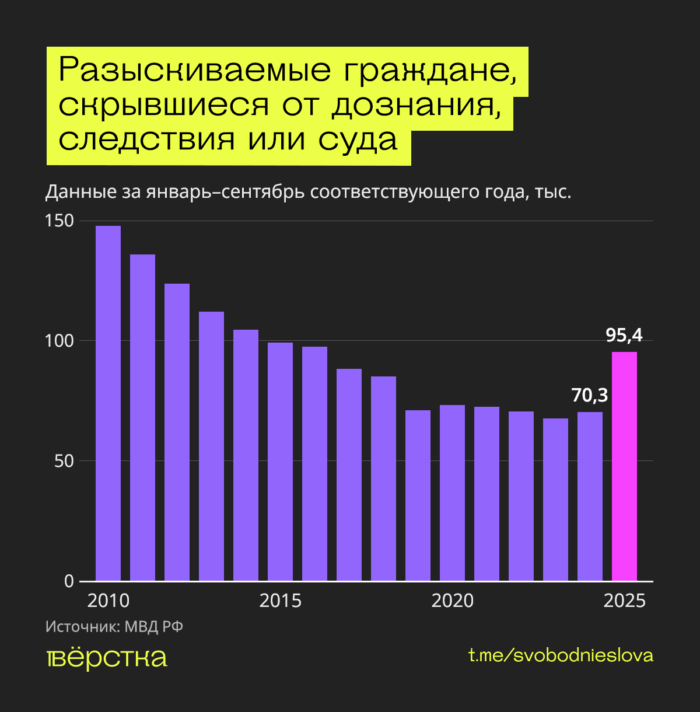
From January to September 2025, the Ministry of Internal Affairs put almost 95.4 thousand people on the federal wanted list who had fled from the authorities of inquiry, investigation or court. This is 25 thousand more than in the same period in 2024, Vorstka noted.
In percentage terms, the growth rate was 36%. This is a record value for the entire period of monitoring statistics since 2009. Moreover, in previous years, the number of fugitive citizens put on the wanted list was predominantly decreasing: over 16 years, a decrease was recorded 14 times, and an increase only twice - by an insignificant 3% and 4%.
In order not to miss new texts from “Layout”, subscribe to our telegram channel
Illegal migrants began to be put on the federal wanted list
Such a sharp increase in the number of wanted people is associated with a change in migration policy and the launch of a register of controlled persons, says Kirill Titaev, a professor at the Faculty of Liberal Arts and Sciences in Montenegro, an expert on the Russian law enforcement system, who studied the statistics at the request of Vestka.
“These are migrants. They (the Ministry of Internal Affairs) began to push migrants who exceeded the deadline into the search database. Previously, the system was like this: you drove in and got lost. Now, if you enter and are included in the register of controlled persons, and then you cannot be found, you are added to the federal wanted list,” Titaev said.
This, in particular, is confirmed by the growth rate of the number of wanted persons. The register was launched in early February, so in the first quarter the smallest increase in the number of people wanted compared to 2024 was recorded - by 24%, and separately in the second quarter it already reached 70%. “The law came into force at the beginning of February, by mid-February we learned how to use it, and somewhere in March we started putting it into the register,” Titaev said.
Due to this significant increase, the total number of wanted fugitives has reached a nine-year high. The last time this figure was higher was in 2016 - then from January to September there were 97.6 thousand people in the wanted list.
New migration policy provides for stricter control over migration
On October 15, Vladimir Putin signed the Concept of State Migration Policy for 2026–2030. The new document has 9 sections and 46 points. They contain information about regulation of entry/exit, status of stay, asylum and citizenship, and data on migration registration. The emphasis is on integrating visitors so that they share “traditional Russian values” and stimulating permanent residence.
In parallel, the authorities promise to fight ethnic enclaves and marginalization, limit the stay of unemployed and non-study family members, and expand the use of information technology and biometrics to control migrants. Thus, since September 11, prohibitions have been introduced for illegal migrants on marriage and divorce, placing children in kindergartens and schools, obtaining a license, opening accounts and driving transport.
The Ministry of Health proposes, from March 1, 2026, to add tests for hepatitis B and C to the existing tests for drugs and infections dangerous to others (HIV, tuberculosis, syphilis, leprosy).
To admit migrant children to schools in Russia, a testing system has recently been introduced, including, among other things , testing for knowledge of the Russian language . Rosobrnadzor reported in September that only 12.6% of migrant children who applied for admission to Russian secondary schools were ultimately enrolled in schools. In addition, a bill on paid education in schools for migrant children was introduced to the State Duma.
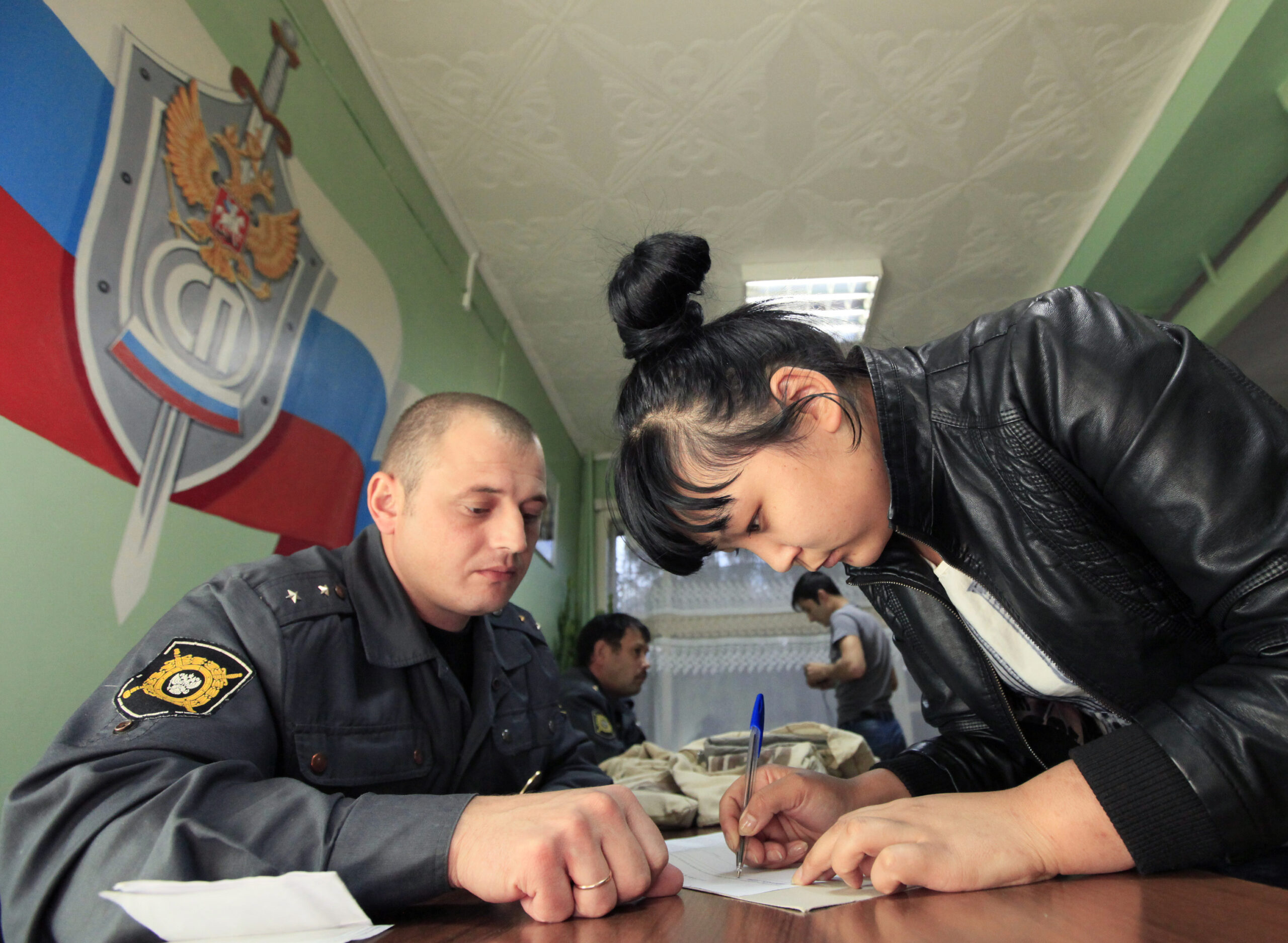
Photo: An illegal migrant from Central Asia fills out paperwork at the Krasnoyarsk police before deportation. REUTERS/Ilya Naymushin
Infographic: El
Support “Vestka” - it’s important and safe →