
Translated material
Spotify is the worst thing that happened to music
Streaming promised to save it from piracy - but pays almost nothing to the musicians themselves, and now it’s trying to do without them altogether
On February 8, 2024, DOXA was added to the register of “undesirable organizations.”
If you are in Russia or planning to return to it, you cannot repost our materials on social networks, link to them or publish quotes.
Read more about what is and is not possible in the cards .
“Spotify is the worst thing that happened to musicians,” Björk says in an interview with Swedish publication Dagens Nyheter. Taylor Swift , Thom Yorke , Neil Young and other major musicians have had their music removed from the service at various times. Lesser-known artists, such as Damon Krukowski of the iconic 1980s band Galaxie 500, often say that the modern streaming model is unhealthy and abnormal. Musicians cannot make a living from their creativity while tech corporations profit from it.
Finally, several bands recently—Deerhoof, Xiu Xiu, King Gizzard and the Lizard Wizard, and Massive Attack— removed their music from Spotify in protest. The reason is the connection of the company's CEO, Daniel Ek, with military technology. This year he invested 600 million in the German defense company Helsing, which deals with drones and military AI.
However, the majority of people who pay for music use streaming services: 84% of recording revenue today comes from streaming services. Spotify is used by 678 million people every month. It seems that streaming is the morally right choice: you pay musicians for their work, and this is definitely better than piracy. But is this true? Or, as some critics write , is Spotify literally an evil corporation?

Editor
Editor
Armen AramyanIllustrator
Illustrator
Vitya ErshovPublication
October 25, 2025
In the 2000s, the music industry—more specifically, the major labels—was in crisis. Previously, music was mainly purchased on physical media: discs, vinyl records and cassettes. At its peak in 1999, the industry earned $14.6 billion in the U.S. alone—adjusted for inflation, that's about $24 billion today—and $39 billion worldwide. The labels controlled distribution, marketing and artist contracts, so they were the main beneficiaries. Musicians typically received only 10–15% royalties from sales.
With the spread of personal computers and the Internet, the situation has changed: piracy has become a much more widespread phenomenon. The main culprit was Napster, which made it easy to share music illegally—more than 60 million people used it in 2000. In addition to exchanging MP3s, listeners burned CD-R discs: copied music onto blank discs and copied albums for each other. It became very easy to distribute music, and distribution was no longer just a matter for the major labels.
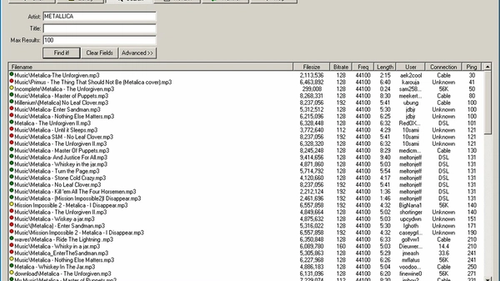
Napster Interface
Quartz
Major labels began to criticize piracy: they say it is immoral, and by sharing music, people are stealing it from musicians. But for small labels and indie musicians, everything was ambiguous: yes, it became more difficult to make money on recordings, but new opportunities appeared - it became easier to bring music to fans and find new audiences.
During this period, there was debate around the world about whether a corporate-controlled copyright system was truly in the best interests of artists. In the early 2000s, American indie rocker and activist Jenny Toomey conducted a study surveying musicians from around the world about copyright issues. This was the dawn of internet piracy - and many (like Moby) said they were glad people were finding their music through piracy.
Indie labels such as Ghostly International, Domino Records and Sub Pop quickly adapted to the new realities and began selling MP3s on the Internet. Major labels and large rights holders - big, unwieldy corporations - could not agree on how exactly to make money from digital music.
The major labels were able to coordinate and shut down Napster - on July 11, 2001, the service was liquidated by court order in response to claims of copyright infringement. But Napster was only one service, and others quickly appeared in its place (Soulseek, eMule, various torrent trackers). To solve the problem of piracy, labels needed help from outside the music industry - they needed technological solutions.
Steve Jobs was the first to come to the rescue - he came up with the idea of selling music through iTunes. The CEO of Apple personally visited the heads of major record companies and convinced them that it was time to sell digital music. The music industry giants turned out to be more accommodating than they would have been a few years earlier - they saw the losses they were suffering due to the fact that they did not have time to adapt to the Internet era.
Then came Spotify.
How Spotify came to be
Spotify was founded by Swedes Martin Laurentsson and Daniel Ek. Laurentson made his fortune with Tradedoubler, a company that automated the sale of banner advertising. In the spring of 2006, Tradedoubler bought Eka's company Advertigo, an online advertising platform. That's how they met. Both quickly became rich in the advertising business.
As journalist Liz Pelley recounts in her book Mood Machine: The Rise of Spotify and the Costs of the Perfect Playlist , Laurentson and Ek felt empty of wealth. They spent days watching movies at Ek's mother's house and became close over a common feeling - life had lost its meaning, and they had nothing left to strive for. That's when they started dreaming up the company that became Spotify.
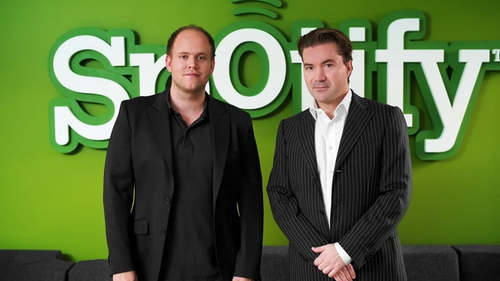
Daniel Ek and Martin Laurentson
Spotify Ltd / K&U, Spotify Ltd
As Laurentson admitted , the original idea for Spotify was not related to music. It was then that the founders of the company began to say that they loved music very much and were worried about piracy. The idea was to create a platform that retains users with content and makes money from advertising - this is exactly what Laurentson and Ek understood. But the source of traffic - why people would come to the platform - was only invented during the process.
Music turned out to be a successful niche: people were already listening to music online—just pirated music. Ek and Laurentson decided to make a convenient alternative. Spotify's competitor was not another music service, but the pirate site Pirate Bay. Moreover, since Spotify did not initially set the goal of “defeating piracy” and “saving music,” the creators did not hesitate to use piracy when developing their own service - its beta version was created using pirated files.
Ultimately, this is what defined Spotify's success: the creators realized that most people wanted convenience. They are not tormented by remorse due to piracy and do not worry about the earnings of musicians. That's why Napster and digital piracy were so popular in the early 2000s—they were more convenient than the alternatives. Any music could be found and downloaded in a few clicks, instead of going to the store to buy a disc.
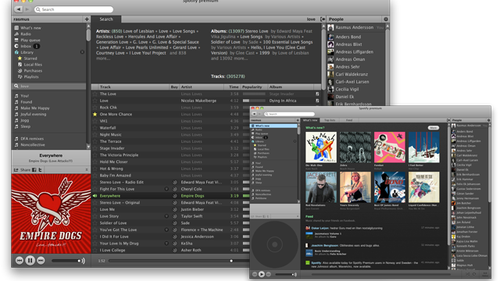
Spotify's first desktop app interface
rsms.me
Already having a finished product, Spotify went to the rights holders to bargain with them about the rights. Ek later said : “When I launched Spotify, I honestly didn’t know that I would need licenses from record labels.”
Although the major labels had no choice and had to agree to cooperate with Spotify, they were still able to negotiate the most favorable terms for themselves: huge advances, guaranteed minimum payments per listen, and shares of the company. Without these labels and their vast catalogs of popular music, Spotify would not exist.
Details of labels' contracts with streaming services are kept strictly confidential. But in 2015, The Verge obtained information about Spotify's initial contract with Sony in the United States. The label received an advance of $25 million for the first two years. At the same time, the contract did not even stipulate whether the label should share this money with its musicians - or could take it all for itself.
From 2000 to 2010, sales of physical music media fell by more than 60%. “The music industry has hit rock bottom,” read a Quartz headline . But streaming services have changed everything. In 2015, for the first time in a decade, the industry generated higher revenue than the year before. The charts went up again. Labels and press declared a savior: Spotify.
But what happened to those whom Spotify was supposed to care about - ordinary musicians? Did they earn more?
Why Musicians Earn Almost Nothing on Spotify
The most common argument in defense of Spotify is that it is legal and morally correct; they say, piracy is evil, and by paying for streaming services you pay for music and support musicians. “We founded Spotify because we love music and piracy was killing it,” the company insists , hiding its origins as a marketing technology company.
The truth is that the money from your subscription does not go to the musicians. Musicians have lost the opportunity to earn money from selling albums and singles. It's not just that people have stopped paying for them - it's that the money is going to corporations.
How much does it cost to listen to a track on Spotify? A figure often cited is $0.0035 at a time. American congresswoman Rashida Tlaib, calling for a change in this situation, calculated that with such payments, a musician needs 800 thousand auditions a month to earn as much as a full-time job paying $15 an hour.
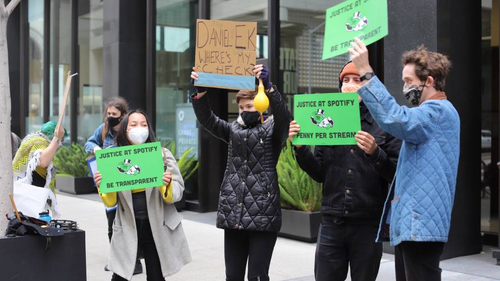
Musicians union protests for fairer conditions for artists
Nastia Voynovskaya
The problem is that even that figure—$0.0035—is misleading. Spotify doesn't pay a flat fee per listen. What's more, Spotify doesn't pay musicians at all - it pays copyright holders, and it pays them in different ways.
“Streaming companies pay rights holders based on a convoluted revenue sharing model called pro rata. According to it, copyright holders are paid based on their share of what streaming companies call stream share,” explains Liz Pelley in a conversation with DOXA.
Let's imagine some major label - say, Universal. Let's say that in one month their catalog accounts for 20% of all streams on Spotify. Then, during this period, Universal receives 20% of all royalties that Spotify has earned and must pay.
Spotify's goal has always been profit for corporations, not a new fair system where artists get enough money
But this is where the difficulties begin. The system is completely opaque. What stream share does each copyright holder have and under what conditions? Unknown - all contracts are individual and are subject to NDA. Musicians do not know under what conditions copyright holders transfer their music to Spotify. For them, this system is extremely confusing.
But that's not all: major labels are disproportionately disadvantaged. “It’s common knowledge in the music business that the major labels negotiate better terms than the indie labels—the size of the royalty pool, the rate per stream, the minimums at certain levels,” says Liz Pelley.
In addition, Spotify is changing its terms so that smaller musicians receive less money. In 2023, the company introduced a new rule : a musician must get at least a thousand streams a year in order to receive any money at all. So Spotify cut off 87% of the music on the platform from revenue - essentially taking $47 million from independent musicians in favor of major labels.
The business model works: While musicians complain that they can't survive on Spotify's payouts, the company's CEO made $376 million last year by selling his shares.
Spotify's goal has always been profit for corporations, not a new fair system where artists get enough money. In 2019, Spotify chief executive Jim Anderson spoke at a music conference where a concerned musician asked him about the financial model and whether it was fair to artists. A dissatisfied Anderson responded : “We were solving the problem of distributing music, not the problem of giving you money, okay?”
This raises the question of money: is that illusory $0.0035 really better than nothing? It’s one thing not to make money from freely distributing your music. It's quite another to earn almost nothing while your music makes Daniel Ek and Martin Laurentsson billionaires and the major labels receive ever-higher profits.
What's the problem with Spotify's algorithms?
Already in the early 2010s, there was a turnaround in Spotify's business model. At first, the goal of the service was simple: to make music easy to listen to anywhere. But soon, thanks to the spread of the mobile Internet, this became a reality - music became universally available.
Then Spotify changed its focus. They decided to re-educate users - to change the way we listen to music. Now it was a matter of guessing (or programming) what you wanted to listen to and when—recommending the perfect playlist at the perfect moment. They began creating functional playlists, each with a utilitarian purpose.
For example, a user comes to the gym, opens the application and immediately turns on the “workout” playlist - without even looking at what musicians are there. The same thing with music for sleeping, jogging or work - there can be many such scenarios.
At some point, Spotify realized that most listeners weren’t particularly interested in music as such. They just need a soundtrack for certain moments of the day. Spotify doesn't sell music - it fills time. At one of the meetings, Daniel Ek said bluntly: “Our competitors are not Apple Music or Amazon. Our competitor is silence."
This model has proven incredibly successful: for a long time, the main distinguishing feature of the service was automatic and curated recommendations. There's a Discover Weekly playlist that generates personalized music recommendations. There are playlists by genre. There is a radio on the tracks. For many musicians, getting included in these recommendations turns out to be life-changing - they can become popular in a matter of days. Spotify themselves boast about helping unknown artists find their audience.
Algorithms lead to people listening to less diverse music
It would seem that this is the problem - Spotify recommends good music, users are happy. It may seem that a data-driven system is fair and just, a true meritocracy. But the truth is that “clean data” does not exist. Any data is biased. Music - like any art - cannot be quantified and broken down into understandable indicators. And algorithms inevitably kill diversity .
Spotify themselves conducted an internal study that showed that algorithms lead to people listening to less diverse music. Why is this a problem? Beyond the cultural reasons - think about whether you'd actually want to live in a world where everyone only listens to Western music, or only music made by men, or only a narrow set of genres - this also refutes the whole meritocracy thing. When diversity approaches zero, “the rich get richer”: only already popular artists become more popular, and unknown talents have no chance.
But more importantly, Spotify's playlists and recommendations contain a disproportionate amount of music that benefits the platform itself. Sometimes - placed for money.
In the mid-20th century, there was payola in the music industry: radio stations had enormous influence - people learned music from the radio. Music labels bribed radio stations to promote the songs they wanted. This was illegal - such practices were banned in the United States back in 1960.
Spotify continues this tradition of promoting music for money - only now through legal mechanisms. “For example, Discovery Mode: artists are asked to agree to lower royalties in exchange for promotion by algorithms, ” Liz Pelly tells DOXA. “ Many people in the independent music world compare it to payola. In the past, everything happened in private - we imagine a record company employee putting money under the door of a radio station or secretly handing over a bag of cash. Now these practices have become part of the business model. Spotify communicates them to its shareholders and posts the information publicly on its website."
Simply put: Spotify is hijacking the culture of music curation and recommendation, creating the appearance of pure meritocracy. Supposedly, if you create talented music, sooner or later it will be recommended to the right audience - it will end up in playlists or appear in the algorithm’s recommendations. In fact, places in playlists and the algorithm are sold. And major labels can buy them first of all. This did not go unnoticed: in 2021, Spotify was investigated by the US House Judiciary Committee because of it.
But Spotify doesn’t even stop there: why pay real musicians and labels and give them places in playlists, if you can use cheaper ones for the corporation... non-existent musicians.
Music from non-existent musicians
“Spotify and other streaming services make money by selling subscriptions and advertising,” explains Liz Pelley. “It makes a lot of money, but they have to give 70% to the rights holders. So they started using strategies to reduce these payments - for example, creating playlists with so-called functional music: for studying, for sleeping, for relaxing, for relaxing after work. Then they fill these playlists with music, which they license on more favorable terms.”
To save on payments to musicians, Spotify began creating pages for fake artists and adding their tracks to playlists. In 2022, the Swedish publication Dagens Nyheter conducted an investigation and found that the same 20 authors were hiding behind about 500 profiles of musicians on Spotify.
How does this work? Spotify orders music from outsourced companies. It's all written by a couple dozen people, but Spotify creates hundreds of pages for them with fictitious musicians and biographies. Music is paid for one-time - this is much more profitable than regular payments to real musicians.
But why create entire fake profiles? It's simple: these fake artists were added to popular playlists to increase plays. A person turns on a “workout” playlist and listens to non-existent musicians, and Spotify makes more money from this.
With the development of AI, these practices have gone even further. Perhaps soon Spotify will not even need front companies and authors - music can simply be generated. Recently, the internet was buzzing about The Velvet Sundown : a fully generated AI band with AI music that has 1 million streams on Spotify.
Why Spotify founder is investing in military AI
In early October this year, Spotify announced a collaboration with OpenAI: ChatGPT can now ask for music recommendations, and the bot will create personalized playlists in Spotify. In an age where AI is being plugged into every service indiscriminately, this isn't surprising—but in the context of Spotify's history, it's even less surprising.
The fact that Daniel Ek was investing in Helsing became publicly known back in 2021 - but then it did not attract much attention. Helsing is an AI startup that focuses on surveillance, military "battlefield intelligence" AI, and drones. In the summer of 2025, Ek had already invested 600 million euros in the company, saying that its goal was to strengthen the “technological sovereignty” and defense capability of Europe.

Military drones manufactured by Helsing
Helsing
After this, several musicians left Spotify - Xiu Xiu, Deerhoof, King Gizzard and the Lizard Wizard and Massive Attack. But as Liz Pelley writes in The Mood Machine, the CEO's financial decision makes sense: Spotify has been part of the digital surveillance industry from the very beginning.
Technology corporations of the 2010s have made surveillance and data collection a key part of their business model. Recommendation systems, selling advertising within applications, testing new functions - all this requires monitoring users, their every movement in the application. Facebook and Twitter have done and are doing this, but also many other applications - not just social networks. Spotify recently launched a messaging feature between friends - and it turned out that they had been collecting information about all interactions between users for years. And this is just the tip of the iceberg.
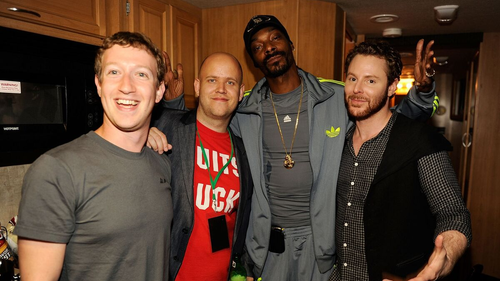
Mark Zuckerberg, Daniel Ek, Snoop Dogg and Sean Parker
WireImage/Kevin Mazur
AI is the same business model and the same technology. Signal Foundation President Meredith Whittaker says the essence of AI is surveillance. This is a development of data collection technology that was previously used for advertising. “AI companies collect as much information as possible to create new products for people to sign up for, or to make their business models work more profitably,” Liz Pelley tells DOXA. The entire era of data-driven platforms - Spotify among them - laid the foundation for what we are seeing now.
Ek and Laurentson once created an advertising platform (which became Spotify) because they knew how to make money from advertising. Today, Ek invests in AI for the same reason—it's a business he's been in for nearly two decades. The fact that this is a military AI does not change the essence.
Journalist and musician Anton Obrazin, in his text about AI in music for Perito, called what corporations are doing with music - as well as with cinema, painting and other phenomena - “colonization of knowledge.” Essentially, AI corporations illegally take copyrighted works, feed them to their models, and generate a new product. This is either the AI applications themselves, which promise users to write music for them, or the generated music - which, as Spotify shows, can also be charged for.
While the spotlight has been on Spotify's CEO's investment in military AI—even leading him to step down as CEO, although there will be no repercussions from the move—it's not entirely Ek's passion. Corporations that built their businesses on collecting data are now looking for new ways to make money from this data - and here comes the idea of replacing human music with music written by machines.
What can you do
The picture is apocalyptic. Because of corporations like Spotify, music is no longer a lucrative profession. Streaming manipulates listeners' tastes and makes music increasingly homogeneous. Ideally, they generally dream of replacing human music with much cheaper music generated by AI.
How to resist this? On an individual level, you can at least give up Spotify. The author of this text did just that during the process of writing it - he switched to another streaming service. Almost any other service will truly be better than Spotify. But in reality, the problem is, of course, broader than one specific platform.
In her book The Mood Machine, Liz Pelly offers systemic options for supporting musicians and challenging the status quo. Some of them apply primarily to the United States, others to the whole world. For example, Pelli calls for the creation and support of unions and other coalitions of music workers.
And also create streaming services based on public libraries. Such services may provide access to local music. Examples already exist: Ann Arbor Library projects or the MUSICat service, which is used by about 20 libraries. Imagine such streaming at the National Library of the Republic of Tatarstan or at the Pablo Neruda regional library in Berlin. They can introduce people to musicians who live in their city. The money from such services will go to musicians in a much higher percentage. And most importantly, there will be no pressure on the musician to be popular, to get into the right playlists or recommendations.
The most radical solution that Liz Pelly talks about in her book is an unconditional basic income and government support. Musicians and other creative professions should not be dependent on corporate platforms and streaming royalties. They benefit the culture, society and economy of the country - which means the state should support them. Ireland recently announced it was making its pilot monthly arts stipend program permanent. Now artists, musicians and others will be able to receive money directly from the government.
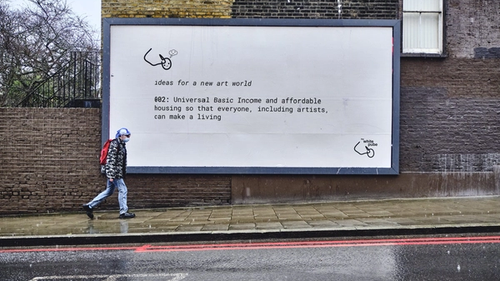
Poster supporting unconditional basic income for artists
Buildhollywood
If you start questioning Spotify and the entire music streaming model, you eventually come to the conclusion: we need to change our relationship with music and culture in principle. If we want diverse music to continue to emerge and musicians to make a living from their art, we need to acknowledge that the current state of affairs is not working.
Trade unions, libraries and unconditional basic income are systemic solutions at the state level. But there are some things you can change individually: at least give up Spotify. Recognize the abnormality of the situation when you pay a little more than ten dollars for access to the music of the whole world, and the money goes to corporations, not to the creators. Support musicians directly - buy concert tickets and merch.
“A lot of the issues that come up when discussing streaming services are issues of corporate consolidation and capitalism more broadly,” says Liz Pelley. What are we at stake when we allow corporations to have too much influence over music and culture? There is definitely another way.”