
Translated material
An island of “loneliness”
How a Russian priest in Yerevan became a taxi driver - and found a home

Yerevan. Surb Anna Church. Photo: Oksana Misirova / Novaya Gazeta
It’s difficult to say what came first: the need to urgently find a job or the desire to write about it. This is about Armenia, about life inside it, about people and meetings.
“Going to the liturgy is like going to a factory”
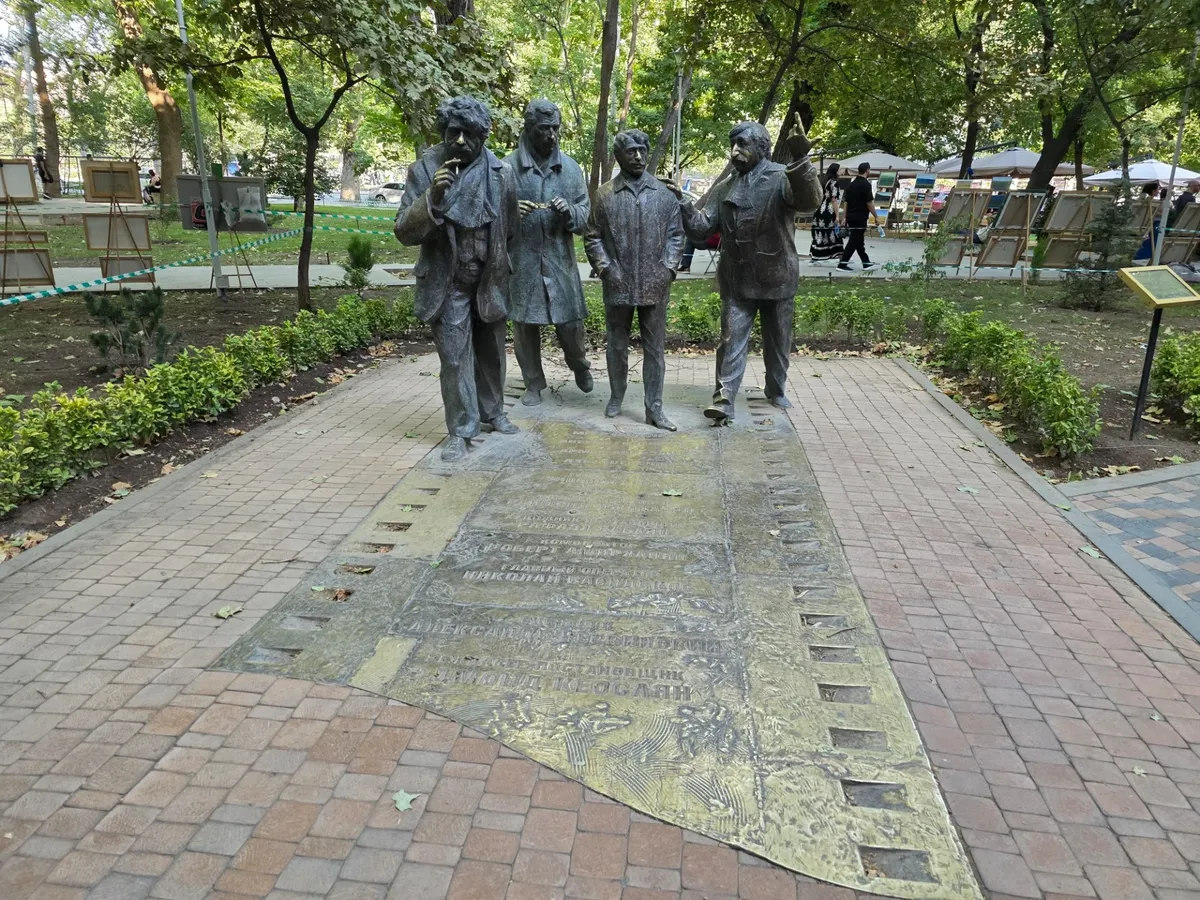
Many people know the sculptural composition in Saryan Square in the center of Yerevan, opposite the Opera. Four male figures purposefully heading somewhere, in whom one can guess fine Armenian film actors. These figures are the work of sculptor David Minasyan, dedicated to the Armenian film “Men” shot in 1972 - a lyrical comedy about the life of four friends, four Yerevan taxi drivers, a story of unrequited love, strong friendship, funny and kind adventures and colorful Yerevan life.
Almost all the dialogues in the film are in Armenian, and only the story about the selfless help of three older friends to the younger one in the vital matter of winning the heart of a city beauty is narrated in Russian in the voice of the wonderful Zinovy Gerdt. The place for the sculpture was not chosen by chance: part of the film, the funniest, the most important, was filmed right here, in this place. Take a look, you won't regret it. Once upon a time, as a teenager, I watched this movie, and I was struck by one detail in it, which I had forgotten about for a while, and then I remembered and looked for this film for a long, long time. But more on that at the end.
Since February of this year I have been working as a taxi driver. For what? Because you have to work, live and immerse yourself in this life. It was impossible to sit and wait until the sea had the right weather; Yerevan is by no means cheap, prices are rising.
I myself am a humanist through and through, I can’t do anything related to mathematics, other exact sciences and computers, there is no remote work, and resources have come to inevitable depletion.
On weekends I continued to serve in the Georgian parish. By the way, finally something happened that I had often asked God for before. Make sure that the financial side of life does not in any way affect my ministry, so that I can serve without thinking about material returns, as is the case in Russia, where all priests receive a salary from the parish. The local parish is beautiful, cozy, modest and also completely poor, so everything else (daily bread, paying rent) is a matter of my efforts. This is a normal situation, this is how priests live in many countries, and this very much helps to look at your calling a little differently than at the work for which you are entitled to a reward.
Yes, Scripture says that the worker is worthy of food, but there is nothing worse than one day feeling that you are going to an evening service or liturgy as if you were going to a factory with a whistle blowing. Then a completely different story begins with many internal conflicts, fatigue and sometimes even despair.
"I was exotic in the garage"
What could I do? I had and still have an old car, so first I went to work in delivery. The benefits from this were even better than those of foot couriers, because a delivery person by car has much more orders and they are very diverse, not always products. But the old Suzuki eats a lot of gasoline, and by the end of the day it became clear that all the earnings were spent on feeding it.
So I dived back into the job search site and found there an invitation to go to a real taxi company, and in an electric car. What kind of animal it was, I didn’t yet know, but I couldn’t hesitate. I was accepted surprisingly easily and quickly, they checked me out for a test drive, gave me a couple of practical tips and invited me to go to work in the morning. The schedule was two 12-hour days and a night shift, from 10 pm to 7 am.
It was a real car park, with dispatchers, a garage, a car wash, charging stations and a large, interesting and very good team. I liked it there, although, of course, it was completely incomprehensible to many how it happened that I, being not an Armenian, decided to go work in a taxi.
For some reason, many who have arrived in recent years are strongly associated with remote work, sitting on a laptop and not being particularly immersed in local realities. But things are far from being like that today. I know people who work remotely well. Another thing is that even with the great empathy of the Armenians, their openness and goodwill, it is not possible to work without knowledge of the Armenian language everywhere. And work here is not easy for locals either. Therefore, at first I was such an exotic in the garage, but I easily joined the team.
There is another argument. I don’t know the percentage of people who want to “make ends meet” and continue their life in Armenia. I saw how many moved on, some returned back to the Russian Federation, but I am not very familiar with those who decided to firmly and thoroughly integrate into the life of Armenia. Although, of course, I consider myself one of those. Therefore, working in a taxi was a very important step in this direction for me.
Knerek, es chem hosum haieren
A lot of people work in taxis in Armenia. And not only men, of whom, of course, are the majority, but also girls. This is a reliable, sometimes the only income, and both old 50-year-old Volgas and brand new Teslas are taxed here equally. In addition to those working in the taxi fleet, there is also a more classic type of drivers of checkered cars, which would be worth writing about separately, this beautiful, but already fading species is so diverse, original and unique. The age is also very diverse - from very young boys, after the army, to venerable backgammon and chess champions in their seventies. Everything that can move and go will definitely get somewhere. Well, it delivers, I must say.
It was a very interesting time. My first working day fell during a snowfall, which rarely happens in Yerevan in winter. Collapse, traffic jams, accidents, a barrage of calls - everything is almost like in another, past life. However, snow in Yerevan is a short-lived guest, especially if the sun is expected the next day. Even in winter it’s real, Armenian, and by lunchtime you already want to take off your jacket, although in the evening, of course, you have to put it on again.
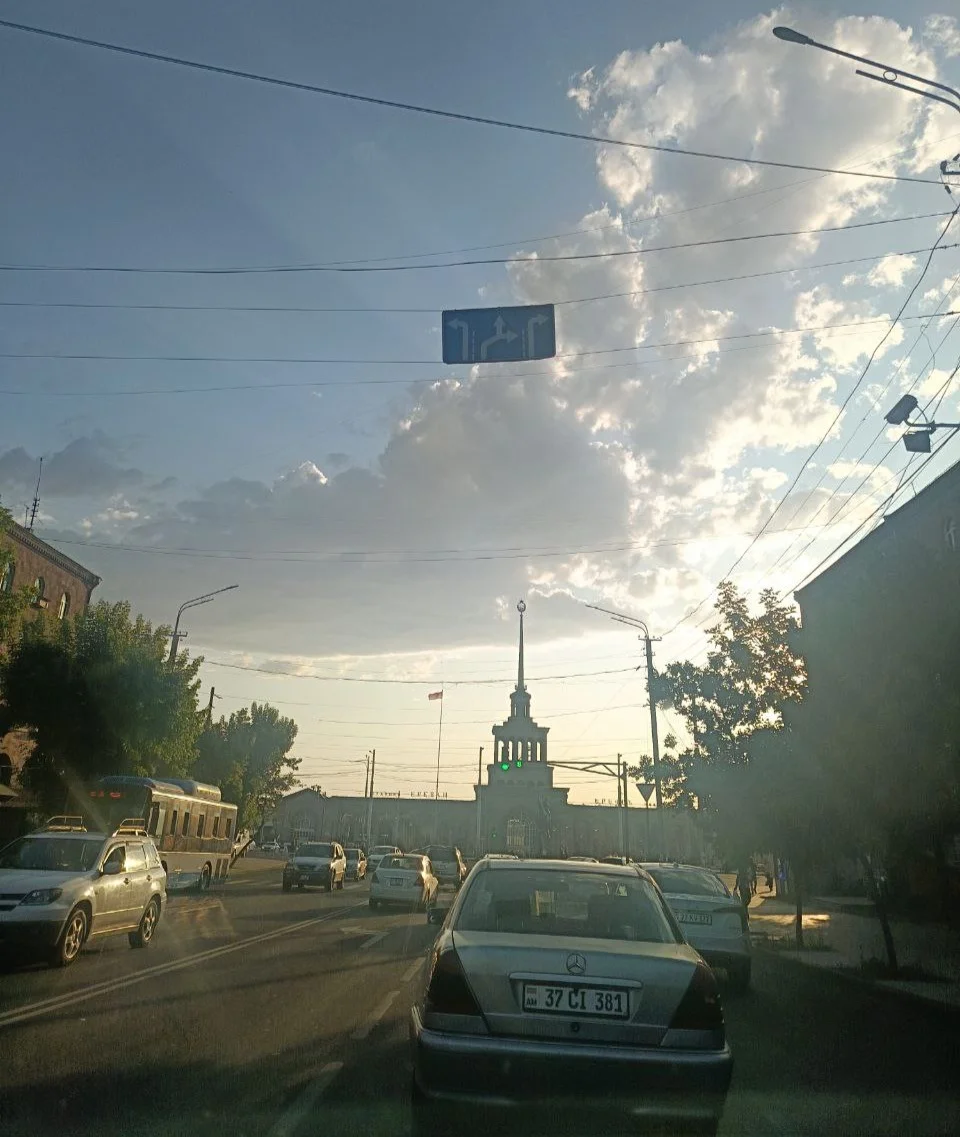
Yerevan roads and traffic were not new to me. I’ve been driving here all the time, since 2022, but in a taxi I began to get to know the city again, in detail, with all its tiny streets, through courtyards, from modern luxury complexes to the ancient private sector.
Communication with people is the most important and priceless. They say that a silent driver is very rare here, but I was just like that, because, firstly, there is no desire to interfere with a person, and secondly, being distracted on the roads in Yerevan is a dangerous thing. And since I didn’t know the language, I didn’t want to lose face. In case of any question, I answered correctly: Knerek, es chem hosum haieren, duk russeren hosum ek? ( “Sorry, I don’t speak Armenian, do you speak Russian?” - Ed. ) - and we continued the conversation in Russian or English. I believe that saying at least a few words in Armenian is much more correct than simply saying: “Sorry, I didn’t understand you.” This is both respect and delicacy, which is very much appreciated. Today you don’t understand and don’t speak, tomorrow it will be easier. Anyway, once you speak, you won’t get anywhere...
I left the taxi company a month later. The schedule could not be adjusted, so I had to miss two Sunday services. It was very sad, and the salary wasn’t very funny either. So I set off on an independent voyage. An electric car was rented to me by a very good person, the head of a large family, we discussed the terms, and I connected to the aggregator, thus gaining at least a little independence.
“Fulfill the blessing, otherwise you will go to work”
And so began the “taxi” everyday life. I increased my workload from 12 to 15–17 hours a day. I can’t complain about catastrophic fatigue, but I realized that I had to leave the line when my attention ceased to be maximum. Here, with local traffic and sudden pedestrians, it should be extreme. I have developed for myself the formula “think for two drivers and one pedestrian” and I always follow it. If you are driving in Yerevan, then do not count on fortune, because your colleague on the road is now counting on it in the same way, and an attempt to pass, fly, be on time, or wedge into a lane can end, if not in disastrous, then sadly, and traffic jams due to even mild collisions are not uncommon here. I have never really seen such passion and desire to take risks, flaunting my skills behind the wheel.
If you have the intention of integrating into another country and becoming friends with the language, take the first step. Even the kindest, calmest and most emotionally stable society will never adapt to you. Before working as a taxi driver, I was still aloof from the flow of local life.
In just four months, almost everything has changed. Of course, I did not become an Armenian, but I gradually began to expand my vocabulary, look closely at people, communicate a little and study the specifics of local life. Someone will ask: why haven’t you done this in almost three years? Apparently no, he didn’t. Even despite studying at the university. Being able to breathe this life from the inside is a completely different story.
YouTube and Instagram* are full of all sorts of videos about what absolute hell the job of a taxi driver is. With aggressive passengers, showdowns, attempts to deceive or demonstrate to the driver their imaginary social superiority. There is no such thing here. I was once told that the word “taxi driver” is not used as such, but is replaced by the word “driver,” although nothing bad is seen in the word “taxi driver” either. People here generally love and appreciate work. They respect those who work and do not shy away from it.
For me, the experience is priceless because I have finally caught up with what I should have started twenty years ago. But my work activity was closely related to sitting at the computer and working with texts, and then there was a time of ministry, and the church authorities, to put it mildly, did not at all encourage earning money in the secular sphere. None. No, it was, of course, quite possible to work semi-underground. Even taxi. And teaching at a university or school might not be underground at all. However, the requirement for the priest to feed “from the altar” was often used by some bishops as a means of threat and manipulation.
“Fulfill the blessing, otherwise you will go to work,” the bishop announced to one of his subordinates, apparently wanting to intimidate. Although it is not clear to me what threat and to whom these words can be heard. But it had an effect on many. And that is why, in fact, if you look at the Russian clergy, most often you will meet a person with a diploma, perhaps not only a seminary, but without any work experience. In the event that the diocesan administrative broom in one way or another swept a person out of the system, after years of priestly service, finding oneself in the world without work experience and qualifications was akin to a disaster.
All this, of course, would not have happened if the priests were not tied to the temple or diocesan accounting department and had the opportunity to work and conduct business. But this is the path to relative independence, and the system has never loved or accepted very independent people. This became especially clear when the fighting began in Ukraine. Father would have been glad to be indignant, but the cry “you’ll go to work” apparently got into his consciousness, and therefore the result always turned out to be “as they bless, we’ll do it.”
And now, in addition to diocesan punishment, you can receive administrative punishment from the state. Or maybe criminal. Depending on the extent to which you are out of step.
I was luckier in this regard - I did not stop studying after a secular university and had the opportunity to earn money by writing articles for various publications. Of course, on a church theme. And then I tried to be a taxi driver in that past life. But I asked God for work. And He gave it to me. Along with new life.
Land of Noah and Covenant
I thought for a long time about who I am: an introvert or an extrovert. It turned out that it was the second one. Despite the infrequent communication, since I am still silent, I like to transport people, to be among people. I love neatness, cleanliness, I like to create a comfortable atmosphere. Sometimes even through silence. But interesting, almost heartfelt conversations happen. The way you feel about yourself is how they will treat you.
Politeness, courtesy and seriousness are of great value here. Taking a suitcase, putting a stroller in the trunk, offering water are very basic things, but it not only pleases others, it is also important for you. In our spiritual life, too, in search of improving ourselves, we look for some practices, read a lot, try to change something in our everyday life, but the much simpler path of ordinary kindness and openness to one’s neighbor does more than any exercises in asceticism and severe fasting. Simply because the commandment to love one's neighbor is unchanged. Even entire libraries won’t teach you this. So at your job you can sometimes be a support to someone else. In rapidly changing times, the usual attitude of a person towards a person is such an island of awareness of “non-loneliness”, which sometimes is more important than all our urgent matters.
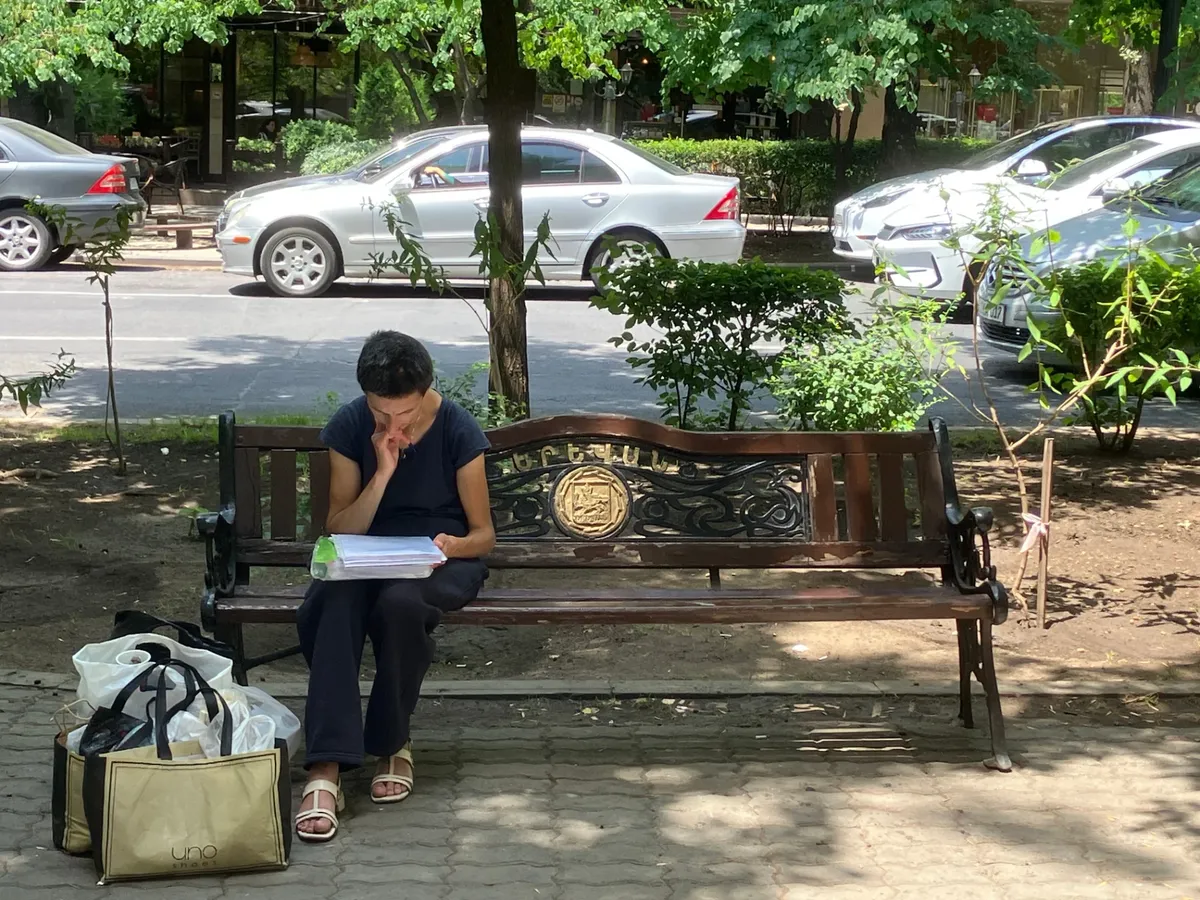
I'm in love with Yerevan. This feeling never left me, but over time it became even stronger and in some cases even renewed. In three years I have seen different Armenia, but I have never seen it as bad, although life here is by no means glamorous, and events are not always rosy either. No matter what happens, there is some kind of invisible hearth here, a feeling of home that warms you on the most difficult and dark days. I don’t remember at all, and maybe I’ve never even known this feeling, but now it exists. This is a very warm land. Even in cold, dank times. And I want to be part of this life.
And people! You can drive for almost an hour and just be silent, and this silence will not be tiresome, just as talking even on very sensitive topics will not become difficult. This core is inside people - I don’t know what it is: upbringing or genetic nobility, or maybe the land of Noah and the Covenant of man with God makes them this way, but I feel it in myself. Maybe that's why I love going out to this job and doing it the best I can. Because there is feedback. Wishing you a good day or good night can be so important! Especially from a stranger. And at this very moment you are not so unfamiliar with him.
What different, dissimilar destinies! Someone rushes with a bouquet to the maternity hospital, and this path is quick and easy, while someone has to go to the funeral service in the funeral hall through large traffic jams and tedious waiting. Time has stopped. Or suddenly very young children get into a taxi, their parents sending them to or from school, you pick up one or two elementary school children, they are met at the entrance. They told me: don’t be surprised, at the time of the trip you are almost a parent to these children, this is how they treat it. Among the passengers were young people whose arrival in Armenia was made possible by the “Walk through the Forest” project**, and their story of escape from hellish hell is almost impossible to believe, although it is still impossible to believe that this bloodshed not only became possible, but has been going on for almost four years.
In the car there is an elderly woman with her daughter, at the end of the trip the eldest says something to me, I answer that I don’t understand, and her daughter corrects: “Mom, the driver is not Armenian, you need to speak to him in Russian.” Mom replies: “How do you know that he is not Armenian? We, too, were once blue-eyed and fair-haired..."
The guy at the end of the ride says he has a large bill. He goes to the store to change money and asks: “Brother, should I buy you something cold?” I say: “No, thank you, I’m fine.” Brings coffee.
I love coming to the airport. But just to go back to Yerevan. Sometimes with passengers, sometimes without them, but to return to this city, and not fly away from it. I don’t remember, I don’t know if I ever had a feeling of home, now it has appeared, and watching the passengers fly away, the planes, I understand that my earthly and air paths lead me here. To rush back along Isakov Avenue again. Home?
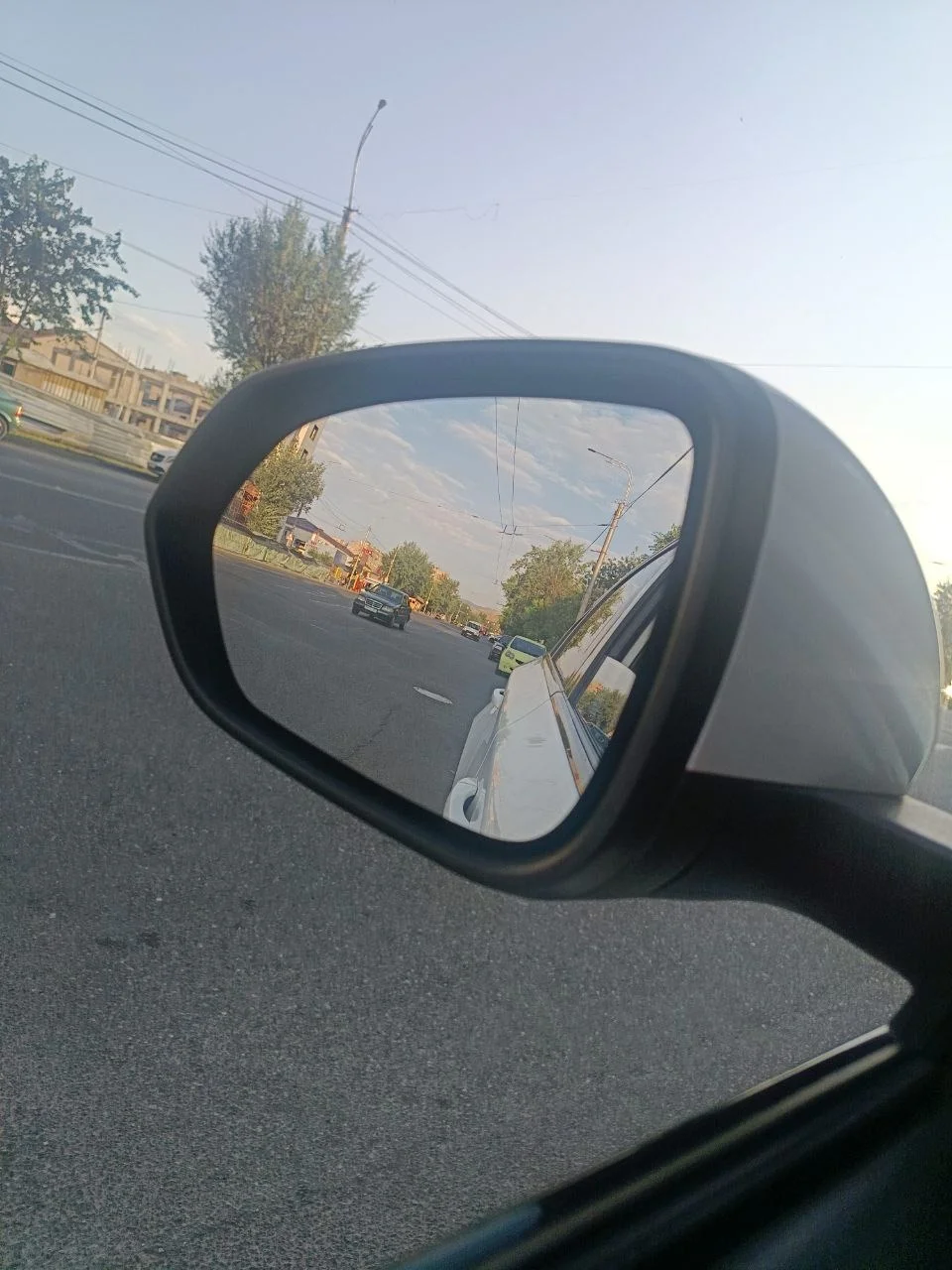
At the end of the film “Men,” when the hero realizes that his feelings will remain unrequited, an absolutely brilliant episode is shown, how sultry, summer Yerevan turns out to be covered with heavy snow and yesterday’s heat with light shirts and T-shirts is replaced by winter jackets. Four friends are walking together, they are heatedly discussing something, but the young man does not tell them that his dream has crumbled and is now covered by this sudden snow, he does not say, because he sees, despite this heartache, that he is not alone, and this “non-loneliness” will help him survive everything and start again.
Moreover, somewhere far from Yerevan a heart is already beating, which has completely dissolved in itself, and it will continue to breathe and give warmth despite all this snow and misfortune. And it won't give up.
The wonderful spirit of these people, of this life, has been preserved in Yerevan. He is unchangeable. You just have to try to feel it.
* Belongs to Meta, a company recognized as extremist and banned in Russia.
** The authorities of the Russian Federation recognized him as a “foreign agent”.
This material was published in the twelfth issue of Novaya Gazeta. Magazine". You can buy it in the online store of our partners.