
Translated material
Back in the 2010s, Trump wanted to build an expensive hotel in Belgrade on the site of the General Staff, bombed by NATO troops in 1999
Now his son-in-law Jared Kushner will do this - the Serbian authorities have already adopted a special law
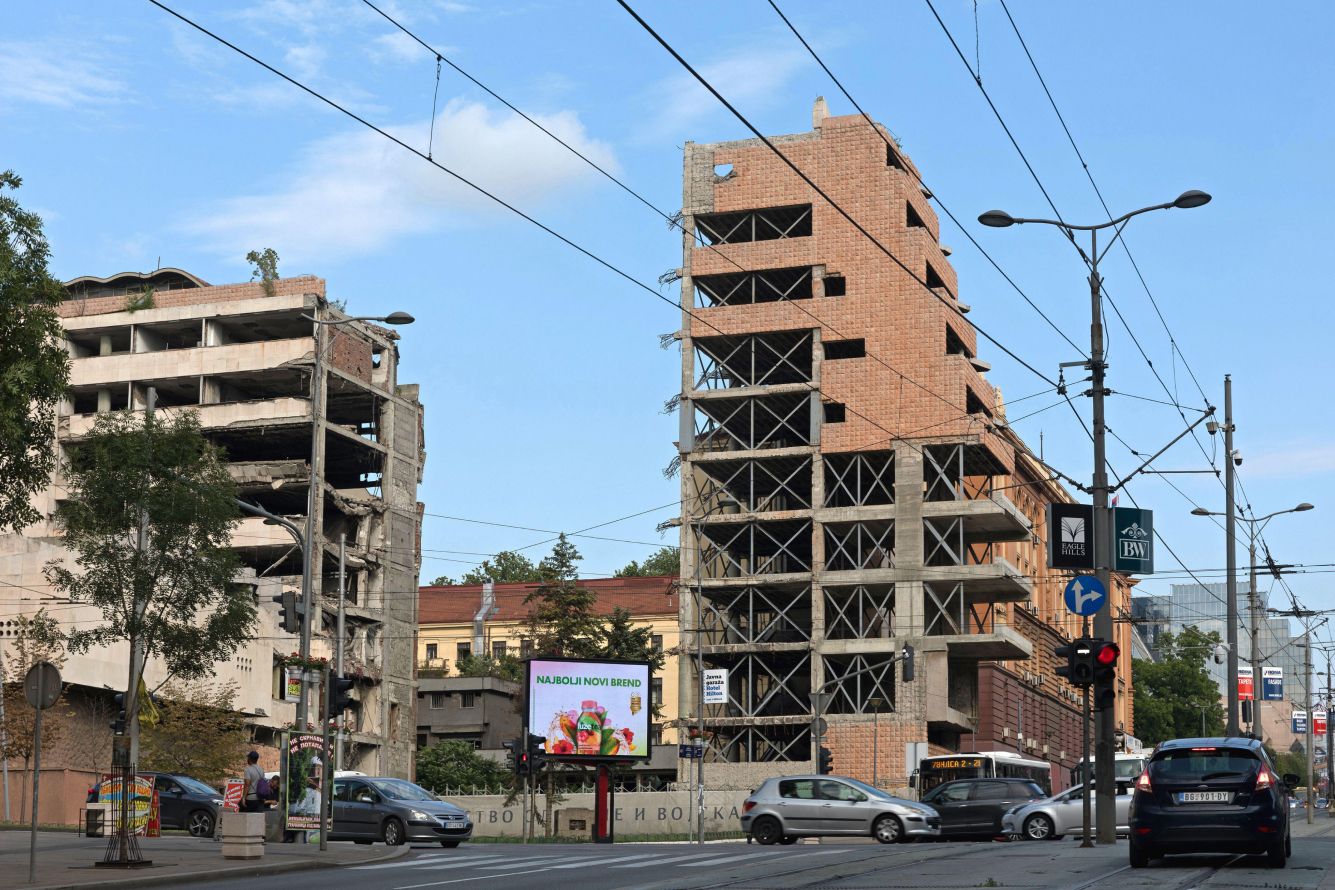
The Serbian Parliament has urgently passed a law that will allow the building of the General Staff of the Yugoslav Army in Belgrade to be demolished and a luxury hotel to be built in its place. The investment company Affinity Partners Development, owned by Donald Trump's son-in-law Jared Kushner, is interested in this. The General Staff building was bombed by NATO troops in 1999 as part of the alliance's campaign to end hostilities in Kosovo, since then it has been practically not restored and served as a monument to historical events in Yugoslavia. The opposition and architectural experts have repeatedly opposed the demolition of the building and the construction of a hotel complex. "Medusa" chronicles efforts to protect this once cultural heritage site that appear to have failed.
Members of the Serbian Parliament, loyal to President Aleksandar Vucic, on Friday, November 7, achieved the urgent adoption of lex specialis - a special law that will allow the American investment company Affinity Partners Development to avoid standard procedures and obtaining the necessary permits for the construction of a new business and hotel complex in the center of Belgrade, where the former General Staff of the Yugoslav army is located. The company has not yet commented on the adoption of the new law.
Affinity Partners Development is owned by Jared Kushner, the husband of Ivanka Trump, daughter of US President Donald Trump. The estimated cost of the project is $500 million. According to The New York Times, the complex will consist of a luxury hotel, residential buildings with 1,500 apartments and a museum.
The Serbian authorities were thinking about getting rid of the destroyed building in the center of Belgrade back in 2013. In January of that year, the desire to build an expensive hotel on the site of the General Staff complex was expressed by UAE Sheikh Muhammad bin Zayed Al Nahyan during his visit to the Balkan Peninsula. And in November of the same year, it became known that businessman Donald Trump discussed investments with the head of the Serbian government, Ivica Dacic, who in the 1990s was considered the main ally of President Slobodan Milosevic, who was in conflict with NATO.
Aleksandar Vucic was the first deputy prime minister of the republic in 2013 and participated in attempts to decide the fate of the General Staff building. “I don’t think these ruins are very beautiful. We will go to the public with a proposal. We will let you know how much they want to invest and how much money our state will receive. And if they tell us that there is not enough money, that the ruins are beautiful, that we are destroying something very important, everything will remain as they say,” Vucic said then.
Oppositionists, architects and many Belgrade residents opposed the demolition of the building.
Discussions about the project of Kushner’s company began in 2024. In May of that year, the Serbian authorities and Affinity Partners Development entered into a 99-year lease for the building. And in November, parliament members stripped the complex of its status as a protected cultural heritage site. This decision was criticized by opposition representatives and architecture experts. Thus, one of the opposition leaders, former head of the Serbian General Staff Zdravko Ponoš, accused Aleksandar Vucic of the fact that the president wants to gain Trump’s support in this way. Vucic himself said that he was “inspired by the project” of Jared Kushner and was ready to “promote it with joy.”
The Republican Committee for the Protection of Cultural Monuments also opposed the construction. They emphasized that according to the law on cultural heritage, withdrawal of status is possible only with the consent of the committee, which did not give it.
The General Staff complex, consisting of two buildings A and B, received security status in 2005 - 50 years after the start of construction and 40 years after its opening. It was designed by Serbian architect Nikola Dobrović - initially as the State Secretariat of National Defense. The building was built in the style of post-war modernism and has a stepped structure, which, according to Dobrović, should resemble the canyon of the Sutjeska River, where one of the most significant battles during the Second World War in Yugoslavia took place in 1943.
On the night of April 29-30, 1999, a month after the start of the NATO military operation , alliance aircraft fired at several key city targets, including the General Staff complex. At least three people died that night and dozens were seriously injured, according to Human Rights Watch. There was no one in the General Staff building itself.
On the 26th anniversary of the start of the bombing, March 24, 2025, Belgrade students staged a “Protest for the General Staff” and also submitted to the Constitutional Court a demand to declare the government’s decision to cancel the status of a cultural heritage site illegal. At the rally, a letter was read from former Colonel Zoltan Dani, who in 1999, together with his colleagues, shot down the so-called invisible plane . Dani wrote that "monsters from the West are trying to get to the scene of their crime." And the representative of the “Defend the General Staff” initiative, Ilija Zivkovic, said that “providing a memorial complex to the aggressor is an insult to the victims, the highest cynicism and a mockery of the Serbian people.”
Aleksandar Vucic himself that day, together with the President of the Republika Srpska Milorad Dodik, spoke at another rally - at a military airfield in the Belgrade suburb of Batajnice . “They [NATO troops] killed our children. We will not forget this and we do not dare to forget. But we must forgive,” he said.
After the authorities deprived the General Staff building of its cultural heritage status, the Serbian Prosecutor's Office for Organized Crime (JTOK) began investigating the legality of this decision. As a result, several officials were accused of fraud and forgery of documents.
In response, President Vucic assured that the deal was concluded legally, and said that back in 2016 he agreed with the American side to turn the General Staff building into a “museum of NATO victims.” According to him, the purpose of the prosecutor’s investigation is to prevent Serbia from “establishing relations with the Trump administration.” The president said all this on the Chirilitsa television program on November 3, after which the prosecutor’s office accused him of abuse of power and trying to put pressure on the judiciary.
Europe calls for the preservation of the building, and Serbian students offer ideas for its restoration
In June 2025, a conference of the Europa Nostra organization was held in Belgrade, at which the General Staff building was included in the list of European cultural heritage sites that are particularly endangered. “In conversations with experts, everyone agrees that demolition is not the answer, the only option is reconstruction. <…> Everyone agrees that it [the General Staff complex] cannot be considered as ruins,” said Europa Nostra Secretary General Sneška Quadlig-Mihajlović.
At the same time, according to the president of the Europa Nostra branch in Serbia, Slavica Vujović, the issue of complete restoration of the building was not discussed. In 2015, building A was partially reconstructed to prevent collapse. At the same time, some Belgrade residents opposed the clearing of the building, demanding that it be preserved as a memory of the “villainous attack by NATO forces.”
In 2022, a competition for reconstruction projects was held among students of the Faculty of Architecture of the University of Belgrade and the Serbian Academy of Sciences and Arts. But since renovation work on a cultural heritage site is impossible without permission from the authorities, the goal of the competition was not restoration as such, but to attract the attention of the government and call for saving the building by turning it into a museum.
"Jellyfish"