
Translated material
More and more Russian high school students are going to technical schools and colleges (that is, to colleges - yes, there is such a term)
This is politics: more people in vocational schools, fewer in universities
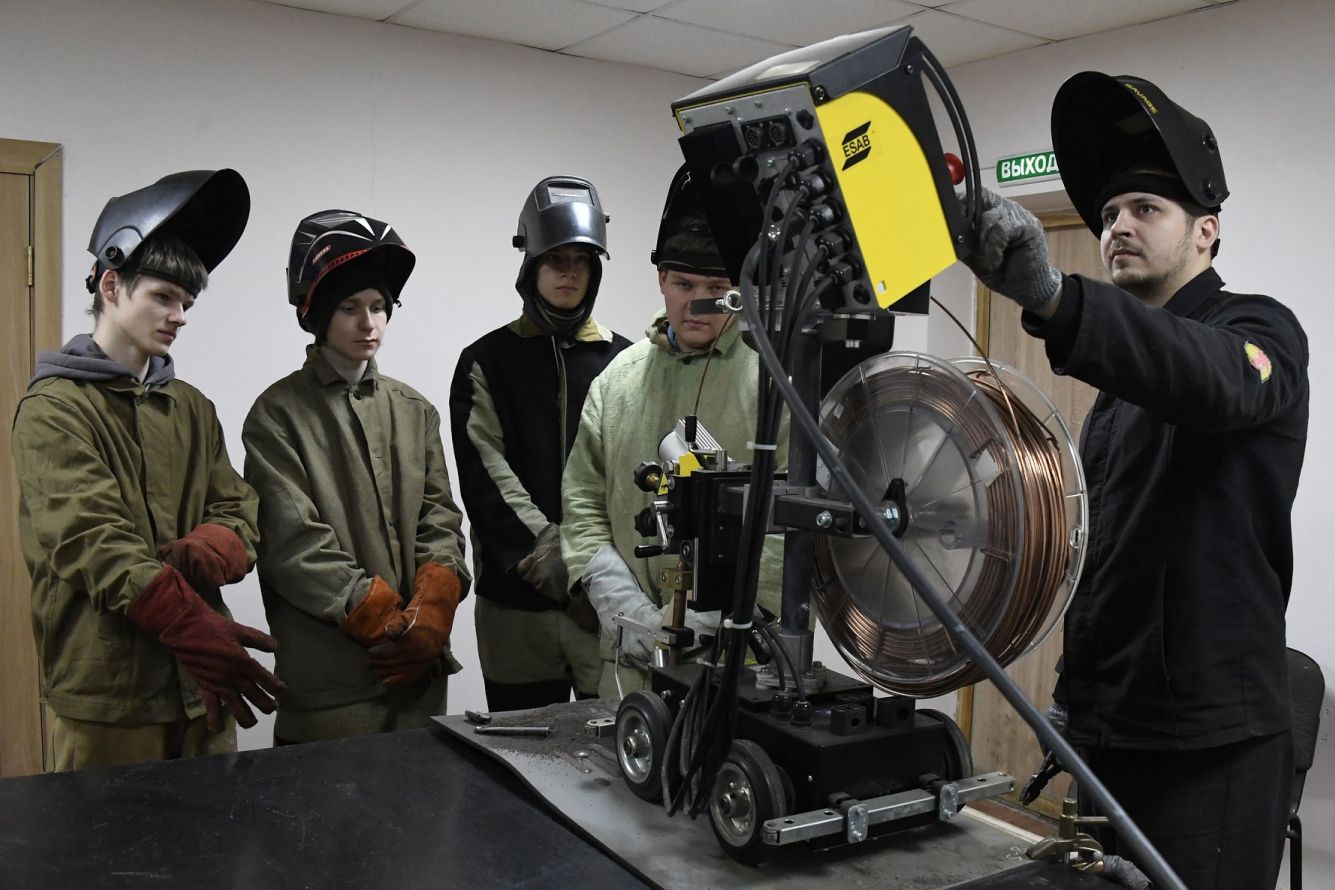
For the third year in a row, more than half of ninth-graders in Russia do not go to high school, but enter secondary specialized educational institutions (colleges - yes, there is such a term, by analogy with universities, in Soviet terminology - vocational schools). These are colleges and technical schools. In 2022, only half of schoolchildren went to college; in 2025, almost two-thirds (62%) chose this option, the government reported . The reason was the new educational policy - the authorities and schools are giving children less and less chances to go to high school and are inclining them to enroll in colleges, writes the association of journalists “History and Facts”. They spoke with students, teachers and parents to understand how changes in school policies affect teenagers. "Medusa" retells the main points of this material.
Since 2023, new federal state educational standards (FSES) have been in force in Russia. They allow schools to form only specialized 10th and 11th grades and refuse students admission. These standards do not prohibit the creation of universal senior classes without a narrow specialization, but in reality it is almost impossible to find such ones.
By law, schools cannot refuse admission to a ninth-grader if he has graduated, passed four exams and applied to his school. But educational institutions are at the same time obliged to comply with the conditions of the Federal State Educational Standard, so as not to lose state accreditation. As a result, school administrators are increasingly pushing parents and students to enroll in college.
Ekaterina from Kaliningrad told reporters that the school management insisted that her daughter go to college. “There was such propaganda. They scare me mostly about passing the Unified State Exam. They say that it’s almost impossible to get a free [place at a university], “so go get a profession already,” she said.
An English teacher at one of the Moscow schools, Anastasia, notes that such pressure is a huge stress for schoolchildren: “I observed this year that everyone was very worried and worried that they would not enter the 10th grade and “go to study at a vocational school.” The school even held meetings with parents to talk about going to college and its benefits.”
In this way, schools want to select only strong students who will bring good results on the Unified State Exam, says Irina Abankina, chief researcher at the Center for Financial and Economic Solutions in Education at the National Research University Higher School of Economics.
Changing standards is part of the consistent policy of the Russian authorities. In April 2025, Russian President Vladimir Putin simplified the conditions for admission to colleges in Moscow, St. Petersburg and the Lipetsk region. Now, to do this, you only need to pass two mandatory state exams (OGE), in Russian language and mathematics. To enter the 10th grade, you must pass four exams. In November, five more regions joined the experiment: Tatarstan, Moscow, Tver, Rostov and Tyumen regions.
In addition to changing educational standards, schools introduced extracurricular career guidance classes. At them, according to teachers, schoolchildren up to 10th grade are told about enterprises where they can get a job after college. Students begin to learn about universities only from the 10th grade.
Researchers at the Higher School of Economics believe that the demand for secondary vocational education is also growing because the real incomes of Russians are falling, and higher education is becoming less accessible. In particular, competition for places in universities is increasing due to laws adopted against the backdrop of the Russian-Ukrainian war. These norms give war veterans and their children benefits for admission to budget-funded places - both in colleges and universities.
Some teachers are generally supportive of students going to college. Alexander, a physics teacher at a Moscow school, noted that some secondary schools teach no worse than universities, but they also have the same level of competition. “It’s often easier to get into Moscow State University than into college,” the teacher noted.
Thus, in 2024, ninth-graders submitted an average of 19 applications for one budget place for “Preventive Dentistry,” 17 for “Animation,” 13 for “Geology and Exploration of Oil and Gas Fields,” eight for “Pharmacy,” and seven for “Graphic Design.” At the same time, there is no competition in many blue-collar occupations.
On average, “Stories and Facts” note, competition for colleges and technical schools is lower than for higher education institutions. But it has been growing in recent years. Parents of schoolchildren also told the authors of this article. “In fact, children who are now finishing the ninth grade are very forcefully driven from school to colleges and create such conditions that they still need to be able to enroll in the tenth grade. But they don’t get into college [for budget places] for the simple reason that the certificate rating there is very high, [the average score of the certificate] is 5.0 and 4.9. And “children of the Northern Military District ”, there are a lot of them now, they go out of turn,” notes the mother of a Kaliningrad schoolgirl, Ekaterina. Not all parents are willing to pay for college, she said.
However, the share of those who enroll in paid places in colleges increases every year. In 2024, more than 500 thousand people were enrolled in colleges and technical schools for paid places - this is 41% of all applicants. And over the past 15 years, the share of paid users has doubled.
As Stories and Facts note, in some areas almost all places in colleges are paid. Thus, a large proportion of paid students are in programs related to law, medicine, finance, logistics, design and advertising. The least number is among those admitted to blue-collar professions (agriculture, industry, housing and communal services).
Another reason why the state is changing educational policy is the shortage of qualified workers. By 2030, Russia will lack about one and a half million workers with secondary vocational education, said Russian Prime Minister Mikhail Mishustin.
But high school students, forced to choose colleges, are turning to programmers, designers, and paralegals. These programs were chosen by 41% of ninth-grade graduates and 20% of eleventh-grade graduates, according to the latest available data from the Institute for Statistical Research and Economics of Knowledge at the Higher School of Economics. Only 10% of ninth-graders and 2.6% of 11th-graders go into working professions. For almost a fifth of ninth-graders, secondary vocational education is a step towards higher education.
According to Irina Abankina, the state’s focus on enrollment in colleges may not lead to an increase in qualified workers also because some graduates may be drafted or voluntarily go to war due to high payments.
Some ninth-graders no longer hope to enter the 10th grade. They are afraid of school demands and competition. “It was a year that many [classmates] perceived as their last at school. I thought until the end that I would go to college,” said Moscow ninth-grader Zhenya. Of the 30 students in his class, only eight remained at school.
Other schoolchildren and their parents are trying to defend their rights to education. They complain about school refusals to enroll in 10th grade to the prosecutor's office, education departments and even the presidential administration. Some eventually succeed in transferring to high school.