
Translated material
Z-mentors
Read more about what is and is not possible in the cards.
If you are in Russia or planning to return to it, you cannot repost our materials on social networks, link to them or publish quotes.
More and more schoolchildren and students are learning to disassemble weapons, perform elements of combat operations, or listen to stories about war and patriotism from mentors from among the SVO participants. Such Z-mentoring projects aim not only to “instill the right values”, but also to help military personnel return to civilian life. At the same time, there are practically no uniform requirements for the SVO participants themselves, their training and selection.
Children stand in the middle of a small square with models of Kalashnikov assault rifles and sticks. Some of them are in camouflage uniforms, others are in jeans and down jackets. Children aim at each other, pretending to be in combat. In other photographs, a schoolboy lies on a bench, pretending to be a wounded soldier, while the instructor bends over him and shows others how medical care is provided.
This is what the training looked like, which took place in April 2025 in Vidnoye, near Moscow, as part of the “Mentor Z” project. The report states that participants "actively worked to improve their skills by learning new tactics and strategies, including the control of unmanned aerial vehicles."
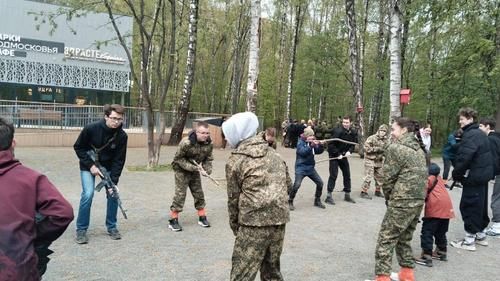
Training within the framework of the project “MentorZ”
Source: Telegram channel of the Chairman of the Council of Deputies of the Lenin City District
Such training is regularly organized by the shell-shocked former “member of the SVO” and part-time deputy from United Russia, Dmitry Belitsky. On his page, he shares videos and photographs from laser tag tournaments and meetings with schoolchildren, where he acts as a mentor. In an interview with local television, Belitsky explains that it makes sense for the participants in the war in Ukraine to communicate with schoolchildren, because they survived and appreciate it.
The number of such mentors returning from the war is only growing: in June last year, Deputy Minister of Defense and Chairman of the Defenders of the Fatherland Foundation Anna Tsivileva spoke about 3.5 thousand “SVO participants” engaged in patriotic education. In mid-2025, Tsivileva was already talking about five thousand people.
From local meetings to federal programs: Who is involved in Z - mentoring
The authorities began to actively involve Russian military personnel returning from the front in working with young people at the beginning of the second year of the war. And in May last year, the role of mentors from among former “SVO participants” in military-patriotic education was separately spelled out in the concept for the development of mentoring until 2030.
Recently, the practice of Z-mentoring has developed into a separate area of public policy, which is carried out by federal agencies, public-state movements, party organizations and small regional initiatives.
SVO participants become mentors within the framework of various projects. Thus, the First Movement has projects on Z-mentoring. The “Movement of the First” was created in July 2022 on Putin’s initiative. Among the goals of the movement are to promote the education, career guidance and organization of leisure activities for children, as well as the formation of the worldview of young people “based on traditional Russian spiritual and moral values.” In 2024, Artur Orlov, a participant in the war in Ukraine, became the leader of the “Movement of the First”. , "Young Guard of United Russia" Youth association of the United Russia party, founded in 2005. , "Rosmolodezh" Federal Agency for Youth Affairs, an executive body involved in youth policy, including patriotic education. , "Combat Brotherhood" An organization of war veterans, created in 1997 and headed by ex-governor of the Moscow region Boris Gromov. , ANO "Warrior" A militarized organization for training children and adolescents, created in 2023 on behalf of Putin. . Among the smaller regional initiatives, projects appeared in the Tula and Murmansk regions , Udmurtia , Tatarstan and the North Caucasus Federal District .
It is difficult to calculate how much the Russian authorities spend directly on such projects related to mentoring war veterans for young people due to the fragmented organization and different sources of funding for projects. For example, some of them are financed by United Russia, others receive grants.
In June of this year, Novaya Gazeta Europe wrote that during three years of war, spending on patriotic education as a whole increased 13 times and reached 66 billion rubles This is twice as much as the budget for healthcare and education of the entire Murmansk region. .
At the same time, the state does not support all initiatives. Some projects that proposed attracting those returning from the front as mentors did not receive presidential grants. Among them are “Defenders of the Fatherland” from Stavropol, “SVOi mentors” from the Moscow region and the project “Association of Veterans of Special Military Operations of the Novosibirsk Region” .
“Patriotic apartment dwellers”, training of future “volunteers” and activities with children in “difficult situations”
In official documents, patriotic mentoring is defined as “a social and pedagogical technology for accompanying a person’s personal and professional development, the formation of traditional Russian spiritual and moral values.” In ongoing projects, this rather broad concept is supplemented with new content.
Thus, “Combat Brotherhood” indicates among its tasks not only patriotic education, but also “popularization of the All-Russian organization “ BATTLE BROTHERHOOD ” among young people,” as well as working with children “in difficult life situations”; in the project “Mentor Z” they talk about the sports development of children and nurturing interest in the “heroic past of the country”; ranks of volunteer Cossack detachments."
The content of projects also differs from initiative to initiative. For example, the autonomous organization Warrior offers courses in fire and tactical training, drone control, and national security. In such initiatives, mentoring becomes almost a learning process, with veterans serving as instructors.
Other programs are built mainly around meetings and “live communication”. In projects like “Dialogues with Heroes” or “Mentor Z”, war participants come to schools, colleges and universities, talk about the war in Ukraine, talk about “correct values” and even organize “patriotic apartment parties”. Sometimes such events are supplemented with first aid training, weaving camouflage nets, or collecting help for the front.
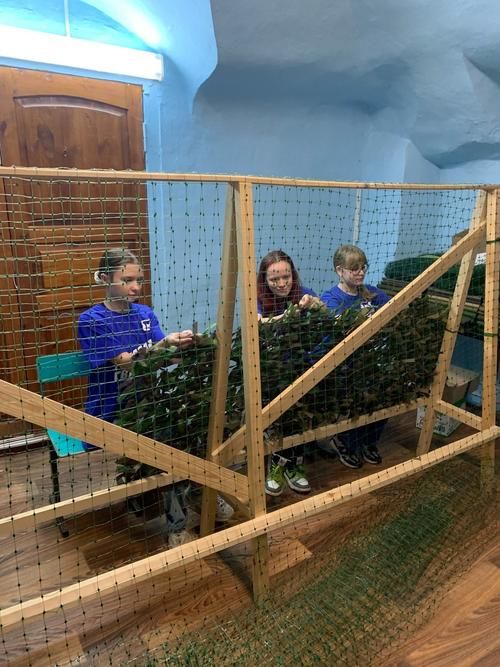
Weaving camouflage nets for Russian soldiers as part of the “Mentor Z” project
Source: Page of the “Young Guard” of the Vologda region
There are also projects that combine mentoring with gaming or sports elements. As part of "Zarnitsa 2.0" , organized by the all-Russian "Movement of the First", schoolchildren participate in competitions, learn to disassemble weapons and complete tasks "for endurance and teamwork." The movement believes that “communication with them—participants in the war in Ukraine—helps the guys realize how difficult the task is to defend their homeland, and return home after the game with new views.”
“We have seen things that make the blood freeze in our veins”: Mentoring as a way to return to life in civilian life
“If they are not helped to socialize, they - participants in the war in Ukraine - can become a threat to society and themselves,” this is how the mentoring project in Udmurtia describes the social significance.
The military themselves say that Z-mentoring initiatives are aimed at adapting “SVO participants.” Fyodor Sapozhnikov from the Irkutsk region, who fought in the Donbass since 2014, told Replika that meetings with teenagers help cope with the return to civilian life.
“Those who come from there [from the front] have seen things that make the blood in normal people’s veins freeze. When they are faced with the reality that no one cares about this [war], it becomes difficult for them,” he told the publication. During classes with young people, he said, the military sees that there are people who “care.”
Artem, a student from Lytkarino and a participant in meetings with such mentors, also says that SVO participants have difficulty integrating into civilian life. According to him, the most difficult topics for war participants during meetings are the death of fellow soldiers, “collision with a “different reality” after returning” and problems of adaptation.
“It’s difficult to admit even to yourself that it’s difficult to get used to family, to work, to the noise of the city. This can lead to feelings of guilt: “I defended this peaceful life, but now I can’t live in it,” he explains.
However, not all mentoring projects by former military personnel involve strict selection of participants or their retraining to work with children and youth.
So, Mikhail Sergeev and. O. The deputy head of the “Young Guard” in occupied Yalta, in response to questions about how mentors are selected and trained within the framework of the “Mentor Z” project, told Replika: “All participants are our Crimean guys! We know all our Crimeans by sight.” And within the framework of the project from the Rospatriototsentr, anyone can nominate a veteran through the website. As a result, the mentor may, for example, be a former member of an organized crime group .
In those projects where retraining is expected, the quality of training of mentors may be insufficient. Thus, as part of the Rosmolodezh project “Your Hero,” 130 project participants were supposed to gather in Pyatigorsk at the Mashuk center for a four-day educational seminar.
It provided “free psychological assistance” and “initial knowledge of pedagogy and psychology for working with youth.” However, according to “Verstka” , only 15 people came to “Mashuk”, and psychological assistance was expressed in one group meeting with a psychologist.
At the same time, the media have already reported on cases when mentors from among the SVO participants committed crimes. Thus, a criminal case was opened against the head of the Volkhov district branch of the “Combat Brotherhood,” 38-year-old Andrei Ivanov, who was involved in patriotic education, under an article of extortion. Ivanov forcibly held an 18-year-old girl in an apartment, beat her and extorted money.
And in Primorye, mentor Nikol Vizichkanich is being tried on charges of hooliganism: he was detained in the parking lot of a shopping center while he was reloading a machine gun.
There are cases of cruel treatment by mentors from among the SVO participants. For example, in March 2024, a resident of Novosibirsk stated that her child was beaten by instructor Danil Shargan during military training. The boy was admitted to the hospital with numerous hematomas.
The Main Directorate of the Ministry of Internal Affairs for the Novosibirsk Region reported that it was conducting an investigation at the request of the child’s mother. However, since then Shargan has continued to engage in patriotic education, for which he even receives certificates and letters of gratitude.
“Today I conducted a “Lesson of Courage” on the topic of SVO at the Center for Assistance to Children Left Without Parents. He talked about children in the war, about enemy Western propaganda, about Nazism in Ukraine. Look at the guys' faces! How these little angels hang on my every word! This is wonderful!" — Shargan wrote on his social networks.
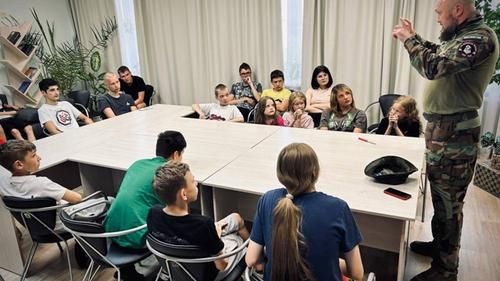
Shargan conducts a lesson at the Warm House children's center in July 2025
Source: Shargana's VK page