
Translated material
War
One thousand three hundred and seventy-third day. “We just want to survive. I don’t give a shit about Europe,” writes our reader from Kharkov about the peace plan (and we are waiting for your other letters)
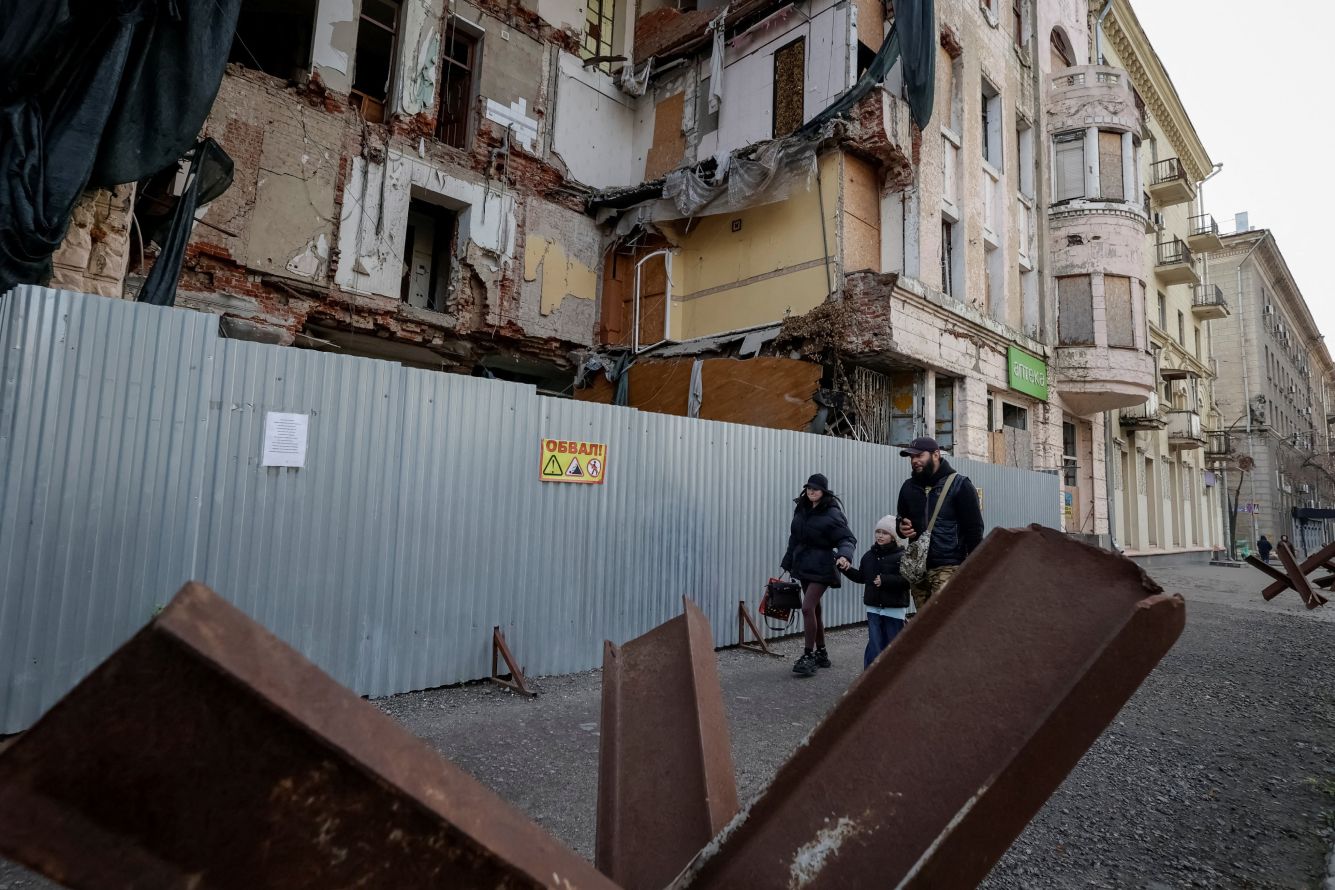
Since February 24, 2022, Meduza has been broadcasting live about the Russian-Ukrainian war. We publish your letters in our daily materials because we are sure that we need to continue talking about the war. What do you think about the peace plan proposed by the US? Is this encouragement of Russian aggression or an opportunity to end the almost four-year war? Should Ukraine agree to these terms before the situation gets worse—or reject and continue the war in the hope of achieving a stronger negotiating position in the future? The feedback form is at the end of this article. A review of the previous day can be read here .
Russia
The Southern District Military Court in Rostov-on-Don sentenced eight defendants in the case of the explosion on the Crimean Bridge in 2022 to life sentences.
On October 8, 2022, a truck driving on a bridge exploded. Three spans of a road bridge collapsed, and fuel tanks caught fire in its railway section. As a result, the truck driver and four people from a nearby car were killed. In 2023, the Security Service of Ukraineadmitted responsibility for this explosion.
The FSB reported on the arrest of eight suspects four days after the explosion (there were a total of 12 defendants in the case, the whereabouts of four of them are still unknown to the Russian special services). As the BBC Russian Service wrote, the detainees are “random people who found themselves in the wrong place at the wrong time.”
In the dock were six entrepreneurs whose business was in one way or another connected with the supply of various products from Russia to Crimea - Artem and Georgy Azatyan, Oleg Antipov, Alexander Bylin, Vladimir Zlob and Dmitry Tyazhelykh. Two more defendants are truck driver Artur Terchanyan and farmer Roman Solomko.
All defendants were charged with a terrorist attack (clause “b” of Part 3 of Article 205 of the Criminal Code) and transportation of explosives (Part 4 of Article 222.1 of the Criminal Code), two of them were also accused of smuggling explosives (Part 3 of Article 226.1 of the Criminal Code).
The process took place entirely behind closed doors. None of the accused admitted guilt - they insisted that they knew nothing about the cargo.
World
Europe is increasingly considering the possibility of an active Russian response to hybrid attacks, such as sabotage on railways or airspace violations by drones. Politico writes about this.
As the publication notes, we are talking about something that “just a few years ago seemed unthinkable.” Options include joint offensive cyber operations against the Russian Federation, as well as emergency NATO-led exercises in response to provocations.
“Russians are constantly testing the limits of what is permitted: how far they can go and what the response will be. We need to act more actively, the signal is sent not by words, but by actions,” Latvian Foreign Minister Baiba Braze told Politico.
So far, the main response to the actions of the Russian Federation has been attempts to strengthen the defense of the eastern borders of the European Union. After Russian drones violated Polish airspace in September, Brussels announced its intention to build a “drone wall”—a coordinated system to intercept drones. However, there is growing criticism in Europe of excessive “inertia” in the face of a growing number of hybrid attacks.
Last week, Italian Defense Minister Guido Crosetto presented a 125-page emergency response plan. He proposed creating a special European Center for Countering Hybrid Warfare, a cyber unit consisting of 1,500 people. He also proposed developing military technologies in the field of artificial intelligence.
“We all need to review our safety procedures. Russia is clearly intensifying its hybrid war against EU citizens,” Polish Foreign Minister Radoslaw Sikorski said on November 20.
At the same time, Politico notes, the question of what Europe’s “more decisive response” to Russia’s actions should be remains open. NATO, as a defensive organization, is “suspicious” of offensive operations, the publication writes. “Asymmetrical responses are an important part of the conversation. But we are not going to stoop to the same tactics as Russia,” one NATO diplomat told Politico.
War through the eyes of Meduza readers
How we choose letters
Meduza's readers live in different countries and have different attitudes towards the war. We publish your letters to see this event through your eyes. Our editors try to present all points of view, even if they do not coincide with the editorial position. However, in accordance with the Meduza code, we do not publish messages that contain “hate speech,” justify the murder of civilians, or express direct support for an aggressive war.
Anonymous reader (Kharkov) . It is very interesting to compare the country and genderof the authors of the letters with the content: the farther from the front and the less chance of traveling in a minivan, the more militant their position against the plan […].
Probably, if I were drinking beer in Berlin or wine in Paris, I would also be standing for everything good and against everything bad. But here, alas, we just want to survive. And I absolutely don’t give a damn about Europe and the imaginary threat from which they covered us.
Are you guys comfortable talking about the value of my life in distant countries?
Share your opinion on Trump's peace plan
"Jellyfish"