
Translated material
Tom Stoppard, cool. Vasily Stepanov - about the most modern playwright of the 21st century
British playwright, screenwriter and director Tom Stoppard died on November 29 at the age of 88. In the 1967 play Rosencrantz and Guildenstern Are Dead, which catapulted him to worldwide fame, he rewrote Shakespeare's Hamlet from the perspective of minor characters. And 23 years later he directed the film of the same name with Gary Oldman and Tim Roth, receiving the Venice Golden Lion for his debut. “Brazil” by Terry Gilliam, “Shakespeare in Love” by John Madden and “Anna Karenina” by Joe Wright are also Stoppard. Film critic and Anglomaniac Vasily Stepanov talks about the most modern playwright of the 21st century.
He was not born British, although it is difficult to argue with the assertion that it was Tom Stoppard who fundamentally changed something in the British spirit. At a minimum, he was an important part of the amazing post-war metamorphoses, which resulted in the introduction into the semantic core of Britain of a “love of freedom” that was not characteristic of yesterday’s empire. The button tightening the collar at the throat was undone by the sixties - this is where Stoppard’s magnificent theatrical debut “Rosencrantz and Guildenstern are Dead” came from. The country of centuries-old foundations, unshakable hierarchies, judicial precedents and closed schools for boys has become different.
He himself was from the east and from a different time. Born in Czechoslovakia in 1937. From Hitler, his parents - Moravian Jews - took him and his brother to Singapore, where in 1942 the father of the family, Julius Streusler, was killed under the bombs of Hirohito. Next was India. In 1945, my mother remarried. Now - for a British officer named Kenneth Stoppard. A year later, he moved his family to Nottingham and tried to ensure that his adopted sons not only received his surname, but also became real British.
However, this is all “Wikipedia” (an expanded version of this tale of wanderings would be appropriate to read in the biography of the playwright, written by Hermione Lee and published not so long ago, in 2020). Another thing is more interesting: to what extent was the young playwright’s interest in the collisions of Shakespeare’s Hamlet in his big debut provoked by the collisions of his own growing up under the supervision of his stepfather? In general, “Rosencrantz and Guildenstern are Dead” seems to be the first to interpret the Shakespearean conflict as a coming-of-age drama - a typical plot from the coming-of-age arsenal: a minor maximalist torments adults with his unbearable antics. If the prince were an adult, he would sit on the throne instead of his uncle, this is what the main characters of the play seem to think. Like Hamlet, Stoppard's studies did not go well - he preferred school to life and work as a reporter in a newspaper over university. And then the theater.
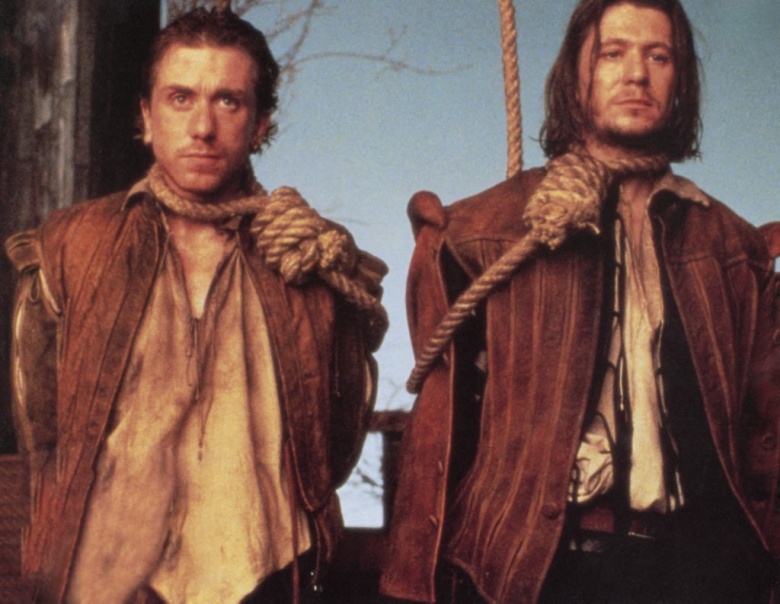
Still from the film “Rosencrantz and Guildenstern are Dead” (1990, dir. Tom Stoppard)
Brandenberg - Thirteen / WNET / Collection ChristopheL via AFP
It seems that despite all the efforts of the venerable Kenneth Stoppard to turn his stepson into a “respectable Englishman,” Tom never forgot about his alien nature. And so he was always with the little man, a stranger, abandoned by the big History God knows where and God knows why. Rosencrantz and Guildenstern, who fell into the millstone of a tragedy that was not their own, are, of course, an ideal example. The supporting characters are not that much more interesting than the characters suffering on the front stage, but the blood literally runs cold from the fact that you know: behind the backs of the two handsome dunces, for whom the invisible playwright has sent, darkness is thickening, about which they are completely unaware. Isn't that true in the real world? Stoppard also composed the little man who dreamed of Love, but ended up in History, for the cinema - in Gilliam’s “Brazil,” a dystopia that today seems even a little more relevant than in the eighties that gave birth to it.
Subscribe to read in full
Subscribe to Redefine.Media to read Republic
Subscribe [You can pay with a Russian or foreign card. The subscription is renewed automatically. You can unsubscribe at any time.]
Where does the subscribers' money go?