
Translated material
Staring into the sun
The Sound of Falling by Masha Shilinski was released and won the Jury Prize at the Cannes Film Festival.

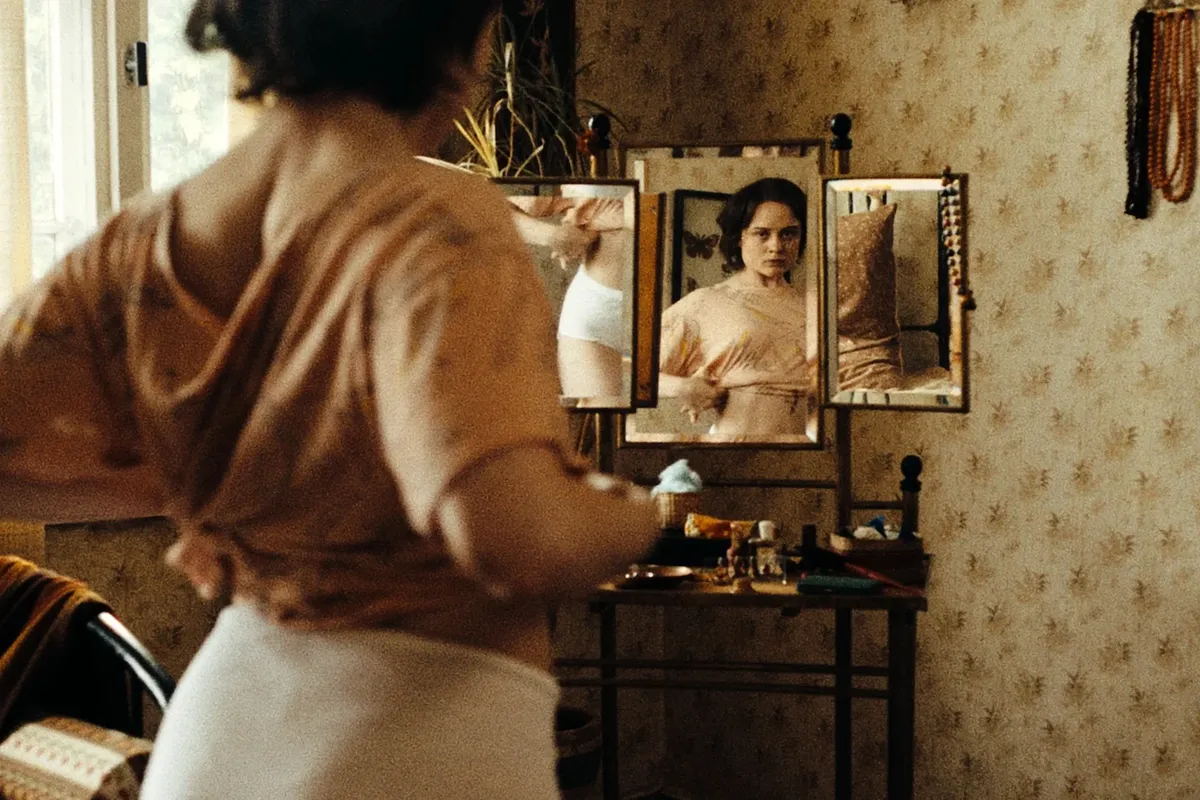
Still from the film “The Sound of Falling”
This is a whimsically constructed film novel, epic and intimate, in which four narrative threads are intertwined, the lives of four maidens - Alma, Erica, Angelika and Lenke - from different historical eras are woven into rhyme. They all grew up on the same farm in the Altmark region of northern Germany (literally "old mark").
On this farm, time has stood still, although eras and social formations change. Not only in posthumous daguerreotypes. Within the walls of the house. It runs only in the river connecting the east with the west, where slippery, nasty eels still swim (snatching an eel from a bowl while riding a bike is Angelika’s favorite game from the GDR sixties). A river flowing from the tenths of the twentieth century into the twenties of the twenty-first. Reminiscent of Styx in the heroines' invincible attraction to death (in fact, this whole story begins with a portrait of a dead girl). Their destinies are connected and reflected in each other, like in an old mirror covered with amalgam,
About how the traumas of the past, hidden latent violence, a long series of experiences do not disappear, they are absorbed into the cracks of the walls, into the scars of time and into the blood of descendants.
The past, like a ghost, stands nearby, breathing in your back. You touch the same doorknob and repeat the fate of someone who lived here before you.
You experience the same intergenerational traumas, grievances, and the feeling of shared sins. Guilt. Pain. Historical unjustified cruelties visited on women throughout the 20th century. From generation to generation. What is “body memory”, the reaction to “it was not there.” How to use a camera to reach the memories of dreams. Behind the visible, consider the invisible.
Tactile cinema, sensual grainy images, textured compositions. Filmed as if copied from the paintings of Grützner, Jean-François Miele (I remember his “Angelus”, in which a strange tension is felt between a peasant and a peasant woman, frozen in a field in evening prayer, and only in the descriptions can one read that initially there was their dead baby between them). Gloomy film painting with detailed details. The subtle cinematography of Fabian Gamper, whose camera itself has turned into a ghost, lives and breathes next to the heroines of different times. Drowning, trying to take a difficult, life-saving breath.
You can write about the soundtrack written in calligraphy separately. In one score: the creaking of doors, muffled screams, dull knocks, the buzzing of a fly and some strange, now receding, now approaching hum - the noise of time. They wrote sounds at the depths of the ocean, looking for the “sound” of a black hole, the elusive sound of a catastrophe.
The authors (Masha Shilinski and her co-author Louise Peter) are interested in the idea of synchronicity of time, significant coincidences described by Jung. All that he called the “mass soul” with its latent torment. In this sense, Szylinski's painting refers to Haneke's "The White Ribbon", the theme of the "hidden", hidden behind the façade of propriety, explored by the Austrian classic.
Latent cruelty is dispersed, scattered, interspersed in everyday sketches, in the games of teenagers, in the confused relationships of adults. But there is also a place for dark humor, sensuality, and rare bursts of light (one of the first titles of the film is “Peering into the Sun”). At times, the heroines of this century, scattered like beads, suddenly look straight into the camera: we are here, nearby. Were and are before you. But the longer you look into the sun, the darker it becomes.
Is this movie ideal, can it be called a work of art? This is a very feminine perspective on history. This is the magic, strength and vulnerability of a film composed both boldly and dottedly. Supersensual at times. With large gaps in which we write our own interpretations.
MORE ABOUT CINEMA
Larisa Malyukova runs a telegram channel about cinema and more. Subscribe here .