
Translated material
“Yes, you will be submissive...”
Why is the connection between faith and politics natural for a Russian person, although in the New Testament there are other options other than loyalty

Photo: Alexander Nemenov / TASS Photo Chronicle
“Our future is a past that never leads to the present.”
Contemporary Russian philosopher Fedor Girenok
Russian life is structured in such a way that the connection between faith and politics has been something natural here for a very long time. Most often you can see that a church-going Orthodox person is somehow, by default, at the same time a person who is loyal to the state authorities. As they used to say - “loyal subject”. Yes, this is most often the case, but it is by no means the only option.
In the recently published monograph by priest Andrei Kordochkin* “To Caesar is Caesar's” there is a reference to the American biblical scholar Walter Pilgrim, to his list of options for the relationship of the Christian church to power. These options, in short, are: loyalty, distancing (critical detachment), protest. Each of these can easily be confirmed in the New Testament.
Those who want to find loyalty first go to the words of the Apostle Paul:
- “ Let every soul be submissive to the higher authorities, for there is no authority except from God; But the existing authorities have been established by God ” (Rom. 13.1).
If distance is needed, then, in principle, the entire text of the Gospel testifies to how insignificant earthly power is for what is looking for “treasure in heaven.” The very gospel image of Christ is completely opposite to how a sovereign with absolute power should look and behave.
If it is necessary to point out the dark nature of power, then there is the Apocalypse of the Apostle John, where the earthly state is likened to a “beast” requiring worship:
- “ And authority was given to him over every tribe and people and tongue and nation. And all who dwell on the earth will worship him, whose names are not written in the Lamb’s book of life ” (Rev. 13:8).
Obviously, a believing Christian can build his attitude towards power in completely different, diametric ways. At the very least, the texts of Holy Scripture give him reason for the most serious reflection on what power is. This is a reason to raise some very troubling questions, because none of the possible options looks indisputable.
...However, if you look at the history of Russian Orthodoxy, then the version from the letter of the Apostle Paul, i.e. the option of submission to the authorities received absolutely predominant importance. Starting from the “Sermon on Law and Grace” by Metropolitan Hilarion to the current Patriarch Kirill.
Despite the fact that all other options were rejected, and their supporters were persecuted. Characteristic is the tragic fate of Metropolitan Philip alone, who raised his voice against the atrocities of the reign of John IV and his guardsmen. By a unanimous verdict of a loyal church council, he was condemned to deprivation of the priesthood and imprisonment, in which he was soon killed by the royal will. Unconditional submission was required not only in relation to the supreme power, but in relation, in principle, to any power, to any commanding rank higher in the hierarchy.
Submission was required to the very established order of things, to the established order of social relations. Anyone who saw anything vicious in this order undermined the very foundations of the “conciliar” world. A critical view, in essence, was equated with a heretical one.
The visiting Byzantine monk Maxim the Greek, outraged by the structure of Russian church reality, receives a long imprisonment and the status of a heretic. Despite the fact that his criticism has nothing to do with the basic theological issues by which “canonical” or “heretical status” is determined. His criticism was about the hypocrisy and money-grubbing of the Orthodox clergy:
- * “Isn’t it worthy of tears and lamentation that, contrary to all truth and all monastic rules, we dare to do regarding our brethren, the poor and wretched, widows and orphans? We not only despise them, seeing how they perish from hunger and cold and from extreme poverty in everyday needs, but we also do not defend them against the strong and lawless, and do not intercede when they take away their property.
And what am I saying about the fact that we do not protect and stand up for them when they are offended? We ourselves often dare against them worse than the worldly..." *(Maxim the Greek. Homily 4. On repentance, very useful for those who read it with faith and unfeigned love, with attention and proper reasoning.)
However, such cases have always been very rare among church ministers. The thesis of the Apostle Paul has almost never been questioned in Russian Orthodoxy.
Of course, one can recall Nil Sorsky and the “non-covetous”, whose position is more reminiscent of the “evangelical”, i.e. conscious distancing from power and its interests. But this, too, is rather an exception from the general series, which did not have a noticeable impact on the general church discourse. The concept of Joseph Volotsky and the “acquisitive”, based on a close alliance with the authorities, took off in the 15th century and has dominated since then.
Those active protests to the authorities that came from “schismatics” in the 17th and 18th centuries can probably be explained not so much by a critical attitude towards the very principle of earthly power, as by disagreement with the fact that the authorities took the side of the reformer Nikon and, accordingly, became “ritually unclean.” This was further aggravated by Peter’s reforms and the opening of a “window to Europe.” A sovereign who does not wear a beard, but wears a German caftan, cannot be a true sovereign for a believing Orthodox person. This is indignation not at the absolutist, autocratic nature of power and not at the lack of rights of its subjects, as was the case with Metropolitan Philip and Maxim the Greek.
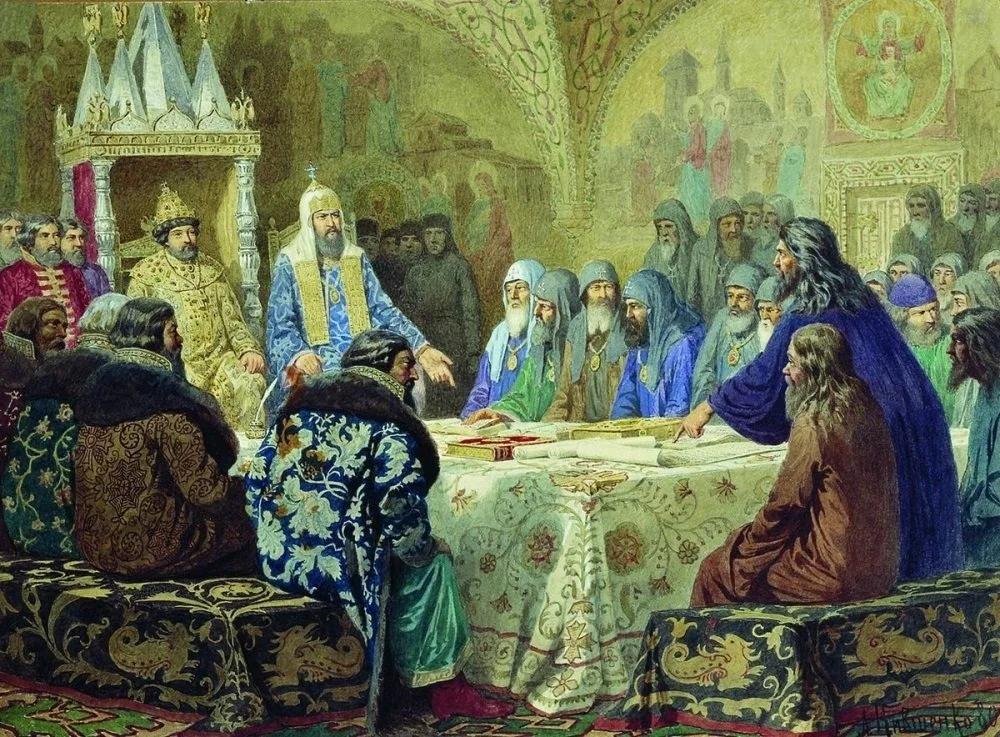
The “schismatics” did not want to put up with the fact that the authorities abandoned their sacred archaic design. They were not at all opponents of “conciliarity”, i.e. spiritual unity and uniformity. On the contrary, they stood up for the impeccability of such uniformity, for “conciliar purity.” They were devoted supporters of “Moscow - the third Rome”, apologists for the holy “Russian kingdom” - but before their eyes this kingdom betrayed itself. They felt the “forsakenness” of the kingdom. A radical disappointment in earthly history. As the philosopher Nikolai Berdyaev said,
The schism was a rejection of history, for it was taken over by the prince of this world, the Antichrist, who had penetrated the heights of the church and state.
That fundamental distrust of the large “heterogeneous” world, which was practiced in Orthodoxy as a whole, among the “schismatics” has already turned on the Orthodox world itself. Not just mistrust, but contempt and hostility. All that remained was to dream about the sacred but lost past. And wait for the transition to another, “above-ground” kingdom. Perhaps the words of the modern Russian philosopher Fyodor Girenko are best suited to characterize the “schismatics”:
- “Our future is a past that never leads to the present.”
...Has the “schism” left its mark on the general “folk” Russian environment? On the one hand, he did not bring anything new - longing for an idealized past, for great and righteous times was already being introduced by the Orthodox Church and formed a stable state of nostalgic conservatism among the “popular” environment. But, probably, the “schism” made this state much more radical and irreconcilable. If the world does not strive for perfection, then such a world has no reason to exist. Such a world is not worth pitying. Probably, thanks to the “schism,” the feeling of nostalgia began to transform in the Russian environment into a feeling of ressentiment with a very high tendency towards destructiveness.
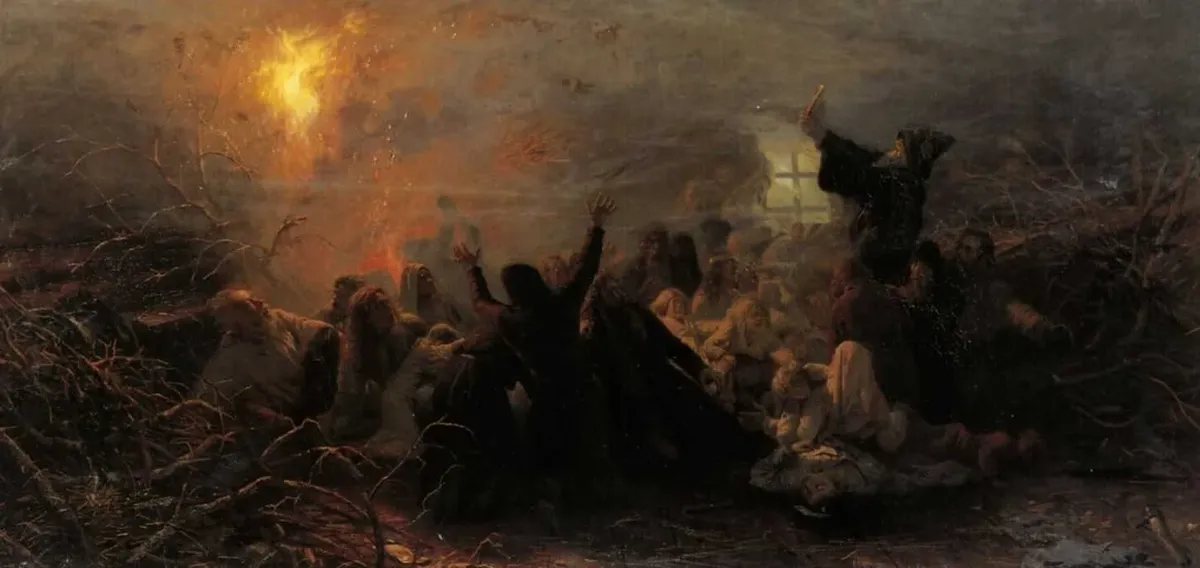
Nihilism, so widespread in the Russian environment, an indifferent-skeptical attitude towards the existence of the surrounding world and a fatalistic attitude towards one’s own existence is also something “schismatic”, which emerged from disappointment in the “earthly kingdom”, in earthly history. As, in fact, is the frivolous attitude towards death, the Russian suicidal courage that manifests itself in troubled border times. Its historical origins can be associated with the “schismatic burnings”, i.e. mass self-burnings, so frequent during times of persecution. This world is bad - so let's help it fall. And we ourselves will fall with this world as its integral part. An ecstatic mood from the thought of one’s own destruction is probably a characteristically “schismatic” trait that has taken root very well in the discourse of the Russian subconscious.
* * *
In the borderline times of Russian history, when power in its ambitions no longer looks back at anything, personalities appear in the church world who express an attitude towards it according to the version of John the Theologian. According to the option, power, the state, is a “leviathan,” a monster that wants to replace all ideas and authorities possible for a person. And therefore you should not feed your soul to him. In times like these, to save your soul, you must stand against authority. This is the position of these individuals.
However, individuals proceed more from their own “inner” Christianity than from the Orthodox tradition of the Russian Church. It is not tradition that prompts them to protest, but their own moral law. And this law, as a rule, is in great conflict with tradition.
The fate of its oppositionists was determined by the church for many centuries quite clearly: prison, exile, accusation of heresy, deprivation of the priesthood. Rather, this is traditional for the Russian Church. As is loyalty to the authorities under almost any circumstances. And time here, in fact, does not change anything. The only thing is that instead of imprisonment in monastery basements, as in the times of Metropolitan Philip and Maxim the Greek, today there is a ban on service and forced emigration. This path is now being followed by the most notable for their enlightenment and independent thinking representatives of the Orthodox clergy. This is the price of “conciliarity.”