
Translated material
Under the guise of "terrorism"
How threats of terrorism are used to establish a regime of terror

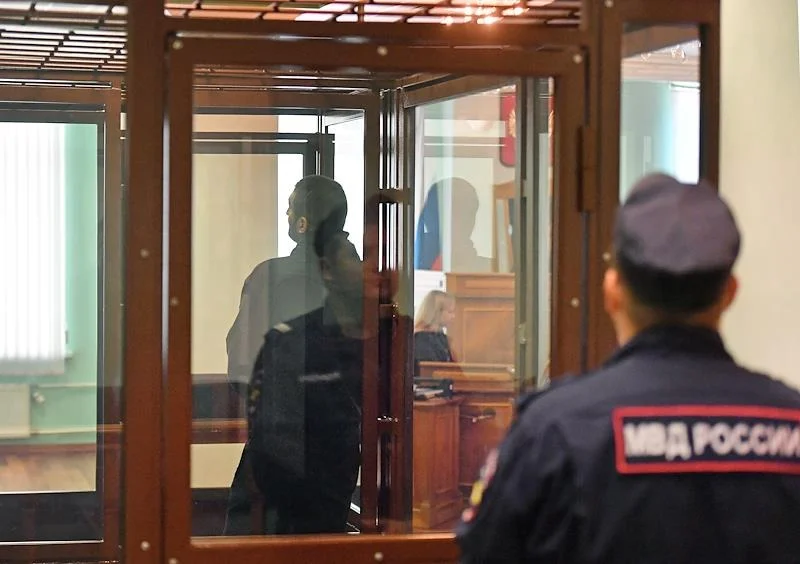
Screenshot from video: DSP FSB RF / TASS
According to the transport prosecutor's office, on November 25, the 2nd Eastern District Military Court in Novosibirsk sentenced four teenagers from Khakassia to 6-8 years in prison under Article 205 of the Criminal Code of the Russian Federation (terrorist attack) in the case of damage to relay cabinets and plans to set fire to a diesel locomotive.
On May 2, 2024, two teenagers, on instructions from an unknown person, set fire to two relay cabinets on the Khakassian route of the Krasnoyarsk railway. One of them, together with another acquaintance, planned to set fire to a diesel locomotive. The teenagers were promised a reward for the arson, and the fourth person involved in the case provided an account for transferring money. Damage from damage to relay cabinets amounted to 55 thousand rubles.
Such cases are heard behind closed doors, and many details remain unclear. In particular: is it so easy to set fire to a diesel locomotive? However, the transport prosecutor’s office reported enough to compare the plot of the case with Article 205 of the Criminal Code of the Russian Federation (terrorist attack): “Committing an explosion, arson or other actions that frighten the population and create a danger of death, causing significant property damage or causing other grave consequences, in order to destabilize the activities of authorities... or influence their decision-making...”
The corpus delicti under Art. 205 of the Criminal Code implies exclusively direct intent.
The teenagers had only one intent in mind - to receive a reward, while “intimidation of the population” and “destabilization” were not included in their intent, and there is no evidence that such took place at all.
Earlier, when analyzing other cases of arson of relay cabinets, Novaya already drew attention to the fact that this does not entail significant consequences for the railway, since if such a cabinet fails, all semaphores automatically switch to the red light.
The practice of qualifying such vandalism under Articles 205 (terrorist attack) or 281 of the Criminal Code (sabotage) did not develop immediately: at first after the start of the SVO, many courts sentenced perpetrators under Article 167 (deliberate destruction or damage to someone else’s property), the maximum penalty for which is five years in prison. Article 205 of the Criminal Code provides for punishment from 10 to 20 years, and in aggravating circumstances (including when a crime is committed by a group) - from 12 to 20 years.
Four Khakass idiots, due to their infancy, received punishments below the minimum limit, but found themselves in solid company: Mikhail Khodorkovsky*, Mikhail Kasyanov*, Garry Kasparov*, Ekaterina Shulman* and other members of the “Anti-War Committee”**, who are accused in absentia of creating a terrorist community and intending to seize power in Russia (compare with the teenagers’ plans to set fire to a diesel locomotive). On the other hand, the perpetrators of the terrorist attack in Crocus City Hall, where at least 150 people died, are also included in the same category.
In a recently published study on the “repressiveness index,” Evgeny Antonov and Kirill Rogov* classify crimes such as terrorism and sabotage (with derivatives in the form of “assistance” and “justification”) to the “gray zone”: in closed hearings, these articles can hide both real acts of “intimidation” and “destabilization,” as well as the notorious relay cabinets and every little thing.
According to the Ministry of Internal Affairs,
Over the nine months of this year, Russia has registered a 75% increase in “terrorist” crimes: a total of 4,467 such crimes were identified, of which 1.8 thousand are related to terrorist attacks, and over a thousand are related to calls for terrorism. At the same time, 1,760 cases were initiated under extremist charges, an increase of 28%.
As of the end of 2024, the list of terrorists and extremists included 619 organizations and 16,056 individuals; during 2025, it was significantly expanded. It is not available in detailed form on the website of Rosfinmonitoring, which maintains this list. Only “brought to the attention of organizations that carry out transactions with funds and other property.” But the site’s help system allows you to obtain information about whether a particular individual or legal entity is included in the list. For example, “International Social Movement AUE***” appears there under No. 198, and Grigory Chkhartishvili * (Boris Akunin) – under No. 18031.
If such a number of terrorists actually operated in the country, not only the relay cabinets would be burning with a blue flame (we will not develop this topic so as not to fall under the article on the propaganda of terrorism).
What is the logic behind such a broad interpretation of the concept of “terrorism”? Is it just a matter of the notorious “stick system” for assessing the work of law enforcement agencies?
One can look at this practice more broadly, regardless of whether individual performers understand its logic. The most important function of power is the so-called taxonomy, that is, the distribution of the “population” into rows and cells using labels.
Under the class system that the Kremlin established, along with the higher castes and the mass population, pariahs, outcasts, and “foreign agents” are needed to complete the picture.
Firstly, failures can be blamed on them, and secondly, such a “taxonomy” allows the majority to breathe a sigh of relief: no one is being imprisoned in vain, but we are not being touched, and this means that this power must be supported, otherwise it would not be worse.
On the other hand, the widespread use devalues the concepts of “terrorism”, “high treason”, “espionage” and others and leads to growing distrust of this kind of official messages.