Translated material
What has risen in price the most during the four years of war?
In four years, the price of these goods has almost doubled
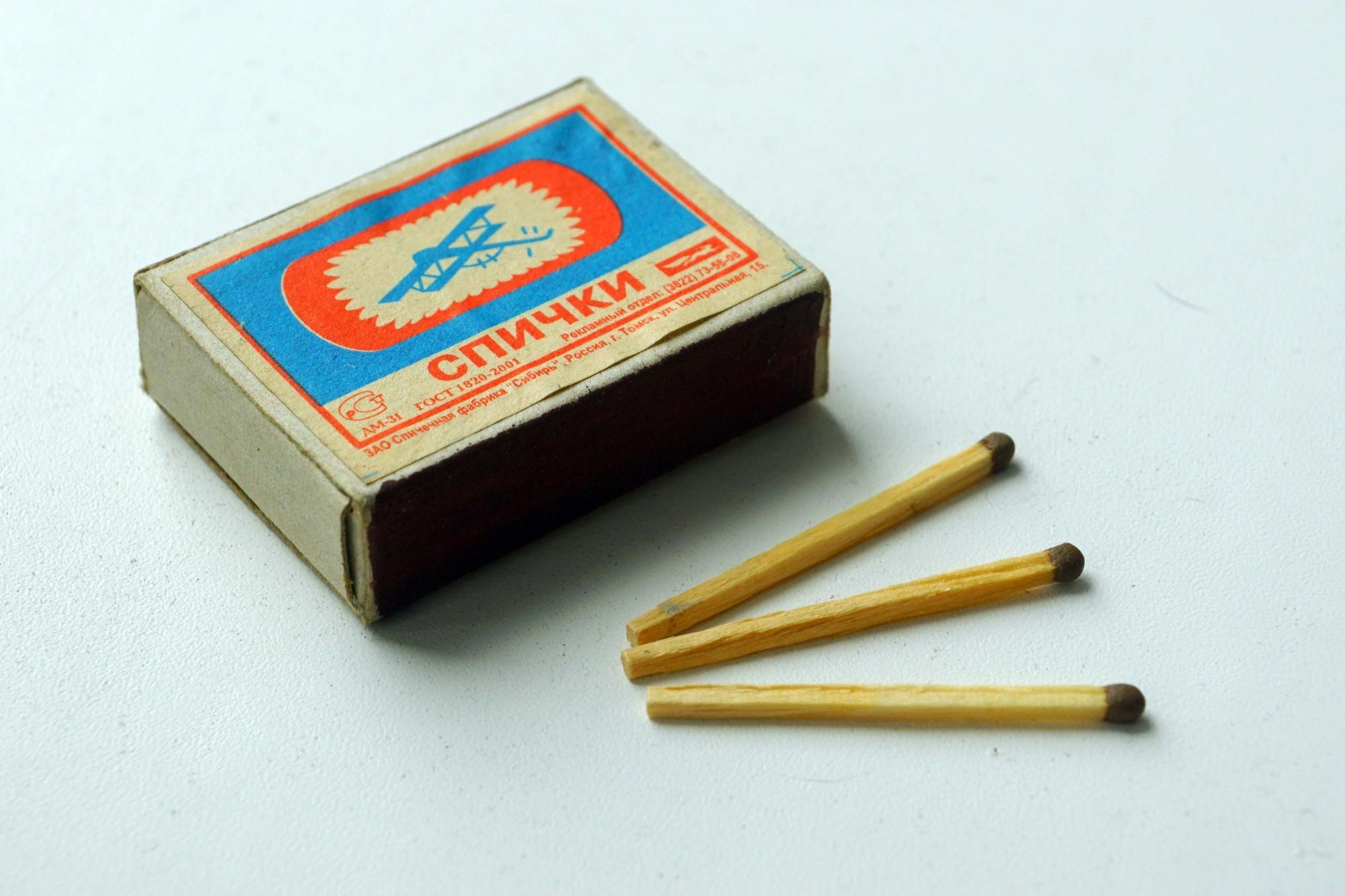
The most expensive goods in Russia during the full-scale invasion of Ukraine were boxes of matches, domestic analgin and a bottle of 25 milliliters of Corvalol, Vorstka calculated, comparing average prices from Rosstat on February 18, 2022 and December 1, 2025.
The price of a box of matches increased during the war from 2.03 rubles to 3.96 (an increase of 95.07%), a package of domestic analgin (10 tablets) - from 21.29 to 40.06 rubles (88.16%), and a bottle with 25 milliliters of Corvalol increased in price from 30.44 to 55.43 rubles (82.1%).
In order not to miss new texts from “Layout”, subscribe to our telegram channel
Cars, fish and toothpaste have also increased significantly in price.
In fourth place are foreign passenger cars (increased in price from 1.38 million rubles to 2.46 million, by 78.68%). In fifth place are domestic passenger cars (the price increased from 778 thousand rubles to 1.35 million, by 73.73%). Next comes a kilogram of frozen whole fish (increase from 190.58 to 328.52 rubles, by 72.38%), a 100-gram package of toothpaste (increase from 111.75 to 186.87 rubles, by 67.22%), a men's T-shirt (increase from 372.32 rubles to 602.15, by 61.73%), kilogram of lamb (except boneless) (increase from 500.72 to 806.7 rubles, by 61.11%).
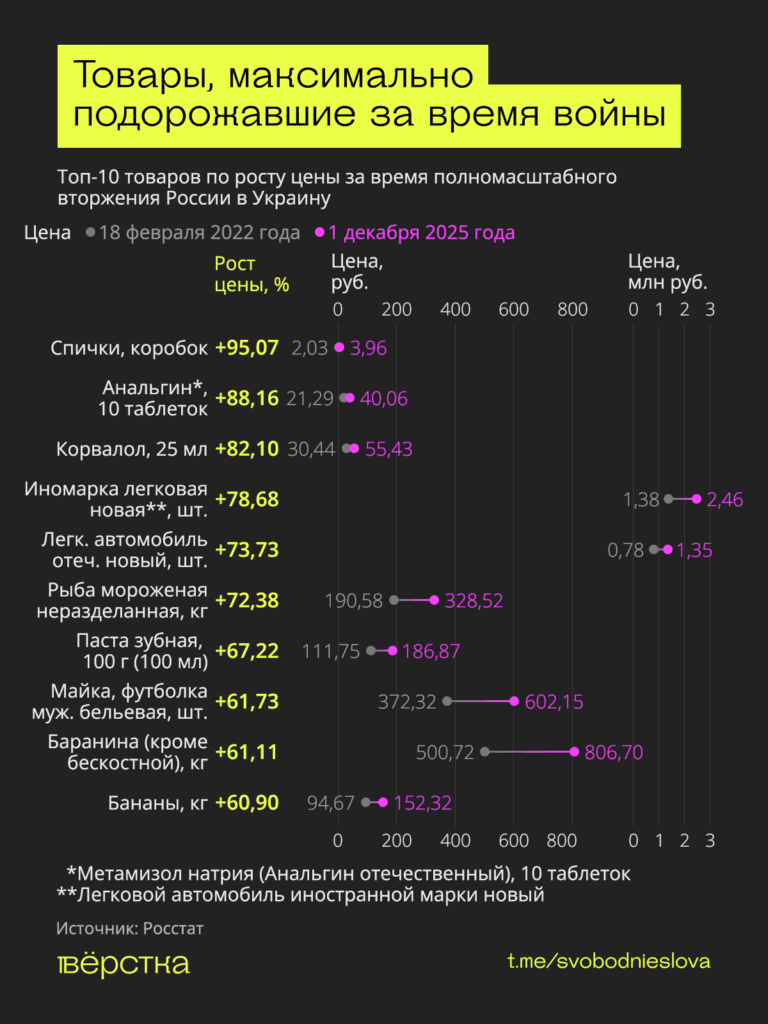
In 10th place are bananas (a kilogram increased in price from 94.67 to 152.32 rubles, by 60.9%), Russian authorities were unable to stabilize the price of the fruit after an increase at the end of 2023 and the beginning of 2024.
As Vorstka noted, the trip to Turkey has disappeared from Rosstat’s calculations of rising prices for goods and services. On February 18, 2022, it cost an average of 30.3 thousand rubles; on March 25 of the same year, it was mentioned for the last time and already costs 56.3 thousand rubles. But then this category no longer appears in the data for 2022-2025.
TVs have remained virtually unchanged in price, but vegetables have become cheaper
At the same time, the top list of least expensive goods, according to Rosstat, was headed by television. Despite the jumps in the dollar exchange rate and the decline in imports of electronics, over almost four years the average price increased by only 1.99% - from 32.2 thousand to 32.9 thousand rubles.
Also among the least expensive ones, according to Rosstat, were a kilo of millet (9.35%), chicken eggs (the final difference was only 9.95% between the pre-war ten for 84.44 rubles and the current one for 92.84 rubles), validol (10 tablets of 60 mg increased in price by only 12.32%), a kilogram of wheat flour (13.85%), floor electric vacuum cleaner (15.82%), kilogram of premium wheat flour pasta (18.03%), kilogram of vermicelli (18.76%), kilogram of sugar (19.13%).
And there are only seven goods that have fallen in price during this period, according to Rosstat data. These are mainly vegetables, the prices of which usually depend on the harvest: fresh white cabbage fell in price by 47.5%, red beets - by 13.69%, carrots - by 13.57%, and fresh cucumbers - by 7.11% (all prices are based on a kilogram).
The authorities, judging by official data, also managed to stabilize potato prices, which dropped by 12.18%, to 42.33 rubles instead of the pre-war 48.2 rubles (and in the spring and summer in Russian stores one could see a kilogram for 130–190 rubles).
Also, according to Rosstat estimates, a kilogram of buckwheat fell greatly during the war - from 122.47 rubles in February 2022, on the eve of rush demand at the beginning of the invasion, to 79.16 rubles on December 1 of this year (a decline of 35.36%). This top seven is closed by particle boards and oriented strand boards used in construction (minus 6.46%).
We would like to remind you that Vorstka previously reported that the observed price increase in November was almost twice as high as official inflation. This is the strongest gap since April 2024.
Support “Vestka” - it’s important and safe →
You can support “Layout” from any country in the world - it is still safe and very important. We really need your support now
How to help us